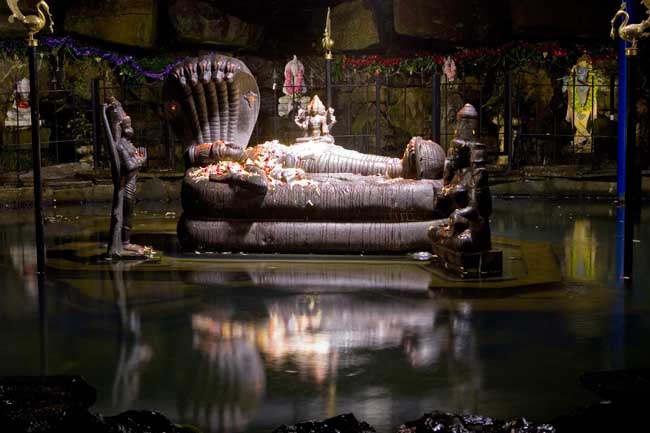
Hindus fast once a month,that is on the eleventh day of the New Moon/Full Moon.It is called Ekadasi, Eleventh day.
This day is dedicated to Lord Vishnu,one of the Trinity of Hinduism.
Lord Vishnu is the ‘Sustainer’
Hinduism believes in a healing body for Body is the dwelling place of Atman.
Body is not to be abused.
Tough spiritual practices,though in vogue,are called as Tamasic(Bhagavad-Gita).
They are called Asura Tapas,tough on body and as such is relegated behind Gnana, Bhakti and Karma Yogas.
In Asura Tapas one goes on Fasting for even years, sometimes people live on Water or only on Air!
But more beneficial results may be obtained by following The Satvic practice of Upavasa.
Upvasa is Fasting
Hinduism, Jainism and Buddhism advocate Upavasa.
While Jainism prescribed Upavasa for long periods,Hinduism recommends once a month.
On Ekadasi.
On this day one fasts completely.
No intake of food at all.
The next morning,Dwadasi,light meal consisting of cooked Rice, Gooseberry salad in Curds along with special Greens,Agathikeerai in Tamil,is taken.
This process ,along with taking three spoonful of Tulasi immersed water,after offering food to Lord Vishnu ,is called Bhaarana.
This light food taken after complete fasting on the earlier day increased longevity and cleans the stomach.
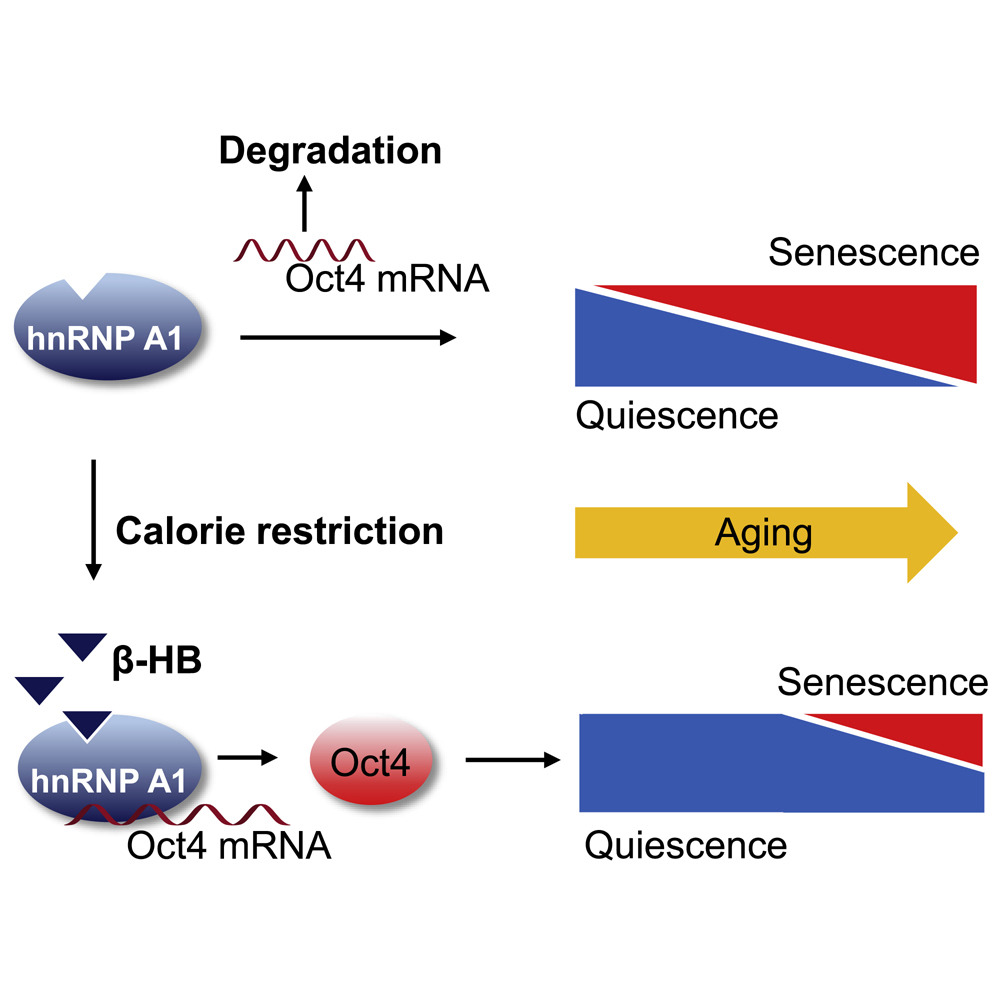
I am providing a research study done in September,2018,which states that fasting,
‘
induce anti-aging effects and alleviate aging-related neurodegeneration.
Study Highlights. Published:September 06, 2018
β-hydroxybutyrate prevents the vascular cell senescence
β-hydroxybutyrate upregulates Oct4 expression via interacting with hnRNP A1
Oct4-mediated quiescence is able to attenuate hallmarks of senescence
Circulating β-hydroxybutyrate alleviates the senescence of mouse aorta
Summary
β-hydroxybutyrate (β-HB) elevation during fasting or caloric restriction is believed to induce anti-aging effects and alleviate aging-related neurodegeneration. However, whether β-HB alters the senescence pathway in vascular cells remains unknown. Here we report that β-HB promotes vascular cell quiescence, which significantly inhibits both stress-induced premature senescence and replicative senescence through p53-independent mechanisms. Further, we identify heterogeneous nuclear ribonucleoprotein A1 (hnRNP A1) as a direct binding target of β-HB. β-HB binding to hnRNP A1 markedly enhances hnRNP A1 binding with Octamer-binding transcriptional factor (Oct) 4 mRNA, which stabilizes Oct4 mRNA and Oct4 expression. Oct4 increases Lamin B1, a key factor against DNA damage-induced senescence. Finally, fasting and intraperitoneal injection of β-HB upregulate Oct4 and Lamin B1 in both vascular smooth muscle and endothelial cells in mice in vivo. We conclude that β-HB exerts anti-aging effects in vascular cells by upregulating an hnRNP A1-induced Oct4-mediated Lamin B1 pathway..
The present area comprising of Russia and the parts of the erstwhile USSR,from Afghanistan border to Arctic and from the black sea to border of China were Vedic.
I had written on,
Rig Veda composed in the Arctic,
Yagnyavalkya had his Ashram in Russia,
Krishna’s son Pradhyumna built the city of Port Barzhyn,
Russia was called Sthree Varsha,Kingdom of women and it was a Republic,
Caspian Sea was Kashyap Sagar,named after Sage Kasyapa,
Lake Baikal was Indra’s Vaikanasa Theeretha,
Narodnaya in Urals was Narada Mountain,
Om Ganeshya Namaha inscription,praising Lord Ganesha is found in Baku,Azharbaijn,
Vishnu idol found in Russia,
One can find River Moksha in USSR,
Seven Rivers,Saptha Sarovar are found in Russia,
The similarities between Sanskrit and Russian language,
….and more.
(You can find the articles mentioned above by searching Google with the search term +ramanan50)
Now one more to establish the presence of Sanatana Dharma in Russia.
That is the observance of Vaikunta Ekadasi,the vrat,the practice of fasting in Russia.
It was called ‘Vizhnyir Ekoratsya Vikunh’
‘In Russian orthodox Christianity, worship is conducted very much like in Vishnu temples. The Russians refer to the feast of Vizhnyir Ekoratsya Vikhunh, directly corresponding with Vaikhunda Ekhadasi. The Russian language also owes a lot to Sanskrit, whose origins 50,000 years ago roughly correspond with the language of the people of the Smritzyi archaeological site, along the banks of the now-dried up Vernstokhlin (Varnasatyakhalini) river system.”
Fasting is observed by the Hindus, generally once a month , on the 11th day of the Moon waxing and waning, called the Ekadasi.
The next day is Dwadasi when those who are on Fast shall break the fast by taking special,yet a simple Food.
This consists of Boiled Rice, boiled Agathi Keerai (Tamil), Gooseberry Salad with Curds and a Gravy made of Sundakkai Vathal.
Ekadasi 11th Day of the Moon Fasting
Agathi Keerai ,scientific name sesbania grandiflora and in English the spinach variety is called as august tree leaves or humming-bird tree leaves.
Medicinal benefits of Agathi Keeerai.
Strong bones are the main contribution of agathi leaves.
The vitamins and rich calcium, iron content in this variety of spinach supplies more strength to bones.
By taking some amount of agathi leaves daily prevent weak bones in older ages and arthritis. Agathi leaves strengthen the nerves of eyes.
Nutritional Value.
Fiber 1.9 %
Fat 1.3 %
Calories 90
Water content 74.5 %
Protein 7.5 %
Calcium 120 Mg
Phosphorus 80 Mg
Iron 3.5 Mg
Vitamin C 165 Mg
B complex less
Minerals 3.4 %
Gooseberry.( Amla)
In South india, gooseberries are boiled in salt water with little turmeric powder and stored. Then whenever we want, the gooseberries can be used to make chutney. Ingredients Gooseberry – 3 nos Green chilli – 2 nos Grated coconut – 3 tblsp (optional – Those who are having cholestrol cannot use coconut.) Salt must be put in after checking since the gooseberry is stored in salt water, very little amount of salt is required in the chutney
1. Mix all the ingredients and grind to a smooth paste. 2. This can be had with dal rice, chappatti, curd rice etc. Tempering: Mustard seeds, Fenugreek seeds, Asafoetida, Oil, Curry leaves and a piece of Red chilli. Variation: Add 3 tblsp of beaten curd to it to make it little watery.
This is gooseberry pachadi .
Eating nellikai during pregnancy gives vitamin c.
The fruit contains high amount of vitamin C. So consumption of amla provides high level of vitamin C to body.
Regular consumption of raw amla relieves the problem of constipation.
To treat chronic cough and cold, mix 1 tsp amla powder with 1 tsp honey and consume this mixture three times a day.
You might have been heard abut nellikai juice benefits in tamil siddha medicine. Mix amla juice in water and gargle with this water to get rid of mouth ulcers and ever bad breathe.
If you are suffering form joint pain of knee pain then is the best treatment for this. The anti-inflammatory property of not only reduces the pain but also helps to lessen the swelling. It is advised for the patients to consume raw amla or amla juice daily.
Ayurveda suggest Nellikai for the treatment of sleeplessness or insomniac condition. Nellikai oil massage is good for body pain.
If you are suffering form joint pain of knee pain then amla is the best treatment for this. The anti-inflammatory property of amla not only reduces the pain but also helps to lessen the swelling. It is advised for the patients to consume raw nelikai or amla juice daily.
As it is rich in vitamin C, amla is always suggested in the treatment of eyes. Regular consumption of amla or amla products are suggested by the eye specialists. It not only improves the vision but also reduces itching, redness and other eye problems in eyes.
Amla cures indigestion. Amla is a natural blood purifier. It washes off harmful toxins from the body. The troubles related to liver and bladder is also cured with the consumption of amla.
Amla is beneficial in treatment of respiratory problems like Asthma.
Studies have proved that amla is beneficial in treatment for cancer patients.
Those who want to shed their weight, amla can be useful for them. Amla increases protein metabolism in body and thus helps to reduce weight.
Amla is rich in vitamin C and thus work as immunity builder.
Nellikai and diabetes: Nellikai is very useful ayurvedic diabetic treatment.
Amla, the wonder fruit contains high level of chromium which is useful in reducing blood glucose level and thus helps to control diabetes.
What Mahabharata says on Fasting-Santi Parva, Section CCXXI.
”
Translated by Sri Kisari Mohan Ganguli
(Abridged)
Yudhishthira said: Common people say that fasting is TAPAS (penances). Is fasting, however, really so, or is penance something different?”
Bhishma said: People do regard fast, measured by months or fortnight or days, as penance. In the opinion, however of the good, such is not penance. On the other hand, fast is an impediment to the acquisition of the knowledge of the Soul. The renunciation of acts (that is so difficult for all) and humility (consisting in the worship of all creatures and consideration for them all) constitute the highest penance. That is distinguished above all kinds of penance.
He who betakes himself to such penance is regarded as one that is always fasting and that is always leading a life of Brahmacharya (celibacy). Such a Brahman will become a Muni always, a deity evermore, even if he lives in the bosom of a family. He will become a vegetarian always, and pure forever. He will become an eater always of ambrosia, and an adorer always of gods and guests. Indeed, he will be regarded as one always subsisting on sacrificial remnants, as one ever devoted to the duty of hospitality, as one always full of faith, and as one ever worshipping gods and guests.
Yudhishthira said: How can one practising such penance come to be regarded as one that is always fasting or as one that is ever devoted to the vow of Brahmcharya, or as one that is always subsisting upon sacrificial remnants or as one that is ever regardful of guests?
Bhishma said: He will be regarded as one that is always fasting if he eats once during the day and once during the night at the fixed hours without eating during the interval. Such a Brahman, by always speaking the truth and by adhering always to wisdom, and by going to his wife only in her season and never at other times, becomes a Brahmacharin (celibate). By never eating meat of animals not killed for sacrifice, he will become a strict vegetarian. By always becoming charitable he will become ever pure, and by abstaining from sleep during the day he will become one that is always wakeful. That Brahman who never eats till gods and guests are fed, wins, by such abstention, heaven itself.
He is said to subsist upon remnants, who eats only what remains after feeding the gods, the Pitris, servants, and guests. Such men win numberless regions of felicity in next life. To their homes come, with Brahman himself, the gods and the Apsaras. They who share their food with the deities and the Pitris pass their days in constant happiness with their sons and grandsons and at last, leaving off this body, attain to a very high end.
______________
From The Mahabharata
Anusasana Parva Section CVI
Translated by Sri Kisari Mohan Ganguli
What are the merits of fasting during
the month of Sravana and other months?
Yudhishthira said: The disposition is seen in all the orders of men, of observing fasts.
The reason, however, of this is not known to us.
It has been heard by us that only Brahmanas and Kshatriyas should observe the vow of fasts
. How, O Grandsire, are the other orders to be taken as earning any merit by the observance of fasts?
How have vows and fasts come to be observed by persons of all orders, O king?
What is that end to which one devoted to the observance of fasts attains?
It has been said that fasts are highly meritorious and that fasts are a great refuge.
O prince of men, what is the fruit that is earned in this world by the man that observe fasts?
By what means is one cleansed of one’s sins?
By what means does one acquire righteousness?
By what means, O best of the Bharatas, does one succeed in acquiring heaven and merit?
After having observed a fast, what should one give away?
Bhishma said:
In former days, O king, I heard of these high merits, O chief of Bharata’s race as attaching to the observance of fasts according to the ordinance,
I had O Bharata, asked the Rishi Angirasa of high ascetic merit, the very same questions which thou hast asked me today.
Questioned by me thus, the illustrious Rishi, who sprang from the sacrificial fire, answered me even thus in respect of the observance of fasts according to the ordinance.
Angirasa said:
As regards Brahmanas and Kshatriyas, fasts for three nights at a stretch are ordained for them, O delighter of the Kurus.
Indeed, O chief of men, a fast for one night, for two nights, and for three nights, may be observed by them.
As regards Vaisyas and Sudras, the duration of fasts prescribed for them is a single night.
If, from folly, they observe fasts for two or three nights, such fasts never lead to their advancement. Indeed, for Vaisyas and Sudras, fasts for two nights have been ordained (on certain special occasions).
Fasts for three nights, however, have not been laid down for them by persons conversant with and observant of duties.
That man of wisdom who, with his senses and soul under control, O Bharata, fasts, by abstaining from one of the two meals, on the fifth and the sixth days of the moon as also on the day of the full moon, becomes endued with forgiveness and beauty of person and conversance with the scriptures.
Such a person never becomes childless and poor.
He who performs sacrifices for adoring the deities on the fifth and the sixth days of the moon, transcends all the members of his family and succeeds in feeding a large number of Brahmanas.
He, who observes fasts on the eighth and the fourteenth days of the dark fortnight, becomes freed from maladies of every kind and possessed of great energy.
The man who abstains from one meal every day throughout the month calledMargasirsha, should with reverence and devotion, feeds a number of Brahmanas.
By so doing he becomes freed from all his sins. Such a man becomes endued with prosperity. He becomes endued with energy. In fact, such a person reaps an abundance of harvest from his fields, acquires great wealth and much corn.
That man, who passes the whole month of Pausha, abstaining every day from one of two meals, becomes endued with good fortune and agreeable features and great fame.
He who passes the whole month of Magha, abstaining every day from one of the two meals, takes birth in a high family and attains to a position of eminence among his kinsmen.
He who passes the whole month of Bhagadaivata (Phalgun), confining himself every day to only one meal becomes a favourite with women who, indeed, readily own his sway.
He who passes the whole of the month of Chaitra, confining himself every day to one meal, takes birth in a high family and becomes rich in gold, gems, and pearls.
The person, whether male or female, who passes the month of Vaisakha, confining himself or herself every day to one meal, and keeping his or her senses under control, succeeds in attaining to a position of eminence among kinsmen.
The person who passes the month of Jyaishtha confining himself every day to one meal a day, succeeds in attaining to a position of eminence and great wealth. If a woman, she reaps the same reward.
He who passes the month of Ashadha confining himself to one meal a day and with senses steadily concentrated upon his duties, becomes possessed of much corn, great wealth, and a large progeny.
He who passes the month of Sravana confining himself to one meal a day, receives the honours of Abhisheka wherever he may happen to reside, and attains to a position of eminence among kinsmen whom he supports.
That man who confines himself to only one meal a day for the whole month ofProshthapada (Bhadrapad), becomes endued with great wealth and attains, to swelling and durable affluence.
The man who passes the month of Aswin, confining himself to one meal a day, becomes pure in soul and body, possessed of animals and vehicles in abundance, and a large progeny.
He who passes the month of Kartika, confining himself to one meal every day, becomes possessed of heroism, many spouses, and great fame.
I have now told thee, O chief of men what the fruits are that are obtained by men observing fasts for the two and ten months in detail
There is no Sastra superior to the Veda.
There is no person more worthy of reverence than the mother.
There is no acquisition superior to that of Righteousness, and no penance superior to fast.
There is nothing, more sacred in heaven or earth than Brahmanas. After the same manner there is no penance that is superior to the observance of fasts.
It was by fasts that the deities have succeeded in becoming denizens of heaven.
It is by fasts that the Rishis have attained to high success.
Chyavana and Jamadagni and Vasishtha and Gautama and Brigu – all these great Rishis endued with the virtue of forgiveness, have attained to heaven through observance of fasts.
In former days Angirasa declared so unto the great Rishis.
The man who teaches another the merit of fasts have never to suffer any kind of misery.
The ordinances about fasts, in their due order, O son of Kunti, have flowed from the great Rishi Angiras.
The man who daily reads these ordinances or hears them read, becomes freed from sins of every kind.
Not only is such a person freed from every calamity, but his mind becomes incapable of being touched by any kind of fault.
Such a person succeeds in understanding the sounds of all creatures other than human, and acquiring eternal fame, become foremost of his species.
12.Panguni-Narasimha Dwadasi, Sukla Paksha Dwadasi for varaha.
13.Kaanthi Vrata;Sukla Paksha Dwithitiyai( second day after New Moon) for Krishna.On this Thithi Krishna/Balarama are to be worshipped and Silver idols of each is be donated .
* New Moon to Full Moon Sukla Paksha
Full Moon to Nwe Moon-Krishna Paksha.
Tamil Months and corresponding English Months.
The number of days in a month varies between 29 and 32.
The following list compiles the months of the Tamil Calendar.
Note: The Sanskrit months above would start one month ahead of Tamil months since the Tamil calendar is a solar calendar while the Sanskrit calendar is a lunisolar calendar.
It is of interest to note that these Vratas cover all the Avataras of Vishnu.
All the Vratas are to be followed on Dwdasi, whic is natural, as Lord Vishnu is associated with number 12-he is one among the 12 Adithyas,His Dwadasa Naama’Om Namo Bhagavathe Vasudevaaya’ contains twelve Aksharas or letters in Sanskrit and Sri Vaishnava practice is to keep everything inmultiples of Twelve including the cheer(things offerd in Marriages.
But the greates Vrata of Vishnu is Ekadasi, which is Symbloic of Lord Shiva!
Sathya Narayna Vrata and others are not found in the Purans, may be they are from the Smritis or by tradition
For January Vaikuntha Ekadashi…
On 10th, Parana Time = 07:17 to 09:29
On Parana Day Dwadashi would be over before Sunrise
Viswaroopa Of Vishnu.
Smartha Vaikuntha Ekadashi = 08/01/2017
On 9th, Parana Time for Smartha Ekadashi = 13:50 to 16:01
On Parana Day Hari Vasara End Moment = 10:17
Ekadashi Tithi Begins = 07:52 on 8/Jan/2017
Ekadashi Tithi Ends = 05:03 on 9/Jan/2017
The term Ekadasi means eleven. Hindus follow two calendars.
One is Surya Manasa, following the movement of the Sun.
The other one is Chandra Manasa where one follows the waxing and waning of the Moon.
In Surya Manasa, the Stars, Nakshatras are given importance for calculations of festivals and auspicious occasions.
Chandra Manasa takes into account the wacing and waning of the Moon, called the Thithis. Nakshatras 28 and Thithis are fifteen.
Thithis are taken into account for calculation of inauspicious occasions like death and performance of Death related rituals like Srardha.
The period from the New Moon Day to Full Moon Day is called Sukla Paksha, which is considered auspicious and for auspicious occasions days/dates are fixed during this period.
However major Vows or Vratas are observed during the waning Moon period, Krishna Paksha.
Vaikunta Ekadasi,Shivratri,Shashti(for Lord Subramanya), Ganesh Chaturthi are observed in this period.
Of the major Vrats, Vaikunta Ekadasi is observed in Onesiance to Lord Vishnu and this is believed to grant many a boon, including the ttainment of Lord Vishnu’s feet at His Abode, The Vaikunta.
This is observed on the eleventh day of the Moon Cycle and the one that falls during Sukla Paksha is important.
However, most important Ekadasi which occurs in the month of Mrigasira, Margazhi in Tamil,December-January in Gregorian calendar, is of special importance and is celebrated on agrand scale in sri Vaishnava Temples, Sriranagam and Srivilliputtur are famous for this occasion.
Early in the morning of the Vaikunta Ekadasy Day, the doors leading to the Inner Sanctum of Lord Vishnu is opened and people enter through this. Special poojas are performed.
The doors remain closed during the other days.
During the Ekadasi day one is expected to fast and take nothing. The next day, Dwadasi, Tulasi water is to be drunk followed by austere food.
This consists of a Raita prepared out of a Dhal Urad dhal,Black Gram), and special Green leaf vegetable(Agathi Keerai) along with a salad of Amla, Nellikkai,Gooseberry in Curds .
Food can be taken once during the day.
At night,light snack made of rice are taken.
The taking of Tulasi water in the morning of Dwadasi is called Dwadasi Baranai’
Now people take light snacks on the Ekadasi day.
This is not correct.
On the Ekadasi day one engages himself in chanting the names Lord Vishnu and visiting His Temple.
One also enters His Inner Sanctum through the Doors early in the morning.
The origin of Ekadashi Vrata.
‘
According the to Vishnu Purana, fasting on Vaikuntha Ekadashi is equivalent to fasting on the remaining 23 Ekadashis of the (Hindu) year.[2] However according to Vaishnava tradition fasting is mandatory on all Ekadashi of both Shukla paksha and Krishna paksha. Fasting on Ekadashi is considered holier than any other religious observation.
Vishnu opened the gate of Vaikuntham (his abode) for two demons in spite of their being against him. They also asked for the boon that whoever listens to their story and sees the image of Vishnu coming out of the door (called Dwar), called Vaikunth Dwar, will reach Vaikunth as well. Temples all over India make a door kind of structure on this day for devotees to walk through.
According to Padma Purana, the female energy of Vishnu slayed the demon Muran and protects the ‘Devas’. This happened on the eleventh day of lunar month during the sun’s journey in the Dhanurrashi or Dhanu Rashi. Impressed by the act, Vishnu names her as ‘Ekadashi’ and gives her the boon that those who worship ‘Ekadashi’ on the day of her victory over Muran would reach ‘Vaikunth’ (His abode).[3]
Vaikuntha Ekadashi is one of the important and auspicious days for Hindus. It is dedicated to Vishnu. It occurs in the Hindu calendar, in the month of Margashirsha (between December and January). When observed, it bestows liberation from the cycle of birth and death.
‘
Mohini Alankaram
Sri Namperumal – Vaikunda Ekadasi Festival – Pagalpatthu 10 day
2017 January 8
Sri Namperumal – Vaikunda Ekadasi Festival – Irappatthu (night) 1 day
Sri Namperumal – Vaikunda Ekadasi Festival – Irappatthu (night) 9 day
2017 January 17
Sri Namperumal – Vaikunda Ekadasi Festival – Irappatthu (night) 10 day
Theerthavari
Vaikunta Ekadasi Significance.
”
According the to Vishnu Purana, fasting on Vaikuntha Ekadashi is equivalent to fasting on the remaining 23 Ekadashis of the (Hindu) year.[2] However according to Vaishnava tradition fasting is mandatory on all Ekadashi of both Shukla paksha and Krishna paksha. Fasting on Ekadashi is considered holier than any other religious observation.
Vishnu opened the gate of Vaikuntham (his abode) for two demons in spite of their being against him. They also asked for the boon that whoever listens to their story and sees the image of Vishnu coming out of the door (called Dwar), called Vaikunth Dwar, will reach Vaikunth as well. Temples all over India make a door kind of structure on this day for devotees to walk through.
According to Padma Purana, the female energy of Vishnu slayed the demon Muran and protects the ‘Devas’. This happened on the eleventh day of lunar month during the sun’s journey in the Dhanurrashi or Dhanu Rashi. Impressed by the act, Vishnu names her as ‘Ekadashi’ and gives her the boon that those who worship ‘Ekadashi’ on the day of her victory over Muran would reach ‘Vaikunth’ (His abode).[3]
Vaikuntha Ekadashi is one of the important and auspicious days for Hindus. It is dedicated to Vishnu. It occurs in the Hindu calendar, in the month of Margashirsha (between December and January). When observed, it bestows liberation from the cycle of birth and death.”
You must be logged in to post a comment.