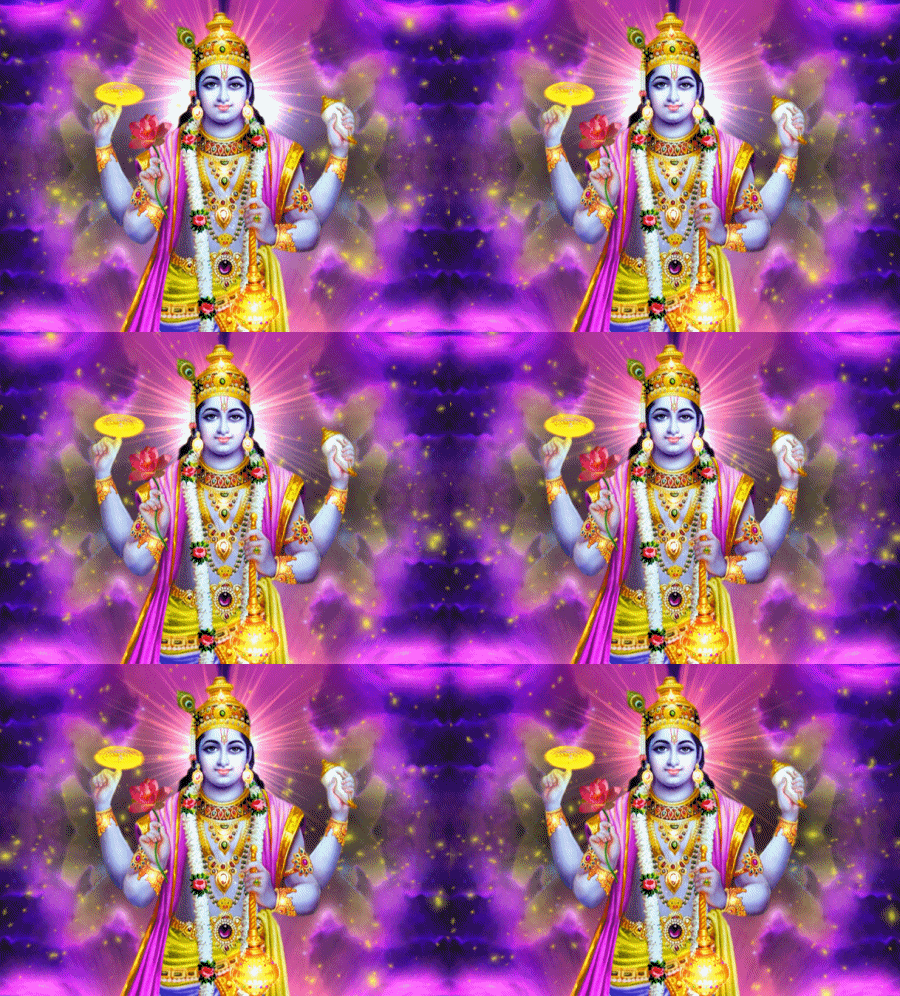
However worship of God’s is also recommended in Hinduism and it is called Saguna Aradhana,while meditating on the Abstract is called Nirguna, Beyond Attributes, Aradhana.
To reach this level is not easy for all.
Therefore worship of Gods is recommended in the form of Idols.
What is indescribable, Avaktavya, becomes Vyaktha, Describable when worships as God of Names and Forms in the form of Idols.
Some of these Idols are called Self Manifested or Swambhu.
There are Eight Self Manifested Idols of Lord Vishnu in Eight Sacred places.
These are called Vyaktha Kshetras,that is where Lord Vishnu makes Himself available as Idol and thus becomes Describable.
There are also called Astakshara Temples as they represent the eight letters of Vishnu’s Sacred Name,
Om Namo Narayanaya.
There also Dwadasa nama temples,after Vishnu’s twelve aksharas.
In this verse Lord Narayana points out that the eight Swayam Vyakta Kshetrams of Srirangam, Tirupathi, SrimushNam, Vanamamalai, Salagramam, Badri,and NaimisharaNyam,Pushkar grant liberation to those who visit the place. The Lord as the Archa Murthy at each of these Kshetrams signifies one Aksharam of his Ashtakshara Mantram.
I had written about the antiquity of Tamils and its close connections to Sanatana Dharma.
One intriguing fact,I have mentioned in many articles,is about Shiva Worship.
While Shiva is mentioned rarely in the Vedas directlty,save Srirudram,no Sukthas directly addressed to Shiva,Tamil literature speaks extensively about Shiva.
While the legend of Shiva is limited to His Marriage with Uma(Parvathi,daughter of Himavan,Daksha) her self immolation in the sacrificial fire in the Yagnya conducted by Her father,And Shiva carrying the body of UMA and the coming into being of the 108 Shakti Peetas,the Tamil literature speaks of 64 Avatars of Shiva,His formulation of Tamil as a language,his sons,apart from Ganesha,Murugan(Subrahmanya)Veerabaahu,Navaveeras,Rudrasena.
And Shiva is called the First Yogi with Sage Agastya,Bhogar and Patanjali as His disciples among others.
Rama is reported to have worshipped Shiva in many places in South India,including Rameswaram.
This probably is one of the strongest clues that Shiva cult preceded Ramayana.
The Sangam classics,dated around 3000 BC,speak of Shiva.
In the light of archelogical findings at Poompuhar,Tamil Nadu sets the Sangam classics by 30,000 Years.
So this is another clue.
The next is Tamil being spoken ,even today,in Afghanisthan as a dialect and in Nortwest frontier province of Pakistan.
I had written that Tamils had a second Capital in the Nortwest of India.
Kind Sibi,a Chola king ruled from there.
He invaded the south and built a Temple in Thirivellarai,near Srirangam,Tamil Nadu for Pundarikaksha,(Vishnu).
Sibi and Manu(not Manusmriti Manu) were Cholas and ancestors of Lord Rama
*please read my articles on these.
So we have two issues.
Tamils preceded Ramayana.
They were present in the northwest of India.
There is evidence that the Tamils lived somewhere near the Gulf of Cambay,Gujarat.
Shall write a detailed article on this.
The present article is about the date of Tamils,whose homeland was Lemuria,/Kumarikandam,/MU)
These three could have been one landmass are different but what can not be disputed is that the land was Tamils homeland.
How old is this land and the people?
Before proceeding further it would be relevant to know about the geographical landmarks provided in Tamil classics.
Sangam literature mentions ‘Thrivengadam’Vada Vengadam’ as the Nothern boundary of Tamil Homeland.
Currently,Tirupati is taken as Venkatam.
This forms a part of Seshacham range of hills and it dates back to 200 million years.
Himalayas were formed only about 70 million years ago.
The reference to Himalayas are not found in Lemuria.
What we have now in Tamil is the works belonging to the The Third Tamil Sangam and one finds reference to Himalayas.
The earlier works belonging to second and first Tamil Sangam were lost due to Tsunami.
They could have contained more references to Lemuria.
The reason why Himalayas is not found in Lemuria is because Himalayas was not formed then while Seshachalalam, Vada vengadam was in existence.
I shall be writing on the mountains,rivers of Lemuria as found in Tamil classics.
In as much as Vengadam is mentioned and not Himalayas,it is safe to postulate that Tamils refer to a period when Seshachalam was in existence and Himalayas yet to be Formed.
‘This page created for trivia and commentary regarding the Tretya Yuga [Silver Age]and the continent of Mu, or Lemuria. [- E.M.]
*Trivia:“[….] The Tretya Yuga, or Silver Age, came after the breakup of the previous age, when Lemuria, by earthquakes and tidal waves, went down under the seas. [….]” [Based on: Paul Twitchell, TheShariyat-Ki- Sugmad, Book Two, p. 113, Second Edition – 1988]
*Trivia: “[….] These records tell us that the legendary paradise of man, thought of as the Garden of Eden, was laid on the lost continent of Lemuria which was sunk by earthquakes and tidal waves fifty thousand years ago. [….]” [Based on: Paul Twitchell, The Shariyat-Ki- Sugmad, Book Two, Second Edition – 1988, p. 107]
Considered to be Earth’s first great civilization, Mu [Lemuria] could naturally be placed in the *Golden Age [about 3,891,102 B.C. – 2,163,102 B.C.] in order to fit a popular mythological paradigm of four [Gold, Silver, Bronze, Iron] great ages. My dates for these four ages [Yugas] were figured by using 3,102 B.C. as a starting date for Kali Yuga [Iron Age] and subtracting the appropriate fractions from 4,320,000 years to determine the rest. Most remarkable, perhaps, is the fact Paul Twitchell appeared to suggest two dates [separated by nearly 2 million years] for the destruction of Lemuria: roughly 2 million B.C. & 50,000 B.C. What are the reasons for these two dates? Can a continent sink twice? Or, during his research, was Paul Twitchell faced with more than one popular paradigm concerning the beginning of civilization? [- E.M.]
* See: pp. 16 and 98 (or Index page reference for Yuga / Satya) The Shariyat-Ki-Sugmad, Book One, by Paul Twitchell; p.77 (or Index page reference for Age / Golden) The Shariyat-Ki-Sugmad, Book Two, by Paul Twitchell; pp. 55 and 163 (or Index page reference for Satya Yuga & Tretya Yuga) The ECK-VIDYA Ancient Science of Prophecy, by Paul Twitchell.
*Trivia: “[….] The destruction of the kingdom of Lemuria and all its colonial empire came about by gas pockets under the crust of the earth some hundreds of thousands of years ago. It was a land of the Aryans who spread the empire throughout the world. [….]” [Based on: Paul Twitchell, The Shariyat-Ki- Sugmad, Book Two, seventh printing, 1982, p. 97 & eighth printing, 1986, p. 97 ]
*Trivia: “[….] The destruction of the kingdom of Lemuria and all its colonial empire came about by gas pockets under the crust of the earth that formed some hundreds of thousands of years ago. [….]” [Based on: Paul Twitchell, The Shariyat-Ki- Sugmad, Book Two, Second Edition – 1988, p. 112]
*Note: “Paul Twitchell died in September, 1971.” [– E.M]
The foregoing two sections of text appear not entirely the same. The newer edition [1988] contains the words that formed. To me [at least for now], this appears to suggest that [hundreds of thousands of years ago] gas pockets were formed under the crust of the earth. The older version of this text [1982 & 1986], however, “appears to suggest” it was the destruction of Lemuria that happened hundreds of thousands of years ago. That is, before the beginning of the Tretya Yuga about 2 million B.C. [- E.M.]
Col. James Churchward suggests a starting date for Mu [Lemuria] at about 200,000 B.C. He bases this date, allegedly, on ancient Nacaal tablets. According to the position of certain stars recorded on those tablets [according, that is, to the conclusion of certain astronomers], he thus determines the date. On the other hand, the final destruction of Mu, according to Churchward, appears to have taken place between 10,000 & 11,000 years B.C.” [- E.M.]
So here we have a case of popular apparent history for one of the oldest recorded civilizations on earth. One that, according to such history, apparently sank beneath the waves of the Pacific Ocean anywhere from 2 million to 10,000 years B.C.
Even more astonishing, perhaps, is the classic church story about how the Garden of Eden and the beginning of the world began at just around 4,000 B.C. Only in the last two hundred years have other older dates for creation really begun to gain public attention. Writers contemporary with the 20th and 21st centuries were once engaged with promoting dates of between ten and fifteen thousand years B.C. for the Biblical flood; not to mention the beginning of man on earth – which probably goes back even further. Of course, some contemporary authors now favor the idea of all four Hindu yugas corresponding – more or less – with the popular 5,000-plus-year cycle for Mayan “suns”, which could have the oldest of them beginning around the 4th millennium B.C.
Obviously, a paradigm shift has been taking place for a number of years. A regular see-saw of dates, or a “hall of mirrors” that “seems to matter”. [- E.M.]
Avatars of Vishnu are reported in all the four yugas,Aeons,Satya,Treta,Dwapara and Kaliyuga.
Of these Avatars only the Kalki Avatar is due towards the close of the present Kaliyug.
Kaliyug runs for 4,37,000 years.
We are now in Kali (3102 +2017 ) 5119.
Kaliyug started in 3102 BC..
Kolhapur Mahalaksmi, Padmavathy?
The Venkateswara of Thirupathi or Balaji is not mentioned as an Avatar that had taken place in the Satya, Treta .
So it should be assigned to Kaliyug.
Balaji Tirupati,Srivathsam is visible.
But the Kalki Avatar of Vishnu is slated towards the end of Kaliyug.
As we are in Kali 5119 , The Avatar of Venkateswara should have been after 3102 BC.
Does this information stand the test of History?
Mahalakshmi who was later to marry lord Venkateswara of Thirupathi ,as Padmavathy was from Kolhapur and she traveled to south, Andhra.
‘Lakshmi was angered by Vishnu’s action of placating Bhrigu who had kicked her place in Vishnu’s body and thus insulted her. She abandoned her heavenly abode and resided in Karavirapur (Kolhapur) on earth. After her departure, a forlorn Vishnu followed suit and took abode in an ant-hill under a tamarind tree, beside a pushkarini on the Venkata hill, meditating for the return of Lakshmi, without food or sleep…
A while later, a King named Akasa Raja who belonged to the Lunar race, came to rule over Tondamandalam. The childless Akasa Raja performed a sacrifice to gain an heir. As part of the sacrifice, he was ploughing the fields. The plough struck a lotus, which had an infant girl in it. Upon the advice of a divine voice that the girl would be a harbinger of fortune, the king adopted the girl and named her Padmavati, since she was found in a lotus (padma). The princess grew up into a beautiful maiden and was attended by a host of maids….. (https://en.m.wikipedia.org/wiki/Venkateswara ).
This can be interpreted as the king from Kolhapur came to Thirumala with Mahalaksmi.
One may note that Kollamma worship was practiced in Kolhapur znd Yellamma worship is in Andhra Pradesh.
Now, Kolhapur region was ruled by Rashtrakuta/Shilhara Dynasty.
This information is corroborated by the conquest of Rajaraja cholan and Rejendra Cholan of the Kolhapur area as well in addition to the Thirumala Region.
The inscriptions found in the Thirumala temple walls confirm Tamil presence and these inscriptions also mention King Krishna Devaraya who was an ardent devotee of Venkateswara.
It may be worth mentioning that Vishnu was worshipped as Maayon or Thirumaal and the early Sangam works mention Thirumala as Vada Venkatam as the border…
‘Raja Raja Chola I (or Rajaraja Chola I) was a renowned king who ruled over the Chola kingdom of southern India between 985 and 1014 CE. During his reign, the Cholas expanded beyond South India with their domains stretching from Sri Lanka in the south to Kalinga in the north. Raja Raja Chola also launched several naval campaigns that resulted in the capture of the Malabar Coast as well as the Maldives and Sri Lanka..
Rajendra led Chola campaigns from 1002 CE. These include the conquest of the Rashtrakutas and the campaigns against the Western Chalukyas. He conquered the Chalukyan territories of Yedatore (a large part of the Raichur district between the Krishna and the Tungabhadra), Banavasi in the north-west of Mysore and capital Manyakheta. Rajendra erected a Siva temple at Bhatkal. In 1004 CE, he captured Talakad and overthrew the Western Ganga dynasty which had ruled over Mysore for almost 1000 years.[He also conquered Kollipakkai, located to the north of Hyderabad in present-day Telangana. An excerpt from an inscription in Tamil from Kolar states:’
The evidence of the Kolhapur connection to Thirumala is corroborated from different sources confirm thecso called legend.
Legend of Padmavathi .
Padmavathi legend is to be interpreted as an allegory for the movement of Mahalaksmi from Kolhapur to Thirupathi.
In as much as this is clarified the so called legend of Venkatewara must also be true as he is mzrried to Padmavathi.I am looking into historical sources of VenKateswara and shall write.
It is,with the present evidence,safe to postulate that Lord Venkateswara is not a myth but is history..
I have set for myself some rules for visiting Temples.
I do not go to temples regularly, for that matter, nor do I perform Pooja regularly at home.
I perform pooja/ visit temples when I feel the urge.
Then I go all out.
Lord Venkateswara Tirupati original image
Pooja may extend upto three hours and at the beginning I would not be sure which Mantras or Pooja I shall perform.
Similarly visiting temples.
I go when I feel like and choose temples ,generally more than 500 years old.
Nor do I list the temples and plan.
I start with one temple ,suggested by some body or one which is quite old.
As I visit the temple I get suggestions from strangers for the next temple.
I proceed.
And I do not use private transport, car,special bus.
I travel by public transport.
I leave by 5 30 am and return by 11 pm.
Food , I normally get offered mostly by temple archakas of the temples in their homes.
Otherwise I do not take food at all.
I travel alone.
During the time between 1 and 4 pm ,when the temples are closed,I sleep in the temple premises.
This way I have been able to cover even 11 temples a day.
I have posted articles on all the temples visited.
My children make fun of these practices.
Their grouse is that I could plan better,stay in comfort.
But I continue my practice.
I get good darshan despite my refusal to have darshan by making payment for special darshan nor do use my contacts.
Exception to these practices are when I accompany my children to have the Grandchildren’s hair to be tonsured and for the their Ear Piercing ,Karna Bhushana in temples.
I do not like to use the term ‘ear boring’
In these cases, my children plan everything in advance and we cover the places in car and stay in very comfortable and, in my opinion, costly rooms.
As a grandfather I keep the child in my lap for these ceremonies.
My children keep away unable to bear the child’s pain and cries.
This 26h and 267th(January) I had been to Thirupati to have my daughter’s second son’s hair tonsure.
My son in law was trying to get the best Darshan at Thirupati through his contacts who are vey influential.
My daughter,to be on the safer side, asked me to get darshan organised through my contacts.
All my sources informed me that they could have organised , had they been informed earlier.
I have a bitter experience of organising my Thirupati trip through my nephew .
The last trip I made to Thirupati was in 1989,when I my daughter was 6 years.
I have visited Thirupati, after 29 years, for her son’s hair tonsuring.
My nephew,sister’s son, organised my trip in 1989 through some of his very high level contacts in the Goverment.
When we left Chennai , he calculated a total of 10 hours for traveling to and fro to Thirupati and Darshan.
Six hours for traveling ,to and fro, four hours for climbing by walk and darshan.
I told him not to set time for God.
He laughed at me saying I was superstitious.
We reached Thirupathi and joined a special queue and we were informed that the darshan will be over in about half an hour.
And my nephew looked at me conveying how ridiculous my statement that one should not set time to God.
After five minutes or so, we were informed that the darshan may be delayed as some VIPs were expected.
And we were made to stand in thexsteel enclosure for….
17, seventeen hours before getting Balaji’s Darshan!
Me,with a six year old who has to eat, use toilet, and stuck up I. Iron brarricade unable to move out!
This time around,my son in law arranged for darshan for some special programme and told me that it would take about 3 hours to have Balaji Darshan.
I said fine but suggested that we conduct Kanyana Utsava for Balaji as I felt like doing it.
He told me that it was too late and that his contact could not change what he has arranged.
And my son in law wanted to know if he wanted me to reschedule the programme.
I already have my experince of being made to stand in the queue in 1989 with a child of 6 years constantly asking me for food, for Toilet facilities when I had a tough time in managing.
So I told my son in law to leave the whole issue of Kalynanatosava to Lord Balaji.
If He wants me to perform it,HE shall have it done.
Or it means He has not given me permission.
We went to Thirupati and as we were about to leave for Darshan from the room,my son in law got a call from his contact that the special darshan he has planned for us has been canceled and we were being allotted special Kalyana Utsava of Lord Balaji!
We had good darshan and I could get a whole of 4 minutes to see Him!
The name of the cottage allted to us was ‘ venkata vijayam’, visit of Venkata, name of Lord Balaji,Venkata Ramana.
The sanctum of Thirupathi Venakateswara, Balaji contains the Idol of Lord Venkateswara and two more Idols of Srinivasa.
Such is the imposing and divine presence of Lord Balaji with His stunning looks, we often miss what else is present in His Sanctum!
Vishnu’s Discus.gif
There are three idols of Lord Balaji, Srinivasa.
They are,
replica of Sanctum Sanctorum(Garba Griha) of Tirumala Venkateswara Temple depicting SriDevi BhuDevi Sametha Malayappa Swamy-Left, Lord Venkateswara Main Deity(Dhruva beram)-Center, Bhoga Srinivasa-Center bottom, Ugra Srinivasa, Sita Lakshmana Sametha Sri Rama, Sri Krishna, Rukhmini- Right. Image credit wiki
1.Sri Bhoga Srinivasa,
2) Ugra Srinivasa,
Legend has it that fire broke out in the village destroying houses during Brahmotsavam at Tirumala in the 14th century A.D. When prayers were offered to the God, a@ vision appeared to a devotee with a message from Lord Srinivasa himself. With the change in times, the Ugra Srinivasa idol could no longer remain the processibon idol and a new idol would be found as utsava murti (Malayappa swami). The Ugra Srinivasa idol is no longer brought out of the temple after sunrise and it is believed that sunrays touching the idol would spark fire in the temple complex.
3) Koluvu Srinivasa,
4) Sri Malayappa,
5) Sri Krishna,
6)Srirama, Sita, Lakshmana and Sugreeva and
7) Sri Chakrattalvar. ‘
It is rare to find seven idols in a Garbha Gruha.
Three of Srinivasa are found.
Srinivasa is an Avatar of Vishnu.
Vishnu,though according to functions is Kshatria,because He protects like a father,the term Vishnu is from Jishnu,meaning one who supports,The Vishnu Purana is classified as Sattvic , not Rajasic as protection is the function of a King with Compassion,Kshama,the ability to forgive.
Yet in Thirupati we find Bhoga Srinivasa given the first place.
Bhoga means enjoyment.
In Srinivasa avatar ,His specific purpose has been to shower Kshama and Blessings and He enjoys it.
Hence Bhoga Srinivasa gets the priority.
Ugra,Srinivasa represents His aspect of unforgiving anger.
Many are not aware of this aspect of Lod Balaji,Srinivasa.
As much as He is known for His munificence,He does not forgive a forget a slight nor goes any of the dues to Him by the Devotees,uncollected.
If one has dues to Him ,like a vow taken to visit Thirupati or forgets to offer money if one has taken a vow to do so.
Normally the signal he is not pleased with you in fulfilling your vow to Him, is your getting inexplicable stomach ailments.
The solution is to fulfill your vow.
Then, as a Father He would ignore your omission and shower you with His Grace.
This,I have experienced personally and also from others.
These do not have any scientific or even religious explanation.
Period.
As to me ,if my issue is resolved it is more than enough, I do not waste my time how and why the problem is solved.
Not very rational,
Isn’t it?
That is way the things are.
‘Koluvu Srnivasa is Utsava Murthy.
I am researching into the presence of Rama,Sita,Sugreeva and Chakkarathalvar in the Sanctum.
They,in my opinion, have a historical connection.
Shall write.
‘
Bhoga Srinivasa Murti:
Sri Bhoga Srinivasa Idol is a true copy of the Dhruva Bera(Main Deity) except that the Sanku and Chakra are permanently fixed in the case of Bhoga Srinivasa. Sri Bhoga Srinivasa gets Abhishekam every morning unlike the Dhruva Bera to which Abhishekam is performed only on Fridays.
Ekanta Seva is performed to Sri Bhoga Srinivasa. During Ekanta Seva, Sri Bhoga Srinivasa is placed in a Silver Cradle in the Sayana Madapam and offered milk to Sri Bhoga Srinivasa. Sandalwood paste is also offered to him every night. Ekanta Seva is performed to Sri Bhoga Srinivasa for all months in a year except Dhanurmasam in which Ekanta Seva is performed to Sri Krishna.
This idol is made of Silver and was consecrated by the donar, the Pallava Queen, Samavai in 966A.D. The donor’s consecration is recorded in an Epigraph on the northern wall of the Temple Prakaram which is perhaps the earliest inscription in the temple.
Koluvu Srinivasa or Bali Bera:
Every day after the morning Thomala Seva, a darbar called Koluvu is held in the Tirumamani Mantapam where the deity is brought and is seated in a silver chair with a gold umbrella above him. This idol officiates for the main idol during this function and hence his name is Koluvu Srinivasa.
He is akin to the guardian deity and supervises the temple household, and keeps himself posted with all the affairs and revenue of the temple. The Panchangam or the Calendar of the day is also read out before Koluvu Srinivasa Every Day.
Sri Malayappa or Utsava Murthi:
The first mention of this deity under the name “Malai Kuniya Ninra Perumal” is found in an Epigraph about the year 1339AD. The idol is in a Standing Pose and is a replica of the Dhruva Bera(Main Deity). The two upper arms hold the Sanku and Chakra, the lower right arm is in the Varada hasta pose and the left arm in Katyavalambite pose. This image has a very rich treasury of precious gems and jewels made of Platinum and Gold.
The idol of Lord Malayappa is about three feet height and stands on a lotus pedestal on a platform about 14inch height. To right is the idol of Sridevi about 30inch height. Sridevi left hand is in the Kataka hasta pose, the right is in the Gajakarna pose. To left is the idol of Bhudevi which is in standind pose. Bhudevi left hand is in the Gajakarna pose, the right is in the Kataka hasta pose.
In the order of preferences the idols that represents the Dhruva Bera’
Description of Thirupathi Balaji’S Grabha Gruha is from the following link and quoted portions are from this source.
You must be logged in to post a comment.