Tag: Temples of Kerala

  • Why How Chottanikkara Bhagavathy Temple Cures Mental Illness.

    Why How Chottanikkara Bhagavathy Temple Cures Mental Illness.

    The three devis of Hinduism, from the philosophical perspective represent three aspects of Human nature.

    The desire to act,the action part impelled by the results one anticipates and the wisdom and courage to act upon a course of action.

    These three are represented by Saraswathi,Lakshmi and Durga.

    Most of us not aware of the fact that Saraswathi is the One who initiates the procees of concept formation,forms words and makes one express clearly in a way that it is understood

    While we take Lakshmi as only the Goddess of Wealth,we are not aware of the subtler aspect of Lakshmi.

    We have Lakshmi Tantra for Self Realization.

    Please read my article on this.

    Even if one forms a concept for action,the human nature demands results,most of the time in terms of material comforts/wealth to impel him to act.

    This is what Lakshmi does.

    Then one should have the wisdom and courage to choose a course of action.

    And this is in the Realm of Durga.

    There are three levels of Speech.

    The Concept,

    The process fron Concept to Thought and

    Expression of Thoughts.

    These three are controlled by Gayatri,Savitri and Sarasvathi respectively.

    When thoughts,concepts,the transformation process are disturbed ,we have mental disturbances,and Autism.

    The Chitta,the highest level of Cognition ,when disturbed,results in mental illness.

    To alleviate this,Saraswathi ,along with Savitri,Gayatri,is to be propitiated,along with Lakshmi to impel the corrective course and Durga to grant wisdom and courage.

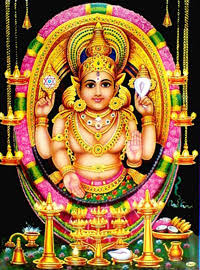
    There is one temple,where all the Three Devis are present in one Form,where the The Three Sukthas,Saraswathi,Sri and Durga sukthas,when chanted here along with Homa,cures one of Mental illness.

    This is Chottanikkara Bhagavathy temple,Kerala,India.

    The Chottanikkara (correction of JyotiannakkaraDevi Temple (Malayalamചോറ്റാനിക്കര ഭഗവതി ക്ഷേത്രം) is a famous temple of mother goddess Shakthi devi or Rajarajeshwari known as Sree Bhagavathi. Maha lakshmi is supposed to be residing in Chottanikkara along with Lord Vishnu. ..

    Chottanikkara Devi is worshipped at the temple, in three different forms: as Maha Saraswati (mother of knowledge) in the morning, draped in white; Maha Lakshmi (mother of wealth) at noon, draped in crimson; and as Sree Durga (mother of power) in the evening, decked in blue. Supreme lord Shiva, Ganesh & Lord Dharmasastha (Ayyappa) is also worshiped at the temple. People suffering from mental illnesses & commonly visit the temple, as Chottanikkara devi is thought to cure her devotees. One should not miss the ‘Guruthi Pooja’ in the ‘Keezhkkaavu’ temple at Chottanikkara. Goddess ‘keezhkkaavu devi’ is believed to be ‘Bhadrakali'(Mahakali), in her fierce form or ugra form. Bhadrakali, is a form of mother Kali, supposed to be born from the third eye of lord Shiva, to kill the demon king ‘Daruka’. Guruthi pooja is a ritual done at late evening to invoke goddess Mahakali. Earlier ‘Guruthi Pooja’ was done only on Fridays. But nowadays, it is performed every day. Mental diseases are believed to be totally cured by Keezhkkaavu Kali…

    How to reach Chottanikkara.

    Air: International Air Port is at Nedumbassery, near Aluva, about 22 km away from Ernakulam, Kochi.

    Rail: The nearest railway station is Chottanikkara Road (KFE) which is close to the temple. But only a few trains stop at this station. The nearest station (main) is at Tripunithura railway station about 6.4 km; another nearby one is Ernakulam about 17 km away from Chottanikkara. The two railway stations in Kochi are Ernakulam Junction and Ernakulam Town.

    Road: KSRTC Central Bus station is near the Ernakulam Junction railway station. There are plenty of private buses available for travel from Ernakulam to other cities.

    Temple Legend.

    Another legend associated to the temple was that of the spiritual leader Shankaracharya(Adi Shankara). During the time where he lived, Adi Shankara realised that there wasn’t a single temple in Kerala that signified the worship of goddess Saraswati. As a result, he himself went to the Chamundi hills in Karnataka and meditated for many days for the goddess to appear before him. His meditation bore fruit and before him stood the stunningly beautiful goddess, clad in white. On enquiry, he said that he would like to bring the goddess to Kerala and establish a temple dedicated to her worship. This way the people from Kerala would not have to go such far off distances to worship her, as in the case for those who were old and aged. After a lot of persuasion, the goddess agreed; she would follow him by foot wherever he went, but only on one condition. If he trusts her, then he was not allowed to look back to see if she followed him or not. If he did, then wouldn’t go any further. He agrees and they proceed walking. They were walking down the Kodachadri hills, with Shankara leading the way and goddess’ anklets tinkling and letting him know that she was with him. After walking some distance, the tinkling stopped all of a sudden. Shankara waited a few moments and stole a quick look backwards to find the goddess still with him, watching him with reproach. In keeping with the condition, the goddess stopped right there. Shankara, however, was not one to give up. He apologized profusely for breaking the condition and repeatedly begged and pleaded with the goddess to go with him to Kerala. After many pleas, the goddess agrees to a compromise. From early hours of morning, she would come and appear before the devotees at the Chottanikkara temple. Then in the afternoon, she would return to the spot where she stopped. This is the spot which would turn out to be the Mookambika temple. Since then, before the doors of the main sanctum in Mookambika temple were opened, the sanctum doors of the Chottanikkara temple were opened during early morning hours in honour of worshipping goddess Saraswati, where the idol is clad in white garments.’

    Reference and citation.

    https://en.m.wikipedia.org/wiki/Chottanikkara_Temple

    http://www.morningkerala.com/ChottanikkaraBhagavathytemple.htmlhttp://www.morningkerala.com/ChottanikkaraBhagavathytemple.html


    Temple timings.

    Chottanikkara Bhagavathy temple Pooja Times

    Opening of Nada (Nirmalya Darsan )
     4.00 a.m.(During Mandalam and Fridays – 3.30 a.m.)
    Ethruthu pooja
     5.30 a.m.
    Seeveli
     6.00 a.m
    Guruthi Nivedyam at Kizhukkavu Temple
     7.30 a.m.
    Pantheeradi Pooja
     7.45 p.m.
    Uchapooja
     12.00 Noon
    Uchaseeveli
     12.10 p.m.
    Evening Nada Opening
     4.00 p.m.
    Deeparadhana
     6.15 p.m.
    Athazha pooja
     7.30 p.m.
    Seeveli
     8.00 p.m.
    Valia Guruthi at Kizhukkavu Temple
     8.45 p.m.
  • Thiruvananthapuram City Padmanabha Swamy 20,000 Years Old

    There are quite a few ancient temples of India which are in good shape.

    Some of them have been assigned dates before Christ,BC,though reluctantly despite strong evidence that they belong to much earlier times.

    Please check my articles on 5000 years old temples of India.

    The Thiruvannamalai temple,Tamil Nadu is dated 3.94 Billion years,Tirupati  2100 million years and Jwalapuram, Cuddapah,Telengana, India is 74,000 years old……….

    There are  some more ancient temples like the Pundarikaksha Temple,Thiruvellarai, near Sriranagam and Srirangamtemple Tamil Nadu.

    There are many more and I shall be writing about them.

    The Ananta Padmanabhaswamy temple at Thiruvananthapuram,Kerala is one such ancient temple where the presiding deity is Lord Vishnu in his form as the Infinite one in yoga Nidra.

    The temple has also been one of the richest temple in India, where billions worth of gold and ornaments have been found sealed in an underground vault and the court had appointed a committee to evaluate the riches.

    This temple is referred to in the Puranas and Tamil Classics of the Sangam era.

    What is now Kerala was a part of Tamil Chera Kingdom.

    Chera kings also enriches the temple and this dynasty goes back to thousands of years.

    However the temple and the city has been dated to around  late first century BC.

    This is way off the mark.

    The Tamil epic Silappadikarama, written by  Ilangao Adigal, brother of the Chera king mentions this temple and also details the Thiruvananthapuram temple .

    Silappadikaram describes the city as golden city and the temple as one which was made of gold.

    Same description is found in the Puranas.

    Poompuhar,Tamil Nadu where most of the action of Silappadikaram takes place has been found off the sea and it has been proved that the people of Poompuhar had extensive trade with the Greeks, among others.

    And now Poompuhar has been dated some 20,000 years back!

    As Silappadikaram speaks of Thiruvananthapuram and Anantha Padmanabhaswamy temple, these two should have existed before the events narrated in Silapadikaram.

    As Poompuhar is dated 20,000  years ago, it is reasonable to state that Thiruvananthapuram and Padmanabhaswamy temple date back to 20,000 years.

    Silappadikaram  has been dated to likely belong to the beginning of Common era.

    The incidence of Kovalan Madhavi and Kannagi took place in the same period as the poet who wrote the Tamil Epic was the brother of the Chera King Cheran Senguttuvan.

    However the recent finding placed these dates to 11000 years back!

    Padmanabha in ananthasayanam.jpg
    Padmanabha in ananthasayanam,Thiruvanathapuram temple

    So it is logical to arrive at the conclusion that the Silappadikaram Town was in existence around 11000 CE and for a rich language as Tamil to develop, from a dialect, colloquial form and then to literary ,it requires  minimum  5000 Years.

    And Tamil quotes Ithihasas ,Ramayana and Mahabharata and the Vedas.

    That should place these Ithihasas earlier .

    Hence based on this evidence available now, Tamil should be at least 16000 years old and the Sanskrit Puranas earlier.

    Please read my Post Million Year Old Tamil quotes Vedas and they quote Tamil.

    But we are assigning Tamil Sangam at 5 BC and Rig veda at 5000 BC!…

    ..

    The date of Poompuhar artifact was arrived at and verified by  Glenn Milne Sea Level changes.

    The place is called Poompuhar. It lies on southeast India’s Coromandel coast facing the Bay of Bengal between modern Tamil Nadu and Sri Lanka. Its immediate offshore area has been the subject of marine archaeological investigations by India’s National Institute of Oceanography since the 1980’s — and numerous non-controversial finds of man-made structures dated between the third century AD and the third century BC have been made in the “inter-tidal zone” close to shore at depths down to 6 feet (approximately 2 metres).

    These finds of structures in shallow water (some so shallow that they are exposed at low tide) have been quite widely written-up in the archaeological literature. But for some reason other discoveries that the NIO has made in deeper water off Poompuhar have attracted no attention at all. Most notably these other discoveries include a second completely separate group of structures fully three miles from the Poompuhar shore in water that is more than 70 feet (23 metres) deep. The lack of interest is surprising because to anyone with even minimal knowledge of post-glacial sea-level rise their depth of submergence is – or should be – highly anomalous. Indeed according to Glenn Milne’s sea-level data the land on which these structures were built last stood above water at the end of the Ice Age more than 11,000 years ago.

    Is it a coincidence that there are ancient Tamil flood myths that speak of a great kingdom that once existed in this area called Kumari Kandam that was swallowed up by the sea? Amazingly the myths put a date of 11,600 years ago on these events — the same timeframe given by Plato for the end of Atlantis in another ocean.

    Like the cities in the Gulf of Cambay the underwater structures three miles offshore of Poompuhar were first identified by an instrument called sidescan sonar that profiles the seabed. One structure in particular was singled out for investigation and was explored by divers from India’s National Institute of Oceanography in 1991 and 1993. Although they were not at that time aware of the implications of its depth of submergence — i.e. that it is at least 11,500 years old — the 1991 study confirms that it is man-made and describes it as:

    a horse-shoe-shaped object, its height being one to two metres. A few stone blocks were found in the one-metre wide arm. The distance between the two arms in 20 metres. Whether the object is a shrine or some other man-made structure now at 23 metres [70 feet] depth remains to be examined in the next field season.

    The 1993 study refines the measurements:

    The structure of U-shape was located at a water depth of 23 metres which is about 5 kilometres off shore. The total peripheral length of the object is 85 metres while the distance between the two arms is 13 metres and the maximum height is 2 metres Divers observed growth of thick marine organism on the structure, but in some sections a few courses of masonry were noted.

    Graham Hancock is an advocate of this theory and I subscribe to this as this has more science to back it up.

    Poompuhar 20,000 Years

    Padmanabhaswamy temple is located in Thiruvananthapuram, Kerala, India. The temple is built in an intricate fusion of the indigenous Kerala style and the Dravidian style (kovil) of architecture associated with the temples located in the neighboring state of Tamil Nadu, featuring high walls, and a 16th-century Gopuram. While the Moolasthanam of the temple is the Ananthapuram Temple in Kasargod, architecturally to some extent, the temple is a replica of the Adikesava Perumal temple located in Kanyakumari District. It is the richest Hindu temple in the world.In terms of gold assets and precious stones, it is by far the wealthiest institution and place of worship of any kind in the recorded history of the world, with an estimated $22 billion worth of gold and jewels stored in underground vaults (not accounting for historical value). At the time of writing, only 5 of the 8 underground vaults had been opened and explored.

    The principal deity Vishnu is enshrined in the “Anantha Shayanam” posture, the eternal yogic sleep on the serpent Adisheshan……

    Several extant Hindu Texts like the Brahma Purana, Matsya Purana, Varaha Purana, Skanda Purana, Padma Purana, Vayu Purana, Bhagavata Purana and the Mahabharata mention this shrine. The Temple has been referred to in the (only recorded) Sangam Period of literature between 500 B.C and 300 A.D several times. Many conventional historians and scholars are of the opinion that one of the names that the Temple had – “The Golden Temple” – literally was in cognizance of the fact that the Temple was already unimaginably wealthy by that point. Many extant pieces of Sangam Tamil literature and poetry, and even the later works of Ninth Century poet-saints like Nammalwar, refer to the Temple and even the city as having walls of pure gold. At some places, both the Temple and the entire city are often eulogized even as being made of gold, and the Temple as Heaven.

    The temple is one of the 108 principal Divya Desams (“Holy Abodes”) in Vaishnavism, and is glorified in the Divya Prabandha,. The Divya Prabandha glorifies this shrine as being among the 13 Divya Desam in Malai Nadu (corresponding to present-day Kerala and some adjoining areas). The 8th century Alvar Nammalvar sang the glories of Padmanabha. The Ananthapuram Temple in Kasargod is believed to be the ‘Moolasthanam’ of the Temple.

    The sage Vilvamangalathu Swamiyar, who resided near Ananthapuram Temple in Kasargod District, prayed to Lord Vishnu for his darshan or “auspicious sight”. The Lord is believed to have come in the guise of a little boy who was mischievous. The boy defiled the Idol which was kept for Puja. The sage became enraged at this and chased away the boy, who disappeared. After a long search, when he was walking on the banks of Arabian Sea, he heard a pulaya lady threatening her child that she would throw him in Ananthankadu. The moment the Swami heard the word Ananthankadu he was delighted. He proceeded to Ananthankadu based on the directions of the lady of whom he enquired. The Sage reached Ananthankadu searching for the boy. There he saw the boy merging into an Iluppa tree (Indian Butter Tree). The tree fell down and became Anantha Sayana Moorti (Vishnu reclining on the celestial snake Anantha). But the edifice that the Lord assumed was of an extraordinarily large size, with His head at Thiruvallom, navel at Thiruvananthapuram, and lotus-feet at Thrippadapuram (Thrippappur), making him some eight miles in length. The Sage requested the Lord to shrink to a smaller proportion that would be thrice the length of his staff. Immediately the Lord shrank to the form of the Idol that is seen at present in the Temple. But even then many Iluppa trees obstructed a complete vision of the Lord. The Sage saw the Lord in three parts – thirumukham, thiruvudal and thrippadam. Swami prayed to Padmanabha to be forgiven. The Swami offered Rice Kanji and Uppumanga (salted mango pieces) in a coconut shell to the Perumal which he obtained from the pulaya woman. The spot where the Sage had darsan of the Lord belonged to Koopakkara Potti and Karuva Potti. With the assistance of the reigning King and some Brahmin households a Temple was constructed. Koopakkara Potti was made the Tantri of the Temple. The Ananthankadu Nagaraja Temple still exists to the north west of the Padmanabhaswamy Temple. The Samadhi (final resting place) of the Swamiyar exists to the west of the Padmanabha Temple. A Krishna Temple was built over the Samadhi. This Temple, known as Vilvamangalam Sri Krishna Swami Temple, belongs to Thrissur Naduvil Madhom’..


    ‘A treasure trove of gold and silver jewelry, coins and precious stones said to be worth billions of dollars has been found in a Hindu temple in southern India, officials said.

    The valuables have an estimated preliminary worth of over 500 billion rupees ($11.2 billion), said Kerala Chief Secretary K. Jayakumar, catapulting the temple into the league of India’s richest temples.

    The thousands of necklaces, coins and precious stones have been kept in at least five underground vaults at the Sree Padmanabhaswamy Temple which is renowned for its intricate sculptures.

    “We are yet to open one more secret chamber which has not been opened for nearly 140 years,” Jayakumar told AFP.

    The actual value of the treasure haul can be ascertained only after it is examined by the archaeological department, said Jayakumar.

    The temple, dedicated to Hindu lord Vishnu, was built hundreds of years ago by the king of Travancore and donations by devotees have been kept in the temple’s vaults since.

    A necklace found on Thursday was 18 feet (six metres) long. Thousands of gold coins have also been found.

    Since India achieved independence from Britain in 1947, a trust managed by descendants of the Travancore royal family has controlled the temple.

    But India’s Supreme Court recently ordered that the temple be managed by the state to ensure the security of valuables at the shrine.

    Until now, the Thirupathy temple in southern Andhra Pradesh state was believed to be India’s richest temple with offerings from devotees worth 320 billion rupees.

    The revelation about the huge riches in the Padmanabhaswamy temple has forced police to sharply step install security cameras and alarms.

    References and Citations.


    https://en.wikipedia.org/wiki/Padmanabhaswamy_Temple#cite_note-11

    https://books.google.co.in/books?id=STbMzFKaxcQC&pg=PA155&redir_esc=y#v=onepage&q&f=false

    http://asi.nic.in/nmma_reviews/indian%20archaeology%201969-70%20a%20review.pdf


    https://web.archive.org/web/20110705192448/http://news.yahoo.com/billions-worth-treasure-found-indian-temple-183022928.html

  • Secret Seventh Vault B Padmanabhaswamy Temple Thiruvananthapuram

    There are mysterious rooms in the world.

    They are spread over many countries.

    I have recently written an article on the Secret rooms in the Bucegi Mountains,which has tables that react to Human DNA, interact with galactic beings,holograms depicting the History of the world……

    And it has tunnels.

    One of the tunnels leads to mount Kailash and the other two are also connected to Kailash in an indirect way.

    There is a secret chamber in Ekambareswara temple, Kanchepuram, Tamil nadu, which is reported to contain ancient manuscripts that link the Tamils to the MU culture.

    I have a detailed article on this.

    We also have a opening in Jharkhand, where a Tunnel in a Temple is reported to lead to Patala Loka (North America/Central America).

    Hanuman in his search for Sita got entangled in a sort of Wormhole in Vindhyas.

    Hanuman in Wormhole.

    Then there is the Nazca Lines in Peru whose significance is that it resembles the Trishul of Shiva and it also reported that it might be representing a Constellation(?)

    Sri Ananta Padmanabha Swamy Temple Trivandrum and sacred Padma Theertha Kulam.jpg Sri Ananta Padmanabha Swamy Temple Trivandrum and sacred Padma Theertha Kulam.

    The Idol of Natarja(Shiva) is designed after a super Nova explosion in 1054 AD.

    There is place radiating Mysterious energy where people have been lost.

    Mysterious Valley Seven Dead Men

    There is more.

    Seventh Secret Door with Snakes, Thiruvanathapuram.jpg
    Seventh Secret Door with Snakes, Thiruvanathapuram.

    But it would require a detailed Post.

    Now there is a secret vault in Sri Padmanabha Swamy Temple, Thiruvanathapuram,Kerala, India.

    This is the seventh chamber, which remains unopened even today.

    In one of the other chambers, treasure worth crores have been found.

    ‘They have discovered under 20 feet of the ground approximately $ 22 BILLION WORTH OF HIGHLY VALUABLE GOLD in the form of, diamond jewellary, golden utencils, weapons, goden idols, golden elephents idols and diamond necklaces having 500 kilograms weight and 18 feet lentgh and bags full of golden coins of different nations, including NAPOLEON and ITALIAN coins in the last one week. With this Sri Anantha Padmanabha Swamy of Tiruvnanthapuram has emerged the richest God on the earth. And this world is looking at the opulance of this God with the mouths opened in a great shock and surprise.’

    But the secret seventh chamber is very mysterious.

    .’

    In 2011, it was opened by the Observers appointed by the Supreme Court of India. But the Observers did not open the inner chamber which possibly houses a Srichakram, an idol of Padmanabha and many valuables meant to enhance the potency of the Presiding Deity. Moreover Devas, Rishis and Kanjirottu Yakshi reside in the inner chamber worshipping the Supreme Lord. The enchanting and ferocious forms of Kanjirottu Yakshi are painted on the south-west part of the main Sanctum. Lord Ugra Narasimha of Thekkedom is believed to be the Protector of Vault B

    There is a serpent’s image on Vault B indicating danger to anyone who opens it. A four-day Ashtamangala Devaprasnam conducted in August 2011 declared the inner chamber of Kallara B as forbidden territory. Emily Gilchrist Hatch, who was in Trivandrum in 1933, recalls in her book a similar but unsuccessful attempt that was made in 1908.However, Gopal Subramanium in his report submitted to the Supreme Court in April 2014 recommended opening of this Kallara after conducting another Devaprasnam’..

    The door has the Serpent Image on it.

    It is believed to be a Nagabandham, a procedure of Locking by the serpent.

    This was said to have been done by the Siddhas who were with the King Marthanda Varma.

    It can be opened only by Garuda Mantra,.

    Garuda is the Mount of Lord Vishnu and is the natural enemy of the Snakes..

    It is reported that one hears the gurgling of water, the hissing of snakes on the other side of the door if one listens at the door.

    The Seventh Door

    Mysterious Lst Door Project Avalon

    Padmanabhaswamy Temple

  • Eight Hundred Thousand Temples India

    Eight Hundred Thousand Temples India

    India is land of temples.

    The temples are so numerous that it is difficult to arrive at the total number of Temples in India.

    Thiruvarur Thiagaaja temple by Night.jpg Thiruvarur Thiagaraja temple by Night,Tamil Nadu.

    (The government list of temples) is as follows:

    Tamil Nadu—34,000 temples

    Andhra Pradesh—43,000 temples

    Karnataka—34, 000 temples

    Kerala—28,000 Bagavathy temples (Travancore and Cochin Devaswam Board –TCDB-alone has 1800 temple)

    (Four South Indian States alone total over 108,000 temples!!!)

    Maharashtra—45,000 temples

    Mathura Brindhavan area—5000 temples

    Himachal Pradesh—over 2000 temples and sacred places

    India has 29 States and seven Union Territories. all unified by One culture..

    Along the banks of 1500 mile long Holy Ganges, thousands of sacred places! And along the 1500 mile long Himalayas every foot is considered sacred place. No need to mention about Badrinath, Kedarnath and Kailash.

    Kanchipuram near Chennai alone has 108 temples. Madurai in Tamil Nadu has 50 temples.

    On the banks of Cauvery we have innumerable temples built by the Tamil Kings,.

    We have down south other temples by Hoysalas, Kakatiyas,

    These do not include rock temples and village deity Temples.Chalukyas ,Nayakas….

    Parashurama built 108 Shiva Temples.

    In Kerala you find Bhagavathi Temple in every Village.

    And we have modern temples, like Hare Krishna movement and in Tamil Nadu and Karnataka one can see virtually every street has a Temple in some form or the other.

    In Tamil Nadu, every Peepal tree has a Vinayaga/Ganesha Idol.

    I would venture to guess that there might be between 7 and 8 Lakh temples in India.

    Reference.

    http://www.speakingtree.in/spiritual-blogs/seekers/pilgrimage/108-000-temples-in-india

    Visit the Link for a List, thought complete.

    https://en.wikipedia.org/wiki/List_of_Hindu_temples_in_India

  • Guruvayurappan Temple Built By Pandya King 5000 Years?

    Guruvayur is a famous temple of Lord Krishna in Kerala and is called as the Dwaraka of the South.

    The temple is referred to as having been a place of worship since 5000 years.

    Sri Guruvayurappan,Image.jpg
    Sri Guruvayurappan, Guruvayur, Kerala,India

    According to the legends, the idol worshipped here is more than 5000 years old. But there are no historical records to establish it. In the 14th century Tamil literature ‘Kokasandesam’, references about a place called Kuruvayur is made. As early as 16th century (50 years after the Narayaneeyam was composed) many references are seen about Kuruvayur. In ancient Dravidic, Kuruvai means sea, hence the village on the coast may be called Kuruvayur.

    But according to Prof. K V Krishna Iyer (eminent historian), the Brahmins had begun to come and settle at Kodungalloor during the period of Chandra Gupta Maurya ( 321-297 BC). Trikkunavay in the Guruvayur documents is the same as Thrikkanamathilakam or Mathilakam mentioned in the Dutch and British records. And this place was in between Guruvayur and Kodungalloor. Guruvayur was Trikkunavay’s subordinate shrine since they were destroyed by the Dutch in 1755. That way Guruvayur must have come into existence before 52 AD. The story of Pandyan King building a shrine here may be a reference to the Azhavars , but they are all silent in their writing about Guruvayur.’..

    The Temple is constructed B.C 3000(Around 5000 years oldest Temple) According to legends, the deity worshipped here is more than 5000 years old. But there are no historical records to establish it. In the 14th century, “Kokasandesam” (a Tamil literary work), references to a place called Kuruvayur are made. As early as the 16th century (fifty years after Narayaniyam was composed) many references to Kuruvayur are seen. In ancient Dravidian languages, “kuruvai” means “sea”, hence the village on the Malabar Coast may be called Kuruvayur. The earliest temple records date back to the 17th century. The earliest mention of the many important Vishnu temples of Kerala are found in the songs of Alwars,Tamil saints, whose time-line is not exactly fixed. Mamankam was a very famous local event at Tirunavaya, on the bank ofBharatappuzha. The battles between the Calicut under Zamorins and Valluvanad popularised Guruvayur Temple. Due to the prolonged battles, people across the riverbank started preferring Guruvayur. Even the Zamorin of Calicut become a devotee and thus his subjects followed him. The central shrine that see today is said to have been rebuilt in 1638 AD. “Viswabali” was performed later to propitiate all the spirits, good and bad. By the end of the 16th century Guruvayur had become the most popular pilgrimage centre in Kerala.

    Considering the evidence I have been able to unearth about Hinduism and its spread throughout the world, its scientific approach and the references made to it by Sanskrit and Tamil literature two of the oldest languages, I am unable to brush aside that Gurauvayur has been a place of worship for 5000 years aside.

    It is a fact that the Vedas do not advocate collective, group, community worship and no mention is found in them to the practice of building temples.

    However, after the advent of the Agamas, the Temple worship has begun.

    The Agamas  are dated behind Lord Krishna and Mahabharata, though there are references to the worship of Mother Goddess in the Mahabharata in small temples.

    How these temples could have been built and by whom?

    The ancient temple, as far as History goes in found in Saluvar Kuppam ,Pondicherry for Lord Subrahmanya, which is excavated.

    Most of the early temples of India have been built by Tamil Kings.

    If the Tamil Kings had to build temples they had to be conversant with the happenings in the North of India and should have been influenced by them.

    They have been a part of Sanatana Dharma.

    The Tamil King Perunchotru Udiyan Neduncherallathan provided food for the armies of the Kauravas and the Pandavas during the epic battle of Mahabharata.

    He allotted lands to Brahmins in lieu for them performing the Yagnyas daily.

    He also offered Tharpana for those soldiers who died in the war.

    Other Tamil Kings followed suit.

    There is also evidence that Lord Krishna attended the Tamil Sangam as an Invitee.

    He also married a Pandyan Princess , had a daughter through her and allotted Yadavas to serve her as a part of her dowry.

    Ravana entered into a peace treaty with a Pandya King.

    Rig Veda and Puranas have references to pieces, Elephant Tusks,Gems, and Pearls being imported from Tamil Nadu /Dravida.

    Tamil Kings were present during the Swayamwar of Damayanthi, Sita, Draupadi, descriptions of the may be found in the Ramayana ,Mahabharata and the Puranas.

    I have some articles on this.

    During the Mahabharata Days the interaction between the South and the North were more intense and frequent than what it was during the Ramayana Period.

    Lord Krishna attended the Tamil Sangam,Conclave of Poets held at Kavatapuram.

    He was a special Invitee.

    “Krishna was known to Tamil lands even during his life time. He had been one of the esteemed guests at the 2nd Sangam assemblage that took place in Kavaatam, the then capital of the Pandyans. Kavaatam’s location can be deciphered from Shugreeva’s description of the trail to the South which he described to the vanaras in chapter 4-41-19a. That place was submerged around the time Byt Dwaraka was submerged.”

    Krishna married Nappinnai, a Pandyan Princess and had a Daughter Pandyahs, that’s how Megasthanes calls her.

    Krishna had his daughter married to a Pandya Prince and settled her near Madurai.

    For more Read here.

    The chances are that the Temple of Guruvayur having been built by a Tamil King, Krishna having been to the south and it could be a Tamil Pandya King who built the temple as Lord Krishna was the son-in-law of the Pandyas and his daughter was a Pandyan Princess.

    Scholars may look into this.

    Citation.

    http://en.wikipedia.org/wiki/Guruvayur_Temple

    http://www.guruvayurdevaswom.nic.in/htemple1.html