When one delves deep into Purana, Ithihasa and ancient texts of India, including regional language texts, one finds one Corroborates the other. Events,Persons mentioned in one is corroborated by the other. While the Purana is in Sanskrit, others are in ancient languages like Pali , Prakrit. Some languages like these may belong to Dialects. However, Tamil, an ancient language of India with which I am familiar, is rich in literature and grammar and it goes back to thousands of years along with Sanskrit. The archeological finds at Poompuhar, Tamil Nadu pushes the date of Tamil, at least, to 20,000 years. An Advanced Tamil civilization site near Chennai,reveals it to be a Million year old! . Thiruvannamalai,Tamilnadu is about 3.94 billion years old, Tirupati 2200 million years old, Jwalapuram Cuddapah, Andhara Is 74,000 years old Guruvayur, Kerala is over 25,000 years!
Lemuris 230 Million years old My Tedtalk
Ancient Bharathavarsha, in South, had Dravida Desa, Southern Countries. This landmass was ruled by three dynasties, Chera, Chola and Pandyas. The Kings of these dynasties trace their lineage to either Surya Vamsa , Ikshvaku Dynasty founded by Ikshvaku, son of the first human being Manu(Manu was the ancestor of Sri Rama) ;or to Chandra Vamsa, Lunar dynasty of Ila, Daughter of Manu.
Ruins of Tamil land off Japan’s coast
Quote on Tamil
Manu, aka Satyavrata Manu or Vaivaswatha Manu was a Dradiva Emperor. This is recorded in the Bhagavadha Purana. I had written an article on this.
While Satyavrata Manu was offering oblations to ancestors, a 🐠🐋🐟 Matsya appeared.
There is a river by name “Krita-Maala”, today famously known as River Vaigai. On the banks of this River Krita-Maala, there was this “Shraadha-Manu”, who had the name “Satyavrata”. As this Satyavrata is living his life at this place, one day he goes to the river bank to do his regular “Tharpana” (Spiritual Practice) in the evening. As he was performing the “Tharpana”, there was a small little fish that got into his hands.
“Tasyaa dheenataram vaakyam ashrutya sa maheepathihi!
As the little fish enters into Satyavrata’s hands, it suddenly started to talk! Upon hearing a fish talk in human language, Satyavrata was surprised! The little fish talks to Satyavrata thus, “Oh Satyavrata! As you see, I’m such a small little fish, just taken birth! Please do not leave me again into this mighty river amidst the fast-flowing water. There are bigger fishes here, which would eat me off. Therefore, please help me out!” Upon hearing this, Satyavrata was moved! He asks the fish thus, “Oh little one! I don’t have any problem in helping you and ensuring your safety. Please tell me what should I do!” The fish replies back, “Oh Satyavrata! Why don’t you put me into your ‘Kamandala’ vessel and take me to your home? You can put me into a small tank at your place, where I would be safe and secure!”
Accordingly, Satyavrata takes the little fish into his vessel, takes it to his home and tries to put it into a nicely made tank, exclusively for that fish alone. But as Satyavrata tries to transfer the little fish into the tank, he is in for another surprise! Within the time that he walked back to his home, the fish has grown in size! It is not able to come out of the ‘Kamandala’ vessel. Now the fish replies thus, “Oh Satyavrata! I think this vessel nor this tank would be of sufficient size to house me. Perhaps you should put me into the well in your house.“ Accordingly thus, Satyavrata takes the fish to the well and drops it inside! Again, Satyavrata is in for a surprise! As he drops the fish into the well, it again grows quickly to a bigger size, which renders the well to be useless to hold it anymore. Again, Satyavrata puts the fish into another big tank, but in vain! Again the fish grows into a mammoth size, engulfing the whole tank!
Upon seeing this, Satyavrata couldn’t understand what is going on here! Hence, he takes the fish and puts it into the river again! Now, the fish grows into a huge whale-like size and engulfs the whole river too! This leaves Satyavrata stunned beyond words! He is clearly running out of options and doesn’t know what is going on around him. This is surely some message from someone who is all-pervasive and all-powerful. At one point, Satyavrata starts to doubt whether this is really a fish or something or someone else!
As Satyavrata looks on with awe and shock, the fish tells him thus, “Oh Satyavrata! Looks like even this river is not capable of holding my mammoth size. I think it’s best that you take me to the ocean and leave me there!” Now Satyavrata is clearly perplexed here! He doesn’t know whether to really honour these words of the fish. With all his past experiences with the fish, he was damn sure that even if he is going to leave it in the ocean, it is going to say that this ocean is also insufficient! What would he do then? Mustering up his courage thus, Satyavrata asks the fish thus, “I do not think that you are an ordinary little fish! You are somebody else! Please tell me who are you and what do you want from me! Why are you playing this game with me?” Skanda 8,Srimad Bhagavadham. https://www.google.com/amp/s/theindiandharma.org/2020/05/05/episode-242-the-matsya-avatara-satyavratas-encounter-with-a-fish/amp/
Now, the purport of this article is not about Manu and the evolution of World as described in the Srimad Bhagavadham. We focus on where Satyavrata Manu was offering Tharpana, Oblations.
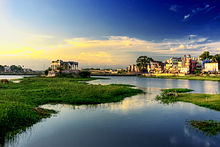
It was in River Kritamala. Kritamala is the name of River Vaigai, at Madurai Tamil Nadu India. So, it is reasonable to postulate that Vaigai, and consequently Madurai is as old as Manu!
https://www.google.com/amp/s/ramanisblog.in/2017/05/20/lemuria-the-home-of-tamils-my-tedtalk-at-coimbatore/amp/Based on Tectonic shift, Archeology and related evidence Ihad ,earlier,arrived at a figure of 230 million years for Lemuria of which Madurai was a part. It was Then Madurai then. Because of tectonic shift, it had moved to it’s present location. The present information in this article is Mind blogging. It is easy to dispose it off as Non sense. But evidence presented and the recent confirmation about the nature of Time as Non linear by Quantum would make one ponder.
More to follow.
This yuga cycle is called maha (in english, it means great/big) or divya (divine) yuga. One thousand such cycles forms one day of Brahma (a demigod in hindu religion which governs the universe). So one day of Brahma is 4.32 million * 1000 = 4.32 billion human years. Each such day of Brahma is called a “kalpa”. His night also constitutes 4.32 billion human years. During his day, life exists in universe. In nighttime, no form of life exists. So one complete day and night has 8.64 billion human years.
-> Age of Brahma is 100 years. Each year of Brahma has 360 days and same number of nights. Thus, total age of Brahma is 360 * 100 * 8.64 billion = 311,040 billion human years. i.e. 311.04 trillion years. This period is called “maha kalpa”. -> The life span of the universe is one “maha kalpa”. i.e. 311.04 trillion human years. This time span is also the duration of one breath of “Vishnu” (the ultimate god in hindu religion). When he exhales, thousands of universes emerges and one “Brahma” is born in each universe. When “Vishnu” inhales, all universes get sucked and Brahma dies. -> This cycle is non-ending and eternal. Thats why “Vishnu” is considered eternal in Vedic Science (or religion). How much old is our universe: -> Note that the period of Satya Yuga is 0.4x, Treta Yuga is 0.3x, Dwapara Yuga is 0.2x and Kali Yuga is 0.1x where x is the time-span of one maha-yuga cycle. I will use ‘x’ as 1 maha-yuga cycle subsequently. -> In 1 day of Brahma, there are 14 “manvantara”. Each “manvantara” is divided into 71 “maha-yuga” cycles. So total make 14*71 = 994x (mahayuga cycles). -> Remaining cycles (1 day of Brahma contains 1000 maha-yuga cycles) are used to fill gaps between manvantara. Before and after each manvantara (called as “sandhya” and “sandhyamsa” respectively), there is a junction of 1.728 million (age of Satya Yuga, or 0.4x) human years. Total number of junctions are 15 (since there are 14 manvantaras). So total gap period is = 0.4 * 15 = 6x. Hence total makes 1000 maha-yuga cycles or 1 brahma day. -> According to the Vedic texts, current age of Brahma is 50 Brahma years and 1 brahma day (we are in the 1st day of 2nd half of brahma)and we are in the seventh “manvantara”, in the 28th turnover of its 71 yuga cycles. In this cycle, we are in the start Kali Yuga. Age of kali yuga is not known perfectly but it is around 5000-10000 years. For calculation, lets assume 8000 human years. -> So current age of our universe (in terms of maha-yuga cycles) = (50 * 720 * 1000) — 50 years * (360 days + 360 nights) * total no. of cycles in one day/night + (6 * 71) — 6 manvantara each of 71 maha-yuga cycle + (7 * 0.4) — 7 junctions or gaps for 6 manvantara + (27 * 1) — we are in 28th cycle of 71 + (0.4+0.3+0.2) — In this cycle, we are in Kali Yuga. Satya Yuga, Treat Yuga and Dwapara yuga are 0.4x, 0.3x and 0.2x respectively. + around 8000 human years — very small, so ignoring it.
Thus total age = (36,000,000 + 456.7)x = 36,000,456.7 * 4.32 million = 155,521,972.944 million years = 155.521972944 trillion human years. Now add the age of kaliyuga. i.e. around 8000 human years. One we calculate the exact age of kaliyuga, we can know the exact age of universe.https://www.cs.ubc.ca/~goyal/age_of_universe.php
The effort to divide North and South continues even today. Though evidence from Sanskrit Ithihasas,Ramayana Mahabharata,Eighteen Puranas present a country called Bharatvarsha,though the Kings as is their wont were fighting against each others.
I have provided evidence from Sanskrit and Tamil literature to prove that Tamil and Sanatan Dharma were intricately connected,Tamil kings participated in Damayanthi,Sita, Draupadi Swayamvara;Vedas mention spices ,Elephant tusk, honey and kings from the South;Krishna married a Pandyan princess,had a daughter; Balarama visited South to have darshan of Lord Muruga, Madurai Meenakshi’s father took part in Mahabharata war;Perunchotru Udiyan Cheralaathan,A Chera King fed the Armies that took part in Mahabharata battle…
Cholas claim they are the descendants from Suryavansha.King Sibi, Ancestor of Rama ruled from his second capital from what is now in Northwest Pakistan.Cholas declare they belong to Kasyapa gotra.
I have written extensively on this.
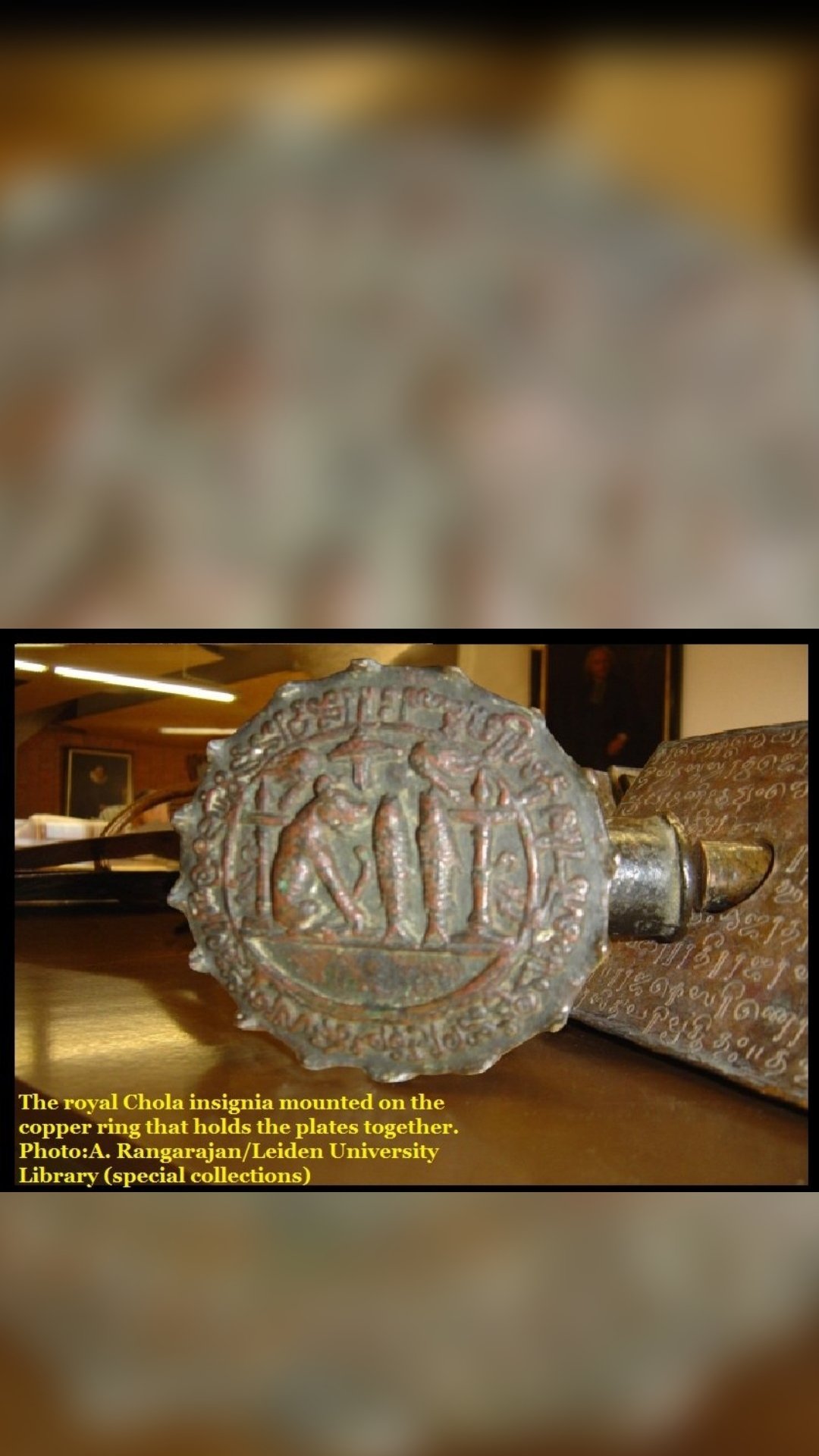
In this article I am providing information from Thiruvalangadu Copper plates Inscription where. Cholas provide their lineage from Ikshvaku Dynasty.
These Copper plates belong to the reign of Rajendra Chola,son of Rajaraja Chola who built the Thanjavur Big Temple.
Rajendra chola was a great king,had a large powerful Navy and conquered Malaysia and Far East He also built the temple in Gangaikonda cholapuram.
I am providing excerpts from Thiruvalangadu Copper plates .
‘The Sanskrit and Tamil portions of the Tiruvalangadu grant were written at different periods, as has been already pointed out by Mr. Venkayya,— the latter at the time to which the inscription refers itself and the former about at least a decade later. A detached inscription written in continuation of the Sanskrit portion on sheet Xa and continued on Xb, is stated by Mr. Venkayya to be a later addition.[5] It registers a grant made to the shrine of the goddess at Tiruvalangadu, perhaps contemporaneously with the grant of Palaiyanur to the temple of Mahadeva (Siva) of that place, but put into writing long after. The characters of the detached record are paleographically at least one or even two centuries later than the characters of the Palaiynaur grant and it is difficult to explain why a gift made to the shrine of the goddess in the 6th year of Rajendra-Chola I. must have been kept without being reduced to writing for such a long period. In this connexion it deserves to be noted that separate shrines of goddesses in Siva temples are, generally, of much later origin than the original Siva temples themselves and that in the stone inscriptions registered on the walls of the Tiruvalangadu temple the shrine of the goddess is referred to for the first time only in a record of the 10th year of Tribhuvana-chakravartin Rajadhiraja II., i.e., in A.D. 1173 – clearly 155 years after the date of the subjoined copper-plate grant
The tradition of the place Tiruvalangadu intimately connects it with Ammai or Karaikkal-Ammai, a great devotee of Siva who, under the orders of that god, put on a dreary emaciated appearance and worshipped his dancing form at Tiruvalangadu. The name Ammai-Nachchiyar which occurs in the detached inscription on plate XVI as a name of the goddess of the temple does not so appear in the stone records of Tiruvalangadu. No. 469 of the Madras Epigraphical Collection for 1905 calls her Periya-Nachchiyar; in another record her name occurs as Vandarkulal Nachchiyar (No. 497 of 1905), which is still current in its Sanskrit form Bhramaralakamba. The god himself is named Ammaiyappa in v. 129. He was perhaps so named on account of his being kind as a father to his devotee Ammai or Karaikkal-Ammai. Both the names Palaiyanur (or Palanai) and Tiruvalangadu occur in the Devaram hymns. In the hymn sung by Sundaramurti-Nayanar the goddess is referred to as Vandarkulali-Umainangai and the god himself as Palaiyanur-Amma. It is not impossible that in the names Ammaiyappan and Ammai-Nachchiyar, Amma is synonymous with the god Tiruvalangadu. The story of Karaikkal-Ammai is not referred to in the Devaram so called. But the eleventh Tirumurai of the sacred collection which describes the god, at Tiruvalangadu was the composition of Karaikkal-Ammai herself and the place of honour is given to it as muthathirupathigam.
The prasasti of the Chola family conveyed by the Sanskrit portion of the grant (vv. 1 to 137) consists of 271 lines and is mostly Puranic[6]. In verse 4 are introduced the sun and Manu, the latter of whom was produced from the Sun by concentration of mind. His son was Ikshvaku (v. 5) ; his son Vikukshi (v. 6) ; his son Puranjaya (v. 7) surnamed Kakutstha (v. 8) ; his son Kakshivat (v. 9) and his son Aryaman (v. 10). In this family was born Analapratapa (v. 11); in his family was born Vena; and his son born from the right arm was Prithu (vv. 12 and 13). In his familywas born Dhundhumara, so called on account of his having killed the demon Dhundhu (v. 14). In (his) family was born Yuvanasva (v. 15) ; his son was Mandhatri who ruled the earth as far as the Lokaloka mountain (v. 16) ; his son was muchukunda who, by killing the demon Kalayavana, pleased the god Mukunda, i.e., Vishnu (v. 17). In (his) family was born king Valabha[7] who founded the city of Valabhi (v. 18) ; his son was Prithulaksha who set the mountain Mandara whirling in the ocean for securing nectar (v. 19) ; his son was Parthivachudamani (v. 20). In (his) family was born Dirghabahu (v. 21) and then came Chandrajit[8] (v. 22); his son was Sankriti who became the emperior at the close of the Krita age (v. 23). In that family was born Panchapa (v. 24)[9] ; in his family was born Satyavrata who conquered Kasiraja, the king of Varanasi (i.e., Benares) (v. 25) and acquired the title Rudrajit (v. 26) by conquering Rudra in battle. In that family was born Sibi; an ornament of his family was king Marutta[10] who was an immediate predecessor of the Pandavas (vv. 27 and 28). In his family was born Dushyanta; his son was Bharata and his son was Chola after whose name the Solar race on this earth became known as Chola (v. 29) and who ruled the Chola country which was abundantly rich (v. 30). Cholavarman’s son was Rajakesarivarman and Rajakesarin’s son was Parakesarin (vv. 30 and 31). These two names were used as titles alternately by the Chola kings in the order of their coronation (v. 32). Parakesarin’s son was Chitraratha; his son was Chitrasva and his son, Chitradhanvan (v. 33). It is stated that this last king Chitradhanvan brought into his dominions the river Kaverakanyaka, i.e., Kaveri, just as Bhagiratha brought into the earth Ganga, the river of the gods (v. 35). In that family was born Suraguru entitled Mrityujit (v. 36). In his family was born Chitraratha who bore the title Vyaghraketu after his banner on which was the figure of a tiger. He also bore as an ornament on his head the flowers of the dhataki (v. 37).[11] His son was Narendrapati who became king at the end of the Treta age. His son was king Vasu entitled Uparichara on account of his having received a celestial car from Indra by which he moved about in all directions (v. 39). In his family was born Visvajit at the close of the dvapara age (v. 40). Thus verses 4 to 40 supply names of kings who ruled in the Krita, Treta and the Dvapara ages and as such can hardly be of any interest to the student of history, excepting perhaps the euponymous name Chola and the titles Rajakesarivarman and Parakesarin of the Treta age.
Coming to the rulers of the Kali age, the first king mentioned is Perunatkilli who was born in this same family and was highly learned (v. 41). In his race[12] was born Kalikala who renovated the town Kanchi with gold and established his fame by constructing flood-embankments for the river Kaveri. The poet explains the name Kalikala as ‘the god of Death (Kala)’ either to the Kali age or to the elephants (kari) of his enemies (v. 42). Evidently here, the tradition recorded in Tamil literature that the name Karikala ‘the burnt-leg’ was derived from an accident which happened to the king while yet he was a boy, was either not known or was purposely ignored by the eulogist. In that family was born Kochchengannan whose former birth as a spider and deep devotion to Siva are described in verse 43. The story of Kochchengannan is found in the Periyapuranam under the name Kochchengatchola-Nayanar. He is there stated to have been the son of Subhadeva and Kamalavati and to have constructed many Siva temples in the Chola country. The classic Tamil poem Kalavali, which is devoted to the history of his life, describes his defeat of the Chera king at Kalumalam.
In the family of Kochchengannan was born Vijayalaya who took possession of Tanchapuri (i.e., Tanjore) and there consecrated the goddess Nisumbhasudani (vv. 44 – 46). With Vijayalaya commences a regular genealogy of the Cholas whose capital was Tanjore. The earlier Cholas of literature whose traditional capital was Uraiyur and who preceded Vijayalaya must have been in a decadent condition serving in some subordinate capacity under the powerful Pallavas. A Telugu branch of them ruling perhaps independently over a small tract of country. His son Adityavarman conquered the Pallava king Aparajita in battle and took possession of his country (vv. 47 – 49). This was the Tondaimandalam which Aditya is known to have subdued.[13] His son Parantaka was a devotee of Siva. He drove the Pandya king into the sea and carried his conquests even into Simhala (Ceylon) (vv. 50-52). This explains the titles Madirai-konda and Maduraiyum-Ilamum-konda often found added to the name of Parantaka in inscriptions. This Parantaka is further stated to have built the golden hall called dabhrasabha (at Chidambaram) and thereby excelled Kubera, thefriend of Siva (v. 53). The larger Leyden plates, on the other hand, state that he only covered it with gold. His son Rajaditya defeated king Krishnaraja in battle and went to heaven (v. 54). The reference here is evidently to the battle of Takkolam[14] in which the Rashtrakuta king Krishna III. and his Ganga feudatory Butuga jointly defeated and killed Rajaditya who was fighting from the back of an elephant as stated in the Leyden grant. The summary way in which Rajaditya has been disposed of by the author of the Tiruvalangadu plates shows that probably he did not succeed to the throne, although the Leyden plates explicitly state that after the death of Parantaka, Rajaditya “ruled” the kingdom.[15] Rajaditya’s brother, Gandaraditya next became king (v. 54). The Leyden plates say of him that he produced a son called Madhurantaka and founded a town after his own name on the northern bank of the river Kaveri.[16] The next king mentioned is Arindama (v. 55) whose exact relationship to Gandaraditya is not specified. But it is known from the Leyden plates and from other inscriptions that Arindama (Arinjaya, Arinjiga or Arikulakesari) was the third son of Parantaka. His rule was evidently neither famous nor long. From the Melpadi inscription published at page 26f of this volume, we learn that Rajaraja I. erected the Siva temple called Arinjisvara (the modern Cholesvara) as a pallippadai (tomb-shrine) to his grandfather Arinjaya who was also known as Arrur-tunjinadeva. Arrur where Arinjaya appears to have died must be distinct from Tondaiman-Arrur where Aditya I. is stated to have died (Madras Epigraphical Report for 1907, page 71, paragraphs 29 and 30). Then came Sundara-Chola or Sundara-Chola Parantaka (II.) who was very famous. Five verses (56 to 60) are devoted to his praise. Of Sundara-Chola the Leyden plates state that at a place called Chevura he fought a great battle and caused rivers of blood to flow. This Sundara-Chola’s son was Arunmolivarma (vv. 61-63). After the death of Sundara-Chola (v. 64) his wife Vanavan-Mahadevi is stated to have abandoned her people and followed her husband to heaven (vv. 65 and 66). His son Aditya next ruled the earth, killed the Pandya king in battle and placed his head high up as a pillar of victory in his capital (vv. 67 and 68). This Pandya king is stated in the Leyden plates to be Vira-Pandya. We also learn from the same plates that Aditya II. had the other name Karikala. Immediately after the death of Aditya, Arunmolivarman (called Rajaraja in the Leyden grant) was requested by his subjects to succeed to the throne but he desired it not while his paternal uncle still coveted his dominions (v. 69). This statement which indicates a probable dispute about the succession to the throne immediately after Aditya-Karikala (II.) is not referred to in the Leyden plates. These latter state that Madhurantaka, the son of Gandaraditya, succeeded straightway after the death of Aditya. Perhaps we have to give credence to the information furnished in the Tiruvalangadu plates and accept that while by right the succession was Rajaraja’s, he voluntarily permitted his uncle Madhurantaka to rule the kingdom, on the understanding that he would himself he chosen for the office of the heir-apparent (v. 70). Madhurantaka ruled the kingdom virtuously as a pious devotee of Siva (v. 71). After Madurantaka, Arunmolivarman was installed in the administration of the kingdom amidst the rejoicings of his people (v. 72). His digvijaya or the conquest of the quarters and the tulabhara i.e., ‘weighing oneself against gold’ are mentioned in verses 74 and 75. The conquest of the quarters began with the south (v. 76). Rajaraja conquered first the Pandya (king) Amarabhujangawhile his commandant (dandanatha) captured the impregnable fortress of Vilinda whose moat was the sea (vv. 78 and 79) The latter officer also crossed the ocean by ships and destroyed the lord of Lanka (Ceylon) (v. 80). Arunmolivarman’s ocean-like army next defeated Satyasrya who fled away to avoid misery. “Being produced to Tail (oil) this (slipping away) was but natural in him” (v. 81) saysthe poet , thereby indicating that Satyasraya who was defeated by Rajaraja was the son of Tail II. He also killed the faultless Andhra king Bhima for the mere reasons that the latter had killed by a powerful club a certain Rajaraja, his namesakeke, who was an expert in war (v. 82). This statement makes it clear that Rajaraja unnecessarily interfered in the politics of the Andhra country, by killing a king called Bhima. This Bhima and the Rajaraja killed by him have not been identified. Rajaraja next conquered the [Kerala] country which was the creation of Rama (i.e., Parasurama) and also subdued in battle successively the Ganga, Kalinga, Vanga, Magadha, Aratta, Odda, Saurashtraka, Chalukya, and other kings (v. 81). This list of Rajaraja’s conquests, though by no means impossible, is yet exaggerated when it includes names like those of Magadha and Saurashtraka. According to the Leyden plates Rajaraja I was known by the title Rajasraya. Rajaraja’s son was Madhurantaka (v. 85) who backed up by a powerful army turned his attention to the conquest of the quarters (digvijaya) (v. 89). This king called Uttama-Chola (II.) started to the south as usual[17] with a desire to conquer the Pandya king (v. 90). The commander of his forces (dandanatha) so struck the Pandya that the latter ran away from the land of Agastya and sought refuge in the Malaya hill (v. 91). After taking possession of many a pure lustrous pearl of the Pandya king (v. 92), Madhurantaka placed there his own son Chola-Pandya for the protection of the Pandya country and started westward (v. 93). For the first time in its history, Kerala, which was impregnable and unconquered, was entirely annihilated (vv. 94 to 97). The king after this returned to his capital and started afresh for the conquest of the north (v. 98), having again appointed his son Chola-Pandya[18] to protect the western country (v. 99). Rajendra-Chola entered Kanchi (i.e., Conjeeveram) in his march against Jayasimha of the Tail family, the lord of the Chalukyas[19] (vv. 99-100). He thoroughly routed him and his forces, thereby causing the ladies of the Ratta kingdom to shed tears[20] (vv. 101-107). Rajendra-Chola returned again to his capital (v. 108). With the idea of bringing the river Ganga into his own country through the strength of his arm he ordered his commander[21] to subdue the kings occupying the banks of that river (vv. 109-110). From v. 113 it is inferred that Rajendra-Chola also held the title Vikrama-Chola. The first king conquered was Indraratha of the Lunar race (v. 114); next, Ranasura was robbed of his prosperity and then Dharmapala. The commander of the Chola army reached the Ganga and got the most sacred water of that river carried to his master Madhurantaka (vv. 116-117). Meantime Rajendra Chola himself reached the river Godavari to meet his able General who had just brought the water of the Ganges, after having defeated Mahipala on the way (vv. 118-119). Here, Rajendra-Chola is stated to have killed the wicked king of Odda and to have accepted as tribute from the surviving claimant, many rutting elephants[22] (v. 120). His next campaign was against Kataha (v. 123). He then constructed in his capital the tank called Cholagangam which was composed of the waters of the Ganga river, and established it there as a memorial pillar of his victory (v. 124). The conquests of Rajendra-Chola are mostly recorded in the historical introductions to his Tamil inscriptions dated from and after the 13th year of his reign.[23] It may here be noted that the Tamil introduction given in lines 131 to 142 below is naturally the shorter one, since it belongs to the 6th year of the king’s reign ; and since it does not include a list of all conquests mentioned above, it has been suggested that the Sanskrit portion of the grant which includes the conquests of the later years must be a subsequent addition.https://googleads.g.doubleclick.net/pagead/ads?client=ca-pub-2137364728838345&output=html&h=250&slotname=6325448717&adk=3007479896&adf=2600224992&w=300&lmt=1506580324&psa=0&guci=2.2.0.0.2.2.0.0&format=300×250&url=https%3A%2F%2Fwww.whatisindia.com%2Finscriptions%2Fsouth_indian_inscriptions%2Fvolume_3%2Fno_205_aditya_ii_karikala.html&flash=0&wgl=1&adsid=ChAI8NSu-QUQsO-A1JmQnLMFEjsAndZOYA_9oqlvxFUxRA7cqQ_JTAgegP2QAo85US6p–swMq3bOrafAvM3Dq3TLD0ve8aIvXgOhxP_rA&dt=1596777723454&bpp=7&bdt=685&idt=172&shv=r20200803&cbv=r20190131&ptt=9&saldr=aa&abxe=1&cookie=ID%3Dcbbe4a7b732d7dbf%3AT%3D1596776454%3AS%3DALNI_MZiYFGbzM4uc1J7Xmn2ePgskSeUyQ&prev_fmts=728×90&correlator=1165038271063&frm=20&pv=1&ga_vid=1596251553.1596776457&ga_sid=1596777724&ga_hid=257832054&ga_fc=0&iag=0&icsg=2239146&dssz=18&mdo=0&mso=0&u_tz=330&u_his=3&u_java=0&u_h=813&u_w=375&u_ah=813&u_aw=375&u_cd=24&u_nplug=0&u_nmime=0&adx=668&ady=3374&biw=980&bih=1782&scr_x=0&scr_y=708&eid=42530558%2C42530560%2C21066125%2C21066819%2C21066973&oid=3&pvsid=373936515875853&pem=13&ref=https%3A%2F%2Fwww.google.com%2F&rx=0&eae=0&fc=896&brdim=0%2C0%2C0%2C0%2C375%2C0%2C375%2C682%2C979%2C1782&vis=1&rsz=d%7Cd%7CEebr%7Cn&abl=XS&pfx=0&fu=8192&bc=31&jar=2020-08-07-02&ifi=2&uci=a!2&btvi=1&fsb=1&xpc=mEIJOnzsbP&p=https%3A//www.whatisindia.com&dtd=184
Being encamped at Mudigondasolapuram, king Madurantaka deputed his minister Janatha, the son of rama, in the 6th year of his reign, to grant the village of Palaiyura to the temple of Siva [at Tiruvalangadu] (v. 125). This Jananatha is stated to have been a minister of Madhurantaka and a crest jewel of the Chalukyas (v. 127). The village Puranagrama, (i.e., Palaiyura quoted above), which was granted to the god Siva named Ammaiyappa, was the ornament of the province of Jayangonda-Chola-mandalam and was situated in the district Paschatyagiri[24] (vv. 128-129). It was also called Tiruvalangadu and was bounded on three sides by Simhalantaka-chaturvedimangalama and on the fourth by Nityavinoda-chaturvedimangalam (vv. 130-131). The srimukha or the royal order conveying the grant was written by Uttamasola-Tamiladaraiyan. Tirukkalatti Pichchan made the request (vijnapti) on behalf of the temple and Araneri, son of Mayana, a native of Mangalavayil and of the fourth caste, did the business of taking round the female elephant (karinibhramana), etc., under orders of Jananatha (vv. 132-135). The learned poet Narayana, son of Sankara and a devotee of Vishnu, composed the grant (v. 136). Tirukkalatti Pichchan and Araneri, sons of Mayana, do not appear in the Tamil portion of the grant described below. Jananatha of the Sanskrit portion is identical with Narakkan Marayan Janathan alias Rajendrasola-Brahmadhirajan who together with three other officers of the king issued the order to execute the grant of Palaiyanur to the Siva temple of Tiruvalangadu. Uttamasola-Tamiladaraiyan is identical with Narayanan-karrali alias Uttamasola-Tamiladaraiyan mentioned in 1. 276 of the Tamil portion.
Information relating to Indian history,often dismissed as Myths,gain acceptance of they are furnished by Western sources. Such information is quoted by me so that people might understand that Indian history is not a myth ,but fact as described in Puranas, Ithihasas Ramayana and Mahabharata and Tamil Classics like Sangam literature.
Information found in Hindu temples are also a source of information as the Sthala Puranas. One can find Epigraphs in Temples which describe the date of construction of the temple,who built it,what grants were allotted bt the kings,details of festivals,family tree of the Kings…Sthalapurana is the history of the place where the temple is,reason for the name of the town/village,the background of the Deities in the temples. During my research of Ramayana and Mahabharata,I have found the Sthala Puranas not contradicting these Ithihasas in anyway,though ,at the first instance the Sthala Puranas might seem to be incredible. If one studies the Ithihasas and the so called Legends,one would no contradiction.
There are two such instances that I am presenting here.
Madurai, Tamil Nadu is reported to have been the home of Tamils from antiquity.Tamil Poets’ Conclave(Tamil Sangam) was held here , according to Tamil Sangam Classics.Madurai was where the Third Tamil Sangam was held,the first at Thenmadurai,the second at Kaparapuram and the Third at Madurai. Madurai is associated with Tamil ,Siva,Murugan,Vishnu as Azhagar and of course Devi Meenakshi, incarnation of Parvati.
Her spouse was none other than Lord Shiva Himself.Her father Sarangadwaja,aka Malayathdwaja Pandian participated in the Mahabharata war,on the side of Pandavas. I have written on this with reference from Mahabharata.
Meenakshi ruled Pandya Kingdom from Madurai. The kingdom was run by women.There is a saying in Tamil about who decides in a family’. It is customary to ask whether your home is Chidambaram or Madurai. Chidambaram is where Lord Nataraja rules,while Madurai by Meenakshi.It is also recorded that the Madurai Kingdom was run so well it was nearly a Republic!
Greek Historian Pliny mentions tha Madurai was ruled by Pandya and the Kingdom was A Republic run by Women.
Mahavamsa refers to this fact and it dates the period between 43 and 29 BC.
There is another women ruler of Madurai,casked Allirani. She was married to Arjuna of Mahabharata and haf a son Babruvahana.She also ran Madurai as a Women Kingdom.She was an Amazonian Queen.Allirani is reported to have ruled from Madurai according Tamil Classics. But,Sri Lankan records show she ruled from Kudiraimalai,Gulf of Mannar.This is also recorded on some Tamil Texts and by Greek writers.
The issue here is the location,Madurai or Kudiraimalai.I am searching for clinching evidence.
But what about the reference of women Pandya Kingdom ?
According to the Vishnu Purana and Harivamsa, Kalayavana was the son of a Brahmin named Ganga, and a Yavana princess. This legend appears to indicate an invasion from across the Himalayas, meaning one of the Central Asian, Middle Eastern or Ancient Greek provinces. After the invasion by combined forces of Jarasandha of Magadha, Kalayavan and their grand alliance, Krishna departed to build the city of Dvārakā amidst sea, transported all his people and left them there.
The legend goes like this: Lord Shri Krishna to save humanity from the evils of an yet another imminent battle with mighty Jarasandha flees Mathura [hence another name of Krishna, Ran-Chod Rai, one who fled war field] and moves his kingdom to newly builtDwarka. Kalayavan, who stood by Jarasandha chases Shri Krishna to Dwarka. Pretending to flee yet again from war field, Shri Krishna lures Kalayavana into the cave where the great king of Treta yuga, Muchukunda, one of the forefathers of Lord ShriRama was in a deep slumber of thousands of years after helping devas in an epic war with Asuras. Contemplating an absolutely undisturbed sleep he was given a boon that anyone who dared to disturb his sleep would get burnt to ashes immediately. Fast forward to Dwapara yuga, in the darkness deep inside the cave, Kalayavan mistakenly wakes up Muchukunda from his sleep, and sure to Muchukunda’s powers Kalayavan was decimated into ashes instantaneously with a fiery glance. And then Muchukunda was delighted to see Lord Shri Krisha there, who was none other than Lord Vishnu. Sri Krishna advises him to perform Tapas to cleanse the accumulated sins to attain Moksha (liberation). After meeting with lord, Muchukunda sets out of the cave. And the story narrates that he is astonished to see that all creatures had shrunken in size over time while he rested in cave, indicating long ages gone by. Muchukunda then goes north to Gandamadana Mountain and from there to Badrikashrama for doing penance and finally achieves liberation, the Moksha.
Kalayavana means a Black Greek/from Middle east.
Yavana is a term used from the Vedic times to denote Greeks,people from the middle east.
References to Yavana is found in ancient Tamil Literature , Vishnu Purana,HariVamsa and Silappadikarm in Tamil.
India imported horses from these areas and exported silk, Muslin,Diamonds, Emeralds ,Spices,Tigers, Elephants.
‘Experts say in the Edicts of Ashoka (c. 250 BCE) especially In the Gandhari Rock XIII : Antiochus is referred as “Amtiyoko nama Yona-raja” (lit. “The Greek king by the name of Antiochus”), beyond whom live the four other kings: “param ca tena Atiyokena cature 4 rajani Turamaye nama Amtikini nama Maka nama Alikasudaro nama” (lit. “And beyond Antiochus, four kings by the name of Ptolemy, the name of Antigonos, the name of Magas, the name Alexander”).
Dipavamsa , Mahavamsa and Sasanvamsa
Buddhist texts such as the Dipavamsa, Mahavamsa and the Sasanavamsa reveal that after the Third Buddhist Council, the elder (thera) Mahárakkhita was sent to the Yona country and he preached Dharma among the Yonas and the Kambojas.
Milindapanha
Another example is that of the Milinda Panha , where “Yonaka” is used to refer to king Menanders (160–135 BCE ) guards.
Mahabharata
The Vanaparava of Mahabharata contains verses in the form of prophecy complaining that “……Mlechha (barbaric) kings of the Shakas, Yavanas, Kambojas, Bahlikas etc. shall rule the earth (i.e India) un-righteously in Kaliyuga…” . This reference apparently alludes to chaotic political scenario following the collapse of dharmic dynasties in northern India and its subsequent occupation by non-dharmic hordes of the Yavanas, Kambojas, Sakas and Pahlavas etc.
Others
other Indian records describe the Yavana attacks on Saketa, Panchala, Mathura and Pataliputra, probably against the Sunga empire, and possibly in defense of Buddhism. The main mentions of the invasion are those by Patanjali around 150 BCE, and of the Yuga Purana, which, like the Mahabharata, also describes Indian historical events in the form of a prophecy:
Yavana in other cultures.
Egyptians used the word j-w-n(-n)-’
Assyrians used the word Iawanu
Persians used the word Yauna or Yavanu
Sri Lankans – used the word Yona in Mahawamsa and other historic texts.
In Biblical writings, the word was Yāvān (and still is, in modern Israeli Hebrew – יוון)
In Arabic and Turkish it is Yunan See Also Sanskrit Yoni
The history of Greece can be traced back to Stone Age hunters. Later came early farmers and thecivilizations of the Minoan and Mycenaean kings. This was followed by a period of wars and invasions, known as the Dark Ages. In about 1100 BC, a people called the Dorians invaded from the north and spread down the west coast. In the period from 500-336 BC Greece was divided into small city states, each of which consisted of a city and its surrounding countryside.
There were only a few historians in the time of Ancient Greece. Three major ancient historians, were able to record their time of Ancient Greek history, that include Herodotus, known as the ‘Father of History’ who travelled to many ancient historic sites at the time, Thucydides andXenophon.
Most other forms of History knowledge and accountability of the ancient Greeks we know is because of temples, sculpture, pottery, artefacts and other archaeological findings.
According to historians and archeological findings, the Neolithic Age in Greece lasted from 6800 to 3200 BC. The most domesticated settlements were in Near East of Greece. They traveled mainly due to overpopulation. These people introduced pottery and animal husbandry in Greece. They may as well have traveled via the route of Black sea into Thrace, which then further leads to Macedonia, Thessaly, Boeotia etc. The second way of traveling into Greece is from one island to another and such type of colonies has been found in Knossos and Kythnos..( http://www.ancientgreece.com/s/History/ )
There are attempts to distort history by saying that the term Yavana was derived from Ionia and that the term was not is use when the term was Yavana was coined.
Yavana is a name coined by the Vedic people with specific meaning and has no reference to Ionia for Ionia was named much later to the Vedic/Tamil Sangam period.
Obviously they could not have derived the term from Ionia.
To say that there was no Greek History then, is distortion of Facts s may be evidenced from the quote above.
Note that the predecessors to Greek civilistion,like the Minoans, were influenced by the Vedic civilization and Indian kings were ruling Minoans and there is also the Tamil connection.
You must be logged in to post a comment.