Tag: Ramayana

  • From Where Did The Brahmins Come?

    One of the most controversial topics is whether the Aryans invaded India and later settled here and if so from where did they come from?

    I have already posted a blog .The Myth called Aryan Invasion’

    The scientific research proves that there is no Aryan Invasion at all.

    I will be adding some more points to disprove this Myth and before that there are some questions to be answered ,the questions arising out of Ramayana.

    Rama and the others ; hailing from the Northerner part of India and if the Ramayana is a fact,which it is( I have posts on this under Hinduism),Lord Rama and others should have been fair-skinned,

    But the description of Rama is Blue Black.

    This is based on the conception of Lord Vishnu as Black in color.while Lakshmi is Golden (Hiranya varnaam(Sri Suktham), Lord Shiva of Reddish Hue,Parvati of greenish hue, as per the Purana.

    But based on geographical origin and the present people living in North India Rama should have been fair-skinned.

    We have two options.

    1.Ramayana was a fiction.

    This is incorrect as the Astronomical data provided in the Ramayana and other Purana stand the test of Science.

    Ramayana is a fact.

    So we are left with the other option that there have been other skinned people in India before Ramayana and there has been an a mix of various groups having different racial characteristics.

    Lord Rama could have been an exception as far as color is concerned.

    Others in the Ramayana were not of the same hue as Rama.

    Sita was fair-skinned.

    Against this Ravana was not described as dark-skinned and he is the brother of Kubera who is fair-skinned and Ravana is a Brahmin though he is described as a Dravidian!

    Therefore logic forces one to conclude that there were more races in India than one homogeneous Race in India which included Sri Lanka.

    Again if one refers to any of the Eighteen Purana, one would find descriptions of people both black and fair-skinned.

    And not all Brahmins were fair-skinned.

    For example, Aurava and you can find Brahmins of Dark hue in South India.

    The Indian Society expanded outwards, not from outwards.

    This is why one finds remnants of Hindu Thoughts in all the continents more specifically Egypt, central America , Australia and the Middle East.

    The early Indian Society was based on disposition, Varna, Brahmanas, Kshatriya , Vaishya and Sudras.

    Therefore the Brahmins did not come from any where to India and were a part of India Society.

    There is a school of thought which establishes that the Dravidian were living South of the Vindhya range and later they mixed with the people from the South.

    Sage Viswamitra banished his sons to the South and they intermingled with the Dravidians.

    Sage Apasthamba came from this mixed race and he composed the Apasthamba Sutra of the Vedas and it is being followed by the Brahmins of South India even today.

    Some more objections to Aryan Invasion of India.

    1) If the ‘light skinned and mostly blonde haired and blue eyed’ Aryans had really invaded India and settled here thereafter, then why are such people with pure Caucasian features rarely found in India now? If it is because of centuries of racial intermixing, then how come one can still find some quite dark skinned people in India but not central Asian/ European type ‘white’ skinned people in India? Even the light brown skinned people found in the far north of India in places like Kashmir aren’t as fair as the ‘Aryans’ are considered to be.

    2) The Aryans divided themselves into 3 classes. The fourth class was the lowly ‘Shudra’ class, explained by the European historians as the Aryan conquered Dravidians’ class. By this logic, all the high castes, esp. the Brahmins had to be white/ light brown skinned and the people belonging to the ‘Shudra’ class had to be dark brown skinned. And yet, many dark skinned Brahmins and light skinned ‘Shudras‘ can easily be found in India – both in north as well as south. And upon that, inter-caste marriages, esp. high and low caste ones, are still uncommon in almost all parts of India. Another point regarding castes is that – Valmiki, the writer of the great Indian epic ‘Ramayana’, was born a Shudra, but ultimately, by attaining the Brahminical aspect of knowledge earning, spiritual understanding and noble mannerisms, became a Brahmin. ‘Ramayana’ is the story (does not matter if it was factual or myth) of a Kshtriya (Aryan) prince of North India – Lord Rama, who at the climax of the story defeats and kills the demonic king of Sri Lanka (south of India) – Ravana. Now, even though Ravana was a Brahmin (Aryan) by caste, he is considered, in the Indian spiritual folklore, as an UnArya or a non-Aryan, on account of his demonic deeds. This all suggests that caste system, originally, was not rigid, and that, ‘Aryan’ was an open, attainable socio-spiritual status.

    3) How come almost all the light brown skinned people in India (considered to be the descedants of the original Aryans) belong to the cold climate locations of India like Kashmir and Himachal and the dark brown skinned (considered to be the Dravidians themselves) belong to the warm climate locations? This suggests that skin colour in India has more do do with the climate and atmosphere of a particular region in India.

    4) If the Aryans were outsiders in India, then why do their spiritual-cultural-social compilation ‘The Vedas’ do not mention any outside cities, rivers and mountains? Why do they only mention the places that are found in India, as their sacred most? Why not some place in Caucasus or Iran? Why don’t the Vedas, which contain references to many battles, contain no reference to an ‘invasion’ of the land of Indus-Saraswati (India)? How come the modern descendants of Aryans in India have no recollection of their foreign origins? How come the descendants of Shudras (so called Dasas or Dasyus or Dravidians or indigenous race of India) have no recollection of an Aryan invasion of their land and their subsequent subjugation because of a defeat at the hands of the Aryans?

    5) If the Dravidians’ Indus valley civilization met its end at the hands of the invading Aryans, then how come no horse remains, broken chariots and burned buildings were discovered in and around the valley.

    Source:

    http://wiki.answers.com/Q/How_did_the_aryans_get_to_India

    Motto of Brahmins
  • Atomic Explosion Mahabharata Harappa Evidence.

    That the ancient Hindus were adept at modern technologies is evident for any one who can read Sanskrit and the Ithihasa and Puranas.

    You can Hear the Audio towards the close of the posts.

    Indians had described Test Tube Babies, vide description of the birth of the 100 Kauravas(Mahabharata) and Thuchchalai,Sage Agasthya< Mandhadha(Vishnu Purana)

    Of Heavenly Vechicle in The Ramayana (Ravana’s Pushpaka Viman), Arjuna’s Chariot given by Agni , when Arjuna burnt Gandeepa Vana,Mahbharata.

    Narcotic Bombs in the Ramayana when Indrajit used it on Lakshmana(Mohanstra)

    Atom bomb explosions are described when talking about the effects of Brahmastra.

    Neutron Bomb in Pasupataastra.

    Another weapon Narayanastra,used by Aswathama after the Mahbharata War, we can not understand this.

    Atomic explosion.

    About ancient atomic explosions Oppenheimer stated that “In ancient India, we find words for certain measurements of length, one was the distance of light-years and one was the length of the atom. Only a society that possessed nuclear energy would have the need for such words.”..

    Historian Kisai Mohan Ganguli says that Indian sacred writings are full of such descriptions which sound like an atomic blast as experienced in Hiroshima and Nagasaki. He says references mention fighting sky chariots and final weapons. An ancient battle is described in the Drona Parva, a section of Mahabharata. “The passage tells of combat where explosions of final weapons decimate entire armies, causing crowds of warriors with steeds and elephants and weapons to be carried away as if they were dry leaves of trees,” says Ganguli.

    Consider these verses from the ancient epic Mahabharata,

    ““A single projectile charged with all the power of the universe. An incandescent column of smoke and flame as bright as the thousand suns rose in its entire splendor. A perpendicular explosion with its billowing smoke clouds. The cloud of smoke rising after its explosion formed into expanding round circles like the opening of giant parasols. It was unknown weapon, an ironic thunderbolt, A gigantic messenger of death, which reduced to ashes.

    The Devastating Power of a Nuclear Bomb.

    Entire race of the Virshins and the Andhakas were destroyed. The corpses were so burned as to be unrecognizable. The hair and nails fell out, pottery broke without apparent cause,And the birds turned white. After a few hours all foodstuffs were infected. To escape from this fire the soldiers threw themselves in streams to wash themselves and their equipment.” Until the bombing of Hiroshima and Nagasaki, modern mankind could not imagine any weapon as horrible and devastating as those described in ancient Indian texts. Yet they very accurately described the effects of atomic explosion which is not possible unless they have experienced a similar one those days. Radioactive poisoning will make hair and nails fall out. Immersing oneself in water gives some respite, though it is not a cure.

    Excavations at Harappa.

    Other evidences were obtained during the excavations at Harappa and Mohenjo-Daro. These excavations discovered skeletons scattered about the cities, many holding hands and sprawling in streets as if some instant, horrible doom had taken place. People were just lying, unburied, in the streets of the city. Excavations down to the street level revealed 44 scattered skeletons, as if doom had come so suddenly they could not get to their houses. All the skeletons were flattened to the ground. A father, mother and child were found flattered in the street, face down and still holding hands. And these skeletons are thousands of years old, even by traditional archaeological standards. What could cause such a thing? Why did the bodies get decay or eaten by wild animals? Furthermore, there is no apparent cause of physically violent death.

    These skeletons are among the most radioactive ever found on par with those at Hiroshima and Nagasaki.

    Another curious sign of an ancient nuclear war in India is a giant crater near Bombay. The nearly circular 2,154-metre-diameter Lonar crater, located 400 kilometres northeast of Bombay and aged at less than 50,000 years old, could be related to nuclear warfare of antiquity.

     
    Giant Unexplained Crater Near Bombay

    No trace of any meteoric material, etc., has been found at the site or in the vicinity, and this is the world’s only known “impact” crater in basalt. Indications of great shock (from a pressure exceeding 600,000 atmospheres) and intense, abrupt heat (indicated by basalt glass spherules) can be ascertained from the site. David Hatcher Childress in Nexus Magazine:

    Crater near Bombay.
    Unexplained Crater near Mumbai

    “The crater is formed in the basalt rock of thickness 600-700m (2,000 to 2,200 feet). This rock is made of many layers or flows which were laid why volcanic activity at various times, five of such flows are exposed at the crater rim. Thickness of these flows ranges from 5 to 30m.

    The crater is about 150m (500 feet)deep and has average diameter of 1830m (1.4 miles). The elevated rim consists of 25m of bedrock and 5m of ejecta over it. This ejecta blanket is spread over about 1350m (4,400 feet) away from the crater rim and slopes away by 2-6°. The uppermost region of ejecta contains the deposits that were melted due to the impact”.


    “Lonar is a place of obscurities, especially as the only meteoric crater formed in basaltic terrain. It has remained relatively intact due to low degree of erosion by environmental agents, making it an excellent model for study. However, several strange things happen here:

    1. The lake has two distinct regions that never mix — an outer neutral (pH7) and an inner alkaline (pH11) each with its own flora and fauna. You can actually do a litmus paper test here and check this for yourself.

    2. There is a perennial stream feeding the lake with water but there seems to be no apparent outlet for the lake’s water. And it is also a big unsolved mystery where the water for the perennial stream comes from, in a relatively dry region like Buldhana. Even in the driest months of May and June, the stream is perpetually flowing. Lonar generates questions and more questions”. Lilyn Kamath

    The total number of skeletons found at the main site of Mohenjo-Daro, during the initial archeological digging during 1922-1931, was, just 37. Let me quote Prof. G.F.Dales from his “The Mythical Massacre at Mohenjo-Daro“. (He was of course debunking the myth of Aryan invasion, much to the joy of Hindu apologists).

    Nine years of extensive excavations at Mohenjo-daro (1922-31) – a city of three miles in circuit – yielded the total of some 37 skeletons, or parts thereof, that can be attributed with some certainty to the period of the Indus civilizations. Some of these were found in contorted positions and that suggest anything but orderly burials. Many are either disarticulated or incomplete….Where are the burned fortresses, the arrow heads, weapons, pieces of armor, the smashed chariots and bodies of the invaders and defenders? Despite the extensive excavations at the largest Harappan sites, there is not a single bit of evidence that can be brought forth as unconditional proof of an armed conquest and the destruction on the supposed scale of the Aryan Invasion.

    Later excavation unearthed more skeletal remains in other Indus valley ruins like HarappaDholaviraLothal etc., which numbered, more than 300. [I am not sure of the exact number.]

    Source:

    http://twitscope.wordpress.com/2008/07/12/evidence-of-nuclear-explosion-in-ancient-india/

    http://veda.wikidot.com/ancient-city-found-in-india-irradiated-from-atomic-blast


    Ramanisblog

    Multi Lingual Blog English Tamil Kannada Hindi Indian History Verified Vedic Thoughts Hinduism around The World Tamils History

  • Details Of Army Strength Mahabharata

    Some interesting information on the strength and the calculation of the Armies during the Vedic period is found in the Mahabharata.

    Mahabharata War.
    Mahabharata War.

    There is also the definition of the unit of distance.

    The Unit for measuring distance is called ‘Yojana’

    One Yojana  is equal to Eight Miles.

    Army strength is  calculated on the base Unit of Akshouhini.

    One Akshouhini consists of ,

    One Chariot,

    One Elephant,

    Three Cavalry

    and Five soldiers constitute One Pathi.

    Three Pathis make one ‘Sena Mukha’

    Three Senamukha is ‘Kulma

    Three Kulma make One ‘Gana.

    Three gans is One ‘Vahini’

    Three Vahinis is One Brudhanai”

    Three Brudhanis is one ‘Samu’

    Three Samus is one ‘Anaakini’

    Ten Anaakinis make one  Akshouhini.

    The Total forces in one Akshouhini is,

    Chariots 21, 870,

    Elephants 21870,

    Cavalry 65,610,

    Soldiers 109350

    The Pandavas had Seven Akshouhinis and the Kauravas Eleven.

    Only ten people survived the Mahabharata War.

    Pandavas, Seven,

    Pandavas Five, Krishna, Sathyaki.

    Kauravas Three,

    Aswathama, Krupar,Krutha Varma.

    Source.

    The Mahabharata By Vyasa, Parva Sangraha of Adi Parva.

    Anugrahmanika Parvam of Adi Parva.

  • Lord Rama’s Death Precedes Krishna’s By 200 Years!

    Interesting observation ,I found, in ancient voice.

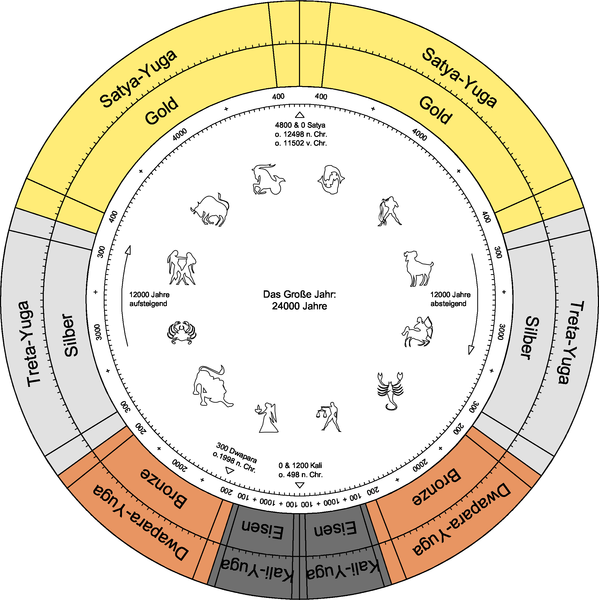
    Yugas of Hindus.
    The concept of Time, Yugas

    All of us know that the Ramayana took place in Treta Yuga while Lord Krishna lived in the Dwapara Yuga, which was after 8.64,000 years after Treta Yuga .

    Yet cross indexing the various Purans and the Astrological data supported by actual Astronomical phenomena like Rama‘s Birth chart,Eclipses during Ramayana and Mahabharata  forces one to the conclusion that Lord Rama’s Death preceded Lord Krishna’s  only by 200 years.

    Time, Hinduism's Concept.
    Time Scale, Hinduism

    This, I think, is not a contradiction .

    The reason is that for the Hindus the Time is Cyclic , not linear.(read my post on this under Astrophysics)

    That Time is Cyclic is being proved to-day by Astrophysics and Quantum Theory.(refer my posts under Astrophysics).

    To put it simply events, Ramayana and Mahabharata not excluded happened , happen and will happen all at the same time,albeit at different planes of existence(read my posts under Science, Astrophysics,Hinduism- Multiverses).

    Science is veering down to this view now.

    And Astronomical events keep recurring at fixed time scales.

    Therefore, this seeming contradiction in the Dates of Ramayana and Mahabharata.

    Check out at the Link provided.

    1. Interestingly enough, the death of Rama precedes the death of Krishna by 200 years, if we consider that Rama died at the age of 70 and Krishna at the age of 80. Not a normal age of death, if we consider that many ancient men like Bhishma (lived close to 95 to 105 years) and Vyasa (lived around 120 years) were long lived. This 200 years is also the duration of the Dwapara Yuga.
    2. Arjuna‘s grandfather’s grandfather viz. Pratipa was 20 years old when Rama died.
    3. Nala lived in Kali Yuga and was a contemporary of Arjuna‘s grandson’s great-grandson Aswamedhadatta.
    4. Kalmashapada (Saudasa) was a contemporary of Rama’s sons Lava and Kusha.
    5. Anaranya was a contemporary of Rama’s grandfather Aja
    6. Hiranya Kasipu and the first Indra were contemporaries.
    7. Prahlada and Vaivaswata Manu were contemporaries.
    8. Pururavas and the great Daitya king Mahabali were contemporaries.
    9. Vitahavya and Divodasa of the Ikshwaku line and Bharata of Puru line were contemporaries. They ruled along with Avikshit whose birth marks the beginning of Treta Yuga.
    10. Pratarddana of Ikshwaku line and Bhumanyu of Bharata line were contemporaries
    11. Sagara of Ikshwaku line and Suhotra of Bharata line were contemporaries
    12. Dilipa of Ikshwaku line and Hasti of Bharata’s line who founded the city of Hastinapura were contemporaries
    13. Ikshwaku king Raghu and Bhagiratha were contemporaries.
    14. Tapati, the wife of Samvarana (of Bharata line) probably married the daughter of an Ikshwaku king (described as Surya) in the south who was a contemporary of Raghu ruling at Ayodhya. Samvarana’s son was the famous Kuru the founder of Kuru dynasty.
    15. The Ikshwaku kings Aja and Muchukunda were contemporaries
    16. King Kuru who established his rule at Kurukshetra was a contemporary of Rama’s grandfather Aja
    17. The Kurukshetra war hero Vrihadvala and his father Suvala, brother Sakuni and sister Gandhari were all descendants of Rama’s brother Bharata.
    18. Rituparna, the friend of Nala was a descendant of Rama or his brothers
    19. Nala (and his brother Pushkara) was a descendant of Krishna
    20. Kali was a descendant of Sakuni
    21. Karkotaka the enemy-turned-friend of Nala was a descendant of Takshaka who killed Arjuna’s grandson Parikshit
    22. Vaisampayana narrated ‘Bharata’ to Janamejaya 75 years after Sanjaya narrated ‘Jaya’ to Dhritarashtra.
    23. Ugrasrava Sauti narrated Mahabharata to Saunaka, 55 years after Vaisampayana narrated ‘Bharata’ to Janamejaya
    24. The crucial formative period of Mahabharata was thus 130 years. It grew even after that with additions to Santi Parva, Anusasana Parva and Vana Parva and also with minor modifications and additions to other Parvas as well.
    25. The same Valmiki, who was an elder contemporary of Rama authored the first two versions of Ramayana. The first version was completed soon after Rama returned to Ayodhya after killing Ravana. The second version was created after Sita was banished from Ayodhya and reached Valmiki’s hermitage. The third version was created after the death of Rama, probably by some descendant of the original Valmiki. Ramayana underwent several modifications which continued even after Mahabharata grew into Sauti-Saunaka dialog.
    26. Source: http://ancientvoice.wikidot.com/article:thousand-year-long-chatur-yuga#toc9

  • Lesser Known Facts Of The Mahabharata

    Lord Ganesh writes the Mahabharata.
    Lord Ganesh writes the Mahabharata.

    Some basic information and lesser known facts of The Mahabharata.

    1.The Mahabharata was written by Sri Krishna Dwaipayaana, popularly know as Veda Vyasa.

    Vyasa is the name given to Krishna Dwaipayayana after he compiled The Vedas.

    The term means one who compose excellently.

    Vyasa is considered to be an Avatar of Vishnu.

    Vyasa is the Great Grand son on of sage Vasista, who fixed the auspicious date for Lord Rama‘s Coronation and who was instrumental in making Kausika as Viswamitra who gave the world the Gayathri mantra.

    * Ramayana is reported to have happened in the Treta Yuga while the Mahabharata was in Dwapara Yuga.

    Please read my posts on Time, a Non Linear Theory filed under Astrophysics to know more about Indian view of Time

    Vyasa is the Grandson of Sakti and son of Parasara.

    Vyaya is the father of Suka Mahrishi and the father of Dhrutarastra, Pandu and Vidura.

    ‘Vyasam Vasishta Napthaaram Sakthe Pouthre kalmasham.

    Parasarthmajam Vande Sukadhaaatham Thaponidhim-Vishnu Sahasranama.

    2.Vyasa did not write or imagine it,.

    He dictated it to Lord Ganesh as it is being revealed to him by the Grace of Lord Brahma.

    There is an interesting anecdote on this(Adi Parva, Anugramani Parva)

    Vyasa , on being revealed the Mahabharata was aghast at the sheer numbers and incidents he had to narrate.

    He prayed Lord Ganesh and requested Him to write as  he dictates.

    Lord Ganesh agreed on the condition that Vyasa should never pause while dictating.

    Vyasa made a counter condition that Ganapahy must not write any thing without understanding the full import of what Vyasa dictates.

    Ganesh agreed.

    Such was the erudition of Vysa and the content of the Mahabharata ,Ganapati had to pause at places to understand the meaning and in the interregnum Vyasa had time to compose further mentally!

    If the Mahabharata is a lie or imagination, it is not humanly possible to lie consistently in 100, 000 slokas.

    That too you have at least five instances of the narration of the entire Mahabharata in the first Parva,Adi Parva  itself when the story of Mahabharata has not begun.

    Ask any writer, he will tell you how tough it is .

    And the Mahabharata  has innumerable  sub-stories, which are individually authenticated elsewhere, other than the Mahabharata.

    Time is considered Cyclic by the Hindus.

    Put it simply the Mahabharata has happened before, in happening, and shall happen in future.

    Hence one will find the references in the Mahabharata  sub-stories , which were reported to have happened before the reference to the Mahabharata itself.

    A separate post on this follows.

    3. Vyasa wrote two versions, one is the Bharata Charitra and another is The Mahabharata which is popular.

    4.Vyasa wrote The Mahabharata with sub-stoiries in 100, 000 slokas for Mankind,

    He also wrote it in 24, 000 slokas without the substories.

    He wrote again  in a compact form containing 150  slokas,

    This is called the Anugramanigathya and is in the First Parva.

    4.Vyasa released further editions of the Mahabharata.

    One for the Deva Loka with 300000 slokas.

    Another for Pithr Loka with 150000.

    With 1400000  for the Rakshasas and Yakshas and 100,00 for humanity,.

    5.The term Bharata means the narration of the Dynasty of Bharata.

    Maha means huge, big, heavy.

    The Mahabharata was weighed on a scale against the Vedas.

    The scale containing the Bharata was down and heavy.

    Therefore the Bharata is called the Mahabharata.

    It is also called the fifth Veda as it contains the practical application of the Truth of the Vedas and expands the concepts of the Vedas.

    6. Mahabharta  contains 18 Parvas or mega Chapters.

    These chapters contain many chapters as well.

    For more read the original.

    More posts to follow.