Tag: Partition of India

  • Constitution of India, Is it Legal for Independent India?

    Constitution of India, Is it Legal for Independent India?

    I wanted to check the discussions that took place in Indian Parliament while passing the resolution on the Constitution of India. All of us are aware of the skeletal facts, That a Constituent Assembly was formed consisting of eminent members and it was Ambedkar who with great effort and scholarship formed the Constitution and he is called the Father of Indian Constitution.But facts seem to be a little different.

    This article is a bit long. Please bear with me and read it in full. This contains mostly quotes from Discussion in The Constituent Assembly sourced from Parliamentary Records.You would find many surprises.
    A character in Frederick Forsyth’s book Dogs Of War days’ Stealing a Republic is the Greatest prize of all ‘ Now I understand the import fully.

    Questions and Answers.

    • Q.Was the Constituent Formed before or After India became Independent?
    • A.Before Independence,in 1946; Independence for India , August 15,1947.
    • Q.The Members of the Constituent Assembly,were they elected directly by the people of India?
    • A.No.The members of the Constituent Assembly were elected by the provincial assemblies by a single, transferable-vote system of proportional representation.
    • Q Was the Constituent Assembly truly representative of the People of India?
    • A.The Assembly was not elected on the basis of universal adult suffrage, and Muslims and Sikhs received special representation as minorities. The Muslim League boycotted the Assembly after failing to prevent its creation. Although a large part of the Constituent Assembly was drawn from the Congress Party in a one-party environment, the Congress Party included a wide diversity of opinions—from conservative industrialists to radical Marxists, to Hindu revivalists..Congress party , condescendingly , arbitrarily nominated members..
    • Q.Did India become Independent or British Power was transferred to Congress Party?
    • A.It was Tranfer of Power from the British.

    The Constitution of India was drafted by Members of a Committee called Constituent Assembly Committe.

    Constitution of India.

    Shri Damodar Swarup Seth (United Provinces: General):*[Mr. President, with your permission I want to place this amendment before the House:

         “Whereas the present Constituent Assembly was not elected on the basis of adult franchise and whereas the final constitution of free India should be based on the will of the entire people of India, this Constituent Assembly resolves that while it should continue to function as Parliament of the Indian Union, necessary arrangements should be made for convening a new Constituent Assembly to be elected on the basis of adult franchise and that the Draft Constitution prepared by the Drafting Committee be placed before it for its consideration and adoption with such amendments as it may deem necessary.”

         Sir, before speaking on this amendment I deem it necessary to point out that I had given notice of a separate resolution to the effect that the consideration of the Draft Constitution should for the time be postponed. But unfortunately for some reason that resolution of mine has not been admitted. Therefore I have no option but to move an amendment for the same purpose as the resolution.

         Sir, yesterday when Maulana Hasrat Mohani Sahib moved his amendment, it was with regret that I noted that some honourable members of this House were mocking at it and were in a way playing with it.].

    Shri S. Nagappa (Madras: General): Mr. President, I would like to know from the honourable member who is moving this motion whether, when he was elected to this august body, he did not recognise this as a sovereign body competent to act as the Constituent Assembly? It not why did he agree to become a member? (Laughter.)

         Mr. President: That is not a point of order.

         Shri S. Nagappa: I would like to know whether he is in order in saying that this body is not a Constituent Assembly and that a new Assembly should be constituted on the basis of adult franchise.

         Mr. President: He is in order in moving his motion. (Renewed laughter)

         Shri Damodar Swarup Seth: *[Sir, I was saying that it is easy to ridicule a resolution or amendment or to ridicule the views of its supporters but it requires some courage to understand the reality and to appreciate it. I am afraid that this amendment of mine may displease some of my friends. But everyone has a duty to perform. It is the duty of every man unhesitatingly and fearlessly to give expression to the voice of his conscience and nature before his fellow beings regardless of the consequences that may follow or of the opinion people may form about him and this because I believe, Sir, that in the lives of nations as in the lives of individuals also there is sometimes a situation in which they have to swallow the bitterest pill. I think that the consideration of the Draft Constitution has brought such an occasion in our country and therefore we need not worry about our views being welcome or unwelcome to one person or the other. We have to perform out duty. I shall at first try to throw light on the representative character of this Constituent Assembly which is assembled here and which is going to consider the Draft Constitution and to pass it….Sir, the first characteristic which a constitution-making body of a free country should possess is that it should be able to claim that it represents the will of the entire people of that country. Sir, with your permission I would put it to the Honourable Members present in this House whether they can sincerely claim that they represent, in this House, the entire people of India. I can emphatically say that this House cannot claim to represent the whole country. At the most it can claim to represent that fifteen per cent of the population of India who had elected the members to the provincial legislatures. The election too, by virtue of which the members of this House are here, was not a direct one, they are here by virtue of an indirect election. In these circumstances, when eighty-five percent of the people of the country are not represented in this House and when they have no voice here, it will be in my opinion a very great mistake to say that this House is competent to frame a Constitution for the whole country. Besides the representative character of the Draft Constitution that is being placed before the house, we have also to consider its nature. We see that the Constitutions of United States of America and Britain have been copied in this Constitution. Some articles have been borrowed from the Constitutions of Ireland, Australia and Canada. A paper has rightly remarked that this is a slavish imitation of the Constitutions of these countries. Sir, the conditions that prevailed in America, Britain, Canada or Australia do not obtain in our country. The conditions prevalent in our country can be compared only with those of Russia – Russia of pre-Soviet Republic days. Besides, we have seven lakh villages in our country and the village is its smallest unit. Thanks to Mahatma Gandhi, our struggle of freedom reached the villages and it was because of the villages and because of their might that India became free…..Read more CONSTITUENT ASSEMBLY OF INDIA DEBATES (PROCEEDINGS)-  VOLUME VII. Friday, the 5th November 1948

    An idea for a Constituent Assembly was proposed in 1934 by M. N. Roy, a pioneer of the Communist movement in India and an advocate of radical democracy. It became an official demand of the Indian National Congress in 1935,The Indian National Congress held its session at Lucknow in April 1936 presided by Pt. Jawahar Lal Nehru. The official demand for Constituent Assembly was raised and Government of India Act, 1935 was rejected as it imposed the Constitution which was against the will of the Indians. C. Rajagopalachari voiced the demand for a Constituent Assembly on 15 November 1939 based on adult franchise, and was accepted by the British in August 1940.……

    On 8 August 1940, a statement was made by Viceroy Lord Linlithgow about the expansion of the Governor-General’s Executive Council and the establishment of a War Advisory Council. This offer, known as the August Offer, included giving full weight to minority opinions and allowing Indians to draft their own constitution. Under the Cabinet Mission Plan of 1946, elections were held for the first time for the Constituent Assembly. The Constitution of India was drafted by the Constituent Assembly, and it was implemented under the Cabinet Mission Plan on 16 May 1946. The members of the Constituent Assembly were elected by the provincial assemblies by a single, transferable-vote system of proportional representation. The total membership of the Constituent Assembly was 389 of which 292 were representatives of the provinces, 93 represented the princely states and four were from the chief commissioner provinces of Delhi, Ajmer-Merwara, Coorg and British Baluchistan.

    The elections for the 296 seats assigned to the British Indian provinces were completed by August 1946. Congress won 208 seats, and the Muslim League 73. After this election, the Muslim League refused to cooperate with the Congress and the political situation deteriorated. Hindu-Muslim riots began, and the Muslim League demanded a separate constituent assembly for Muslims in India. On 3 June 1947 Lord Mountbatten, the last British Governor-General of India, announced his intention to scrap the Cabinet Mission Plan; this culminated in the Indian Independence Act 1947 and the separate nations of India and Pakistan. The Indian Independence Act was passed on 18 July 1947 and, although it was earlier declared that India would become independent in June 1948, this event led to independence on 15 August 1947. The Constituent Assembly met for the first time on 9 December 1946, reassembling on 14 August 1947 as a sovereign body and successor to the British parliament’s authority in India…The Constituent Assembly of India, consisting of indirectly elected representatives, was established to draft a constitution for India (including the now-separate countries of Pakistan and Bangladesh). It existed for approx. three years, the first parliament of India after independence in 1947. The Assembly was not elected on the basis of universal adult suffrage, and Muslims and Sikhs received special representation as minorities. The Muslim League boycotted the Assembly after failing to prevent its creation. Although a large part of the Constituent Assembly was drawn from the Congress Party in a one-party environment, the Congress Party included a wide diversity of opinions—from conservative industrialists to radical Marxists, to Hindu revivalists. .At 11 am on 9 December 1946 the Assembly began its first session, with 211 members attending. By early 1947, representatives of the Muslim League and princely states joined, and the Assembly approved the draft constitution on 26 November 1949. On 26 January 1950 the constitution took effect (commemorated as Republic Day), and the Constituent Assembly became the Provisional Parliament of India (continuing until after the first elections under the new constitution in 1952)….

    29 August 1947: Drafting Committee appointed with B. R. Ambedkar as its Chairman. The other six members of committee were Munshi, Muhammed Sadulla, Alladi Krishnaswamy Iyer, N. Gopalaswami Ayyangar, Khaitan and Mitter. 16 July 1948: Along with Harendra Coomar Mookerjee, V. T. Krishnamachari was also elected as second vice-president of Constituent Assembly. 26 November 1949: The Constitution of India was passed and adopted by the assembly. Source.https://en.m.wikipedia.org/wiki/Constitution_of_Indiahttps://en.m.wikipedia.org/wiki/Constitution_of_India

    The constitution has been, in more recent times, critiqued on the basis of the fact that the members of the Constituent Assembly were chosen not by universal suffrage, but rather, they were predominantly members of the Congress party.[citation needed] It has been argued that the Congress party aimed not to overthrow British power, but rather transfer its power into Indian hands.[citation needed] In his book The Constitution of India: Miracle, Surrender, Hope,Rajeev Dhavan has argued that the Indian people did not have much say in the making of the Constitution which was they had no choice but to accept…https://en.m.wikipedia.org/wiki/Constituent_Assembly_of_India

    ,

    Join 4,576 other subscribers
  • Edwina Nehru Love Special Sweet, Will be Tactful Help- Mountbatten.

    Edwina Nehru Love Special Sweet, Will be Tactful Help- Mountbatten.

    Though it may not be polite to write about the personal affairs of a Public figure, I am compelled to write on Nehru as he more or less ran India as his fiefdom and his heirs till about Seven years ago, though elected democratically, were ruling, I repeat Ruling India. He was / is being described as to give the impression that he alone,along with Gandhi was responsible for India attaining independence.He is touted as a great literatuer, a visionary and a man who projected India as a modern power to the world.Excepting the fact that he was the man who gave priority to Industry,many would say at the cost of Agriculture, I do not see anything he has done more that a Prime Minister ought to have done.His much touted foreign policy satisfied his ego and India was considered as a vassal of the British among the comity of Nations.

    Instead getting independence for India, he accepted the Dominion status .Though he was furious initially for the Mountbatten Plan of dividing India and Pakistan as Dominions,he agreed to it because Edwina Mountbatten wife of Mountbatten are him agree to the plan .So it becomes necessary to find out how influential was Edwina in determining the fate of India and the kind of relationship she had with Nehru with the full knowledge and connivance of her husband Mountbatten and his family, including his daughter! So the motivation behind the acts Nehru and his relationships are to be made public as his actions had affected the fate of a Country.

    India Remembered is an inside account of the events leading up to Indian Independence released on its 60th anniversary. It is authored by a Mountbatten, the family that played such a pivotal role in the attainment of Independence and the paroxysms of Partition. Pamela Mountbatten, daughter of Lord Mountbatten, the last Viceroy of India, was 17 when she arrived in India in 1947 with her parents, who immediately plunged into hectic negotiations with Indian leaders in the desperate race to meet the deadline of August 15. She spent 15 months in what is now Rashtrapati Bhawan with a front row seat to history-in-themaking. This book is culled from the diaries she kept as well as those of her parents. There is also a foreword by India Hicks, Pamela’s daughter, who adds her own experience of the country she was named after.

    Citation towards the close of the post.
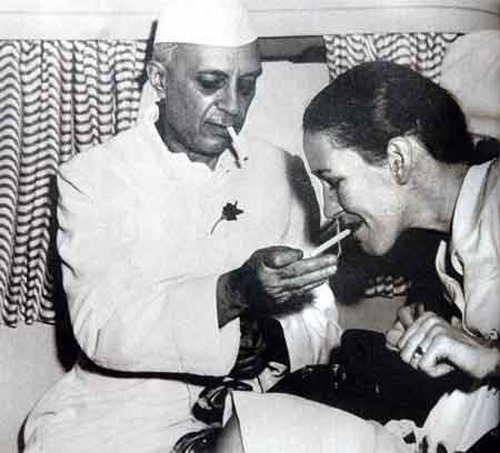
    • My mother had already had lovers. My father was inured to it. It broke his heart the first time, but it was somehow different with Nehru. He wrote to my sister in June 1948: ‘She and Jawaharlal are so sweet together… Pammy and I are doing everything we can to be tactful and help….’ So there existed a happy three-some based on firm understanding on all sides.
    • The relationship remained platonic but it was a deep love. And although it was not physical, it was no less binding for that. It would last until death. They met about twice a year. She would include a visit to India in her overseas tours on behalf of the St John Ambulance Brigade and the Save the Children Fund…. Panditji would come to London for the Commonwealth Prime Ministers’ conferences. He would always come down to Broadlands, our house in Hampshire, for a weekend. We kept a little grey mare for him so that he could come out riding with us.
    • My mother was on an overseas tour in 1960… when her heart gave out and she died in her sleep aged fifty-eight. A packet of letters from Panditji was found by her bedside. In her will she left the whole collection of letters to my father. A suitcase was crammed full of them. My father was almost certain that there would be nothing in the letters to wound him. However, a tiny doubt caused him to ask me to read the letters first. I was happy to be able to reassure him. They were remarkable letters, but contained nothing to hurt him.
    • Source..

    https://www.indiatoday.in/magazine/society-the-arts/story/20070709-india-remembered-by-lady-pamela-mountbatten-748220-2007-07-09

  • Sardar Vallabhbhai Patel Suppressed History of India

    I&B have uploaded excellent Videos of Inspiring Speeches,Music and rare documentaries of the Independence Struggle in YouTube .

    Some:

    Sardar Vallabhbhai Patel’s Speech delivered on 12th February 1949

    Sardar Vallabahbhai Patel, the Iron Man of India is in fact the Architect of Modern India.

    Like Rajaji(C.Rajagopalachari0 was a Statesman, who did not bother popularity.

    He did what was Right was for the Country and obviously not popular as he did not play to the Gallery.

    He was a Man who called Nehru wrong when Nehru was wrong when none was prepared to point it out scared of the charisma of Nehru.

    My dear Jawaharlal,

    Ever since my return from Ahmedabad and after the cabinet meeting the same day which I had to attend at practically fifteen minutes’ notice and for which I regret I was not able to read all the papers, I have been anxiously thinking over the problem of Tibet and I thought I should share with you what is passing through my mind.

    I have carefully gone through the correspondence between the External Affairs Ministry and our Ambassador in Peking and through him the Chinese Government. I have tried to peruse this correspondence as favourably to our Ambassador and the Chinese Government as possible, but I regret to say that neither of them comes out well as a result of this study. The Chinese Government has tried to delude us by professions of peaceful intention. My own feeling is that at a crucial period they managed to instill into our Ambassador a false sense of confidence in their so-called desire to settle the Tibetan problem by peaceful means. There can be no doubt that during the period covered by this correspondence the Chinese must have been concentrating for an onslaught on Tibet. The final action of the Chinese, in my judgement, is little short of perfidy. The tragedy of it is that the Tibetans put faith in us; they chose to be guided by us; and we have been unable to get them out of the meshes of Chinese diplomacy or Chinese malevolence. From the latest position, it appears that we shall not be able to rescue the Dalai Lama. Our Ambassador has been at great pains to find an explanation or justification for Chinese policy and actions. As the External Affairs Ministry remarked in one of their telegrams, there was a lack of firmness and unnecessary apology in one or two representations that he made to the Chinese Government on our behalf. It is impossible to imagine any sensible person believing in the so-called threat to China from Anglo-American machinations in Tibet. Therefore, if the Chinese put faith in this, they must have distrusted us so completely as to have taken us as tools or stooges of Anglo-American diplomacy or strategy. This feeling, if genuinely entertained by the Chinese in spite of your direct approaches to them, indicates that even though we regard ourselves as the friends of China, the Chinese do not regard us as their friends. With the Communist mentality of “whoever is not with them being against them”, this is a significant pointer, of which we have to take due note. During the last several months, outside the Russian camp, we have practically been alone in championing the cause of Chinese entry into UN and in securing from the Americans assurances on the question of Formosa. We have done everything we could to assuage Chinese feelings, to allay its apprehensions and to defend its legitimate claims in our discussions and correspondence with America and Britain and in the UN. Inspite of this, China is not convinced about our disinterestedness; it continues to regard us with suspicion and the whole psychology is one, at least outwardly, of scepticism perhaps mixed with a little hostility. I doubt if we can go any further than we have done already to convince China of our good intentions, friendliness and goodwill. In Peking we have an Ambassador who is eminently suitable for putting across the friendly point of view. Even he seems to have failed to convert the Chinese. Their last telegram to us is an act of gross discourtesy not only in the summary way it disposes of our protest against the entry of Chinese forces into Tibet but also in the wild insinuation that our attitude is determined by foreign influences. It looks as though it is not a friend speaking in that language but a potential enemy.”

    Nehru paid for his folly when China invaded India in 1962 and Nehru died a disillusioned Man.

    Liberation Of Hyderabad from The Nizam.(Daily pioneer)-How Vindictive was Nehru?

    Sardar Vallabhbhai Patel, the then Deputy Prime Minister and Home Minister of India, whose 137th birth anniversary is on October 31, was insulted, humiliated and disgraced by the then Prime Minister, Pandit Jawaharlal Nehru, during a Cabinet meeting. “You are a complete communalist and I’ll never be a party to your suggestions and proposals,” Nehru shouted at Patel during a crucial Cabinet meeting to discuss the liberation of Hyderabad by the Army from the tyranny of the Razakkars, the then Nizam’s private army.

    Sardar Patel
    Sardar Vallabhbhai Patel

    “A shocked Sardar Patel collected his papers from the table and slowly walked out of the Cabinet room. That was the last time Patel attended a Cabinet meeting. He also stopped speaking to Nehru since then,” writes MKK Nair, a 1947 batch IAS officer, in his memoirs “With No Ill Feeling to Anybody”. Nair had close ties with both Sardar and VP Menon, his Man Friday.
    Though Nair has not written the exact date of the above mentioned Cabinet meeting, it could have happened during the weeks prior to the liberation of Hyderabad by the Indian Army. Operation Polo, the mission to liberate Hyderabad from the Nizam, began on September 13, 1948 and culminated on September 18. While Sardar Patel wanted direct military action to liberate Hyderabad from the rape and mayhem perpetrated by the 2,00,000 Razakars, Nehru preferred the United  Nations route.
    Nair writes that Nehru’s personal hatred for Sardar Patel came out in the open on December 15, 1950, the day the Sardar breathed his last in Bombay (now Mumbai). “Immediately after he got the news about Sardar Patel’s death, Nehru sent two notes to the Ministry of States. The notes reached VP Menon, the then Secretary to the Ministry. In one of the notes, Nehru had asked Menon to send the official Cadillac car used by Sardar Patel to the former’s office. The second note was shocking. Nehru wanted government secretaries desirous of attending Sardar Patel’s last rites to do so at their own personal expenses.

    Foresight in accepting Partition

    But the greatest of his foresights was shown by the way he dealt with the crisis created by Muslim League after it entered the Interim Government on 25th October 1946. He was the first to realize that the League had created a vertical divide in the entire governmental machinery on a communal basis, up from a Member (Minister) down to the lowest peon. There was a virtual inter-Departmental (the term Ministry was used only after Independence) war on the Raisina Hill. The League was making a determined attempt to demonstrate that Hindus and Muslims could not work together, to strengthen the notion that partition of the country was unavoidable. In fact, the League had already, in a way, created several Pakistans on Indian soil, if one looked at the working of the Departments of Finance, Industry, Health, Posts & Air, which were under League Members; Liaqat Ali, the Finance Member, presented the Finance Bill (Central Budget) of 1947 to the Central Assembly without showing it in advance to Nehru, who was the leader of the Interim Government.

    “How can the country be governed in such a divided way, now and in future?” Patel is reported to have wondered. Nehru was angry with the League, but it was Patel whose prescience helped him and the country to realize the inevitability of the Partition. It was neither defeatism nor a hurry to capture power, as has been imputed to both of them in subsequent years. It was nothing short of foresight and wisdom which Poet Tulsi Das had advocated in the 16th century in this famous verse: “Budh ardh tajain, lukh sarvasa jata” (the wise give up half when they see the whole is going).(dadinani.com)(PC Modi)

    Patel was intensely loyal to Gandhi and both he and Nehru looked to him to arbitrate disputes. However, Nehru and Patel sparred over national issues. When Nehru asserted control over Kashmir policy, Patel objected to Nehru’s sidelining his home ministry’s officials.[63] Nehru was offended by Patel’s decision-making regarding the states’ integration, having neither consulted him nor the cabinet. Patel asked Gandhi to relieve him of his obligation to serve, knowing that he lacked Nehru’s youth and popularity. He believed that an open political battle would hurt India. After much personal deliberation and contrary to Patel’s prediction, Gandhi on 30 January 1948 told Patel not to leave the government. A free India, according to Gandhi, needed both Patel and Nehru. Patel was the last man to privately talk with Gandhi, who was assassinated just minutes after Patel’s departure.[64] At Gandhi’s wake, Nehru and Patel embraced each other and addressed the nation together. Patel gave solace to many associates and friends and immediately moved to forestall any possible violence.[65] Within two months of Gandhi’s death, Patel suffered a major heart attack; the timely action of his daughter, his secretary and nurse saved Patel’s life. Speaking later, Patel attributed the attack to the “grief bottled up” due to Gandhi’s death.[66]

    Criticism arose from the media and other politicians that Patel’s home ministry had failed to protect Gandhi. Emotionally exhausted, Patel tendered a letter of resignation, offering to leave the government. Patel’s secretary persuaded him to withhold the letter, seeing it as fodder for Patel’s political enemies and political conflict in India.[67] However, Nehru sent Patel a letter dismissing any question of personal differences and his desire for Patel’s ouster. He reminded Patel of their 30-year partnership in the freedom struggle and asserted that after Gandhi’s death, it was especially wrong for them to quarrel. Nehru, Rajagopalachari and other Congressmen publicly defended Patel. Moved, Patel publicly endorsed Nehru’s leadership and refuted any suggestion of discord. Patel publicly dispelled any notion that he sought to be prime minister.[67] Though the two committed themselves to joint leadership and non-interference in Congress party affairs, they would criticise each other in matters of policy, clashing on the issues of Hyderabad’s integration and UN mediation in Kashmir. Nehru declined Patel’s counsel on sending assistance to Tibet after its 1950 invasion by the People’s Republic of China and ejecting the Portuguese from Goa by military force.[68]

    When Nehru pressured Dr. Rajendra Prasad to decline a nomination to become the first President of India in 1950 in favour of Rajagopalachari, he thus angered the party, which felt Nehru was attempting to impose his will. Nehru sought Patel’s help in winning the party over, but Patel declined and Prasad was duly elected. Nehru opposed the 1950 Congress presidential candidatePurushottam Das Tandon, a conservative Hindu leader, endorsing Jivatram Kripalani instead and threatening to resign if Tandon was elected. Patel rejected Nehru’s views and endorsed Tandon in Gujarat, where Kripalani received not one vote despite hailing from that state himself.[69] Patel believed Nehru had to understand that his will was not law with the Congress, but he personally discouraged Nehru from resigning after the latter felt that the party had no confidence in him.[70](Wiki)

    http://www.friendsoftibet.org/main/sardar.html

    Enhanced by Zemanta