Tag: Om

  • Athmalinga In Body Sadhasiva Pranava Form Thirumandhiram

    Athmalinga In Body Sadhasiva Pranava Form Thirumandhiram

    Siva means Auspiciousness. Siva worship in the South preceded the worship of Siva in Vedas. Details of Siva , in comparison with Siva in North India, is quite exhaustive in the South.The Avatars Siva are detailed as 64 in the South in ancient Tamil literature. The concept of Self Realisation, God, in the Saiva Siddhandha is the same as in Vedic Thought. The principles explained in Saiva Siddhandha are more detailed , 64 , though the Advaitic Non Dualism is the core. Nirguna Upasna is detailed as also Saguna Aradhana. Saguna Aradhana is centred around Siva. The basic principles are Pasu, Pathi and Paasam. This corresponds to Jivatma( Pasu) Paramatma ( Brahman, Pathi) and Maya(Paasam)

    One of the earliest and authentic works on Saiva Siddhandha is Thirumandhiram by Thirumoolar.Here one can get a detailed account of Saiva Siddhandha and also the essence of Yoga.

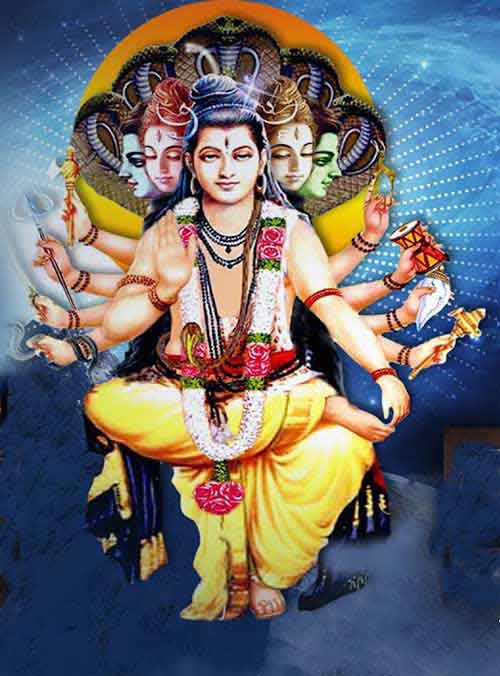
    Siva, as in Vedic Thought is expressed as Sabda Brahman in the Form of Five Aksharas ந ம சி வா ய. These Five letters are the same as Na Ma Si VA ya in Sanskrit.The pronounciation is the same with the same time taken , Matra.Siva ,as in Vedic Thought, is portrayed in Sthoola Rupa, in Gross , as Saguna with Five faces.

    As Nirguna Siva is expressed as Pathi and He manifests in Human Body too.Siva remains as Sound, Nadha Brahma, Pranava As Brahman. This is Subtle.This is experienced by chanting of Pranava OM.Si VA ya can also be chanted but it’s Chanting is different from chanting OM, though the results are the Same,Siva.

    This Sookshma Siva Manifests in Human Body when Om is chanted. OM, ஓம், Tamil ancient texts slightly differ in explaining OM, in that they say that when one pronounces A, அ,and உ , U mouth remains open and when you close the mouth ம்,M sound rises. Note that A and U are a part of OM in Vedic Thought too. There the explanation is that A U and M constitute Pranava,OM and that A rises from the mouth U from Throat and M from the pit of the stomach. These are the only places from where sounds originates in Human body.This is the Primordial sound and the basis of all spoken words.

    In Tamil Thoughts, Thirumandhiram By Thirumoolar,Saiva Siddhandha, A அ represents Siva and U, உ represents Sakthi.

    When these two Aksharas( letters) are intoned,OM is completed and Siva and Sakthi together rise as Sadhasiva in the Subtle Level in Human Experience. And This Experience is Athma Linga.Itcis also expressed as Siva is expressed as Sakthi and Siva in Humans as U and A respectively உ அ.

    One visuvalises this in the Gross Form as Siva with Five Faces.

    அகார முதலாய் அனைத்துமாய் நிற்கும்,

    உகார முதலாய் உயிர்ப்பெய்து நிற்கும்,

    அகார உகாரம் இரண்டும் அறியில்,

    அகாரம் உகாரம் இலிங்கம் அதாமே” Thirumandhiram 1753

  • SUN Hums OM Scientific Study

    The Universe, which includes us, Is, because of vibrations and Sound.

    interstellar Sound recorded
    interstellar Sound


    It is constantly in Motion and motion creates sound( or is it the other way around?)

    And apart from the above facts mentioned by Hindu Texts, they also mention that what is is in the Macrocosm is in the Microcosm, that is what is found in the biggest objects in the Universe is also found in the minutest things/organisms in the Universe.

    Universe is made of Five elements,Earth, Water,Fire, Air and Ether(Aakasa)

    the sun god Surya in Hinduism
    Surya, son God

    So are we.

    What happens in the Universe also happens in/to us.

    The Vibration of the Universe is recorded.

    I have written on on OM , the sacred Mantra of Hindus, which can be chanted by any one, how it originates in the Human Body, how the breath of Earth is identical to OM ., and how Om throws up the image of Sri Yantra, a practice of worshiping through geometric shapes, on  screen when used by a tonoscope.

    The sound generated by Sun is OM.

    Watch the video.


    Our Sun lies 93,000,000 miles away, surrounded by the vacuum of space. Sound won’t travel through space, of course. But with the right instrument, scientists can “hear” pulsations from the Sun.

    The entire Sun vibrates from a complex pattern of acoustical waves, much like a bell. If your eyes were sharp enough, you could see a bell’s surface jiggle in complex patterns as the waves bounced around within it.

    Likewise, astronomers at Stanford University can record acoustical pressure waves in the Sun by carefully tracking movements on the Sun’s surface. To do this, they use an instrument called a Michelson Doppler Imager (MDI), mounted on the SOHO spacecraft, circling the Sun 1,000,000 miles from Earth.

    The Sun’s acoustical waves bounce from one side of the Sun to the other in about two hours, causing the Sun’s surface to oscillate, or wiggle up and down. Because these sound waves travel underneath the Sun’s surface, they are influenced by conditions inside the Sun. So scientists can use the oscillations to learn more about how the structure of the Sun’s interior shapes its surface.

    The Sun’s sound waves are normally at frequencies too low for the human ear to hear. To be able to hear them, the scientists sped up the waves 42,000 times — and compressed 40 days of vibrations into a few seconds. What you’ll be hearing are just a few dozen of the 10 million resonances echoing inside the Sun.

    Studying the Sun Through Its Sounds Waves (NY Times)

     Listen To the Sun’s Song These solar sounds were generated from 40 days of SOHO/MDI data and processed by A. Kosovichev

    Reference. and citation.

    http://solar-center.stanford.edu/singing/

    http://www.noao.edu/education/ighelio/solar_music.html

  • Five Types Of Shiva Name Panchakshara

    Mantras contain sounds grasped from Ether by the Rishis, Sages.

    These sounds in the written form are called Aksharas.

    Lord Shiva seated.jpg
    Lord Shiva seated in Yoga Posture

    This corresponds to Alphabets, yet more than Alphabets.

    The specialty in Sanskrit is that  the term Akshara means limitless, A+Kshara.

    Sound is limitless.

    Five letters of Shiva.
    The Five letters of Shiva.


    ( Imagecredit.

    http://www.4rissa.com/ebay6/braceletcopperomshivaya/omnamahshivaya.png)

    The basic sounds according to Hinduism are,

    A, that raises from the Mouth,

    U, raises from the Throat and

    M raises from the pit of the stomach.

    Correct pronunciation can be from Sanskrit letters.

    Listen.

    These three sounds are the basis of life and Motion.

    The galaxies hum this sound.while in Motion and they are constantly in Motion.

    Please read my article on this.

    These three sounds make the Pranava  OM/AUM.

    Each God is assigned the Aksharas.

    Shiva has five Aksharas assigned to Him.

    This is called the Panchakshara.

    The letters are,

    Na,

    Ma,

    Si,

    Vaa, and

    ya.

    नम:शिवाय.

    This mantra is a maha mantra and is kept as a secret in the Sri Rudram in the Veda.

    The intention is not to prevent some from knowing it, but enable one who is spiritually qualified and has the welfare of the world at heart.


    The Panchakshara Mantra of Lord Shiva, like Mantras in general and the Maha Mantras in particular will not yield good results, but might yield unpleasant ones, if chanted  by one who does not fulfil the above mentioned criterion.


    These Maha Mantras are to be taught by a Guru in person, not Online.


    And there are strict procedures including Diet, daily routine and behaviour.


    How is Maha Mantra, Panchakshara is protected and kept secretively in the Vedas?


    The name of Shiva , the Panchakshara is in the Yajur Veda.


    The Middle portion of the fourth Kanda has a  middle portion.


    The Fifth Prasna.


    This is Sri Rudram.


    In the middle of the Sri Rudram occurs the name of Shiva,


    Nama: Sivaaya’


    In the Middle of this ( when written in Sanskrit), lies the name of Siva, the two letters of Shiva.


    This is called the Jiva Ratna, The precious Jewel of Life

    Shiva Name Kept as a Secret

    Shiva pooja is a difficult one to perform.

    The Panchakshara  of Shiva is to be initiated by a Guru.

    There are Five Types of Panchaksharas.

    1.Sthula(Gross) Panchakshara.(Letters)

    नम:शिवाय.

    2.Sukshma(Subtle) Panchaksharam

    शिवाय नम:

    3.Karana ( Active/submission by senses) Panchakshara.

    शिवाय शिव

    4.Mahakarana( senses and their roots) Panchakshara.

    शिवाय

    and

    5.Mukthi(Liberation) Panchakshara.

    शि

    For Tamil Readers.

    நமசிவாய = ஸ்தூல பஞ்சாட்சரம்
    சிவாயநம = சூட்சும பஞ்சாட்சரம்
    சிவாயசிவ = கரண பஞ்சாட்சரம்
    சிவாய = மகா கரண பஞ்சாட்சரம்
    சி = முக்தி பஞ்சாட்சரம்

  • Murugan Teaches Shiva Pranava Veda Swamymalai

    It is traditional to recognize Four Vedas , the Scripture of the Hindus.

    There are references in the Vedas and Tamil literature that that there is a Fifth Veda.

    The Vedas are the uswaasa and Viswaasa of Brahma , the Creator.

    Murugan Teaching Shiva Samymalai
    Murugan Teaching Shiva

    That is from the Inhalation and Exhalation of the  Breath of Brahma.

    Vedas came from the Five Heads of Brahma.

    Brahma , Puranas assert, had Five Heads and one was removed by Lord Shiva because of Brahma’s arrogance , His effort to Create , and assume that He is the Supreme Lord.

    This happened after Brahma’s evolution from the Naabhi, Belly Button of Lord Vishnu.

    On His emergence Brahma was commanded by Vishnu to meditate and begin Creation.

    When Brahma started meditating on Brahman , the Reality, His breath came out as The Vedas.

    As He had five heads then, Five Vedas came into Being.

    After the censure by Shiva the Fifth Veda was lost as Brahma’s head was removed by Shiva.

    This Veda is the Pranava Veda.

    The Chandogya Upanishad.


    It states that there is another Veda, the Fifth veda.


    ‘itihāsapurāṇaṃ pañcamaṃ vedānāṃ’

    -Chandogya Upanishad (7.1.2)


    It is one thing for an Ithihasa or agreat literary work to be called a Veda, as a  tribute; but a Upanishad, a part of Veda, declaring that there is another Veda, is intriguing.

    ‘the Mahabharata declares itself a new Veda for a new era, intended for all people, and which is the equal of, and in some ways superior to, the four canonical Vedas.The other major Hindu epic, the Ramayana, also makes a claim to be the fifth Veda’

    The Bhagavata Purana elaborates on the Chandogya Upanishad’s statement concerning the fifth, by stating that after the four Vedas emerged from each of Brahma’s four mouths, the fifth Veda – itihasapurana – emerged from his fifth mouth[1] or all his mouths.[6] It then declares itself supreme over all other puranas, on the grounds that it was Vyasa’s crowning achievement.[5] Similarly, the Skandapurana, too, suggests that the puranas are the Fifth Veda, thus giving itself scriptural authority


    There is another view that this fifth Veda is called the Pranava Veda and it was from the Pranava ‘OM’


    Eighty-four year old V. Ganapati Sthapati, is a renowned architect and sculptor.
    Ganapati Sthapati’s range of accomplishments is extraordinary. He has designed and built more than 600 temples in India and the U.S., the U.K., Australia, Singapore, Malaysia, Fiji, Sri Lanka and Kenya. He was the architect of Swaminatha Swami Murugan temple, popularly called Malai Mandir, situated on a hillock at Ramakrishnapuram, New Delhi.’He asserts that the controversy over which language is older – Sanskrit or Tamil – is needless. He calls Sanskrit “the classical language of sculptors.” He will build a Veda Mandapam in the University to teach not only the Rig, Yajur, Sama and Atharva Vedas but also the Pranava Veda in Tamil. He estimates that the Pranava Veda is older than the other four Vedas. Ganapati Sthapati has already recorded on audio-tape the 50,000 stanzas of the Prananva Veda. He is keen that the Tamil Nadu Government should publish it and spread it.’

    “The Pranava Veda is the first Veda and the “source Veda.” Dr. V. Ganapati Sthapati explains, “A good deal of evidences is available both in Tamil as well as in Sanskrit works, particularly in Srimat Bhagavatam and Skandam about the remote existence of Pranava Veda. This Veda was later on called the science of Vastu (energy) and Vaastu (embodied energy), which is gaining much popularity today across the globe.”

    Dr. V. Ganapati Sthapati goes on to say that Veda Vyasa himself said in the Bhagavatam:

    “eka eva pura vedo pranavha sarva vangmayha”
    (9th skandha, 14th chapter, sloka 48 of Bhagavatam)

    This phrase by Veda Vyasa, the compiler of the present day Vedas, means that there was only one Veda in the remote past and that Veda is called Pranava Veda – the Veda of the shilpis of India. Artharva Sheershopanishad makes mention of the term “Pranava” as being “ongara” – the all-pervasive substance.

    The Fifth Veda Pranava Veda Ramni’s blog

    Now there are references in the Purnas, especially the Skanda purana about Lord Subrahmanya teaching Lord Shiva, His Father the meaning of Vedas.

    And the place where He is reported to have done the Upadesa is Swamymalai, near Kumbakonam,Tamil Nadu.

    Swamynathan, Lord Subrahmanya
    Swamynathan, Lord Subrahmanya at Swamy malai

    This is one of the famous six temples dedicated to Lord Subrahmanya.,Arupadai Veedu in Tamil which means one of the six places which leads to Moksha, Self Realization, padai means regualating in ancient Tamil, refer Thirumurugatrupadai by Nakkeeran of Sangam Period.

    Because Kaarthikeya, called Murugan in Tamil,taught the precept of the Veda to Shiva, Guru of Gurus, a realized souls Brahmin, Murugan, meaning most beautiful, came to be known as Subrahmanya, The best among Brahmins, those who realized brahman, the Reality.

    He is also called Swamynathan, the Leader of leaders,

    Traditional accounts brush aside this stating that Subrahmanya explained the meaning of Pranava the letters A, U and M.

    To me this seems too simple an explanation for the Four Vedas contain detailed of Pranava in the Upanishads.

    Then what did Subrahmanya impart to Shiva , His Father ?

    It should have been the the Fifth Veda, the Pranava Veda, which was  lost when Brahma’s head as removed y Shiva.

    Pranava Veda went out of circulation  and Subrahmanya must have remind Shiva of this at Swamymalai..

    Please read my articles on Shiva a Man, Pre Sanatana Worship of Shiva.

    Will be writing more on this.

    Pranava Veda Text Ganapathi Sthpathai

    Swamymalai.

    How to reach.

    https://www.ixigo.com/how-to-reach-swamimalai-murugan-temple-swamimalai-india-ne-1293022

    Airport. Tiruchirapalli.

    Railway Station. Swamymalai. neaer by stations kumbakonam, Mayuram.

    Bus Station. Kumbakonam, Tiruchi, Mayuram.

    Worship Time :

    Period Timing
    Morning Open 05:00 A.M
    Morning Close 12:00 Noon
    Evening Open 04:00 P.M
    Evening Close 10:00 P.M


    Pooja Time :

    Pooja Timing
    Usha Kalam 06:00 A.M
    Kalasandhi 09:00 A.M
    Uchikala Poojas 12:00 Noon
    Sayaratchai 05:30 P.M
    Rendam kalam 08:00 P.M
    Arthajama pooja 10:00 P.M

    Image credit.

    http://3.bp.blogspot.com/

    Temple information credit.

    http://www.swaminathaswamytemple.tnhrce.in/

  • How Sri Yantra Was Created

    Sound , language and Self Realization are intricately connected in Hinduism.

    While the Reality is a principle beyond qualities, names and forms God concept has been advocated to ensure that the Mind has an object to concentrate upon in the path to Realization.


    Sri Chakram.jpg
    Sri Chakram.

    Please read my post God has names and forms Yes and No.

    Sound/Vibrations are basis of creation.

    Universe is born of Motion.

    One may never determine which precedes the other, sound or vibration, one may never know.

    The Sri Chakra of Devi.The Devi's Sri Chakra.iamge.jpg
    Sri Chakra

    Consciousness which is beyond Space and Time is linked to sound in effort to realize itself, that is Self.

    While Consciousness  can communicate and commune with Reality at the highest level, at the rudimentary level it communicates through sound and vibrations.

    Realizing this Hinduism has arrived at three levels from here the sound originates in the Human Body.

    From the Mouth, as in A,

    From the Throat, as in U, and

    From the pit of the stomach, as in M.

    Correct sound of these letters may be found when one pronounces the Sanskrit script.

    These primordial sounds of A, U and M are combined and the resultant Sound Om or AUM is the vital basic Mantra of Hinduism.

    No Mantra is complete with out these three sounds.

    In some Mantras these sounds though invisible are embedded in Mantras and stotras by Great Acharyas.

    Soundaryalahari By Adi Shankaracharya contains the 51 Bheejaksharas, the Seed sounds of Devi , they are embedded in the text though it is invisible.

    Each God is assigned specific numbers of letters, called Aksharas,

    Interesting to note that Akshara, loosely translated as Letters means Limitless, therby signifying the power of sound produced by each letter.

    Shiva is assigned five,

    Vishnu Twelve,

    Subrahmanya Six  and

    Devi 15/51.

    These letters when intoned correctly form the Geometrical shape of Yantra.

    OM produces Sri Yantra.

    Please read my article on this.

    How the Devi’s Yantra is produced?

    Ho did it evolve?

    Lalita Devi in Sri Pura.jpg
    Lalita Devi in Sri Pura.

    ‘Formation of the Shri Yantra

    The creation of the Shri Yantra is described in the Yogini Hridaya (Heart of the Yogini Tantra), which still does not exist in an English translation, as far as we are aware. This is said to be the second part of the Vamakeshvara Tantra.

    “From the fivefold Shakti comes creation and from the fourfold Fire dissolution. The sexual union of five Shaktis and four Fires causes the chakra to evolve. O Sinless One! I speak to you of the origin of the chakra.

    “When she, the ultimate Shakti, of her own will (svecchaya) assumed the form of the universe, then the creation of the chakra revealed itself as a pulsating essence. From the void-like vowels with the visarga (:) emerged the bindu, quivering and fully conscious. From this pulsating stream of supreme light emanated the ocean of the cosmos, the very self of the three mothers.

    “The baindava of the chakra has a triple form, dharma, adharma and atma, and matri, meya and prama. The chakra of nine yonis is the great mass of consciousness bliss and is the ninefold chakra and the nine divisions of the mantra.

    “The baindava is placed on a dense flowery mass and is the Chitkala. Similarly, the ambika form of eight lines is the circle of the vowels. The nine triangles quiver forth the effulgent form of 10 lines. The Shakti, together with her surrounding nine blossomed forth the 10 trikonas. The second quivering form of 10 lines has Krodhisha as first of the 10. These four chakras, of the nature of light, create the 14-fold form, the essence of perception.” — Yogini Hridaya, I 6-16.

    At the very heart of the bindu or centre of the Shri Yantra is that which caused it to emanate. This is Kamakala, consisting of the three bindus or potentials. One is red, one is white, and one is mixed. The red bindu is ova, the white bindu semen, and the mixed bindu the union of Shiva-Shakti, the individual as potential Shri Cakra.

    Father and Mother are represented in Shri Vidya by two limbs or aspects of Lalita known as Varahi and Kurukulla. The semen of Varahi, the father-form, gives four alchemical dhatus to the child. The ova of Kurukulla, the mother-form, gives five dhatns to the child. Consciousness enters via orgasm. The three bindus, collectively known as Kamakala (digit of sexual desire), are the root potential of sun, moon and fire. It is like sun and moon coming together in an eclipse, or the seed from which the plant human being grows.

    Varahi’s four alchemical dhatus are known as the four fires. Kurukulla’s alchemical dhatus are known as the five saktis. The combination of these five saktis (downward pointing triangles) and four fires (upward pointing triangles), forms the complex figure in the centre of Shri Cakra.

    Varahi’s four fires are the 12 (3 x 4) sun Kalas, 12 sidereal constellations. Kurukulla’s five triangles are the 15 (5 x 3) Kalas of the moon, 15 lunar days. The complete individual grows within nine months to be born as a Shri Yantra or plant. The flowering of this plant is shown by the 24 petals of the yantra. The above all gives rise to the familiar shape of the Shri Yantra. The yantra is usually arranged in one of two forms. In the Bhuprastara, it is two dimensional and laid flat, usually facing the east, but sometimes the north, depending on the practice. The Meruprastara has the yantra in a pyramidal form. Unless the yantra be decorated with the appropriate bija and other mantras, it is worthless. It is also dead unless it is installed with life and the individual doing the puja is initiated into one of the lines (parampara).
    “The baindava is placed on a dense flowery mass and is the Chitkala. Similarly, the ambika form of eight lines is the circle of the vowels. The nine triangles quiver forth the effulgent form of 10 lines. The Shakti, together with her surrounding nine blossomed forth the 10 trikonas. The second quivering form of 10 lines has Krodhisha as first of the 10. These four chakras, of the nature of light, create the 14-fold form, the essence of perception.” — Yogini Hridaya, I 6-16.
    At the very heart of the bindu or centre of the Shri Yantra is that which caused it to emanate. This is Kamakala, consisting of the three bindus or potentials. One is red, one is white, and one is mixed. The red bindu is ova, the white bindu semen, and the mixed bindu the union of Shiva-Shakti, the individual as potential Shri Cakra.

    Father and Mother are represented in Shri Vidya by two limbs or aspects of Lalita known as Varahi and Kurukulla. The semen of Varahi, the father-form, gives four alchemical dhatus to the child. The ova of Kurukulla, the mother-form, gives five dhatns to the child. Consciousness enters via orgasm. The three bindus, collectively known as Kamakala (digit of sexual desire), are the root potential of sun, moon and fire. It is like sun and moon coming together in an eclipse, or the seed from which the plant human being grows.

    Varahi’s four alchemical dhatus are known as the four fires. Kurukulla’s alchemical dhatus are known as the five saktis. The combination of these five saktis (downward pointing triangles) and four fires (upward pointing triangles), forms the complex figure in the centre of Shri Cakra.

    Varahi’s four fires are the 12 (3 x 4) sun Kalas, 12 sidereal constellations. Kurukulla’s five triangles are the 15 (5 x 3) Kalas of the moon, 15 lunar days. The complete individual grows within nine months to be born as a Shri Yantra or plant. The flowering of this plant is shown by the 24 petals of the yantra. The above all gives rise to the familiar shape of the Shri Yantra. The yantra is usually arranged in one of two forms. In the Bhuprastara, it is two dimensional and laid flat, usually facing the east, but sometimes the north, depending on the practice. The Meruprastara has the yantra in a pyramidal form. Unless the yantra be decorated with the appropriate bija and other mantras, it is worthless. It is also dead unless it is installed with life and the individual doing the puja is initiated into one of the lines (parampara).

    Source of the quote,

    http://www.shivashakti.com/tripura.htm