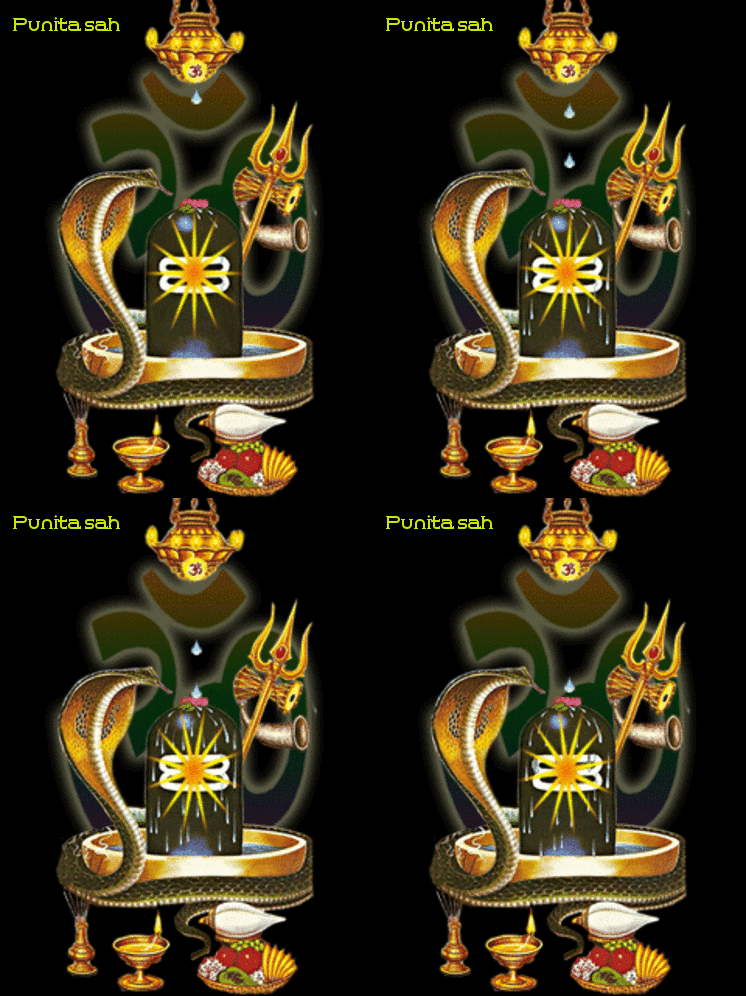
There are procedures for performing Pooja in Hinduism.
The Universe is connected and interdependent.
Any action performed affect another and there may be certain elements which may not be tolerant of your actions.
There may be elements that would help you in your endeavor.
To prevent the former and facilitate the latter some procedures have been evolved in Hinduism.
While this may not be necessary for daily parayana , it is necessary for Pooja and more so for Tantrik Sadhana.
The places are Head, Lips,Heart,Shoulder blades,Palm and Fingertips and in some cases pit of the stomach and Buttocks.
Some Nyasas.
Mahashodha nyasa where a sadhaka or sadhvika places planets, constellations, sacred sites and other elements of Lalita’s cosmology on her or his body. T
Rishi Nyasa, Kara (hand) Nyasa, Matrika Nyasa and Sadanga Nyasa.
Every mantra has a Rishi or seer who first pronounced the mantra,
Matrika Nyasa is a form where the 50 letters of the Sanskrit alphabet are placed on the body.
Sadanga Nyasa uses bijas connected with long vowels of the Sanskrit alphabet.
Kara Nyasa refers to use of fingers and marking them.
Mudras are special expressions with the fingers.
There is another aspect, Dikbandhana, when the Diretions (Space) are marked to prevent evil influences disturbing one’s concentration.
.(These are body gestures and hand gestures to invoke the Gods of the mantra. Thegestures are called Anga nyaasa and karanyaasa. (Anga means parts of the body and karameans hand. Nyasa is the gestures.) The 6 gestures are made uttering the seed letterscalled Bijaksharas. They are Klaam, Kleem, Kloom, klaim, klaum and klah.
They should be learnt from the Guru.)
Ater this, meditation is done with the following thoughts:
Vishvamitra addressed Rama in a harmonious voice calling, ‘oh, Rama’, on the southern riverbank of Sarayu. ( Valmiki Ramayana, Book 1, Chapter 22, Verses 10b, 11a)
गृहाण वत्स सलिलम् मा भूत् कालस्य पर्ययः || १-२२-११
मंत्र ग्रामम् गृहाण त्वम् बलाम् अतिबलाम् तथा |
“Take water, my boy, and like that you receive a group of hymns, bala and ati bala from me, and let no time lapse. (1-22-11b, 12a)
“On receiving these hymns neither tiredness nor fever, nor disfiguring of personality can effect you, nor the demons can charge you either you are sleeping or unvigilant. (1-11-12b, 13a)
“As it is none whosoever on earth can equal you in dexterity, Rama, and by reciting these hymns none can equal you in the three worlds. (1-22-13b, 14a)
“My dear Raghava, if bala atibala hymns are practised, oh, impeccable one, none can equal you in the world by your handsomeness, calibre, erudition, by your discernment, and even in replying or rebutting you. (1-22-14b, 15)
“On receiving these two teachings there will be none similar to you, for bala and atibala are the mothers of all knowledge. (1-22-16)
“Oh, best one among men, Raghava, if you go on reciting bala and atiblala hymns, my dear Rama, there will be no hunger or thirst to you. (1-22-17)
“And if these twin teachings are practised an inestimable renown will also accrue, oh, Raghu’s legatee, these two hymns that possess brilliance are the daughters of Forefather Brahma, and oh, Rama of Kakutstha, I intend to impart these hymns to you, oh virtuous one, as you are the most eligible one, hence take the teachings that are kept safe from the world. (1-22-18, 19a)
“Though all of these numerous qualities are undoubtedly available with you, that too in abundance, yet these hymns if ascetically nurtured will yield various results.” Thus spoke Sage Vishvamitra to Rama. (1-22-19b, 20a)
(ii) Bala Atibala Teaching:
Sage Vishvamitra is the Seer for Gayatri hymn. He is the same Sage to impart bala atibala hymns to Rama and Lakshmana. This hymn is yet another aspect of Gayatri, and there is no hymn superior than Gayatri, na gaayatriyaah paramam japam.
(One will get maximum benefit if the teaching from Guru).
om aapyaayantu mamaangaani vaakpraanashcakshuh shrotramatho balamindriyaanicasarvani | sarvam brahmaupanishadam | maaham brahma niraakuryaam maa maa brahma niraakarot | aniraakaranamastu aniraakaranam me’stuh tadaatmani nirate ye upanishatsu dharmaaste mayi santu te mayi santu || om shaantishshaantishshaantih |
You must be logged in to post a comment.