Tag: India under British rule

  • British Genocide of 1.8 Billion Indians Detailed Breakup.

    British Genocide of 1.8 Billion Indians Detailed Breakup.

    Showing Reddit comments

    Some comments on my article ‘ Genocide of 1.8 Billion Indians by the British’ By Redditors.

    I normally do my research before writing any article and I was surprised that I missed out .I did further research. I found one of the links on the basis of which I had written had become Private.And during the process, I found evidence of the Genocide of Indians related news items, articles,blogs have either disappeared (!) .One article on Bengal famine death toll was questioned saying that it was Not Churchill who was responsible and the figures were inflated. Fact is Winston Churchill said on Bengal Famine,India: Churchill claimed “I hate Indians. They are a beastly people with a beastly religion”. Churchill seized millions of tons of inessential rice to send the Middle East. Four million Bengals starved to death, and he said ‘famine’ was their own fault “for breeding like rabbits”
    6:33 AM · Jun 8, 2020′. I shall be writing on this in detail and on Bengal Famine.

    I am providing a researched paper on the Genocide of 1.8 Billion Indians by the British.

    Originally published: CounterCurrents by Dr Gideon Polya (December 28, 2018 )  |  – Posted Jan 15, 2019

    Note on the author of the information. ‘

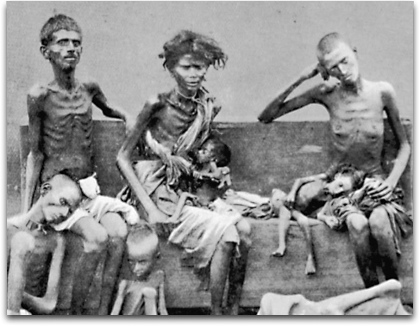
    Bengal Famine image

    Professor Utsa Patnaik is professor emeritus at Jawaharlal Nehru University, New Delhi. Utsa Patnaik is a Marxist economist and taught at the Centre for Economic Studies and Planning in the School of Social Sciences at Jawaharlal Nehru University (JNU) from 1973 until her retirement in 2010. She obtained her PhD in economics from Oxford University, UK, and has researched the transition from agricultural  peasant societies to industrial societies, and food security and poverty, especially in India.(1) Utsa Patnaik’s  latest book, co-authored with Prabhat Patnaik, is “A Theory of Imperialism” (2016).(2)

    (B) 1.8 billion Indians died avoidably from egregious deprivation under the British.

    Imposed poverty kills. Poverty-derived  avoidable mortality (avoidable death, excess mortality, excess death, premature death, untimely death, death that should not have happened) can be estimated as the difference between the actual deaths in a country and the deaths expected for a peaceful, decently governed country with same demographics (birth rate and percentage of children).(12) Below are listed in rough  chronological order some shocking salient features of the deadly impact of rapacious British imperialism over 2 centuries in British India, Britain’s Auschwitz.

    In the 1769-1770  Great Bengal Famine 10 million out of 30 million over-taxed Bengalis starved to death(6)(13).

    Scores of millions of Indians perished in man-made famines between the  1769-1770  Great Bengal Famine and the 1942-1945 WW2 Bengal Famine.(6)

    Using Indian census data 1870-1950, assuming an Indian population of about 200 million in the period 1760-1870, and estimating by interpolation from available data an Indian avoidable death rate in (deaths per 1,000 of population) of 37 (1757-1920), 35 (1920-1930), 30 (1930-1940) and 24 (1940-1950), one can estimate Indian excess deaths of 592 million (1757-1837), 497 million (1837-1901) and 418 million (1901-1947), roughly 1.5 billion in total or 1.8 billion including the Native States.(14)

    Scores of millions of distant British keeping hundreds of millions of Indians on the edge of starvation was enabled by relatively small numbers of British soldiers and much greater numbers of well-fed Indian soldiers threatening requisite violence.(6) It has been estimated by Amaresh Misra that 10 million Indians were massacred in the decade after the 1857 Indian Mutiny (Indian Rebellion) as reprisals for 2,000 British deaths.(15)(16)

    Despite a very high birth rate, the Indian population did not increase between 1860 (292 million) and 1934 (292 million) [17]. This is indicative of massive avoidable deaths from imposed deprivation that can be estimated as 745 million (1860-1934) or an average of about 10 million Indian avoidable deaths from deprivation per year.(14)

    Addressing the House of Commons in 1935, racist, imperialist and mass murderer Winston Churchill made an extraordinary confession in stating of the subjugated Indians: “In the standard of life they have nothing to spare. The slightest fall from the present standard of life in India means slow starvation, and the actual squeezing out of life, not only of millions but of scores of millions of people, who have come into the world at your invitation and under the shield and protection of British power”.(6)(18)(19) 7 years later Churchill commenced  the deliberate starving to death over 4 years of 6-7 million Indians in Bengal, Orissa, Bihar and Assam as the British exported grain from India and slashed grain imports.(6)

    8. In the 1942-1945 WW2 Bengali Holocaust (Indian Holocaust, WW2 Bengal Famine) 6-7 million Indians were deliberately starved to death for strategic reasons by the British with Australian complicity (Australia was complicit by denying starving India food from its huge wartime food stores).(6)(12)(14),  (19)(27) This atrocity has been white-washed from history and general public perception by successive generations of Anglo journalist, editor, politician and academic presstitutes. Indeed perpetrator Churchill made no mention for this atrocity in his 6-volume history “The Second World War” for which he was awarded the Nobel Prize for Literature.(6)

    According  to Professor Utsa Patnaik Indian per capita annual consumption of food  was 200 kg in 1900, but went down to 137 kg during World War II and in 1946.(28) This is consonant with the following data from my book “Jane Austen and the Black Hole of British History”: “The population of India at that time [1940] was about 400 million and total grain production was 50 to 70 million tons annually. The population was growing at a rate of about 5% per year and there was a requirement of net imports of about 1-2 million tons of grain per annum to make up for deficiencies… Behrens’ figures for grain shipments (in tons) for India in 1942-1945 are as follows: 1942 (30,000), 1943 (303,000), 1944 (639,000) and 1945 (871,000). The 1942 shipment involved 2 lots from Australia contracted for at the rate of 15,000 tons per month to supply the Indian Army (the balance of the demand was not shipped that year). 2.4 million men served in the Indian Army during World War 2. This estimate can be “reduced” since not all of these were in the Army at the same time, scores of thousands were in the Mediterranean theatre (250,000 served there), had been captured by the Japanese or had died. Taking the gross Indian annual grain production estimates of about 60 million tons for 400 million people, we see that the average consumption was 0.15 tons per person per year (obviously more for adults and less for children). The annual requirement for about 2 million men in the “reduced” Indian Army was therefore 0.3 million tons. We can arrive at a figure having a similar order of magnitude from the 1942 contracted requirement of 15,000 tons per month i.e. 0.18 million tons for a whole year. If we assume that an Indian Army soldier required 50% more food than the average Indian we would estimate that the annual grain requirement for a 2 million strong Indian Army would be about 0.45 million tons. The average yearly importation in 1942-1945 was 0.46 million tons and thus we can see that the grain actually imported was merely enough to feed the Indian Army” (pages 156-158, Chapter 15 (6))…Things got much better after Indian Independence. The 1.8 billion avoidable Indian deaths from deprivation under the genocidal British over 2 centuries is not that surprising when one considers that despite modern medicine, antibiotics, and the essential absence of famine, avoidable deaths from deprivation in the period 1950-2005 in India totalled 0.35 billion.(14)  Annual avoidable deaths as a percentage of population fell from a genocidal 2.4% per year  in 1947 under the British to 0.35% per year in 2005, but the population of India increased from 380 million in 1947 to about 1,100 million in 2005. Today 4 million Indians die avoidably from deprivation each year as compared to zero (0) in China that, unlike capitalist India, has overcome endemic poverty. https://mronline.org/2019/01/15/britain-robbed-india-of-45-trillion-thence-1-8-billion-indians-died-from-deprivation/

    Multi Lingual Blog English Tamil Kannada Hindi Indian History Verified Vedic Thoughts Hinduism around The World Tamils History

  • Genocide Of 1.8 Billion Indians By The British

    Genocide Of 1.8 Billion Indians By The British

    I am used to hearing people of my earlier generation and many from my generation as well, speak highly of the British Rule in India, about British Honesty and Fair play,

    Their contribution to uniting India,

    Bringing in the Industrial Revolution to India and introducing English in India.Each of these statements need rebuttals for the impressions are not correct and the motives behind these acts are criminal in Nature.

    They have invaded all countries that are found in the Map today, excepting 22!

    # As is expected of Anglophiles and British pechant for hiding crimes, some Links I have quoted may not work now.See the Sites, you shall understand what I am saying.

    Before I start rebutting these points one by one, let me furnish some information about the Genocide of Indians by the British.

    We are aware of one Jallianwala Bagh .

    We do not know about more serious Genocide by the British in India,

    Now Britain claims it is a Champion of Freedom and a friend of the downtrodden and we respect them!

    The news was obviously blacked out by the Anglo Media.

    Excerpts.

    Educated Indians are aware of the ghastly 2-century imposition of British colonialism on India. However, because history is generally written by non-scientists, most Indians are utterly unaware of the horrendous human cost (1.8 billion violent and non-violent avoidable deaths in the period 1757-1947).
    Under British rule, Indian cultivators were forced to produce for export, and heavily taxed while denied necessary infrastructure, like roads, to move their products to market. As one observer noted, “In this predicament, the cargo of cotton lies sometimes for weeks on the ground, and the merchant is ruined.” Shown: Indian and European merchants trade at the Bombay cotton market, ca. 1870.

    Th British deliberately caused famines in India, in order to force the indigenous population into relief works, such as road-building. The tenant-laborer, writes Carey, “is mercilessly turned from his land and his mud hut, and left to die on the highway.” Here, Indians on their way to the relief works, published in the LondonNews, 1874…

    Queen Victoria, Empress of India, ruled over a people broken by poverty, inhumane treatment, famines, and despair. As one British author wrote: “And this occured in British India—in the reign of Victoria the First. Nor was the event extraordinary and unforeseen. Far from it: 1835-36 witnessed a famine in the northern provinces; 1833 beheld one to the eastward; 1822-23 saw one in the Deccan. They have continued to increase in frequency and extent under our
    sway for more than half a century.”

    During the terrible famine of 1838, according to one reporter, millions of pounds of rice and other edible grains were exported from Calcutta, to feed the kidnapped Indian Coolies, who had been sent to the Mauritius, to work in the fields.

    These are just the figures of the British-man-made famines, it does not include the Epidemics induced by Famines, Anglo-Indian Wars, Indians killed fighting for the British, Freedom Fighters martyred by the British.

    If all these are included the figures reaches over 1.8 Billion mark (ignored by Anglo Media)

    Citations and References.

    http://greatgameindia.wordpress.com/2013/01/13/indian-holocaust-under-british-raj-1-8-billion-excess-deaths-ignored-by-anglo-media/

    This Link,when I last checked  ,was Marked ‘Private’

    1. Dutt, Romesh Chunder (1908). The economic history of India under early British rule, Pg. 52

    2. Grove, Richard H. (2007), “The Great El Nino of 1789–93 and its Global Consequences: Reconstructing an Extreme Climate Event in World Environmental History”, The Medieval History Journal 10 (1&2): Pg. 75–98

    3. Ibid

    4. Reference 1: Digby, William. Prosperous British India, Pg.127.
    Reference 2 : Dutt, RC. Famines and Land Assessments in India, Pg.3

    5. Ibid

    6. Ibid

    7. Digby, William. Prosperous British India, Pg.127

    8. Reference 1: Digby, William. Prosperous British India, Pg.127.
    Reference 2 : Dutt, RC. Famines and Land Assessments in India, Pg.5

    9. Ibid

    10. Ibid

    11. Ibid

    12. Ibid

    13. Fieldhouse, David (1996), “For Richer, for Poorer?”, in Marshall, P. J., The Cambridge Illustrated History of the British Empire, Cambridge: Cambridge University Press. Pp. 400, pp. 132

    14. Reference 1: Digby, William. Prosperous British India, Pg.127.
    Reference 2 : Dutt, RC. Famines and Land Assessments in India, Pg.9

    15. Ibid

    16. Ibid

    17. A Maharatna, The Demography of Famine, quoted by Mike Davis, Late Victorian Holocausts, El Nino Famines and Making of the Third World, pg 7,table P1.

    18. Digby, William. Prosperous British India, Pg.128

    19. Ibid

    20. Ibid

    21. Ibid

    22. The Lancet 16 may 1901, quoted in Mike Davis. Late Victorian Holocausts, El Nino Famines and Making of the Third World, pg 7, table P1

    23. Maharatna quoted by Mike Davis, Late Victorian Holocausts, El Nino Famines and Making of the Third World, pg 174

    24. Bengal Tiger and British Lion: An Account of the Bengal Famine of 1943, Richard Stevenson, Pg.139
    Famines in Bengal: 1770-1943, K C Ghosh, pg.111
    Famine Inquiry Commission Report, 1943. Pg.110

    Click to access H%20Carey%20British%20free%20trade.pdf

    Churchill’s Crimes From Indian Holocaust To Palestinian Genocide
    http://www.countercurrents.org/polya230109.htm

    How many Indians died in the genocides committed by the British Raj?

    How many Indians died in the genocides committed by the British Raj?

    Bengal Famine Man-Made
    News Article – The Sydney Morning Herald Tuesday 16 November 1943
    http://trove.nla.gov.au/ndp/del/article/17882909

    Anglo Holocaust Denial – BBC’s “The Story of India” IGNORES Bengal Famines & British Indian Holocaust
    http://creative.sulekha.com/anglo-holocaust-denial-bbc-s-the-story-of-india-ignores-bengal-famines-british-indian-holocaust_412021_blog

    Churchill’s Famine?
    http://www.outlookindia.com/article.aspx?266849

    INDIAN HOLOCAUST under British Raj: 1.8 BILLION excess deaths
    https://sites.google.com/site/muslimholocaustmuslimgenocide/indian-holocaust

    British in India : Slavery and Famine

    Click to access H%20Carey%20British%20free%20trade.pdf

    Doubts have been raised about the Figure 1.8 Billion

    1.As I have mentioned in the Post the period and between 1757 and 1947.

    2.The table shows only Famine deaths.

    3.More research papers.

    “The “avoidable deaths” (from violence, deprivation and deprivation-exacerbated disease) in British India totalled 1.5 billion (or 1.8 billion if you include the so-called Native States).

    Major British-imposed genocidal events in India included the Great Bengal Famine (10 million dead, 1769-1770), successive famines that killed scores of millions of Indians up to the World War 2 Bengal Famine (6-7 million dead in Bengal and surrounding provinces; see the recent BBC broadcast involving me, Economics Nobel Laureate Professor Amartya Sen and others: http://www.open2.net/thingsweforgot/bengalfamine_programme.html ), the estimated 10 million Indians murdered by the British in reprisals for the so-called Indian Mutiny (in which 2,000 British were killed) and the underlying British-imposed condition of “living on the edge” that was responsible for most of the “avoidable deaths” (see my book “Jane Austen and the Black Hole of British History. Colonial rapacity, holocaust denial and the crisis in biological sustainability”, G.M. Polya, Melbourne, 1998, 2008: http://janeaustenand.blogspot.com/ ).
    https://sites.google.com/site/muslimholocaustmuslimgenocide/indian-holocaust

    Enhanced by Zemanta