Tag: History

  • Spot Where Indraprastha Was Built In Delhi

    I have been checking the Geographical locations mentioned in the Mahabharata to validate (already validated, I am cross checking).

    Humayun's Fort, Delhi
    Purana Qila

    I  had earlier posted an article on Indraprastha, based on the Adi Parva of Mahabharata with comparison to Roman cities.

    Purana Qila was built on Inraprastha
    Purana Qila, Delhi

    In this search I stumbled into an article which had indicated the exact spot where Indraprastha was built in Delhi.

    It is the Purana  Qila, The Old Fort of Humayun,

    The Fort was mentioned by Abdul Fazil in Ain-I-Akbari.

    “A book called the Ain-I-Akbari by Abul Fazl was written in the sixteenth century during the region of the Mughal emperor Akbar. It says that Indraprastha, the capital of the Pandavas, the heroes of the Mahabharata story, was located at the spot where Humayun built his fort. In fact, till the end of the nineteenth century, there was a village called Indarpat (which sounds very similar to ‘Indraprastha’) inside the fort. Was ancient Indraprastha located here? This is a question that is difficult to answer with a simple ‘yes’ or ‘no.’

    Archaeologists carried out excavations at the Purana Qila from the 1950’s to the 1970’s. they were interested in finding out how old this site was, and to find out whether or not it could be identified with ancient Indraprastha. The excavations showed that the Purana Qila was indeed a very old site. Archaeologists found that the settlement had many phases dating from about the fourth century B.C. (or earlier) to the nineteenth century A.D.. Pieces of old pottery known as Painted Grey Ware (PGW for short) were also found here and there, and this suggested that people may have lived at some spot in or around the Purana Qila from about 1000 B.C. onwards.

    Why don’t we know for sure whether ancient Indraprastha was located on the spot where the Purana Qila stands?
    There are several reasons for this. First of all, we are not sure whether the Mahabharata is purely a legend, or whether it is a legend based on events that actually happened. Secondly, even in some of the events and people mentioned in the story were real, the evidence from the excavations at the Purana Qila really doesn’t tell us about these events or people. What is does tell us is that there was a very old settlement at or near the Purana Qila perhaps from about 1000 B.C. onwards.’

    The article goes on to state that it can not confirmed as,

    1.We are not sure whether Mahabharata was a fact,

    2.There are more layers to be analyzed and

    3.The Purana Qila records do not ell us about the people of Mahabharata,( other than the mention by Abdul Fazil.

    As to point number 1, The Mahabharata is validated based on the various sites spread throughout the country and in fact in Sri Lanka as well

    Please read my posts on these, filed under Hinduism.

    So this argument is no longer valid.

    2. No doubt the job is difficult to analyze the layers.It needs effort.

    As to the fact that there is no mention of the people of Mahabharata in Purana Qila information, you do not expect the invaders to record the conquered nation’s History.

    One should be thankful to Abdul fazil for mentioning this fact in Ain_I_Akbari.

    “Here is a table showing the seven layers or periods identified by archaeologists at the Purana Qila. Different sorts of artifacts were found at the different levels. Remember that the older layers are found at the bottom of a site, and the upper layers are more recent. Think of these archaeological levels as different floors in a seven-storeyed building. As you travel in a lift from the ground floor to the seventh floor, you are traveling forward in time, from earlier to more recent periods..

    Source:

    http://www.4to40.com/travel/print.asp?p=The_Purana_Qila_in_Delhi&k=Mahabharata


    Enhanced by Zemanta
  • Americas The Patala Of Hinduism Mayas Hindus

    I read an interesting article while researching for proof on the Vedic India encompassed the entire world.

    I have posted quite a few articles on the Ancient Kingdoms of India with Time line,names,The Dynasties List and the existing archeological proof for the statement that Bharatvarsha extended throughout the world.

    Kanchi Periyavar mentions this fact in the Book Deivathin Kural in Tamil( Free download of the Book is available in this site),with astonishing evidence from the Vedic Texts.

    The Mayan civilization as well as the Egyptian Civilizations often intrigued me.

    Their method of worship of the Sun, the reverence for the Dead and some cultural practices are very close to Hinduism.

    Now on to this information in the article.

    Patala Loka
    Patala, Hinduism
    Hindus Conception of World
    The World as described in the Purans

    “The Vedas tell a number of valid facts about ancient America . They call Mexico and Central America Patala. In Sanskrit, Patala means ‘one of the seven regions under the earth and the abode of serpents’ According to the myths, an eagle named Garuda transported thousands of ancient mariners, called snakes (Nagas, there in its beak. Although I feel they came here in ocean-going ships, the implication is clear that they could have flown here as well. The legends of the O’odhams of Arizona describe such a sky-born ship. They call it Nah-Big, a term definitely derived from the Sanskrit Nag-Bhaga or Snake God. One cannot help but become impressed when he reads the O’odham stories of the Nah-Big. It is clear that it was some kind of flying ship. The O’odhams even speak of it as being propelled by an energy generator having positive (male) and (female) female poles…

    In the Mayan-derived dialects along Mexico’s northern east coast down to and including the Central America republics, Patal means ‘abandoned or deserted land; without people.’

    Naga-like derivatives also exist in Mexico . In Sanskrit, Nag-asta means Western Naga Land . The Mayan lowlands down to and including Costa Rica are called Nacaste.

    According to Hindu legends, a naga could turn into a human being. In Mexico, a nagual was a were-animal. Nagual derived from the Sanskrit Nag-Baal, meaning Snake Demon…

    The Hindu Naga Mayas also belonged to a powerful Dravidian group of Nagas called Asuras. Whether or not the Asuras were demi-gods or demons depended on one’s point of view. The leader of these Naga Asuras was the Hindu (really a Bulgarian) god of precious metals, wealth, traders and even agriculturists (really a group) named Kubera or Khyber (Kheever). For Christians and Jews he was Heber. This Kubera, Khyber, or Heber was leader of a horde called Yakshas or Yakhas (Biblical Joktan?). They were reputed to be both superior mentally and materially. Their servants were called Guhyakhas (Yakha shit). Today, in Judaism, which evolved from the Kubera teachings, the term has changed to Goy, but the meaning has never changed. The Kubera hordes, composed of Yakshas or Yakhas and their Guyakha underclass captured most of India’s undesirables, the unredeemably savage and cannibilistic Rakshasas, exiling them to Ceylon or Lanka. Later, they exiled them to Patala, supposedly in air ships.

    The Mayas had their own nation in Lanka, also named Maya, with a sub-group called Laks (Mexico’s Lacandones). It is a strange anomaly that Rama, Lenka (Lanka), and Lacandon Mayan peoples exist in Meso-America, including the inhabitants of Yucatan (Yakhustan; Joktan?)…

    In India, many Hindus love to mention them as a superior race of people who came to them from Uttara Kuru ( Siberia and the North Pole). Yet, the Kurus (Ari) and Ramas were just the Indian people themselves who once inhabited the whole of the Eastern Hemisphere — Kurus the north, and Ramas, the Indian sub continent itself. In the mythologies of all the world, the Kurus (Turks) and the Hindus (Ramas) are the Holy Twins. Although both groups were partners (twins) in international trading, the Kurus (Turks) provided the shipping and the Ramas their services as warrior traders. The Ramas were ferocious warriors, just as they were described in the Mahabharata.

    It just so happens that the Carib (Cariva) Indians of the Caribbean islands claimed that their creator gods were the Kuru Rumani. The Mexicans will tell you that the state of Veracruz derives its name from Ver a Cruz (Seeing at a Cross), but such a name is preposterous for a variety of reasons. The people of Vera Cruz are really descendants of Carib Indians, called Vira–Kurus (Hero Kurus). Emperor Moctezuma of Mexico himself told the Spaniards that the Mexican royal family descended from a ruling eastern caste called Colhua, the only way the Aztecs could pronounce Kaurava.

    I could provide almost an infinity of evidence to validate my claim that the Kurus and Ramas (Aryans and sub-continent Hindus) first colonized the Americas , but that’s not necessary. What I have to say in the last part of this article is sufficient unto itself.

    The Hindus of antiquity had an ancient astro-geographical map with four lotus petals pointing in the cardinal directions, called Mt. Meru (the world mountain). The point of the left petal fell on a seaport called Ketumala or Chetumala. Both pronunciations were used. The lower center petal was Jambudvipa (subcontinent India ).”

    More at:

    http://www.viewzone.com/gene.india.html

    Enhanced by Zemanta
  • Pushpaka Vimana Service Sita’s Food Tunnels Sites

    While looking for the evidence proving the Ramayana, I was also looking from the angles of Ravana’s Legacy, Sri Lanka sites referred to by Valmiki in The Ramayana.

    I have found historical sites  in Sri Lanka corroborating the Ramayana, the places have Sinhalese Names with Ramayana background.

    I have posted an article on the places where Sita was shifted by Ravana after being kidnapped by him.

    In this article i have posted information on what food was offered to Sita,Ravana’s Pushpak Vimana Service Centre, the place Sita rearranged her hair and the secret Tunnel network of Ravana.

    More information may be had at the link provided in the Post.

    Rama sent Brahmastra
    Place where Lord Ram sent the Brahmastra to Kill Ravana
    Pushpaka Vimana  was Repaired here by Ravana
    Pushpaka Vimana Repair Centre

    Gurulu Potha,Lankapura:

    There was an aircraft repair center in the capital city. This place is known as Gurulupotha. In Valmiki’s depiction King Ravana‘s Vimana resembled a huge peacock. The Vimana in Sinhala language means Dhandu Monara which is known as ‘flying peacock’, and hence the name Gurulupotha, which means ‘parts of birds’.

    Seetha threw Rice Balls Kodakai
    Where Sita Threw Rice balls around

    Kondakalai.

    Kondakalai like many other cities and villages in Sri Lanka also derives its name from the Ramayana, when King Ravana took Sitadevi in a chariot to Ashoka Vatika her hairs got deranged because of the speed of the chariot. Konda kalai in tamil means deranging of hair. Till date the villagers live with legacy of this event.

    When King Ravana carried Sitadevi on his chariot to Ashoka Vatika, he provided her with vitaminised rice balls for refreshment. But Sitadevi who did not want to consume anything provided by King Ravana, scattered the rice balls all over the place during her journey, and they are found till date along the chariot track. The local people call these rice balls Sita Gooli and they prescribe them for their children as a cure for stomach disorders and headaches. The farmers too keep them in their cash boxes or grain pots for prosperity. It is claimed that carbon dated testing has been done in Tokyo and Delhi on these rice balls and ascertained to be more than five thousand years old.

    Ravana had his sentries here.
    Sentry Point of Ravana

    Laggala.

    The cartels behind the Dunuvila lake are called Laggala. Laggala is derived form the Sinhala term Elakke Gala, which when translated into English gives us the meaning Target Rock. Laggala served as a sentry point to the King Ravana’s army and it was from this rock the first Glimpse of Lord Rama’s army was sighted and informed to King Ravana. This hill is geographically the highest part of the northern region of King Ravana’s city and on a clear day the north east side that is Thiru Koneshwaran and north west side that is Talai mannar could be seen even today. King Ravana is believed to have done meditation on this rock and prayed Lord shiva at Thiru Koneshwaran from this point.
    It is here that King Ravana was killed by Lord Rama’s Brahmaastharam. The top of Laggala is flat and is believed to have been hit by the Brahmaastharam.

    Secret Cave  of Ravana
    Ravana’s Secret Caves
    Enhanced by Zemanta
  • Vatican Shiva Temple?

    I have posted articles that the Kaaba was a Shiva Temple and a Linga is still in there with authentic links.

    Vatican a Shiva Temple.
    This is the Hindu deity Shiva. This piece is at present on view in the Etruscan Museum at the Vatican in Rome. Encyclopedia Britannica mentions under the headings “Etruria” and “Etruscan” that between the 2nd and 7th centuries BC, northern Italy was known as Etruria

    Sanatan Dhrma spread from the south of the Vindhyas twards the west of India,.

    When Satyavata Manu , ancestor of Lord Rama left for Ayodhya ( in the north of the Vindhya,from the South (his son Ikshvaku fiunded a Kingdom ,Dynasty by the same name),Shiva and Ganesha left  the Dravida Desa ( south)  and traveled through the west, the first stop being what is nowknown as the Arbian Peninsula, which consists of Oman, Dubai and the other Emirates,Saudi Arabia, Iraq,Jordan,Lebanon,Turkey,Greece ,Italy before finally arriving in the Arctic.

    They had the Rig Veda composed in the Arctic and returrned to India through Russia.

    Please read my posts oon each of these places where the footprints of either Shiva/Ganesha are found

    I came across some credible information worth postin g whaich states that the Vatican was built on

    1.Pagan Tempe.

    2.Shiva Temple.

    Story:

    Originally Posted by believenothing

    St. Peter’s Basilica is built on a large pre-Roman and pagan cemetery which included an old temple with red walls. Very little is known about this excavation because it was done by the Catholic Church themselves. It was used to claim that Simon Peter’s bones are actually buried there.Actually, pretty much all of Christdom’s oldest churches are either retro-fitted temples, extensions of temples, or built on the foundation of old temples…

    ” During excavations many such “meteoric stones mounted on carved pedestals” are discovered in Italy. Obviously, therefore, this one was dug up from the Vatican itself. Many more must be lying buried in the Vatican’s massive walls and numerous cellars. Vatican is itself the Sanskrit word “Vatica” applied to Hindu cultural-cum-religious centers as in “Ashrama-Vatica” or “Dharma-Vatica” or “Ananda-Vatica.” Therefore, the Vatican was obviously a Hindu religious seat before its incumbent was forced to accept Christianity.

    “The ancient Vedic custom of applying ash or sandalwood paste to the body is still retained by Christianity in the observance of Ash Wednesday. The so-called “All Soul’s Day” is an exact translation of the Vedic observance of Sarva Pitri Amavasya, the day fixed by tradition for the worship of all deceased ancestors

    .Another Christian tradition derived from Vedic origins is that of having and ringing bells in the churches, especially before or during worship. In Vedic temples it is often seen where bells are rung during worship and when pilgrims enter the temple, announcing their entrance. Christian churches also ring bells to announce the beginning of worship.

    The word “bell” comes from the Sanskrit bal which means strength. This is in reference to the idea that ringing a bell adds force to the voice of prayer in invoking divinity.

    When the Christians say “Amen” at the end of their hymns or to emphasize something, what they are saying is a corrupted form of “Aum” or “Om,” which is a standard form of Vedic meditation and name of the Supreme Being.

    While we are on the topic of words used in Christianity that are derived from Sanskrit, the Catholic term “Madonna,” another name for Mother Mary, comes from the Sanskrit Mata Nah, meaning “Our Mother.” This is also derived from the great Vedic Mother Goddess. Thus, Mother Mary was a reference not only to the mother of Jesus alone, but a reference to the Goddess, mother of all humanity. Furthermore, the European term of “Madam” is a soft pronunciation of the Hindu term mata or mataji, which also means “Mother.”

    The term “vestry” in referring to the room in churches in which holy clothes are kept comes from the Sanskrit word vestra, meaning clothes. Even the word “psalm” with a silent “P” comes from the Sanskrit word sam or sama which means holy and serious sacred songs, hymns or chants, as found in the Sama-veda.

    Other Christian links with Sanskrit words can be found in the name Bethlehem, which is the English mispronunciation of the Sanskrit Vatsaldham, which means “the home (town) of the darling child.” The Sanskrit term Nandarath is linguistically connected with Nazareth. Nandarath means Nanda’s chariot, and King Nanda was the guardian at whose village he nurtured Lord Krishna (sometimes pronounced as Chrisn, and later Christ in some regions).

    The Christian term “Satan” and the Islamic term “Shaitan” both are derived from the Sanskrit term Sat-na, which means non-truth, falsehood, or fraudulence.

    The Christians who explain the term “Devil” as a fallen angel should realize that the word is derived from the Sanskrit terminology which signifies a fallen Deva.”

    More  Research/proof is needed
    Enhanced by Zemanta
  • Hanuman To Lanka Place Distance Controversy

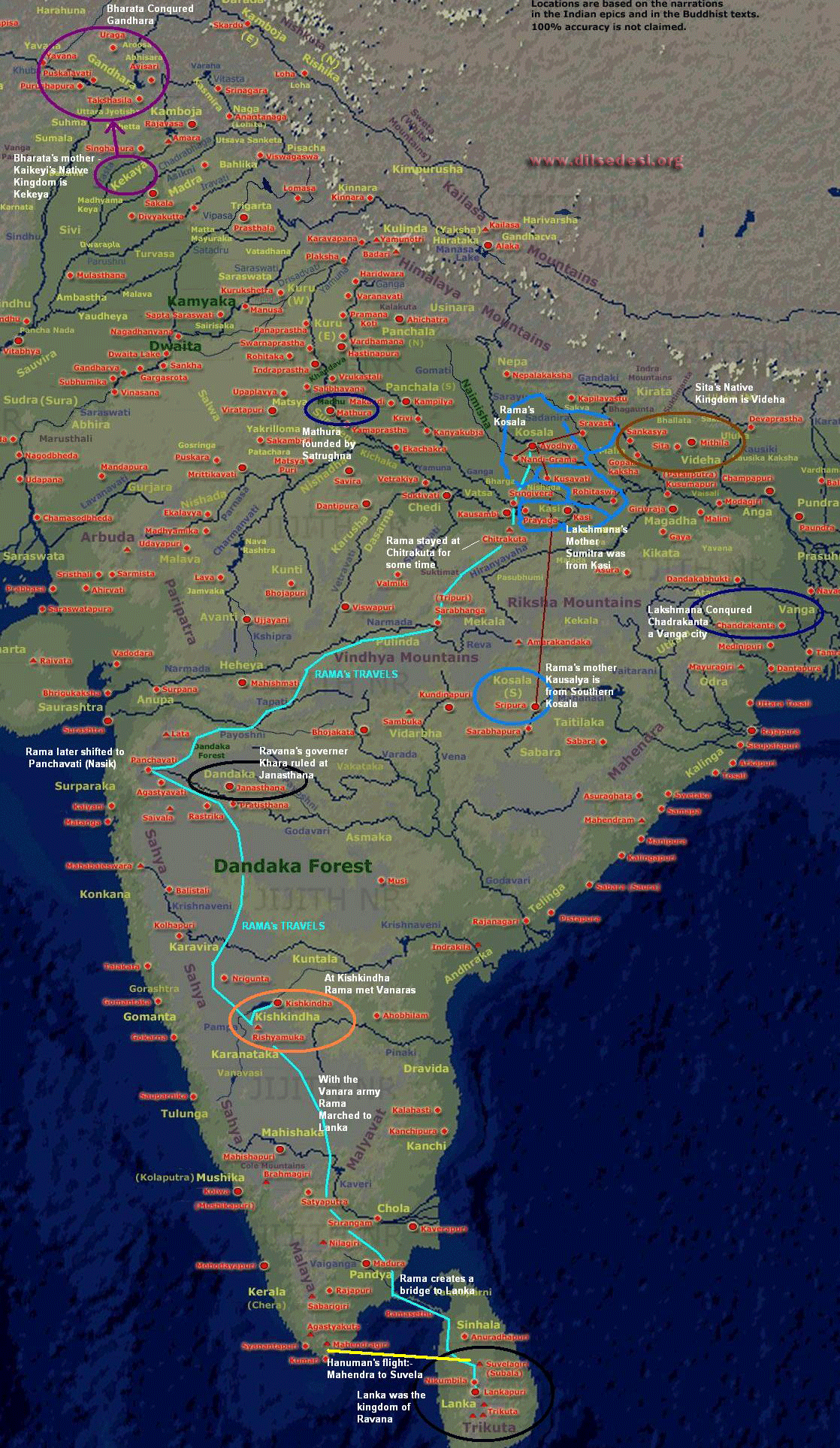
    Hanuman is reported to have crossed to Lanka from the Southern tip of India and returned from Lanka from Trikuta Parvatha in Lanka

    That Hanuman with great strength crossed the insurmountable ocean without becoming tired and viewed the city of Lanka located on the peak of Mount Trikuta. After that, Hanuma standing there shone like one made of flowers being showered by a rain of flowers released by trees.9Sarga 2, Sundara Kanda)

    India Lanka distance 24km  Hanuman Crossing Ocean.
    Hanuman Crossing the Ocean, Image source. https://venetiaansell.wordpress.com/page/3/

    This Mountain is reported to have been in Sri Lanka.

    Lanka /ˈlæŋkə/ (Sanskrit: लङ्का lankā meaning “respected island”, Sinhala: ලංකාපුර (Langkapura), Malay: Langkapuri, Tamil: Ilankai or Lankapuram, Javanese and Indonesian:Alengka or Ngalengka) is the name given in Hindu mythology to the island fortress capital of the legendary king Ravana in the great Hindu epics, the Ramayana and theMahabharata. The fortress was situated on a plateau between three mountain peaks known as the Trikuta Mountains. The ancient City of Lankapura is thought to have been burnt down by Lord Hanuman. After the King Ravana was killed by Lord Rama with the help of the former’s brother Vibhishana, Vibhishana was crowned King of Lankapura by LordRama after which he ruled the kingdom. The mythological Lankapuri is identified today as Sri Lanka.”..

    Now there is a reference to Trikuta Paravatha.

    This Mountain is in Kashmir!

    Trikuta is located in Jammu, which is one of the three administrative divisions within Jammu and Kashmir, the northernmost state inIndia. Trikuta, the triple peak, is where the holy shrine of Vaishno Devi can be found”

    Trikuta Mountain
    Trikuta Parvatha Kashmir

    The above references are from Wiki.

    So the anomaly.Readers may contribute.

    I have a Theory in the light archeological findings of the Tamils remains.

    I shall post.

    2.The distance between Lanka and India, from its southern tip is about 24 km.

    The distance is from Kodiyakkarai, Point Calimere,where Ram surveyed the Ocean.

    But the Ramayana states that the distance is 100 Yojanas, one Yojana is about  8 Miles.

    That it is 800 Miles?

    This verse and others clearly mention that Hanuma crossed an ocean of hundred yojanas. At the present time the shore to shore distance between southern tip of India and Northern tip of Sri Lanka is around sixty miles. Even with a measure of 2.5 miles per yojana, hundred yojanas translate to 250 miles. To explain this anomaly, we need to consider that around the time of Ramayana, the distance was lot more than the current sixty miles. This is in sync with the current theories by geologists that the ocean between India and the current Sri Lanka had been replaced by land mass over a period of time. Most of the land to the south of current Raghunatha Pura had been covered by landmass in antiquity. Also according to Ramayana, the mountains Trikuta, Lamba and Suvela were to the north of Lanka, but currently the mountains are found in the southern part of Lanka. This suggests that the northern parts of current Lanka were submerged in water during the Ramayana period.”

    “Hearing those delightful words of Sampati, we with our Chief Angada started soon from there. The monkeys were very much delighted and satisfied. They were making up their energy to see you, rose up from Vindhya mountain and reached the northern shore of the ocean. All the monkeys with their Chief Angada, in their anxiety to see you, reached the ocean. They were frightened after seeing the ocean there and they were again worried.” 

    “Thereafter, seeing the ocean, I removed the serious fears of the army of monkeys who were worrying and crossed hundred Yojanas across the sea. Entering even Lanka, filled with demons in the night, I saw Ravana and you too who were immersed in grief. O the faultless princess! I told you all this as actually occurred. I am the messenger of Rama. Talk to me.”..

    Another version: 

    As mentioned in Valmiki Ramayana, the evidences for its location in Rameshwaram-Dhanushkodi are provided : atra purvam mahadevah prasaam asoorot prabhu. 

    While returning to Ayodhya, together with Sita Devi, after killing Ravana, there are episodes related from Pushpaka Vimaana. Sri Rama notes, pointing to the starting point of Setu (Dhanushkodi), that Sri Mahadeva granted anugraha to Sri Rama at this place. 

    Rama Setu is 100 yojanas long, 10 yojanas wide, according to Valmiki Ramayana. This ratio of 10:1 is evidenced by the dimensions of Rama Setu at Rameshwaram-Dhanushkodi. 

    The pre-colonial Indian linear measure reckoning table was as follows: 

    24 angula = 1 muzham 

    4 muzham = 1 dhanu 

    2 dhanu = 1 danda 

    50 danda = 1 kooppidu 

    4 kooppidu = 1 yojana 

    This is the basis for determining the 100 yojana length. Any other way of linear measurement will be like the blind figuring out an elephant. 

    One yojana is the longest distance traveled by sound – of a call from a tall place; the sound distance (300 metres or 1050 feet). 

    10 yojanas wide = 300 m X 10 = 3000 metres = 10,500 ft. 

    100 yojanas long = 300 m X 100 = 3,00,000 metres = 10,50,000 ft. 

    Thes actual dimensions of Rama Setu can be seen by everyone. 

    Even if we follow the argument of Jesuit scientists that it is only 10,00,000 years since human beings evolved, Hindu people believe that Ramayana events occurred in the latter part of Treta yuga and hence, assuming that Ramayana occurred in the 1,00,000th year of Treta yuga + Dwapara yuga 8,32,000 years, uptodate Kali 5107 total 9,37,107 years. We can explain that Ramayana occurred 62,893 years after the evolution of modern man. Thus, instead of researching objectively, if the objective is just to ridicule Hindu belief systems, any efforts to argue ‘scientifically’ will not be effective. 

    Rama Setu in Sangam literature, evidence from 2300 years before present 

    If we accept as factual evidence the kings, events mentioned in Sangam literature, 2300 years before present evidences for Rama Setu, Purattirattil Ramayana, Sri Rama, Vaanara species are provided in: Akanaanooru, Puranaanooru, Kalittogai, Paripaadal.’

    3.This raises another question.

    The above text refers that Hanuman crossed from the North of Vindhya Mountains.

    This is further North of Kodiyakkarai!

    As far as I know Maruti crossed from Mahendra Parvatha, the Eastern Ghats in the South.

    I am trying to resolve this.

    Any inputs?

    Source:

    http://www.valmikiramayan.net/sundara/sarga2/sundara_2_prose.htm

    http://in.answers.yahoo.com/question/index?qid=20101003210651AANKM62


    Enhanced by Zemanta