I am planning to post a series of articles on some interesting information ,facts,,stories from the Mahabharata.
Mahabharata By Rajaji
The source is the Mahabharata by Veda Vyasa in Sanskrit,
I have tried to understand it with my limited knowledge of Sanskrit and Tamil and from a host of references ,mainly from Sri Maharishi Veda Vyasarin Mahabharata Parvangal( Sri Mahabharata Parvaas by Maharishi Veda Vyasa, Translation by E.Srinivasachariar,Sri.M.V.Ramanujachaariar of Kumbakonam and by Sri Ganapahy Sastrigal,The Guru of Kanchi Maha Periyavar,Karunkulam Krishna Sastrigal and A. Venkatesachariar, published by Sri Chakra Publications, Urappakkam ,Chennai)
For the present i Ma quoting relevant portions from the Adi Parva, which I am currently studying.
Corrections and suggestions from authentic sources are welcome to make the posts more authentic.
Now onto the post.
Indians are accused of not possessing an authentic History.
The accusations are from the West and the self-styled Anglophiles and the Liberals(!?) from India.
History is what one chooses to write or more accurately what one chooses to believe in.
What is the History that the West believes in?
Thucydides,Xenophon,Plato,GM Trevelyan,Macaulay, or Winston Churchill?
Or is it the Bible,the reformation literature attributed to so many?
No body saw Socrates, Plato,writing the History as they saw it.
We have books, works attributed to them by the others and we believe in them.
The same applies to the Bible, which is essentially a collection of fables with few facts thrown in.
And mind you, one must remember that the Bible was compiled, not composed or written three hundred years after the death of Christ by Emperor Constantine to keep his Empire intact.
Please read my posts on this filed under Christianity.
And people know the motive behind Macaulay’ History once you look at his speeches in the British Parliament about the introduction of English as the medium of instruction in India, his general attitude to Indians, the Natives as they were /are called and his suggestions to handle the Natives of India.
Compare this with the view of Warren Hastings about Indian Culture.
Hastings was of the view that the Indian Culture and History was very rich!
As to Churchill, well one knows what his attitude towards the Natives and the Independence of India/Indians are.
Yet we believe in their versions of History!
One forgets that the Indian Culture is more ancient and there are records,
The criticism is that they are not in the written form.
Does it mean that what ever some one says is untrue and what is written is true?
In continuation of my earlier posts, lets us consider the Etymology of The Taj and Mahal.
Blue print of the Taj Mahal showing cross-section of Central Edifice in a book by J Fergusson in 1855. It clearly shows the hidden basements For larger Image Click on This Image.
Nowhere an Islamic Mausoleum the word Mahal is found anywhere in the World.
The name itself consists of two words, Mumtaz and Mahal.
The name of Mumtaz is not Mumtaz, it was a pet name , given by, one is not sure by whom.
That Shahjahan called her this way is not found in any reference.
Even if one were to assume her name has been given to the Taj Mahal, it should be The Taz Mahal and not Taj Mahal.
“Tavernier, a French jeweller has recorded in his travel memoirs that Shahjahan purposely buried Mumtaz near the Taz-i-Makan (i.e.,`The Taj building’) where foreigners used to come as they do even today so that the world may admire. He also adds that the cost of the scaffolding was more than that of the entire work. The work that Shahjahan commissioned in the Tejomahalaya Shiva temple was plundering at the costly fixtures inside it, uprooting the Shiva idols, planting the cenotaph in their place on two stories, inscribing the koran along the arches and walling up six of the seven stories of the Taj. It was this plunder, desecrating and plundering of the rooms which took 22 years.
Peter Mundy, an English visitor to Agra recorded in 1632 (within only a year of Mumtaz’s death) that `the places of note in and around Agra, included Taj-e-Mahal’s tomb, gardens and bazaars’.He, therefore, confirms that the Tajmahal had been a noteworthy building even before Shahjahan.
27. De Laet, a Dutch official has listed Mansingh’s palace about a mile from Agra fort, as an outstanding building of pre shahjahan’s time. Shahjahan’s court chronicle, the Badshahnama records, Mumtaz’s burial in the same Mansingh’s palace.
28. Bernier, a contemporary French visitor has noted that non muslim’s were barred entry into the basement (at the time when Shahjahan requisitioned Mansingh’s palace) which contained a dazzling light. Obviously, he refered to the silver doors, gold railing, the gem studded lattice and strings of pearl hanging over Shiva’s idol. Shahjahan commandeered the building to grab all the wealth, making Mumtaz’s death a , a convenient pretext.
Johan Albert Mandelslo, who describes life in agra in 1638 (only 7 years after mumtaz’s death) in detail (in his `Voyages and Travels to West-Indies’, published by John Starkey and John Basset, London), makes no mention of the Tajmahal being under construction though it is commonly , in error,,asserted or assumed that the Taj was being built from 1631 to 1653.
The plaque put the archaeology department outside the Taj Mahal describes the edifice as a mausoleum built by Shahjahan for his wife Mumtaz Mahal , over 22 years from 1631 to 1653. That plaque is a specimen of historical bungling. Firstly, the plaque sites no authority for its claim. Secondly the lady’s name was Mumtaz-ulZamani and not Mumtazmahal. Thirdly, the period of 22 years is taken from some mumbo jumbo noting by an unreliable French visitor Tavernier, to the exclusion of all muslim versions, which is an absurdity.
20. Prince Aurangzeb’s letter to his father,emperor Shahjahan,is recorded in atleast three chronicles titled `Aadaab-e-Alamgiri’, `Yadgarnama’, and the `Muruqqa-i-Akbarabadi’ (edited by Said Ahmed, Agra, 1931, page 43, footnote 2). In that letter Aurangzeb records in 1652 A.D itself that the several buildings in the fancied burial place of Mumtaz were seven storeyed and were so old that they were all leaking, while the dome had developed a crack on the northern side.Aurangzeb, therefore, ordered immediate repairs to the buildings at his own expense while recommending to the emperor that more elaborate repairs be carried out later. This is the proof that during Shahjahan’s reign itself that the Taj complex was so old as to need immediate repairs.
21. The ex-Maharaja of Jaipur retains in his secret personal `KapadDwara’ collection two orders from Shahjahan dated Dec 18, 1633 (bearing modern nos. R.176 and 177) requistioning the Taj building complex. That was so blatant a usurpation that the then ruler of Jaipur was ashamed to make the document public.
22. The Rajasthan State archives at Bikaner preserve three other firmans addressed by Shahjahan to the Jaipur’s ruler Jaising ordering the latter to supply marble (for Mumtaz’s grave and koranic grafts) from his Makranna quarris, and stone cutters. Jaisingh was apparently so enraged at the blatant seizure of the Taj Mahal that he refused to oblige Shahjahan by providing marble for grafting koranic engravings and fake cenotaphs for further desecration of the Taj Mahal. Jaising looked at Shahjahan’s demand for marble and stone cutters, as an insult added to injury. Therefore, he refused to send any marble and instead detained the stone cutters in his protective custody.
The three firmans demanding marble were sent to Jaisingh within about two years of Mumtaz’s death. Had Shahjahan really built the Taj Mahal over a period of 22 years, the marble would have needed only after 15 or 20 years not immediately after Mumtaz’s death.
Moreover, the three mention neither the Taj Mahal, nor Mumtaz, nor the burial. The cost and the quantity of the stone also are not mentioned. This proves that an insignificant quantity of marble was needed just for some superficial tinkering and tampering with the Taj Mahal. Even otherwise Shahjahan could never hope to build a fabulous Taj Mahal by abject dependence for marble on a non cooperative Jaisingh.”
”
Shajahan himself was probably responsible for this twisting of historical truth. The truth would have shown him to be inconsistent and this could not be tolerated. For this reason also, the histories contain no statements of any kind that are critical of the Emperor or his policies, and even military defeats are rationalized so that no blame could be attached to him. … effusive praise of the Emperor is carried to such extremes that he seems more a divinity than a mortal man.” (p. xxvi)
With the court chroniclers’ histories carefully edited, and with the great scarcity of documents we are fortunate to have four surviving farmans or directives issued by Shahjahan to Raja Jai Singh of Amber-the very same local ruler from whom the Emperor acquired the Taj property. On the basis of these farmans, the court chroniclers and a visiting European traveler, we learn that: (i) Mumtaz died and was buried temporarily at Burhanpur on June 17, 1631; (ii) her body was exhumed and taken to Agra on December 11, 1631; (iii) she was reburied somewhere on the Taj grounds on January 8, 1632; and (iv) European traveler Peter Mundy witnessed Shahjahan’s return to Agra with his cavalcade on June 11, 1632.
The first farman was issued on September 20, 1632 in which the Emperor urges Raja Jai Singh to hasten the shipment of marble for the facing of the interior walls of the mausoleum, i.e., the Taj main building. Naturally a building had to be there to receive the finish. How much time was needed to put that basic building in place?
Every successful new building construction follows what we call in modern-day construction a “critical path”. There is a normal sequence of steps requiring a minimum time before other processes follow. Since Mumtaz died unexpectedly and relatively young (having survived thirteen previous child-births), we can assume that Shahjahan was unprepared for her sudden demise. He had to conceive, in the midst of his trauma, of a world class tomb dedicated to her, select an architect (whose identity is still debated), work out a design program with the architect, and have the architect prepare designs, engineer the structure and mechanical systems, detail the drawings, organize the contractors and thousands of workers, and prepare a complex construction schedule. Mysteriously, no documents relating to this elaborate procedure, other than the four farmans have survived.
We cannot assume that the Taj complex was built additively with the buildings and landscaping built as needed. It was designed as a unified whole. Begley and Desai make this clear by their analysis of the grid system that was employed by the designer to unite the complex horizontally and vertically to into a three-dimensional whole. If one did not “know” that it was a solemn burial grounds, one would believe that it was designed as a palace with a delightful air of fantasy and secular delights of waterways and flowering plants. Could it be that this is Raja Jai Singh’s palace, never destroyed, converted by decree and some minimum face-lifting to a Mughal tomb?
Assuming that Shahjahan was galvanized into prompt action to initiate the project on behalf of his deceased beloved, we can safely assume that he needed one year minimum between conception and ground-breaking. Since Mumtaz died in June 1631, that would take us to June 1632. But construction is said to have begun in January 1632.
Excavation must have presented a formidable task. First, the demolition of Raja Jai Singh’s palace would have had to occur. We know that the property had a palace on it from the chronicles of Mirza Qazini and Abd al-Hamid Lahori. Lahori writes:
“As there was a tract of land (zamini) of great eminence and pleasantness towards the south of that large city, on which before there was this mansion (manzil) of Raja Man Singh, and which now belongs to his grandson Raja Jai Singh, it was selected for the burial place (madfan) of that tenant of paradise.[Mumtaz]” (p. 43)
Measures would have to be taken during excavation of this main building and the other buildings to the north to retain the Jumna River from inundating the excavation. The next steps would have been to sink the massive foundation piers, put in the footings, retaining the walls and the plinth or podium to support the Taj and its two accompanying buildings to the east and west plus the foundations for the corner towers, the well house, the underground rooms, and assuming the complex was done at one time, all the supports for the remainder of the buildings throughout the complex. To be conservative in our estimate, we need at least another year of construction which takes us up to January 1634.
But here is the problem. On the anniversary of the death of Mumtaz, each year Shahjahan would stage the Urs celebration at the Taj. The first Urs occurred on June 22, 1632. Though construction had allegedly begun only six months earlier, the great plinth of red sandstone over brick, 374 yards long, 140 yards wide, and 14 yards high was already in place! Even Begley and Desai are somewhat amazed.
Where was all the construction debris, the piles of materials, the marble, the brick scaffolding, the temporary housing for thousands of workers, the numerous animals needed to haul materials? If “heaven was surpassed by the magnificence of the rituals”, as one chronicler puts it, then nothing should have been visible to mar the exquisite panorama that the occasion called for.
But by June 1632, it was not physically possible that construction could have progressed to completion of excavation, construction of all the footings and foundations, completion of the immense platform and clearing of all the debris and eyesores in preparation for the first Urs.(http://www.stephen-knapp.com/an_architect_looks_at_the_taj_mahal_legend.htm)
The World History is full of distortions,example Indian History as told by the British, which is in vogue in India till to day.
Some of the events that took place in the World and India about 40 years back( when I was 23) is to day totally misinterpreted.
Well that is documented, that’s all!
Now to the story on hand.
If your not going to open Google Earth, Put in 66°15’05.22″ S 60°53’08.61″ W and go look yourself don’t complain 🙂 It is at sea level and is in a area that has been free from ice. The pixel to meter ration is amazing on this very hi-res shot. The Pyramids are 25ft and 40ft and the statues are about 15-30ft long. Find each find with the scale on my video Antarctica – Stills video. Sadly people cannot comment without using vile profanity and try argue that a video based on Google Earth could be some how debunked or not debunked. You do not understand my channel if you believe this. Come check out some other videos and comment if you are so inclined.
Statue, Dog, Mushroom statues at 13:25 minute mark.
A California TV crew missing since November 2002, a video they left behind and a mission by U.S. Navy SEALs are the key elements in a story that claims extensive ancient ruins have been found under the ice of Antarctica. That’s according to archaeologist and adventurer Jonathan Gray of World Education Research Ltd in his free newsletter Archaeology News Flash.
A spokesman for the company is reported to have said at the time that “The U.S. government said it will seek to block the airing of a video found by Navy rescuers in Antarctica that purportedly reveals that a massive archaeological dig is underway two miles (3,200 meters) beneath the ice.”
“The AtlantisTV production crew that shot the video is still missing.” reports Gray.
Attorneys for the Beverly Hills-based AtlantisTV stressed at the time that the company’s primary concern was for the safety and welfare of the crew.
The Vishnu Purana, where the Evolution of the Universe is described, also describes a Number Kingdoms, there were fifty-six .
The other Seventeen Puranas also do for this for the description of the Universe and the Bharatavarsha is one of the Rules for being classified as a Purana.
There is also a tradition that there were fifty-six Kingdoms in India, this is explained in the Mahabharata, where the Story of Nala and Damayanti is narrated.
It provides a list of fifty-six kings who attended the Swayamvara of Damayanti.
The Ramayana also lists more or less the same number in the Ramayana for the Swayamvara of Sita.
Tamil Classical Literature also mentions fifty-six Kingdoms.
Now I came across information that the number of Kingdoms are not fifty-six but seventy-six,
One may note from the Sankalpa or Resolution a Hindu chants for a function includes the Line.
Jambo Dweepe.,Bharata Varshe, Bharatakkande’
‘KANDA ‘ Means Continent.
As Kanda has already been mentioned, Varsha must be larger than this but smaller than Jambudweep.
There is a view that Jambudvipa means ‘beginning from Kashmir’
The Term Jamboo means a Tree bearing a Fruit of the same name, a type of Blackberry.
I do not see any connection between this Blackberry and Kashmir..
As the text goes on to describe the geographical locations, it must be indicative of a Large Mass of Earth,smaller than a Planet, bigger than a continent.
Again the Ancients Texts mention ‘Milechas’ indicating people beyond the Bhartakanda, but not approved by the Bharatvarsha and are declared to be unfit to be called as decent as Human Beings.
Some subscribe to the view that the term Milecha means the early European tribes, including the Americans.
I do not think so.
Texts also mention about these tribes as Nomads differentiating them from those who are unfit.
So the Jambudweep must mean(Dweepa means Continent) ,a large Island Continent, possibly Atlantis.
Lemuria has been included in the Dravidian land Mass.
Now I have information from a site that lists 76 Kingdoms.
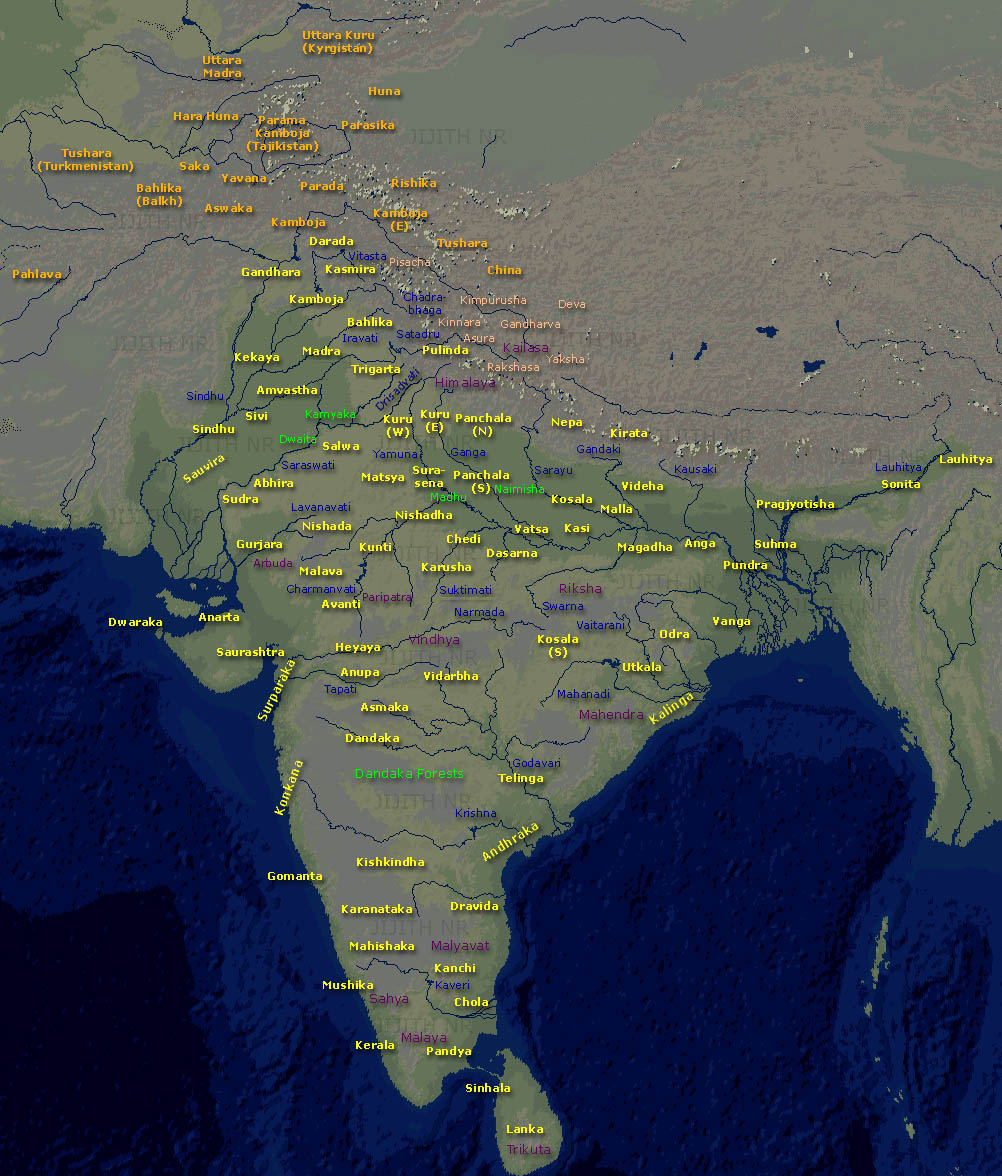
Jamvudvipa is the name of the regions south of the Himalaya region as per ancient Indian texts. Some identifies this region with the Jammu region that lies to the immediate south of Himalaya in Kashmir. Others identify it with the whole of Indian peninsula that lied to the south of the Himalayan range and also consider Himalaya to be a mountain range that surrounds this region both to the west (the western mountain ranges in Pakistan , north (Himalaya proper) and east (eastern ranges in North-Eastern India and Myanmar) of it.
Below is the Ancient India Map I created in 2004. It is formerly added to Wikipedia under creative common license. It is also used by many web-sites dealing with ancient India. Jamvudwipa is the Indian Peninsular region which can be seen in this map. The smaller Jamvu region is the region south of Kasmira, between the rivers Vitasta and Chandrabhaga. It is not marked in this map.



You must be logged in to post a comment.