Category: Hinduism

  • Porus Defeated Spared Alexander Life .

    A I wade through the History of India , I found and still find that it is littered with lies.

    As about 5000 years of History has been suppressed and misinterpreted, it is an arduous task.

    Reason for this state of affairs lies in the attitude of Indians.

    wp-1452866636801.jpeg
    King Porus

    By tradition and their religious belief  Indians considered mundane subjects like History and even science as inferior knowledge s only the Knowledge of the Reality is worth considering as Knowledge.

    Secondly the invasion by foreigners, who , realizing that the Indians could not be subjugated without destroying their faith in their Religion, their History as enumerated in their Puranas and the science as revealed in the Vedas and other Sanskrit Texts ( and in regional languages as well), destroyed this faith in the garb of bringing in western education and culture.

    One is by the early invaders like the Greeks and  in a more systematic way by the British who colonized and ruled  Indian for nearly 300 years.

    In between we had Muslim invaders who, though misinterpreted Indian History, it was not as damaging as the British.

    asia_323bc
    Alexander Empire?

    This blog is about exposing these lies, misinterpretations with evidence from Archeology,etymology, cultural affinities between various civilizations around the word and Sanatana Dharma, which was labeled as Hinduism.

    Indian History taught at school begins with the Invasion of India as the beginning of Real (?) History , events narrated in Indian texts, both English and Regional having been dismissed as legends,myths and fantasies.
    That India did not exist before 4000 years (John Stuart Mill in History of India, the first official(?) History of India.)
    That Indians were a barbaric race deeply mired in superstitions and uncivilized religious practices,
    That the Greeks were the first to bring civilization to India,
    There were Aryans who entered India through the Khyber Pass and drove the Dravidians south,
    There was caste system which was eating away the vitals of India,
    Aurangazeb was a pious and noble man,

    Islamic invaders left a legacy in architecture, mutual respect for other religions, in the last case by Emperor Akbar’s Deen Elahi.
    There was an immortal love story of Shah Jehan and he built the Taj Mahal in memory of his love,
    No mention about authentic puranic evidence found by archeology and validated by carbon dating and infra-red analysis,
    No mention of advanced modern concepts in the Vedas and other treatises.
    This blog explores the history of India with the help of Indian texts,archeology,other scientific tools like astronomy based dating (Internal evidence as found in Sanskrit and Regional language, references in the contemporary texts of other civilisatios(external evidence) and the archaeological finds in other countries, their language , culture and present customs.

    I have written a number of articles on these subjects.
    In an earlier article that Alexander’s triumph over Porus and Alexander’ subsequent return to Greece looked suspicious., as thte source one depends on heavily is Megasthanes’s Indica of Chadra Gupta Maurya Empire.

    Megasthanes writes in detail about Chandra Gupta even intimate details.

    But the catch is Megasthanes never met Chandra Gupta Maurya.
    Now I have found information that buttresses my claim that Alexander did not defeat Porus and it was Porus who defeated Alexander.
    And scared of meeting up with Porus’s army Alexander’s army revolted and as a result Alexander returned to Greece and en route he died or poisoned tp death.
    The latter seems to be true in the light of Alexander’s remains having been found to contain evidence of poisoning.
    What  ist aught as history on Alexander in Indian schools and colleges?

    Alexander, having won all the kingdoms west of Greece up-to Bacteria( Persia) , proceeded to India ,defeated many kings and finally met his foe Porus in Punjab.
    Alexander entered into a pact with Ambhi a sworn enemy of Porus with whom he attended the Taxila as a Student.

    Ambhi was a descendant of Shakuni of Mahabharata

    Alexander defeated Porus and in appreciation of his valor, Alexander gave the Kingdom back to Porus and left Selecus Nicator as his Representative in India..

    What are the facts?

    “Strabo, the Greek historian wrote: “Generally speaking, the men who have written on the affairs of India were a set of liars…Of this we became the more convinced whilst writing the history of Alexander.”

    “Following Alexander’s failure to gain a position in India and the defeat of his successor Seleucus Nikator, relationships between the Indians and the Greeks and the Romans later, was mainly through trade and diplomacy. Also the Greeks and other ancient peoples did not see themselves as in any way superior, only different.”

    This statement by Russia’s Marshal Gregory Zhukov on the Macedonian invasion of India in 326 BCE is significant because unlike the prejudiced colonial and Western historians, the Greeks and later Romans viewed Indians differently. For instance, Arrian writes in Alexander Anabasis that the Indians were the noblest among all Asians.

    In fact, Arrian and other Greeks say the Indians were relentless in their attacks on the invaders. They say if the people of Punjab and Sindh were fierce, then in the eastern part of India “the men were superior in stature and courage”.

    All this is glossed over by Western historians, in whose view the one victory over king Porus amounted to the “conquest of India”. But the Greeks made no such claim…

    Greek contemporary writers describe the Battle of Hydaspes (Jhelum) as the hardest fought of all Alexander’s battles. Frank Lee Holt, a professor of ancient history at the University of Houston, writes in his book, Alexander the Great and the Mystery of the Elephant Medallions: “The only reference in Arrian’s history to a victory celebration by Alexander’s army was after the battle with Porus.”

    Alexander’s army did not indulge in celebrations after the Battle of Gaugamela where they defeated 200,000 Persians. No wild festivities were announced after the Battle of Issus where they defeated a mixed force of Persian cavalry and Greek mercenaries.

    The fact they celebrated after the Battle of Hydaspes suggests they considered themselves extremely lucky to survive after the clash with the Hindu army, with its elephant corps.

    According to the Greeks, Alexander was apparently so impressed by Porus he gave back his kingdom plus the territories of king Ambhi of Taxila who had fought alongside the Macedonians.

    This is counterintuitive. Ambhi had become Alexander’s ally on the condition he would be given Porus’ kingdom. So why reward the enemy, whose army had just mauled the Macedonians?

    The only possible answer is at the Battle of Hydaspes, the Macedonians realised they were dealing with an enemy of uncommon valour. Sensing defeat they called for a truce, which Porus accepted. The Indian king struck a bargain – in return for Ambhi’s territories, which would secure his frontiers, Porus would assist the Macedonians in leaving India safely.

    Alexander’s post-Hydaspes charitable behaviour, as per Greek accounts, is uncharacteristic and unlikely. For, in battles before and after, he massacred everyone in the cities he subdued.

    Description of the War.

    In reality, the Greek-Macedonian force, after having lost several thousand soldiers fighting much smaller Indian mountain cities, were terrified at the prospect of fighting the fierce Paurava army. They had also heard about the havoc that Indian war elephants were supposed to create among enemy ranks. The modern equivalent of battle tanks, the war elephants also scared the wits out of the horses in the Greek cavalry.

    According to the Roman historian Marcus Justinus, the battle was savagely fought. Puru challenged Alexander, who charged him on horseback. In the ensuing duel, Alexander fell off his horse and was at the mercy of the Indian king’s spear (and this is where legend meets history) when Puru perhaps remembered his promise to his rakhi sister (probably a Trojan horse sent in by the Greeks). He spared the Macedonian’s life, and Alexander’s bodyguards quickly carried off their king.

    The Greeks may claim victory but if Alexander’s troops were so badly mauled by the petty regional fiefdoms, how could they have crushed the comparatively stronger army of Puru? An unbiased re-examination of contemporary histories suggests the Greeks probably lost the battle and Alexander sued for peace.

    In his epic volume, The Life and Exploits of Alexander, a series of translations of the Ethiopic histories of Alexander, E.A.W. Budge, Egyptologist, orientalist and philologist, has given a vivid account of the Macedonian’s misadventure in India.

    According to Budge, who worked for the British Museum in the early part of the 20th century, in the Battle of Hydaspes the Indians destroyed the majority of Alexander’s cavalry? Realising that if he were to continue fighting he would be completely ruined, the Macedonian requested Puru to stop fighting. True to Indian traditions, the magnanimous Indian king spared the life of the surrendered enemy. A peace treaty was signed, and Alexander helped Puru in annexing other territories to his kingdom.

    The Greek geographer Strabo complains in the Geographika that all who wrote about Alexander preferred the marvellous to the true. Certainly he alludes to Alexander’s original propaganda to glorify his struggle in the East. He created his own mystified version of the campaign, transforming it into a search for divine traces.

    Watch AleanderA movie by Oliver Stone.

    You will not find the lie of

    • Alexander winning in India,
    • Porus Episode,
    • Ambi conspiring with Alexander against Portus,
    • Alexander appointing Selucus as Alexander’s representative in India.

    These stories are India special.

    As usual there is a brigade saying Oliver Stone research is faulty.

    My article was written before I saw the film.

    I find the research to be good, except for the description of the people of India.

    May be innate aversion to admitting any culture superior to their’s.

    Sources and Citations.

    Marshal Gregory Zhukov, the legendary Russian commander, on Alexander’s Invasion

    http://www.esamskriti.com/essay-chapters/Why-the-Greeks-never-came-back-to-India-1.aspx

    https://ramanisblog.in/2014/07/04/chandra-gupta-megasthanes-never-met-history-faked/

  • How To Control Husbands Draupadi to Satyabhama

    As human beings, we try to take advantage of others,though we may deny it.
    This trait is inbuilt as a tool for survival.
    This trait does not exclude any relationship,father,mother,children,spouse and friends.
    This does not exclude the differnciation between male and female.

    image

    The process of taking advantage of others involves manipulation and control of others.
    This happens every where, in all relationships.
    When this is noticed between a husband and wife, charges like being controlled by wife or by husband it assumes unwarranted issues ,like the observation that men control women and women’s freedom is in danger.
    (When a man becomes hen pecked, there are no comments)

    I checked Mahabharata,greatest treatise ob human relaionships as what ought to be and what is,for information.
    When Sathyabhama,a wife of Krishna meets Draupadi,wife of the Pandavas, this issue is addressed.
    On being asked by Sathyabhama how to control her husband Krishna Draupai replies thus,
    ,

    SECTION CCXXXI
    (Draupadi-Satyabhama Samvada)
    Vaisampayana said, “After those Brahmanas and the illustrious sons of Pandu had taken their seats, Draupadi and Satyabhama entered the hermitage. And with hearts full of joy the two ladies laughed merrily and seated themselves at their ease. And, O king, those ladies, who always spake sweetly to each other, having met after a long time, began to talk upon various delightful topics arising out of the stories of the Kurus and the Yadus. And the slender-waisted Satyabhama, the favourite wife of Krishna and the daughter of Satrajit, then asked Draupadi in private, saying, ‘By what behaviour is it, O daughter of Drupada, that thou art able to rule the sons of Pandu–those heroes endued with strength and beauty and like unto the Lokapalas themselves? Beautiful lady, how is it that they are so obedient to thee and are never angry with thee? Without doubt the sons of Pandu, O thou of lovely features, are ever submissive to thee and watchful to do thy bidding!

    [paragraph continues] Tell me, O lady, the reason of this. Is it practice of vows, or asceticism, or incantation or drug at the time of the bath (in season) or the efficacy of science, or the influence of youthful appearance, or the recitation of particular formulae, or Homa, or collyrium and other medicaments? Tell me now, O princess of Panchala, of that blessed and auspicious thing by which, O Krishna, Krishna may ever be obedient to me.”
    “When the celebrated Satyabhama, having said this, ceased, the chaste and blessed daughter of Drupada answered her, saying, ‘Thou askedest me, O Satyabhama, of the practices of women that are wicked. How can I answer thee, O lady, about the cause that is pursued by wicked females? It doth not become thee, lady, to pursue the questions, or doubt me, after this, for thou art endued with intelligence and art the favourite wife of Krishna. When the husband learns that his wife is addicted to incantations and drugs, from that hour he beginneth to dread her like a serpent ensconced in his sleeping chamber. And can a man that is troubled with fear have peace, and how can one that hath no peace have happiness? A husband can never be made obedient by his wife’s incantations. We hear of painful diseases being transmitted by enemies. Indeed, they that desire to slay others, send poison in the shape of customary gifts, so that the man that taketh the powders so sent, by tongue or skin, is, without doubt, speedily deprived of life. Women have sometimes caused dropsy and leprosy, decrepitude and impotence and idiocy and blindness and deafness in men. These wicked women, ever treading in the path of sin, do sometimes (by these means) injure their husbands. But the wife should never do the least injury to her lord. Hear now, O illustrious lady, of the behaviour I adopt towards the high-souled sons of Pandu. Keeping aside vanity, and controlling desire and wrath, I always serve with devotion the sons of Pandu with their wives. Restraining jealousy, with deep devotion of heart, without a sense of degradation at the services I perform, I wait upon my husbands. Ever fearing to utter what is evil or false, or to look or sit or walk with impropriety, or cast glances indicative of the feelings of the heart, do I serve the sons of Pritha–those mighty warriors blazing like the sun or fire, and handsome as the moon, those endued with fierce energy and prowess, and capable of slaying their foes by a glance of the eye. Celestial, or man, or Gandharva, young or decked with ornaments, wealthy or comely of person, none else my heart liketh. I never bathe or eat or sleep till he that is my husband hath bathed or eaten or slept,–till, in fact, our attendants have bathed, eaten, or slept. Whether returning from the field, the forest, or the town, hastily rising up I always salute my husband with water and a seat. I always keep the house and all household articles and the food that is to be taken well-ordered and clean. Carefully do I keep the rice, and serve the food at the proper time. I never indulge in angry and fretful speech, and never imitate women that are wicked. Keeping idleness at distance I always do what is agreeable. I never laugh except at a jest, and never stay for any length of time at the house-gate. I never stay long in places for answering calls of nature, nor in pleasure-gardens attached to the house. I always refrain from laughing loudly and indulging in high passion, and

    from everything that may give offence. Indeed, O Satyabhama, I always am engaged in waiting upon my lords. A separation from my lords is never agreeable to me. When my husband leaveth home for the sake of any relative, then renouncing flowers and fragrant paste of every kind, I begin to undergo penances. Whatever my husband drinketh not, whatever my husband eateth not, whatever my husband enjoyeth not, I ever renounce. O beautiful lady, decked in ornaments and ever controlled by the instruction imparted to me, I always devotedly seek the good of my lord. Those duties that my mother-in-law had told me of in respect of relatives, as also the duties of alms-giving, of offering worship to the gods, of oblations to the diseased, of boiling food in pots on auspicious days for offer to ancestors and guests of reverence and service to those that deserve our regards, and all else that is known to me, I always discharge day and night, without idleness of any kind. Having with my whole heart recourse to humility and approved rules I serve my meek and truthful lords ever observant of virtue, regarding them as poisonous snakes capable of being excited at a trifle. I think that to be eternal virtue for women which is based upon a regard for the husband. The husband is the wife’s god, and he is her refuge. Indeed, there is no other refuge for her. How can, then, the wife do the least injury to her lord? I never, in sleeping or eating or adorning any person, act against the wishes of my lord, and always guided by my husbands, I never speak ill of my mother-in-law. O blessed lady, my husbands have become obedient to me in consequence of my diligence, my alacrity, and the humility with which I serve superiors. Personally do I wait every day with food and drink and clothes upon the revered and truthful Kunti–that mother of heroes. Never do I show any preference for myself over her in matters of food and attire, and never do I reprove in words that princess equal unto the Earth herself in forgiveness. Formerly, eight thousand Brahmanas were daily fed in the palace of Yudhishthira from off plates of gold. And eighty thousand Brahmanas also of the Snataka sect leading domestic lives were entertained by Yudhishthira with thirty serving-maids assigned to each. Besides these, ten thousand yatis with the vital seed drawn up, had their pure food carried unto them in plates of gold. All these Brahamanas that were the utterers of the Veda, I used to worship duly with food, drink, and raiment taken from stores only after a portion thereof had been dedicated to the Viswadeva. 1 The illustrious son of Kunti had a hundred thousand well-dressed serving-maids with bracelets on arms and golden ornaments on necks, and decked with costly garlands and wreaths and gold in profusion, and sprinkled with sandal paste. And adorned with jewels and gold they were all skilled in singing and dancing. O lady, I knew the names and features of all those girls, as also what they are and what they were, and what they did not. Kunti’s son of great intelligence
    had also a hundred thousand maid-servants who daily used to feed guests, with plates of gold in their hands. And while Yudhishthira lived in Indraprastha a hundred thousand horses and a hundred thousand elephants used to follow in his train. These were the possessions of Yudhisthira while he ruled the earth. It was I however, O lady, who regulated their number and framed the rules to be observed in respect of them; and it was I who had to listen to all complaints about them. Indeed, I knew everything about what the maid-servants of the palace and other classes of attendants, even the cow-herds and the shepherds of the royal establishment, did or did not. O blessed and illustrious lady, it was I alone amongst the Pandavas who knew the income and expenditure of the king and what their whole wealth was. And those bulls among the Bharatas, throwing upon me the burden of looking after all those that were to be fed by them, would, O thou of handsome face, pay their court to me. And this load, so heavy and incapable of being borne by persons of evil heart, I used to bear day and night, sacrificing my ease, and all the while affectionately devoted to them. And while my husbands were engaged in the pursuit of virtue, I only supervised their treasury inexhaustible like the ever-filled receptacle of Varuna. Day and night bearing hunger and thirst, I used to serve the Kuru princes, so that my nights and days were equal to me. I used to wake up first and go to bed last. This, O Satyabhama, hath ever been my charm for making my husbands obedient to me! This great art hath ever been known to me for making my husbands obedient to me. Never have I practised the charms of wicked women, nor do I ever wish to practise them.”
    Vaisampayana continued, “Hearing those words of virtuous import uttered by Krishna, Satyabhama, having first reverenced the virtuous princess of Panchala, answered saying, ‘O princess of Panchala, I have been guilty, O daughter of Yajnasena, forgive me! Among friends, conversations in jest arise naturally, and without premeditation.”
    In essence if one serves another even to take advantage later, this helps one to take control over the other.

    In the process no body loses but the ego.

    I have observed that women who, in the eyes of outsiders, is bossed over and controlled by her husband is really the Boss and controls the husband and the husband knows it.

    Family decisions are taken, though they may appear to be taken by the Husband, is realyy by the wife
    Mahabharata Translation Citation . from Sacred Texts.com

    Draupadi Sathyabhama discussion

  • Why No Shiva Gotra Among Brahmins

    I have written articles on the Gotra, the Hindu System of tracing Lineage, with a List of Brahmin Gotras and Brahmin Surnames in India.

    I have also published Vaisya and Kshatriya Surnames.

    Shiva,jpg Shiva, Image credit.www. stephen Knapp.com

    Often I receive mails and calls to verify whether a Gotra belongings to Brahmins and I have been replying.

    I shall be writing a Post on How to identify Brahmin Gotra.

    In the course of answering these questions I was struck by one fact.

    That there is No Shiva Gotra is not found among Brahmins, despite Shiva being considered as a Brahmin because of Function and Vishnu as Kshatriya because of the same yard stick, that of protecting us.

    And Subrahmanya is considered as the best among the best of Brahmins-Su+Brahmanya.

    One does not find Rama and Krishna Gotras among Hindu community.

    I have written on this, explaining the reason.

    Then why Shiva is left out, even though He is described as a Brahmin?

    1.Shiva is truly a Ayonija, never born of a womb.He appears from nowhere and disappears.

    He does not have progeny  ,like Rama or Krishna.

    2.The term Brahmin denotes one who realizes Brahman by self efforts.

    Shiva being Para Brahman Himself, He need not realize.

    He is without attributes, Nirguna.

    Hence  to belong to a Brahmin Gora he should have realized Brahman which is not the case with Him.

    Hence no Shiva Gotra among Brahmins.

    In comparison between Rama and Krishna. while Rama was aware of Himself as Brahman occasionally, Krishna was all the time aware of it and He, like Shiva did not need to Realize Himself.

    And Krishna’s Children were killed and He was left with no progeny, consequent to Gandhari’s Curse.

    However Shiva Gotra is found among communities other than Brahmins for it had been a practice to denote Shiva as the Father when one is unable to trace the ancestry.

    Anoter intersting point to note is that though Viswamitra was not a Brahmin by birth we find Viswamitra Gotra among Brahmins indicating that caste is by disposition and character and not by birth.

    Inputs with authentic sources welcome.


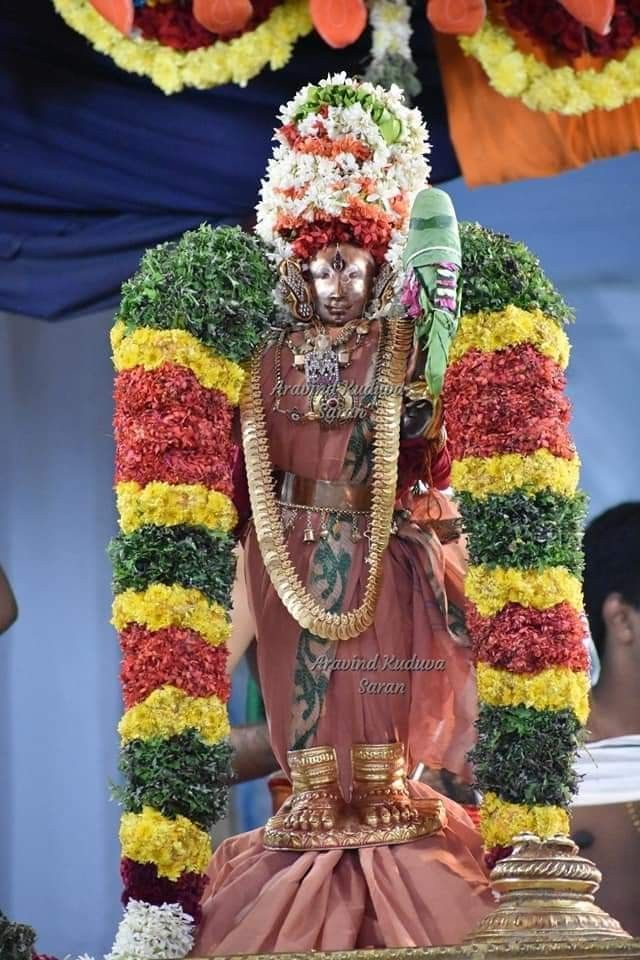
  • Goddess Andal Takes Oil Bath Srivilliputhur Ennai Kaapu

    Goddess Andal Takes Oil Bath Srivilliputhur Ennai Kaapu

    One of the special features of Hinduism is its treatment of Gods and Goddesses as human beings and interacting with them as with humans.

    God can not be known.

    But can be and is felt.

    Divine experience relates to Heart , emotions and feelings and never to Mind and Brain.

    The fact is despite all reasoning and Rationalism Man is driven by emotions and lives by it.

    The sense of devotion is heightened when one treats as one among ourselves and not some one or thing which sits in a Lofty tower wielding clubs and delivering punishment.

    I can never relate to this God.

    Goddess Andal's Hair being combed.jpg

    Goddess Andal’s Hair being combed.Margazhi Utsavam

    I relate to God as a Human Being till I spiritually evolve to know that He is a Principle.

    Till then I shall treat Him as my Father, Mother, Brother, Teacher, Lover and Friend.

    The Path of Devotion called Bhakti Marga is this.

    One gets engrossed in the emotion of God and gets spiritually elated.

    In Tamil literature there are poems belonging to the Middle Ages, around 1200 -1400 extolling this aspect of Bhakthi, propagated by Azhwars( of Vishnu) and Nayanmaras( of Shiva)

    Each temple in India is associated with the activity of God a Human Being and there are temple festivals relating to them, when these events are enacted.

    Andal Ennaikkaappu .jpg

    Andal Ennaikkaappu

    In Srivilliputhur, The Home of Andal one of the Saints of Hinduism and Vishnu Chitta, her father, both of them venerated Azhvars( which happens to be my place of Birth and early schooling) this interaction of Man and God is very much in evidence in the form of Festivals.

    One special Festival is the bathing of Andal in Oil.

    Then she is bathed with a specil bathing powder Snana Powder, whic is miles ahead of your Shampoos in therms of clearing oil and emitting fragrance)

    The she is decked up.

    Andal12118

    This is called Ennaikkappu(anointment of Oil)

    Gingelly Oil is anointed to the Utsava Murthy of Andal.

    This festival falls on the last seven days of Margazhi,Mrigasira month(December end, January first week) and one day in Thai Month(Makara Sankaranthi)

    ‘Margazhi Ennai Kappu Utsavam is presently taking place at Srivilliputtur Sri Andal Rangamannar Divya Desam. Ennai Kappu Utsavam is annually celebrated during the last eight days of the Margazhi month. During this utsavam, Andal is taken to the Ennai Kappu mandapam and thailam is applied by the Battars to Andal and the uapcharams is  performed by Archakars. The highlighted fact of this utsavam is the famous Souri kondai. There are four sessions in a day during Ennai kappu – first from moolastanam special alangarams is performed for example Azagarkolam, Krishanar kolam and Muthangi; then the second session is the Ennai kappu kollam with Andal in Souri Kondai; the third session is Thirumanajam; and the fourth session  is Vahana Seva (different vahanams on the 8 days).’

    Citation.

    http://anudinam.org/2014/01/10/srivilliputtur-sri-andal-margazhi-ennai-kappu-utsavam/

  • Rama’s Chandi Homa Details To Defeat Ravana

    I have been curious about our worship of Lord Rama and Krishna.

    Which God did Rama and Krishna worship?

    They worshiped Shiva and Devi, apart from performing the Yagnyas prescribed in the Vedas.

    Please read my Post.

    Whom did Rama worship Ramani’s blog

    Chandi Homa in progress.
    Chandi Homa in progress.


    Are there any specific Homas performed by Rama during the Ramayana Period?

    Rama seems to have performed Santhi Homa after killing Ravana and returning to Ayodhya.

    Rama's Coronation.jpg
    Rama Pattabhishekam

    He also performed a Yagnya at Buxar after His Coronation by marking the Yaagashaala with the tip of His arrow for Lord Shiva .

    This is called Ramarekhaghat in Buxar.

    Rama Ramrekha Ghat

    Apart from this Rama seems to have performed Chandi Homa to defeat Ravana.

    This was performed after Indrajith performed a Secret Yaaga to defeat Rama.

    After this Lakshmana was rendered unconscious by Inderjith.

    ‘Rama had performed “Chandi Homa” and invoked the blessings of Durga, who blessed Rama with secret knowledge of the way to kill Ravana. On the day of Ashvin Shukla Dashami, Rama defeated Ravana and rescued Sita. Thus it is termed as Vijaya Dashami. Based on the inferences from Valmiki’s Ramayana, Kalidas’s Raghuvamsa, Tulsidas’s Ram Charit Manas, and Keshavdas’s Ram Chandra Yas Chandrika as well as common perception in India, Rama, Sita, and Lakshmana returned to Ayodhya on the 30th day of Ashwin (19–20 days after Vijayadashmi). To mark the return of Lord Rama, in the evening, the residents of Ayodhya lit their city with millions of earthen lamps (called Deepak). Since then, this day is celebrated in India as Deepawali’

    Benefits of Chandi Homa.

    Chandi Homa can aid one in clearing off the obstacles and hurdles on the path to success.

    Goddess Durga, the chief deity of this Homa will gift you with the power to balance one’s passion and dispassion, indulgence and denial.

    With her blessing, one will be able to manifest your true divine Self that unites selfishness and selflessness.

    By performing this Homa, one can invoke the energy of Goddess Durga, who will help you master your life!

    Steps in Performing Chandi Homa.

    A Chandi Homa is not an ordinary Homa and has to be performed by expert priests.

    Duraga Sapthashati will be chanted.

    Ganapathy pooja: Prayers are offered to the Lord Ganesha seeking his blessings. Worshipping Lord Ganesha clears all the obstacles and paves way for one’s success. So, before any auspicious beginning, Lord Ganesha is first addressed with pooja and prayers.

    Kanya pooja: Kanya Pooja is one of the highlight of the Navaratri celebrations. Kanya pooja is a ritual of worshiping girls (aged 6 – 10) who haven’t attained puberty, symbolizing the Kanya Kumari (prepubescent) form of Goddess Chandi or Durga. This ritual is specially performed to recognize the divine feminine power vested in a girl child.

    Anugna Sankalpam: Seeking the consent of the Goddess to perform the Yagna which is a sacred ritual. The ritual specifies for whom, where and when the yagna is performed.

    Punyahavachanam: Purifying the mind, body and place before the yagna is performed. Water is sprinkled with mango leaves around the place with the chanting of Mantras.

    Kalasa Sthaapana: Kalasa means a pot. It is made of metal and is filled with water and placed with Mango leaves immersed in the water. Pooja is made to this Kalasa invoking the blessings of the goddess.

    Saptashati Parayanam: Chanting of Durga Saptashati Slokas (700 sanskrit poems) and worshipping the various forms of the Goddess. Bhairava Bhali (offering): After the chanting of Slokas, offering is made to Lord Bhairava (an incarnation of Lord Shiva) to signify the ritual.

    Ganapathy pooja: Prayers are offered to Lord Ganesha before beginning the Yagna

    Punyahavachanam: Pooja and mantras are chanted to purify the place and people who are performing the Yagna

    Gho pooja: The Sanskrit word Gho means Cow. In Hinduism, Cow is considered to be a holy animal embodied with divine qualities. Pooja and prayers are offered to the cow before the yagna, seeking her blessings for prosperity.

    Suhasini Pooja: Worshipping an elderly married woman (whose husband is alive) and performing Pada (traditional foot washing ceremony) pooja to invoke her blessings.

    Dampathi pooja: Dampathi means couple. Prayers are offered to an elderly couple with Padha pooja.

    Brahmachari pooja: A Brahmachari is an unmarried man. He is held in high esteem in Vedas and Puranas for several reasons. Padha pooja and prayers are offered to a Brahmachari seeking his blessings.

    Chandi yagna: The fire ritual is performed with the chanting of Mantras and Slokas.

    Sumangala Dravyaahuti: Auspicious materials such as Saree, turmeric, sandalwood powder, kumkum (vermillion) etc. are offered to the Goddess invoked in the Fire.

    Purnaahuti: Any Yagna becomes complete only when this ritual is performed. Betel leaves, Betel nuts, Coconut, Kumkum (red colored auspicious powder), Turmeric, Flowers, Fruits, a coin, a small bag of herbs are put together in a silk cloth and tied. The bag is dropped into the fire seeking the blessings of the Almighty.

    Maha Deeparadhana: A ritual to honor the Goddess. Lights are lit using camphor and are used to glorify the Goddess. It is also called Aarthi and is performed during the end of the pooja.