Interesting observation ,I found, in ancient voice.
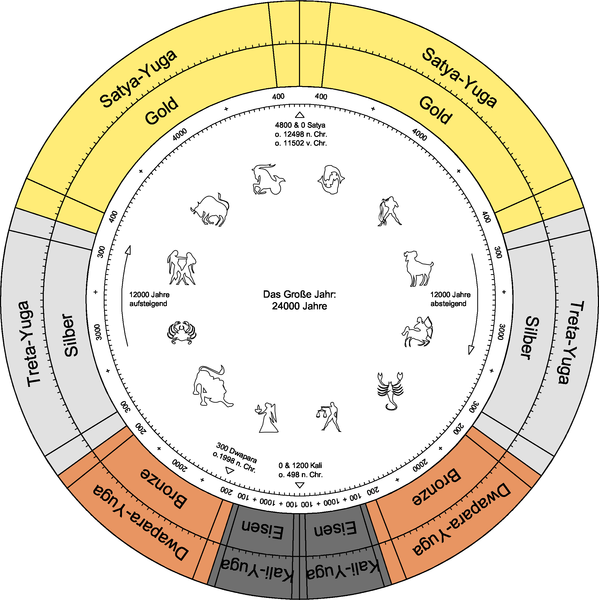
All of us know that the Ramayana took place in Treta Yuga while Lord Krishna lived in the Dwapara Yuga, which was after 8.64,000 years after Treta Yuga .
Yet cross indexing the various Purans and the Astrological data supported by actual Astronomical phenomena like Rama‘s Birth chart,Eclipses during Ramayana and Mahabharata forces one to the conclusion that Lord Rama’s Death preceded Lord Krishna’s only by 200 years.

This, I think, is not a contradiction .
The reason is that for the Hindus the Time is Cyclic , not linear.(read my post on this under Astrophysics)
That Time is Cyclic is being proved to-day by Astrophysics and Quantum Theory.(refer my posts under Astrophysics).
To put it simply events, Ramayana and Mahabharata not excluded happened , happen and will happen all at the same time,albeit at different planes of existence(read my posts under Science, Astrophysics,Hinduism- Multiverses).
Science is veering down to this view now.
And Astronomical events keep recurring at fixed time scales.
Therefore, this seeming contradiction in the Dates of Ramayana and Mahabharata.
Check out at the Link provided.
- Interestingly enough, the death of Rama precedes the death of Krishna by 200 years, if we consider that Rama died at the age of 70 and Krishna at the age of 80. Not a normal age of death, if we consider that many ancient men like Bhishma (lived close to 95 to 105 years) and Vyasa (lived around 120 years) were long lived. This 200 years is also the duration of the Dwapara Yuga.
- Arjuna‘s grandfather’s grandfather viz. Pratipa was 20 years old when Rama died.
- Nala lived in Kali Yuga and was a contemporary of Arjuna‘s grandson’s great-grandson Aswamedhadatta.
- Kalmashapada (Saudasa) was a contemporary of Rama’s sons Lava and Kusha.
- Anaranya was a contemporary of Rama’s grandfather Aja
- Hiranya Kasipu and the first Indra were contemporaries.
- Prahlada and Vaivaswata Manu were contemporaries.
- Pururavas and the great Daitya king Mahabali were contemporaries.
- Vitahavya and Divodasa of the Ikshwaku line and Bharata of Puru line were contemporaries. They ruled along with Avikshit whose birth marks the beginning of Treta Yuga.
- Pratarddana of Ikshwaku line and Bhumanyu of Bharata line were contemporaries
- Sagara of Ikshwaku line and Suhotra of Bharata line were contemporaries
- Dilipa of Ikshwaku line and Hasti of Bharata’s line who founded the city of Hastinapura were contemporaries
- Ikshwaku king Raghu and Bhagiratha were contemporaries.
- Tapati, the wife of Samvarana (of Bharata line) probably married the daughter of an Ikshwaku king (described as Surya) in the south who was a contemporary of Raghu ruling at Ayodhya. Samvarana’s son was the famous Kuru the founder of Kuru dynasty.
- The Ikshwaku kings Aja and Muchukunda were contemporaries
- King Kuru who established his rule at Kurukshetra was a contemporary of Rama’s grandfather Aja
- The Kurukshetra war hero Vrihadvala and his father Suvala, brother Sakuni and sister Gandhari were all descendants of Rama’s brother Bharata.
- Rituparna, the friend of Nala was a descendant of Rama or his brothers
- Nala (and his brother Pushkara) was a descendant of Krishna
- Kali was a descendant of Sakuni
- Karkotaka the enemy-turned-friend of Nala was a descendant of Takshaka who killed Arjuna’s grandson Parikshit
- Vaisampayana narrated ‘Bharata’ to Janamejaya 75 years after Sanjaya narrated ‘Jaya’ to Dhritarashtra.
- Ugrasrava Sauti narrated Mahabharata to Saunaka, 55 years after Vaisampayana narrated ‘Bharata’ to Janamejaya
- The crucial formative period of Mahabharata was thus 130 years. It grew even after that with additions to Santi Parva, Anusasana Parva and Vana Parva and also with minor modifications and additions to other Parvas as well.
- The same Valmiki, who was an elder contemporary of Rama authored the first two versions of Ramayana. The first version was completed soon after Rama returned to Ayodhya after killing Ravana. The second version was created after Sita was banished from Ayodhya and reached Valmiki’s hermitage. The third version was created after the death of Rama, probably by some descendant of the original Valmiki. Ramayana underwent several modifications which continued even after Mahabharata grew into Sauti-Saunaka dialog.
- Source: http://ancientvoice.wikidot.com/article:thousand-year-long-chatur-yuga#toc9
”
Related Articles
- Caste Origin Genome Study Misleading Mischievous (ramanan50.wordpress.com)
- Ramayana Mahabharata Dynasties From Manu (ramanan50.wordpress.com)


Leave a Reply to ramanan50Cancel reply