Tag: Valmiki Ramayana

  • Rama’s Sister Shanta Born 4449 BC,Abandoned By Dasaratha?

    Rama’s Sister Shanta Born 4449 BC,Abandoned By Dasaratha?

    I came across an article in a respected site that Shanta,Lord Rama’s Elder sister,Dasaratha’s daughter through Kausalya Rama’s Mother) was abandoned by Dasaratha and hence Kausalya was miffed with him.

    The article seems to have been influenced by A popular TV Serial.

    Here are the excerpts.

    The Mystery of Shanta- Lord Rama’s sister

    Of the two legendary Indian mythologies, Ramayan enjoys a priestly following amid Hindu community. Surrounded by some startling facts including that it is written by once a dacoit-turned-sage Valmiki, and written partly on the basis of what Sita explained to him, it makes Ramayan ev

    en more mystifying.

    Shanta in Ramayan

    There have been quite a few instances when not every part of story of this epic mythology was put forth for the audience to see, sometimes certain characters were kept in low limelight to highlight the importance of others. Like that of Shanta, King Dashrath’s first born; even the narration around her birth and abandonment were kept low, until only recently a popular TV show hinted to unfold a mysterious character in epic Ramayan.

     King Dashratha and Queen Kausalya were blessed by their first born, a daughter, who they named Shanta. She was the epitome of poise, peace and harmony. She grew up to be a beautiful princess with qualities of a warrior. But, King Dashrath longed for a son, to continue his reign.


    Dasharatha’s wives- Kausalya, Sumitra and Kaikeyi

    He married Sumitra and Kaikeyi with an intention to bear a son, a ruling prince for Ayodhya. But, years went by and Ayodhya never received good news of their awaiting wish to see a prince.

    Rishi Vibhandak and Urvashi

    With guilt abiding within him, King Dashrath visited Sage Vashishta to seek an answer to his miseries. Vashishta told him about Sage Vibhandak, whose strict penance to achieve great power scared Lord Indra. Thus, he ordered a celestial paramour Urvashi to intervene his yogic activity.

    Rishi Rishyasringa

    As a result of which Sage Vibhandak got distracted, and his alliance with Urvashi bore him a son Sage Rishyasringa. Vibhandak pledged to raise his son alone in an isolated society, with no mention of womenfolk or even their existence.

     King Dashratha was informed that if only a woman with great power could manage to bring Rishyasringa into a family world, then the Putrakameshti Yagya performed by him could bear the former sons.


    Marriage of Shanta and Rishi Rishyasringa

    Dashratha, out of desperation and helplessness abandoned his daughter Shanta and asked her to bring Sage Rishyasringa. She followed her father’s order and, despite Queen Kausalya’s plea to stay back, Shanta gave up princely life and went to live with Rishyasringa.

       https://www.speakingtree.in/allslides/why-king-dashrath-abandoned-his-daughter-and-lord-ramas-sister-shanta/369981

    Sage Rishyasrunga,at the request of Dasaratha performed the Putrakameshti Yaaga to beget sons and Dasaratha was blessed with four sons,Ramayana,Bharathanatiyam,Lakshmana and Shatrugna.

    Valmiki Ramayana is the authority for Ramayana.

    Here is what Valmiki Ramayana says,

    ‘ ikSvaakuuNaa.m kule jaato bhaviSyati sudhaarmikaH |

    naamnaa dasharatho naama shriimaan satyapratishravaH || 1-11-2

    2. ikshwaaknaam= in Ikshwaku; kule+jaato= dynasty, born in; su+dhaarmikah= very virtuous one; naamna= by his name; Dasaratha; naama= named; shreemaan= resplendent one; satyapratisravah= truthful to his vow.

    ” A king named Dasaratha will be born into Ikshwaku dynasty who will be very virtuous, resplendent and truthful to his vow.” [said Sanat Kumara, the Sage] [1-11-2]

     a~nga raajena sakhyam ca tasya raaj~no bhaviSyati |

    kanyaa ca asya mahaabhaagaa shaa.ntaa naama bhaviSyati || 1-11-3

    3. angaraajena= with the king of Anga; sakhyam= friendship; tasya+raajno= to that, king [to Dasaratha]; bhavishyati= will happen; kanyaa=daughter; cha+asya= also of him [King of Anga]; mahaabhaagaa= great women; Shanta; naama= named one; bhavishyati= will born.

    ” King Dasaratha will befriend the king of Anga and he, the King of Anga will beget a great girl named Shanta. [1-11-3]

     putrastu so~Ngaraajasya romapaada iti shrutaH |

    tam sa raajaa dasharatho gamiSyati mahaayashaaH || 1-11-4

    4. putrastu= son of; sah= him [ Anga, the king of Anga]; Romapaada; iti+shrutah= thus heard; tam= to him; sah+raajaa= that king; Dasaratha; gamishyati= goes; mahaayashah= the well renowned.

    The son of King Anga [the original king of Anga kingdom after whom the kingdom is named] will be known as King Romapaada and to him goes the well renowned King Dasaratha. [1-11-4]

     anapatyo.asmi dharmaatman shaa.ntaa bhartaa mama kratum |

    aahareta tvayaa aaj~naptaH santaanaartham kulasya ca || 1-11-5

    5. anapatyah= childless; asmi= I am; dharmaatman= Oh! Righteous One; Shaantaa+bhartaa= Shanta’s husband; mama+kratum= my, Vedic ritual; aahareta= shall preside over; twaya= by you; aajсpta= be instructed; santaanaartham= cherishing children; kulasya+cha= for dynasty also.

    [Then King Dasaratha says to King of Anga] “Oh! Righteous One, I am childless and hence I intend to perform a Vedic ritual. Shantaa’s husband [Sage Rishyasringa] shall preside over that Vedic ritual that enhances my dynasty, at your instruction. [1-11-5]

     shrutvaa raaj~no.atha tat vaakyam manasaa sa vici.ntya ca |

    pradaasyate putravantam shaa.ntaa bhartaaram aatmavaan || 1-11-6

    6. shrutvaa= having heard; rдjnah= King’s, Dasaratha’s; tad+vaakyam= those words; manasaa= heartily; vichintya= considered; cha= also; pradaasyate= will give, will allow; putravantam= one who endows children by his boons; Shaanta+bhartaaram= Shanta’s husband; aatmavaan= that benevolent soul.

    ” That benevolent soul, [Romapaada, the king of Anga] on hearing those words of King Dasaratha, considers heartily and he gives away [will allow] Shanta’s husband, [i.e., his son-in-law, Sage Rishyasringa] one who endows progeny with his boons [to go along with King Dasaratha.] [1-11-6]

     shaa.ntaa tava sutaa raajan saha bhartraa vishaam pate |

    madiiya nagaram yaatu kaaryam hi mahadudyatam || 1-11-19

    19. shaantaa= Princess Shantaa; tava+sutaa= your, daughter; raajan= Oh! King; saha= along with; bhartraa= her husband; vishaampte= Lord of subjects; madeeya= my own; nagaram= city; yaatu= may go over; kaaryam= a deed, the ritual; hi= verily[because]; mahat= great one; udyatam= is contemplated[by me].

    ” Oh! King, the Lord of Subjects, Princess Shaanta your daughter, along with her husband Sage Rishyasringa may go over my city Ayodhya, as I contemplate [to perform] a great Vedic ritual, which is great deed. ” [Said Dasaratha] [1-11-19]

     Reference and citation.

     http://www.valmikiramayan.net/bala/balaitrans11.htm

    There no evidence that Shanta was Dasaratha’s Daughter,according to Valmiki.

    However, Sri.B.G.Kanuja,in his book Immortal Love of Ramayana, writes that Shanta was Dasaratha’s Daughter and was given in adoption to Romapada.

    She was born on 12th March,4449 BC.

    He quotes Valmiki Ramayana ,Canto 9 (?),Sloka 12?

    I am unable to find the reference.

    Scholars may clarify.

    And there is no evidence Dasaratha abandoned her.


    https://books.google.co.in/books?id=zHgW9SezCqoC


    “> https://books.google.co.in/books?id=zHgW9SezCqoC&lpg=PA48&dq=shanta%2Cramayan&pg=PA48&output=embed

  • Advaita Ramayana Adhyaatma Ramayana  Pdf

    Advaita Ramayana Adhyaatma Ramayana Pdf

    Over a Thousand versions of Ramayana ,one of the two Great Epics of India,the other being Mahabharataha!

    Of these versions many are in Sanskrit in which it was composed and that too by the same author,Sage Valmiki.

    Some versions are meant for Higher Beings,some abridged,and some short and some stressing the Abstract Reality embodied in Lord Ramachandra,the Emperor of India.

    Ramachandra was also the Emperor of the entire landmass on Earth and He is mentioned in ancient texts of the world including the Sumerian Kings List.

    He was also referred to as RA and Rama worship is found in Americas ,Africas and ancient Europe.

    While there are various versions in Sanskrit, in regional languages of India and in the Far East,all of them are in agreement with the fact that he was a Historical personality and not a figment of imagination of a creative poet.

    Notwithstanding language barriers and the varied locations where/in which the Ramayana is composed,basic facts mentioned by Sage Valmiki in his Ramayana are adhered to.

    In some versions certain changes are made in the narrative to enhance the quality of the literary work and the poets ensure that hints are made available in the text that there are such variations from Valmiki Ramayana.

    While some of these versions enhance the quality of the work through characterisations,some provide more details in respect of Geography:some include the regional customs.

    As the very name Ramayana implies Ramayana is the ‘Path of Rama’.

    Rama Ayana meaning Path followed by Rama.

    The Path travelled by Rama during his life was marked as Ideal and as such is recommended for people as it is deemed to be the Righteous one.

    As Rama was not a fictional character,the writers felt that it would be more authentic to present Rama as the Ideal one to follow for He was Real.

    There are some versions which are subtle and they convey the message of various philosophical concepts of Hinduism that are to be practiced by one to Realize the Self,Brahman.

    One can read the Valmiki Ramayana as History and also as an explanation of Karma yoga and lokayata,the worldly way of performing one’s duties in accordance with Dharma,come what may.

    There are some versions that stress on the Divine aspect of Rama and emphasize Bhakti yoga,the Path of Surrender to God.

    Saint Tulsidas’s Ramcharitamanas belongs to this category where RamaBhakti takes priority and as Bhakti yoga implies Duality or Qualified Duality.

    Dwaita and Visishtadvaidha,are two aspects of the Reality,Brahman as explained in the Vedas.

    The other system Vedic Thought on Reality needs to be brought out.

    This Thought is Advaita,the system that explains the Reality as One,non dual, Advaita.

    This aspect is brought forth in Adhyaatma Ramayana.

    It is said to have been composed by Veda Vyasa,the compiler of the Vedas and the Puranas.

    There is also a view that Adhyaatma Ramayana was composed during the middle ages.

    Adhyaatma Ramayana stresses Advaita system of them,made popular later by Adi Shankaracharya .

    The Advatic thought runs through Adhyaatma Ramayana and the Rama Gita, where Rama’ discourse on Reality to Lakshmana is pure Advaidha.

    The term Adhyaatma Ramayana indicates it to be Advaidha.

    the Sanskrit scriptures have a very precise definition of the word spirituality (adhyatma): “aatmani adhi iti adhyatma”, meaning all that which is performed in accordance with the wishes of the soul (aatma)is spirituality.

    From Bhagavad Gita, 8.3 : अक्षरं ब्रह्म परमं स्वभावोऽध्यात्ममुच्यते । means:

    The indestructible, transcendental living entity is called Brahman, and his eternal nature is called adhyātma, the self.

    The text represents Rama as the Brahman (metaphysical reality), mapping all saguna (attributes) of Rama to the nirgunanature (ultimate unchanging attributeless virtues and ideals). Adhyatma Ramayana raises every mundane activity of Rama to a spiritual or transcendent level, the story into symbolism, thus instructing the seeker to view his or her own life through the symbolic vision for his soul, where the external life is but a metaphor for the eternal journey of the soul in Advaita terminology.

    The book is aimed to be used as a guide and a ready source of instruction for a spiritual seeker, as it presents the Ramayana as a divine allegory.

    Adhyaatma Ramayana has Seven Cantos,Chapters,4500 verses.

    Apart from this there are variations to Valmiki Ramayana in Adhyaatma Ramayana.

    These are,

    Comparison with Valmiki Ramayana

    In a study of Adhyatma Ramayana it is essential to know where it differs from the Valmiki Ramayana.

    Valmiki’s object seems to describe Rama as an ideal human character though he accepts him as an avatarof Maha Vishnu; but the divinity of Rama is always kept latent. This objective of Valmiki is made clear at the very beginning of the epic in verses 1 to 18 of Chapter 1 of Bala Kanda. Here Valmiki asks Narada the following questions:

    1. “Who in the world today is a great personage, endowed with all virtues, who is courageous, who knows the secret of Dharma, who is grateful, who is ever truthful and who is established in sacred observances”?

    2. “Who has great family traditions, who has got sympathy for all creatures, who is most learned, who is skilful, and whose outlook is ever kindly”?

    3. “Who is courageous, who has subdued anger, who is endowed with splendor, who is free from jealousy, who, when angry in the field of battle, is a terror even to the Devas”?

    In reply to this question, Sage Narada narrated in brief the entire Rama Katha which formed the basis for Valmiki to expand and make it a vast, beautiful and unique epic poem of great literary value which came to be called Valmiki Ramayana. (Narada’s brief exposition of Rama Katha to Valmiki is called ‘Sankshepa Ramayana’ which is used in many households for the purpose of daily recitation).

    The object of an epic which begins with such a description of its hero is obviously to give us a picture of human perfection. But this does not mean that Valmiki did not recognize divinity in his hero. When a person is described as a Deity, it happens that ordinary human beings start worshipping him and are not inclined to treat him as a role-model to imitate and follow. This probably must have been the reason for Valmiki to propound the divinity of Rama in subdued tones and paint him prominently as a great human being with all the human frailties and weaknesses so that the people at large may learn from his life.

    While Valmiki’s great epic is the saga of Rama in respect of its direct approach, Adhyatma Ramayana is a direct elaboration of its spiritual implications. In the former Rama is a great hero, in the latter he is a deity- Maha Vishnu, covered in thin apparel – held before all to worship. This is made clear in the very first chapter of the book entitled ‘Sri Rama Hridaya”.

    The text of Adhyatma Ramayana projects Rama as the Supreme Self; but while doing so it takes care to see that Rama is also a Personal Deity, the Supreme Isvara, who is to be prayed and sought after by all those who seek knowledge of non-duality. It teaches Bhakti of the most intensive type and stresses that through devotion to Rama alone the saving Jnana would arise in the Jiva. The teaching of the Adhyatma Ramayana is an extension of the declaration of the Svetasvatara Upanishad, “it is only in one who has supreme devotion to God and to his spiritual teacher that this truth – knowledge of the non-dual Self – when taught will shine”.

    Thus to establish Rama’s divine status, as an object of worship and devotion and to teach that Bhakti and Jnana are not only reconcilable but always go together is the prime object this great text. In order to achieve this objective, the Adhyatma Ramayana, while sticking to the main trends and incidents of the Rama Katha described in Valmiki’s epic, makes various deviations in the course of its extensive narration. A few such instances are cited below.

    ….

    The major alteration in the fact of the story found in the Adhyatma Ramayana is the introduction of a “Shadow Sita” throughout the period of her abduction. The real Sita disappears into fire just before the golden deer episode. Tulasidasa also follows the Adhyatma Ramayana in this respect.

    Compare Tulasi’s Sri Ramacharitamanasa, Aranya Kanda, Doha 23 and the Chopai: “When Lakshmana had gone to the woods to gather roots, fruits and bulbs, Sri Rama, the very incarnation of compassion and joy, spoke with a smile to Janak’s daughter (Sita):- Listen my darling, who have been staunch in the holy vow of fidelity to me and are so virtuous in conduct: I am going to act a lovely human part. Abide in fire until I have completed the destruction of the demons.”

    “No sooner had Sri Rama told Her everything in detail than she impressed the image of the Lord’s feet on Her heart and entered into the fire, leaving with Him only a shadow of Hers, though precisely of the same appearance and the same amiable and gentle disposition. Lakshmana, too, did not know the secret of what the Lord had done behind the curtain.”

    In the Adhyatma Ramayana, Sita emerges from the fire at the end of the war when the shadow Sita enters into it. (The whole drama is preplanned and enacted at the bidding of Sri Rama Himself).

    Other alterations in the Adhyatma Ramayana include: Ravana treats Sita with the respect due to a mother and Sri Rama establishes a Sivalinga at the site of the bridge to Lanka.

    The major contribution of the Adhyatma Ramayana lies in the casting of Rama in the role of the spiritual teacher and in the several exquisite hymns sung in praise of Rama. There are four occasions when Rama assumes the role of the teacher and gives philosophical disquisition.

    Rama reveals himself as four-handed Mahavishnu at his very birth, a feature that is not seen in Valmiki

    Sage Valmiki depicts Sri.Rama as an ideal man while admitting his divinity, whereas Sage Vyasa present him as the Supreme Being incarnate with the full remembrance of his divinity and the recognition of it by all wise men.

    In response to Lakshmana’s questions on different occasions he teaches knowledge, devotion and detachment, methods of worship and the way of emancipation. In reply to Kaushalya’s query, Rama teaches the three Yogas of Karma (action), Jnana (knowledge) and Bhakti (devotion).

    The well known Ramagita is part of Adhyatma Ramayana. It contains teachings on Advaita Vedanta. The real contribution of this work is in its repeatedly propounding the doctrine that Rama is Brahman the Absolute and that Sita is His Maya-shakti or Prakriti, thereby raising the personality of Rama to the highest level and providing a firm base to the worship of Rama.

    Ahalya the wife of Sage Gautama is in invisible form in the Valmiki Ramayana, whereas in the Adhyatma she has been depicted in the rock form.

    In the Ayodhya Kanda of Adhyatma Ramayana the section opens with a visit of Sage Narada to Sri. Rama to remind him of the purpose of his incarnation, which Sri. Rama acknowledges. All these incidents are not in Valmiki.

    In the Adhyatma, banishment of Sri Rama is accomplished by the Devas through Goddess Saraswathi, by possessing the two women i.e. maid servant Manthara and Kaikeyi. In Valmiki this incident is explained as a simple court intrigue.

    Sage Valmiki’s evil past has been explained in detail in Adhyatma, but not in the other.

    In Adhyatma, Lakshmana requests Rama to instruct him on the means of attaining Salvation. Rama also gives him an elaborate discourse on Jnana and Bhakti, conveying the quintessence of Vedanta. This is not there in Valmiki Text.

    According to Adhyatma, Ravana is aware of the fact that Sri. Rama in human form is Lord Vishnu incarnated to kill him. Ravana is also aware of the fact that destruction at Sri. Rama’s hand is easier way of gaining salvation than through spiritual practices (devotion through confrontation – an example for vidvesha bhakti).

    In Adhyatma – unknown to Lakshmana, Rama informs Sita that Ravana will be coming to abduct her, and that therefore he is handing her over to the Fire deity Agni for safe custody, till he takes her back again. In her place Maya Sita is left in Asrama, and it is this illusory Sita that Ravana abducts. This is unknown in the Valmiki.

    In Valmiki, it is Kabandha who advises Sri. Rama to make friends with Sugreeva and gives details about the place of his residence, whereas in Adhyatma it is ascetic Sabari who first tells Rama about Sugreeva and informs him that Sita is confined in Ravana’s palace.

    After the death of Vali it is Hanuman who consoles Tara in Adhyatma Ramayana, whereas in Valmiki Sri. Rama gives her an elaborate advice of philosophy of Vedanta and the practice of devotion, besides consoling her.

    In Adhyatma while Rama is staying at Mount Pravarshana after the coronation of Sugreeva, he gives an elaborate discourse to Lakshmana on the ritualistic worship of Lord Maha Vishnu (i.e Himself), thus revealing his identity with the Supreme Being openly.

    Swayamprabha comes to meet Rama and praises Him, identifying him as Supreme Being. According to the advice of Rama she goes to Badari to attain Mukthi.. This episode is absent in Valmiki.

    Sampati gives an elaborate discourse to the monkeys who meet him He quotes Sage Chandramas, while telling about the divinity of Sri. Rama. This incident is available in Adhyatma only.

    A conspicuous addition in the Adhyatma is Rama’s installation of the Sivalinga in Rameswara, before the construction of Sethu for the success of the enterprise. Rama also declares about the merit of Pilgrimage to Rameswara and Sethu Bandha here. These elaborations are not available in Valmiki.

    Sri Rama is well aware of his divinity during the Nagapasa missile episode and Garuda’s arrival to release them. In Valmiki, Rama is not aware of his Divinity till the end when Brahma imparts that knowledge to him.

    Kalanemi obstructs Hanuman while he is on his way to bring Mritasanjivani, a herb that can revive one who is almost dead. This incident is absent in Valmiki.

    Narada praises Rama after the death of Kumbakarna in Adhyatma. This is absent in Valmiki.

    Killing of Maya Sita by Indrajit and illusion created thereon by black magic is available in Valmiki but not in Adhyatma

    Before going to battle Ravana, for gaining invincibility in fighting, begins fire rite, as per the advice of his guru Sukra. This rite is blocked and stopped by the monkeys. These incidents are absent in Valmiki Ramayana.

    Rama cuts down the heads of Ravana repeatedly, but could not kill him. Vibhishana informs Rama that Ravana has got amrita deposited in his umbilicus and that until it is removed he cannot be killed. This is available in Adhyatma Ramayana. But in Valmiki Ramayana as per the advice of Sage Agasthya Rama chants Adhithya Hrudaya and worships Lord Soorya to kill Ravana.

    According to Adhyatma on the death of Ravana, his spirit, having luminosity of lighting enters into Rama and attains salvation. This explanation finds no place in Valmiki.

    After the death of Ravana, Sita’s fire ordeal is only to replace the Maya Sita by Rama. The whole event is given the appearance of a real ordeal in Valmiki.

    In Adhyatma Ramayana every one praises and chants the hymn on Rama starting from Vamadeva, Valmiki, Bharadwaja, Narada, Viradha, Sarabanga, Sutikshna, Agasthya, Viswamitra, Vasishta, Jatayu, Kabhanda, Sabari, Swayamprabha, Parasurama, Vibhishana, Hanuman etc. This is absent in Valmiki.

    Reference and block quote citation.

    Visit the following link for quality information on Hinduism.

    http://stotraratna.sathyasaibababrotherhood.org/adr2.htm

    For download of Adhyaatma Ramayana in Sanskrit with English Translation by MSri. Munilal

  • Flowers Trees Plants Fruits in Rama Vanvas True,Research Proves

    I had written how the elephant described by Valmiki in Ramayana has been useful  in arriving at the date of Ramayana.

    The animal is extinct now.

    Places visited by Rama, Valmiki Ramayana.image.
    Places visited by Rama

    In the Valmiki Ramayana, Sundara-Kanda (or Book 5), Chapter 4, verse 27, [Gita Press, Gorakhpur, India] it explains that when Hanuman first approached Ravana’s palace, he saw the doorways surrounded by horses and chariots, palanquins and aerial cars, beautiful horses and elephants, nay, with four-tusked elephants decked with jewels resembling masses of white clouds.

    Elsewhere in the Valmiki Ramayana, Sundara-Kanda (or Book 5), Chapter 27, verses12, an ogress named Trijata has a dream of Lord Rama, which she describes to the other demoniac ogresses upon awakening. In that dream she sees Rama, scion of Raghu, united again with Sita. Sri Rama was mounted on a huge elephant, closely resembling a hill, with four tusks.

    (The question is how could there be a mention of the elephants with four tusks unless Valmiki and the people of his era were familiar with such creatures? A quick search on the Encarta Encyclopedia will let us know that these four-tusked elephants were known as Mastodontoidea, which are said to have evolved around 38 million years ago and became extinct about 15 million years ago when the shaggy and two tusked Mastodons increased in population.”)

    Valmiki does not lie.

    His facts check out in Geographical descriptions and astronomical events.’

    This finding dates Ramayana beyond one million years!

    Now a recent study by researchers have unearthed evidence that proves the information by cross checking the Flora described by Valmiki in Ramayana in the areas traveled by Lord Rama and described in the Ramayana.

    Source.https://ramanisblog.in/2015/06/14/rama-date-one-million-years-ago-gomphotheriidae-elephant-proof/

    182 plants (including flowers, trees, fruits) mentioned in the Ramayan have been found to be true. M Amrithalingam and P Sudhakar, the two botanists working with the CPR Environmental Education Centre, Chennai, said they could confirm the existence of the flora and fauna mentioned by Valmiki in the Ramayan.

    “We tracked the route travelled by Lord Ram, Sita and Lakshman from Ayodhya in the north to south as part of their exile to the forest for 14 years. To our surprise, we could identify all the plant species in the Ramayan mentioned by Valmiki along this route,” Amrithalingam told The Pioneer. As a taxonomist, Sudhakar confirmed the plant variety with their Sanskrit and Latin names.

    The duo commenced their journey from Ayodhya and reached Chitrakuta’s tropical and deciduous forest. “Valmiki knew his flora, fauna and the geography. What we found was that the same flora and fauna existed in the same places as written in the epic,” pointed out Nanditha Krishna, director, CPREEC, who supervised the project.

    According to Krishna, the Ramayan is geographically very correct. “All sites in their route are still identifiable and has continuing traditions . It is not possible for a person to just write something out of his imagination and fit it into local folklore for greater credibility. Valmiki has not erred anywhere while specifying the plant species, flowers and wild animals,” she said.

    Sudhakar pointed out that in the Ramayan, Ram, Sita and Lakshman were warned to be cautious while they entered Dandakaranya forests. “This forest had lions and tigers. Now there are no lions in the area. This is because they were killed by poachers over the centuries. But the rocks in the famous Bhimbetka has prehistoric paintings of lion and tigers together which confirm Valmiki’s observation,” he said.

    Amrithalingam and Sudhakar journeyed from Dandakaranya to Panchavati and Kishkinda. “We found that Kishkinda has a dry and moist climate which synchronises with what Valmiki has authored,” said Amrithalingam.

    http://www.dailypioneer.com/todays-newspaper/ramayan-era-plants-bear-witness-to-vanvas-route.html )

    Detailed research paper.

    The article presents a list of plants mentioned in Ramayana one of the two great epics of this country which has been compiled and the probable equivalent botanical names have been fixed. This study will be useful to the botanists, palaeo – botanists, ethonobotanists, foresters, naturalists and environmentalists as well. ‘

    Flora described in the Ramayana found in the areas traveled by Rama.

    Link.

    Pdf

  • Ramayana Sugreeva To Hanuman Describes Tamil Chera Chola Pandya Kingdoms

    Ramayana Sugreeva To Hanuman Describes Tamil Chera Chola Pandya Kingdoms

    Some time back there was a comment for one of my articles that there is no reference to Tamil Kings and Tamil Kingdoms in the Valmiki Ramayana. nd that I am making this up only to make Tamil and Tamils look ancient!
    Funny that it was nade by a gentleman in/from Tamil Nadu!

    Readers of Ramanis blog are aware that I do not promote or align my self to any language or region and I present facts as available in Indian and reliable foreign texts.

    The purpose of Ramanis blog is to get rid vof the misinformation spread over thecpast few cetuiries about India and Sanatana Dharma and to clear the cobwebs about Hinduism that had crept in because of not referring to original sources including Vedas , Puranas and Ithihasas.

    It is also aimed at sourcing ancient languages of India,Sanskrit , Tamil Brahmi texts along with other world languages cultures and Religion.

    I am aware that the other languages of India are also ancient have  vast information.

    I shall take them up too.

    These two languages have been taken up because I know something about these.

    Now the Tamil Kingdoms of Chera, Chola and Pandyas are described by Sugreeva to Hanuman and Angadason of Vaali, when Sugreeva directs them to routes to be taken by themthe places to search for Sita, who was kidnapped by Ravana.

    These verses appear in the Valmiki Ramayana.

    I am providing the text of slokas and translation hereunder.

    Valmiki Ramayana,Sundarakanda, Slokas 1 to 49.

    ‘Sugreeva sends Vanara-s to southward which troop includes Hanuma, Jambavanta, Niila and others and Angada is its leader. Sugreeva gives a vivid picture of the southern side of Jambu dviipa up to the south-most part of passable regions, next to which the abode of Yama, the Terminator is there. This troop is also given one month’s time to find the whereabouts of Seetha.

    tathaa vangaan kalingaam ca kaushikaan ca sama.ntataH |
    anviikSya daNDaka araNyam sa parvata nadii guham || 4-41-11
    nadiim godaavariim caiva sarvam eva anupashyata |
    tathaiva aandhraan ca puNDraan ca colaan paaNDyaan keralaan || 4-41-12

    11, 12. tathaa= like that; vangaan kalingaam ca=, Vanga, Kalinga [kingdoms,] also; sam antataH= verily, at its fringes; available; kaushikaan ca= Kaushika [territories,] also; you search and then; sa parvata nadii guham daNDaka araNyam = with, mountains, rivers, Dandaka, forest, caves; anviikSya= on seeing – on searching Dandaka; godaavariim nadiim caiva= Godavari, river, also, thus; tathaiva= like that; aandhraan ca= Andhra territory; puNDraan ca colaan paaNDyaan keralaan= Pundra, Chola, Paandya, Kerala [provinces]; sarvam eva= all of them; anu pashyata= closely, see – make a through search.

    “Like that Vanga, Kalinga territories shall be searched along with Kaushika territories available on their fringes, then cast about the Dandaka forest all over its mountains, rivers, and its caves, then River Godavari that courses through Dandaka forest, and then the provinces of Andhra, Pundra, Chola, Paandya, Kerala are to be searched thoroughly. [4-41-11, 12]

    Some other mms have Matsya desha in this verse instead of the Vanga desha. The Vanga is the present day Bengal and this territory retained its epical name, but while pronouncing it becomes banga because the Sanskrit grammar allows to pronounce or write va as ba by the rule va ba yoH abhedaH and thus it is called Baangla or Bengal as British used to call. Kaushika in some other mms is read as kaashika. Kalinga is Orissa which touches Bengal at its north, and it is the Kie-ling-kia as said by Huet Tsang.

    The Andhra is the present day Andhra Pradesh and Chola is the present Tamil Nadu, especially northern area, and Pundra is roughly in between Andhra and Chola. Paandya is south-most area where in Kanyakumari district the Cape Camorin is there, and Kerala is the present Kerala state from Gokarna to Kanyakumari. Its historical name was chera raajya and in Ashoka’s time, it was called kerala putra.

    ayomukhaH ca ga.ntavyaH parvato dhaatu maNDitaH |
    vicitra shikharaH shriimaan citra puSpita kaananaH || 4-41-13
    suca.ndana vanoddesho maargitavyo mahaagiriH |

    13, 14a. dhaatu maNDitaH= with ores, crowded with; vi citra shikharaH= verily, amazing, with crests; shriimaan= prosperous [mountain]; citra puSpita kaananaH = motley, flowered, with forests; such a; ayaH mukhaH parvataH= iron, mouths, mountain – a mountain having iron-ore mines in the shape of mouths, namely Mt. Malaya]; gantavyaH= reachable – you shall go to; su candana vanaat deshaH= best, sandalwood trees, with copses, places; mahaa giriH maargitavyaH = great mountain, is to be searched.

    “You shall go to the prosperous Mt. Malaya which is crowded with iron-ore mines as its vast mouths, and with amazing crests and motley flowered forests. Search shall be carried out on that great mountain in the places that are with the copses of sandalwood trees. [4-41-13, 14a]

    This Mountain is also called Agastyamalai and it is in Western Ghats from which River Tamraparni emerges.

    tataH taam aapagaam divyaam prasanna salilaashayaan || 4-41-14
    tatra drakSyatha kaaveriim vihR^itaam apsaro gaNaiH |

    14b, 15a. tataH= from there; divyaam= divine one; prasanna salila ashayaan= limpid, waters, receptacle of; apsaraH gaNaiH vihR^itaam = by apsara, throngs, make pleasure-trips; taam kaaveriim= her, Kaveri; aapa gaam= water, flowing [river]; tatra drakSyatha = there, you shall see.

    “From there you shall go and see the divine River Kaaveri there, a receptacle of limpid waters, to where throngs of apsara-s will be making pleasure-trips. [4-41-14b, 15a]

    The River Kaaveri is the best river in southern peninsula of India that flows from Braham Giri Mountains in Coorg of Western India to the East draining in Bay of Bengal and irrigating a major chunk of land. Many legends are associated with this river, of which one is that when Sage Agastya was bringing waters of River Ganga, they sprinkled from his kamandulau, the handy water-vessel, and flooded like Kaaveri. The original Tamil name is kakaviri where kaakam is ‘crow…’ viri ‘spread out…’ When Agastya is bringing water it sprinkled from his handy vessel and flooded the kaa ‘the garden…’ in Tamil, the garden of Indra. Then it is called kaaviri, but Shilpadikkaaram records its name as Kaaveri only pulavoy vazhi kaaveri… nadanthai vazhi kaaveri…

    tasya aasiinam nagasya agre malayasya mahojasam || 4-41-15
    drakSyatha aaditya sa.nkaasham agastyam R^iSi sattamam |

    15b, 16a. mahaa ojasam= highly resplendent [mountain]; tasya malayasya nagasya agre = of that, Mt. Malaya, mountain, on the top of it; aasiinam= who is sitting; aaditya sankaasham= Sun, in similarity; R^iSi sattamam agastyam drakSyatha= Sage, the eminent, Agastya, you shall see.

    “You shall see the eminent sage Agastya, whose resplendence is akin to that of the Sun, and who will be sitting on the top of that highly resplendent Mt. Malaya. [4-41-15b, 16a]

    saa candana vanaiH citraiH pracChannaa dviipa vaariNii || 4-41-17
    kaantaa iva yuvatii kaantam samudram avagaahate |

    17b, 18a. citraiH candana vanaiH = with amazing, sandalwood trees, copses; pracChannaa dviipa vaariNii= with overlapped, islands, water; saa= she [the river]; yuvatii= a young woman [Taamraparni]; kaantaa = one who is yearning for; kaantam iva= for whom she is yearning – her love, as with; samudram= to ocean; avagaahate = [she will be] rendezvousing.

    “She whose water is overlapped with amazing copses of sandalwood trees and islands that River Taamrapani will be drifting for a rendezvous with her much yearned lover, namely the ocean, as with a young woman who will be coursing to have a rendezvous with her yearned lover. [4-41-17b, 18a]

    tato hemamayam divyam muktaa maNi vibhuuSitam || 4-41-18
    yuktam kavaaTam paaNDyaanaam gataa drakSyatha vaanaraaH |

    18b, 19a. vaanaraaH= oh, vanara-s; tataH= from there; yuktam= joined to – braced to the wall of fortress; hemamayam divyam= full with gold, beautiful one; muktaa maNi vibhuuSitam= pearls, gemstones, decorated with; paaNDyaanaam kavaaTam= of Paandya [kingdom’s,] castle-door; gataaH= having gone there; drakSyatha= you shall see; search inside that gateway.

    “From there, on going to the Paandya Kingdome you shall see a fully golden castle-door bracing the compound-wall of the fortress, which is decorated with pearls and jewels, and conduct your search even in that kingdom. [4-41-18b, 19a]

    tataH samudram aasaadya sa.mpradhaarya artha nishcayam || 4-41-19
    agastyena antare tatra saagare viniveshitaH |
    citra saanu nagaH shriimaan mahendraH parvatottamaH || 4-41-20
    jaata ruupamayaH shriimaan avagaaDho mahaarNavam |

    19b, 20, 21a. tataH samudram aasaadya= then, [southern] ocean, on reaching; artha nishcayam sampradhaarya = purpose’s, resolve, on resolving; agastyena= by Agastya; tatra= there; saagare antare vi niveshitaH= in ocean, inside, verily, penned up [one end of mountain]; citra saanu nagaH= one with marvellous, terraces, trees; shriimaan mahendraH = glorious, Mt. Mahendra; parvata uttamaH= among mountains, best one; jaataruupamayaH= completely golden; shriimaan mahaa arNavam= august [Mt. Mahendra,] into great, ocean; avagaaDhaH= will be steeping in.

    “Then on reaching the southern ocean, and on taking a resolve with regard to the purpose of your task, viz., importance of the mission undertaken vis-à-vis your individual capacities to leap the ocean, you reach the glorious Mt. Mahendra. Sage Agastya once penned its one end in the ocean, and the other end is now visible. That august and best one among all mountains will be completely golden with marvellous terraces and trees, and it will be steeping into ocean on the other side of land, and this mountain becomes the jumping-off point for you vanara-s. [4-41-19b, 20, 21a]

    naanaa vidhaiH nagaiH phullaiH lataabhiH ca upashobhitam || 4-41-21
    deva R^iSi yakSa pravaraiH apsarobhiH ca sevitam |
    siddha caaraNa sa.nghaiH ca prakiirNam sumanoharam || 4-41-22
    tam upaiti sahasraakSaH sadaa parvasu parvasu |

    21b, 22, 23a. naanaa vidhaiH= numerous, sorts of; phullaiH nagaiH= with flowered, trees; lataabhiH ca upashobhitam= with climbers, also, glorified; deva R^iSi yakSa pravaraiH= by gods, sages, yaksha-s, important ones; apsarobhiH ca= by apsara-s, even; sevitam= adored; siddha caaraNa sanghaiH ca = by siddha-s, caarana, groups of, also; pra kiirNam= well, overspread; su manaH haram= truly, heart-stealing [for a look]; tam= it – to that mountain; sahasraakSaH= Thousand-eyed Indra; parvasu parvasu= on auspicious day, on auspicious day – on every auspicious day; sadaa = always – regularly; upaiti= he comes.

    “Mt. Mahendra is glorified with numerous kinds of flowered trees and climbers. Important gods, sages, yaksha-s and even apsara-s will adore it, and it is overspread with the groups of siddha-s and caarana-s, and thus it will be heart-stealing for a look. And the Thousand-eyed Indra will always be visiting that Mt. Mahendra on every auspicious day. [4-41-21b, 22, 23a]

    dviipaH tasya apare paare shata yojana visR^itaH || 4-41-23
    agamyo maanuSaiH diiptaH tam maargadhvam sama.ntataH |

    23b, 24a. tasya= its – Mt. Mahendra’s; apare paare= on the other, shore; shata yojana visR^itaH= hundred, yojana, in breadth; maanuSaiH= by humans; a + gamyaH = not, passable; diiptaH= a dazzling; dviipaH= island – is there; tam samantataH maargadhvam = that, till its fringes, you have to search.

    “There is a dazzling island on the other side of the shore of Mt. Mahendra, which is breadthwise a hundred yojana-s, and which is an impassable one for humans, and you have to search that island up to its fringes. [4-41-23b, 24a]

    This island on the other shore of the ocean is Ravana’s Lanka, and it is believed to be the present day Sri Lanka. That island’s association with River Taamraparni is as noted above.’

    Reference and citation.

    http://www.valmikiramayan.net/kishkindha/sarga41/kishkindha_41_frame.htm

  • Rama’s Chandi Homa Details To Defeat Ravana

    I have been curious about our worship of Lord Rama and Krishna.

    Which God did Rama and Krishna worship?

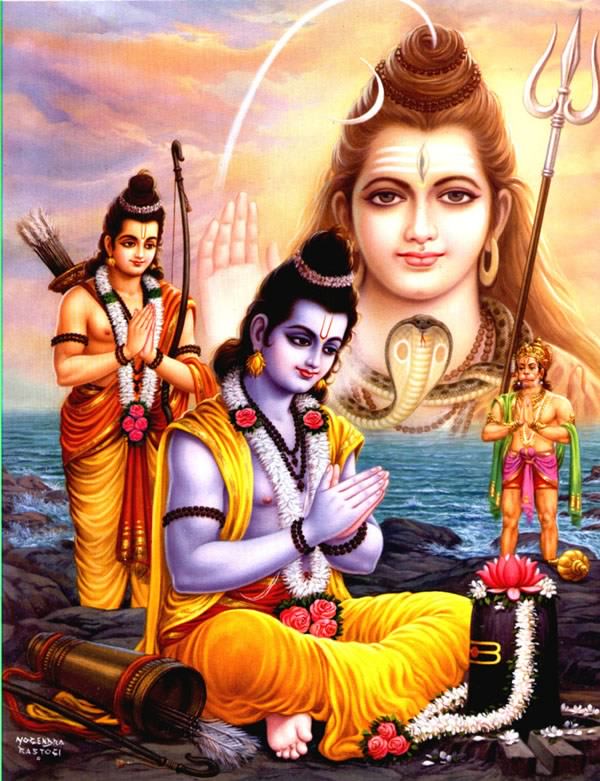
    They worshiped Shiva and Devi, apart from performing the Yagnyas prescribed in the Vedas.

    Please read my Post.

    Whom did Rama worship Ramani’s blog

    Chandi Homa in progress.
    Chandi Homa in progress.


    Are there any specific Homas performed by Rama during the Ramayana Period?

    Rama seems to have performed Santhi Homa after killing Ravana and returning to Ayodhya.

    Rama's Coronation.jpg
    Rama Pattabhishekam

    He also performed a Yagnya at Buxar after His Coronation by marking the Yaagashaala with the tip of His arrow for Lord Shiva .

    This is called Ramarekhaghat in Buxar.

    Rama Ramrekha Ghat

    Apart from this Rama seems to have performed Chandi Homa to defeat Ravana.

    This was performed after Indrajith performed a Secret Yaaga to defeat Rama.

    After this Lakshmana was rendered unconscious by Inderjith.

    ‘Rama had performed “Chandi Homa” and invoked the blessings of Durga, who blessed Rama with secret knowledge of the way to kill Ravana. On the day of Ashvin Shukla Dashami, Rama defeated Ravana and rescued Sita. Thus it is termed as Vijaya Dashami. Based on the inferences from Valmiki’s Ramayana, Kalidas’s Raghuvamsa, Tulsidas’s Ram Charit Manas, and Keshavdas’s Ram Chandra Yas Chandrika as well as common perception in India, Rama, Sita, and Lakshmana returned to Ayodhya on the 30th day of Ashwin (19–20 days after Vijayadashmi). To mark the return of Lord Rama, in the evening, the residents of Ayodhya lit their city with millions of earthen lamps (called Deepak). Since then, this day is celebrated in India as Deepawali’

    Benefits of Chandi Homa.

    Chandi Homa can aid one in clearing off the obstacles and hurdles on the path to success.

    Goddess Durga, the chief deity of this Homa will gift you with the power to balance one’s passion and dispassion, indulgence and denial.

    With her blessing, one will be able to manifest your true divine Self that unites selfishness and selflessness.

    By performing this Homa, one can invoke the energy of Goddess Durga, who will help you master your life!

    Steps in Performing Chandi Homa.

    A Chandi Homa is not an ordinary Homa and has to be performed by expert priests.

    Duraga Sapthashati will be chanted.

    Ganapathy pooja: Prayers are offered to the Lord Ganesha seeking his blessings. Worshipping Lord Ganesha clears all the obstacles and paves way for one’s success. So, before any auspicious beginning, Lord Ganesha is first addressed with pooja and prayers.

    Kanya pooja: Kanya Pooja is one of the highlight of the Navaratri celebrations. Kanya pooja is a ritual of worshiping girls (aged 6 – 10) who haven’t attained puberty, symbolizing the Kanya Kumari (prepubescent) form of Goddess Chandi or Durga. This ritual is specially performed to recognize the divine feminine power vested in a girl child.

    Anugna Sankalpam: Seeking the consent of the Goddess to perform the Yagna which is a sacred ritual. The ritual specifies for whom, where and when the yagna is performed.

    Punyahavachanam: Purifying the mind, body and place before the yagna is performed. Water is sprinkled with mango leaves around the place with the chanting of Mantras.

    Kalasa Sthaapana: Kalasa means a pot. It is made of metal and is filled with water and placed with Mango leaves immersed in the water. Pooja is made to this Kalasa invoking the blessings of the goddess.

    Saptashati Parayanam: Chanting of Durga Saptashati Slokas (700 sanskrit poems) and worshipping the various forms of the Goddess. Bhairava Bhali (offering): After the chanting of Slokas, offering is made to Lord Bhairava (an incarnation of Lord Shiva) to signify the ritual.

    Ganapathy pooja: Prayers are offered to Lord Ganesha before beginning the Yagna

    Punyahavachanam: Pooja and mantras are chanted to purify the place and people who are performing the Yagna

    Gho pooja: The Sanskrit word Gho means Cow. In Hinduism, Cow is considered to be a holy animal embodied with divine qualities. Pooja and prayers are offered to the cow before the yagna, seeking her blessings for prosperity.

    Suhasini Pooja: Worshipping an elderly married woman (whose husband is alive) and performing Pada (traditional foot washing ceremony) pooja to invoke her blessings.

    Dampathi pooja: Dampathi means couple. Prayers are offered to an elderly couple with Padha pooja.

    Brahmachari pooja: A Brahmachari is an unmarried man. He is held in high esteem in Vedas and Puranas for several reasons. Padha pooja and prayers are offered to a Brahmachari seeking his blessings.

    Chandi yagna: The fire ritual is performed with the chanting of Mantras and Slokas.

    Sumangala Dravyaahuti: Auspicious materials such as Saree, turmeric, sandalwood powder, kumkum (vermillion) etc. are offered to the Goddess invoked in the Fire.

    Purnaahuti: Any Yagna becomes complete only when this ritual is performed. Betel leaves, Betel nuts, Coconut, Kumkum (red colored auspicious powder), Turmeric, Flowers, Fruits, a coin, a small bag of herbs are put together in a silk cloth and tied. The bag is dropped into the fire seeking the blessings of the Almighty.

    Maha Deeparadhana: A ritual to honor the Goddess. Lights are lit using camphor and are used to glorify the Goddess. It is also called Aarthi and is performed during the end of the pooja.