Tag: Then madurai

  • Madurai 155 Trillion Years Old? Puzzling Evidence.

    Madurai 155 Trillion Years Old? Puzzling Evidence.

    When one delves deep into Purana, Ithihasa and ancient texts of India, including regional language texts, one finds one Corroborates the other. Events,Persons mentioned in one is corroborated by the other. While the Purana is in Sanskrit, others are in ancient languages like Pali , Prakrit. Some languages like these may belong to Dialects. However, Tamil, an ancient language of India with which I am familiar, is rich in literature and grammar and it goes back to thousands of years along with Sanskrit. The archeological finds at Poompuhar, Tamil Nadu pushes the date of Tamil, at least, to 20,000 years. An Advanced Tamil civilization site near Chennai,reveals it to be a Million year old! . Thiruvannamalai,Tamilnadu is about 3.94 billion years old, Tirupati 2200 million years old, Jwalapuram Cuddapah, Andhara Is 74,000 years old Guruvayur, Kerala is over 25,000 years!

    Lemuris 230 Million years old My Tedtalk

    Ancient Bharathavarsha, in South, had Dravida Desa, Southern Countries. This landmass was ruled by three dynasties, Chera, Chola and Pandyas. The Kings of these dynasties trace their lineage to either Surya Vamsa , Ikshvaku Dynasty founded by Ikshvaku, son of the first human being Manu(Manu was the ancestor of Sri Rama) ;or to Chandra Vamsa, Lunar dynasty of Ila, Daughter of Manu.

    Manu, aka Satyavrata Manu or Vaivaswatha Manu was a Dradiva Emperor. This is recorded in the Bhagavadha Purana. I had written an article on this.

    While Satyavrata Manu was offering oblations to ancestors, a 🐠🐋🐟 Matsya appeared.

    There is a river by name “Krita-Maala”, today famously known as River Vaigai. On the banks of this River Krita-Maala, there was this “Shraadha-Manu”, who had the name “Satyavrata”. As this Satyavrata is living his life at this place, one day he goes to the river bank to do his regular “Tharpana” (Spiritual Practice) in the evening. As he was performing the “Tharpana”, there was a small little fish that got into his hands.

    “Tasyaa dheenataram vaakyam ashrutya sa maheepathihi!

    Kalasaapshu nihiteneyam dayaalu ninya aashramam!!”

    As the little fish enters into Satyavrata’s hands, it suddenly started to talk! Upon hearing a fish talk in human language, Satyavrata was surprised! The little fish talks to Satyavrata thus, “Oh Satyavrata! As you see, I’m such a small little fish, just taken birth! Please do not leave me again into this mighty river amidst the fast-flowing water. There are bigger fishes here, which would eat me off. Therefore, please help me out!” Upon hearing this, Satyavrata was moved! He asks the fish thus, “Oh little one! I don’t have any problem in helping you and ensuring your safety. Please tell me what should I do!” The fish replies back, “Oh Satyavrata! Why don’t you put me into your ‘Kamandala’ vessel and take me to your home? You can put me into a small tank at your place, where I would be safe and secure!”

    Accordingly, Satyavrata takes the little fish into his vessel, takes it to his home and tries to put it into a nicely made tank, exclusively for that fish alone. But as Satyavrata tries to transfer the little fish into the tank, he is in for another surprise! Within the time that he walked back to his home, the fish has grown in size! It is not able to come out of the ‘Kamandala’ vessel. Now the fish replies thus, “Oh Satyavrata! I think this vessel nor this tank would be of sufficient size to house me. Perhaps you should put me into the well in your house. Accordingly thus, Satyavrata takes the fish to the well and drops it inside! Again, Satyavrata is in for a surprise! As he drops the fish into the well, it again grows quickly to a bigger size, which renders the well to be useless to hold it anymore. Again, Satyavrata puts the fish into another big tank, but in vain! Again the fish grows into a mammoth size, engulfing the whole tank!

    Upon seeing this, Satyavrata couldn’t understand what is going on here! Hence, he takes the fish and puts it into the river again! Now, the fish grows into a huge whale-like size and engulfs the whole river too! This leaves Satyavrata stunned beyond words! He is clearly running out of options and doesn’t know what is going on around him. This is surely some message from someone who is all-pervasive and all-powerful. At one point, Satyavrata starts to doubt whether this is really a fish or something or someone else!

    As Satyavrata looks on with awe and shock, the fish tells him thus, “Oh Satyavrata! Looks like even this river is not capable of holding my mammoth size. I think it’s best that you take me to the ocean and leave me there!” Now Satyavrata is clearly perplexed here! He doesn’t know whether to really honour these words of the fish. With all his past experiences with the fish, he was damn sure that even if he is going to leave it in the ocean, it is going to say that this ocean is also insufficient! What would he do then? Mustering up his courage thus, Satyavrata asks the fish thus, “I do not think that you are an ordinary little fish! You are somebody else! Please tell me who are you and what do you want from me! Why are you playing this game with me?” Skanda 8,Srimad Bhagavadham. https://www.google.com/amp/s/theindiandharma.org/2020/05/05/episode-242-the-matsya-avatara-satyavratas-encounter-with-a-fish/amp/

    Now, the purport of this article is not about Manu and the evolution of World as described in the Srimad Bhagavadham. We focus on where Satyavrata Manu was offering Tharpana, Oblations.

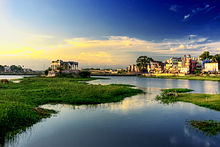
    It was in River Kritamala. Kritamala is the name of River Vaigai, at Madurai Tamil Nadu India. So, it is reasonable to postulate that Vaigai, and consequently Madurai is as old as Manu!

    https://www.google.com/amp/s/ramanisblog.in/2017/05/20/lemuria-the-home-of-tamils-my-tedtalk-at-coimbatore/amp/Based on Tectonic shift, Archeology and related evidence Ihad ,earlier,arrived at a figure of 230 million years for Lemuria of which Madurai was a part. It was Then Madurai then. Because of tectonic shift, it had moved to it’s present location. The present information in this article is Mind blogging. It is easy to dispose it off as Non sense. But evidence presented and the recent confirmation about the nature of Time as Non linear by Quantum would make one ponder.

    More to follow.

    This yuga cycle is called maha (in english, it means great/big) or divya (divine) yuga. One thousand such cycles forms one day of Brahma (a demigod in hindu religion which governs the universe). So one day of Brahma is 4.32 million * 1000 = 4.32 billion human years. Each such day of Brahma is called a “kalpa”. His night also constitutes 4.32 billion human years. During his day, life exists in universe. In nighttime, no form of life exists. So one complete day and night has 8.64 billion human years.

    -> Age of Brahma is 100 years. Each year of Brahma has 360 days and same number of nights. Thus, total age of Brahma is 360 * 100 * 8.64 billion = 311,040 billion human years. i.e. 311.04 trillion years. This period is called “maha kalpa”.
    -> The life span of the universe is one “maha kalpa”. i.e. 311.04 trillion human years. This time span is also the duration of one breath of “Vishnu” (the ultimate god in hindu religion). When he exhales, thousands of universes emerges and one “Brahma” is born in each universe. When “Vishnu” inhales, all universes get sucked and Brahma dies.
    -> This cycle is non-ending and eternal. Thats why “Vishnu” is considered eternal in Vedic Science (or religion).
    How much old is our universe:
    -> Note that the period of Satya Yuga is 0.4x, Treta Yuga is 0.3x, Dwapara Yuga is 0.2x and Kali Yuga is 0.1x where x is the time-span of one maha-yuga cycle. I will use ‘x’ as 1 maha-yuga cycle subsequently.
    -> In 1 day of Brahma, there are 14 “manvantara”. Each “manvantara” is divided into 71 “maha-yuga” cycles. So total make 14*71 = 994x (mahayuga cycles).
    -> Remaining cycles (1 day of Brahma contains 1000 maha-yuga cycles) are used to fill gaps between manvantara. Before and after each manvantara (called as “sandhya” and “sandhyamsa” respectively), there is a junction of 1.728 million (age of Satya Yuga, or 0.4x) human years. Total number of junctions are 15 (since there are 14 manvantaras). So total gap period is = 0.4 * 15 = 6x. Hence total makes 1000 maha-yuga cycles or 1 brahma day.
    -> According to the Vedic texts, current age of Brahma is 50 Brahma years and 1 brahma day (we are in the 1st day of 2nd half of brahma)and we are in the seventh “manvantara”, in the 28th turnover of its 71 yuga cycles. In this cycle, we are in the start Kali Yuga. Age of kali yuga is not known perfectly but it is around 5000-10000 years. For calculation, lets assume 8000 human years.
    -> So current age of our universe (in terms of maha-yuga cycles) =
    (50 * 720 * 1000) — 50 years * (360 days + 360 nights) * total no. of cycles in one day/night
    + (6 * 71) — 6 manvantara each of 71 maha-yuga cycle
    + (7 * 0.4) — 7 junctions or gaps for 6 manvantara
    + (27 * 1) — we are in 28th cycle of 71
    + (0.4+0.3+0.2) — In this cycle, we are in Kali Yuga. Satya Yuga, Treat Yuga and Dwapara yuga are 0.4x, 0.3x and 0.2x respectively.
    + around 8000 human years — very small, so ignoring it.

    Thus total age = (36,000,000 + 456.7)x = 36,000,456.7 * 4.32 million = 155,521,972.944 million years = 155.521972944 trillion human years. Now add the age of kaliyuga. i.e. around 8000 human years. One we calculate the exact age of kaliyuga, we can know the exact age of universe.https://www.cs.ubc.ca/~goyal/age_of_universe.php

  • Then Madurai Tamil Sangam Era In Micronesia, North of Australia

    Then Madurai Tamil Sangam Era In Micronesia, North of Australia

    Tamil Classics of the Sangam era speak of Three Conclaves of Poets (Tamil Sangam)

    According to Tamilian legends, there were three Sangam periods, namely Head Sangam, Middle Sangam and Last Sangam period. Historians use the term Sangam period to refer the last of these, the first two being legendary. So it is also called Last Sangam period (Tamil: கடைச்சங்க பருவம், Kaṭaissanka paruvam , or Third Sangam period (Tamil: மூன்றாம் சங்க பருவம், Mūnṟām sanka paruvam . The Sangam literature is thought to have been produced in three Sangam academies of each period. The evidence on the early history of the Tamil kingdoms consists of the epigraphs of the region, the Sangam literature, and archaeological data.

    Approximately during the period between 400 BC to AD 200, Tamilakam was ruled by the three Tamil dynasties of Pandya, Cholaand Chera, and a few independent chieftains, the Velir.(wiki)

    Map_FM-Nan_Madol.PNG ‎(550 × 500 pixels, file size: 18 KB, MIME type: image/png)

    *In the Light of new evidence indicating that Poompuhar, Chola Port being dated by about 20,000 years ago,

    Million year old Tamil site being found in Chennai and more evidence both archaeological in India and abroad,

    The Tamils  being considered as the forerunners of the MU civilization, which was in the periphery of Lemuria and

    Tamils being the forerunners of the Olmechs who  predate the Incas and Mayas,

    the date of the Sangam needs revision.

    The first Sangam was conducted in Then Madurai(South Madurai)

    Present Madurai, Tamil Nadu is different.

    Pohnpei island.Gif
    the unexcavated tomb of Qin Shi Huang, the first Emperor of China, and numerous other pyramids and burial mounds; and the underwater ruins of Nan Madol that surround Pohnpei Island.THEN Madurai?

    Thenmadurai was the capital of the Pandya Kings.

    Meenakshi , the presiding deity of the present Madurai was a Queen of Madurai.

    Her husband was Sundareswara, who is considered to be an Avatar of Shiva.

    Meenakshi’s father Malathdwaja Pandyan participated in the Mahabharata War at Kurukshetra as an ally of the Pandavas.

    Lord Krishna attended Tamil Sangam and he married a Pandyan Princess and  had a daughter whom he got married to a Pandyan Prince, and

     we have facts that tell us Parashurama, Balarama, Karna,Arjuna, Vidhura,and Agastya visited south Dravida Desa.

    Rama’s ancestor Vaivaswatah Manu lived in the Dravida desa and migrated to Ayodhya because of a tsunami recorded in Tamil classics,Puranas, Ramayana, Mahabharta and in foreign sources.

    Foreign sources call this as the Great Flood and this finds reference in Christianity , Judaism and the legends of all civilizations of the world.

    Manu, before migrating to Ayodhya meditated in Madagascar.

    The present South Indian land mass seems to be only a fraction of the original land of the Dravidas.

    The Land mass is being identified as Lemuria and there was another surrounding  Lemuria which was also occupied by the Dravidas.

    *It has to borne in mind that, while studying about such vast stretches of Time, the present land mass we have in India has no relevance to it.

    Because of tectonic movements, India was at one point of time near the Arctic, where the rig Veda was composed.

    Please check my article on this and also for all the statements I have made in this article.

    So Dravida desa was in Lemuria and MU.

    Tamil Kings ruled from there.

    The Tamil Nadu Kings List runs to thousands of years.

    ‘The earliest explicit discussion of a katalkol(“seizure by ocean”, possibly tsunami) of Pandyan land is found in a commentary on Iraiyanar Akapporul. This commentary, attributed to Nakkeerar, is dated to the later centuries of the 1st millennium CE. It mentions that the Pandyan kings, an early Tamil dynasty, established three literary academies (Sangams): the first Sangam flourished for 4,400 years in a city called Tenmaturai, attended by 549 poets (including Agastya) and presided over by gods like Shiva, Kubera and Murugan. The second Sangam lasted for 3,700 years in a city called Kapatapuram, attended by 59 poets (including Agastya, again). The commentary states that both the cities were “seized by the ocean”, resulting in loss of all the works created during the first two Sangams. The third Sangam was established in Uttara (North) Madurai, where it is said to have lasted for 1,850 years.

    The early Cheras, Cholas and Pandyas were ruling from there.

    There is a view that the Cholas came much later and this needs further research.

    This landmass had,

    Nakkeerar’s commentary does not mention the size of the territory lost to the sea. The size is first mentioned in a 15th-century commentary on Silappatikaram. The commentator Adiyarkunallar mentions that the lost land extended from Pahruli river in the north to the Kumari river in the South. It was located to the south of Kanyakumari, and covered an area of 700 kavatam (a unit of unknown measurement). It was divided into 49 territories (natu), classified in the following seven categories:[10]

    • Elu teñku natu (“Seven coconut lands”)
    • Elu Maturai natu (“Seven mango lands”)
    • Elu munpalai natu (“Seven front sandy lands”)
    • Elu pinpalai natu (“Seven back sandy lands”)
    • Elu kunra natu (“Seven hilly lands”)
    • Elu kunakarai natu (“Seven coastal lands”)
    • Elu kurumpanai natu (“Seven dwarf-palm lands”)’

    Lemuria had an area of 34 million Square Miles and its western boundary touched the present Greece.

    Lemuria( in my opinion Lemuria is different from Kumarikandam, please read my article on this) had three major rivers, Pahruli, Nadu aaru and Peraaru( River is called Aaru in Tamil and major mountain ranges included the Malayamarutha and Kandhamanatha .

    Please check my article Manu meditated in Madagascar where  I have explained how the eastern and western ghats of the present Tamil Nadu reach up to Madagascar.

    Then Madurai was a part of Dravida desa and the Pandyas ruled from there.

    First Tamil Sanagm was conducted in Then Madurai.

    the first Sangam flourished for 4,400 years in a city called Tenmaturai, attended by 549 poets (including Agastya) and presided over by gods like Shiva, Kubera and Murugan. The second Sangam lasted for 3,700 years in a city called Kapatapuram, attended by 59 poets (including Agastya, again). The commentary states that both the cities were “seized by the ocean”, resulting in loss of all the works created during the first two Sangams. The third Sangam was established in Uttara (North) Madurai, where it is said to have lasted for 1,850 years.’

    When Lemuria submerged during first Tamil Sangam, Then Madurai also got submerged.

    Madurai is called as Naan Maada Koodal,  city of  Skyscrapers.

    The traditional explanation of Naan Maada Koodal is what I have stated above.

    The term Koodal is Tamil also means union , as in Husband and wife and also where Oceans meet.

    In my opinion Koodal means where Oceans meet and this becomes clearer when one sees the landmass of Lemuria.

    So, the present Madurai, Tamil Nadu could not have been the Then Madurai.

    Then Madurai , in my opinion was called Koodal, where Oceans meet.

    The present Madurai is also called as Koodal managar, remnant of History.

    Now archaeologists have excavated  a Town from under the sea in Micronesia.

    It is called ,Naan Madol!

    Nan Madol is a ruined city adjacent to the eastern shore of the island of Pohnpei that was the capital of the Saudeleur Dynasty until about 1628.It is in the present day Madolenihmw district of Pohnpei state, in the Federated States of Micronesia in the western Pacific Ocean. The city, constructed in a lagoon, consists of a series of small artificial islands linked by a network of canals.The site core with its stone walls encloses an area approximately 1.5 km long by 0.5 km wide and it contains nearly 100 artificial islets—stone and coral fill platforms—bordered by tidal canals.

    The name Nan Madol means “spaces between” and is a reference to the canals that crisscross the ruins. The original name was Soun Nan-leng (Reef of Heaven), according to Gene Ashby in his book Pohnpei, An Island Argosy. It is often called the “Venice of the Pacific”.

    Today Nan Madol forms an archaeological district covering more than 18 km² and includes the stone architecture built up on a coral reef flat along the shore of Temwen Island, several other artificial islets, and the adjacent Pohnpei main island coastline. The site core with its stone walls encloses an area approximately 1.5 km long by 0.5 km wide containing nearly 100 artificial islets—stone and coral fill platforms—bordered by tidal canals.

    Carbon dating indicates that the construction of Nan Madol began around 1200 AD, while excavations show that the area may have been occupied as early as 200 BC. Some probable quarry sites around the island have been identified, but the exact origin of the stones of Nan Madol is yet undetermined. None of the proposed quarry sites exist in Madolenihmw, meaning that the stones must have been transported to their current location. It has been suggested that they were floated via raft from the quarry, and a short dive between the island and the quarries shows a trail of dropped stones. However, no one has successfully demonstrated or explained the process. Some modern Pohnpeians believe the stones were flown to the island by use of black magic.

    In 1985 the ruins of Nan Madol were declared a National Historical Landmark. Currently, a greater effort is being made to preserve them’

    I postulate that Then Madurai was a part of Lemuria and it is now found as Naan Madol

    and it was located near Australia in Micronesia.

    References and citations.

    https://en.wikipedia.org/wiki/Nan_Madol

    https://en.wikipedia.org/wiki/First_Sangam

    https://en.wikipedia.org/wiki/Sangam_period#History

    .https://ramanisblog.in/2013/05/01/lemuria-home-of-tamils-in-ramayana-mahabharata/

    https://en.wikipedia.org/wiki/Kumari_Kandam

    http://atlantisrisingmagazine.com/article/where-atlantis-meets-lemuria/