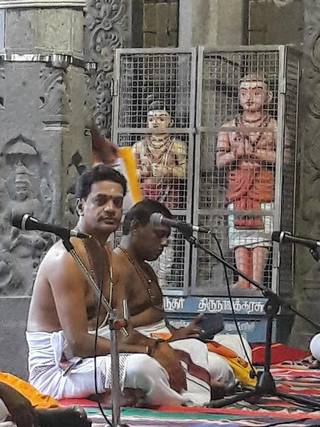
It is a shame that those who work in Hindu temples are paid less than a pittance by the Government of Tamil Nadu,through the HR&CE Department. There are different classes of workers in Hindu temples. In this article, I am addressing the issue of Odhuvars,Singers of Tamil Bhakthi literature,namely Thevaram,Thiruvasakam and Thirumurais.The Odhuvars are Saivites and they sing Hymns in praise of Sri. Shiva and Devi in Temples. These songs are the equivalent of Sanskrit slokas and stotras.Odhuvars belong a community who are dedicated to the singing of Thevaram, Thiruvasakam and other Saivite religious Hymns.Mainly, the Hymns are by the four great Tamil Saivite Devotees,Appar,Sambandar,Sundarar and Manikkavasakar. In Subrahmanya temples, Hymns by Arunagirinathar’s Thiruppugazh is sung.
The Odhuvars were a respected community and were given lands and produce by the Tamil Kings from the great Karikal Chozhan times.Pandya and Chera kings also gave Odhuvars grants. These grants were called Iraili in general. This includes lands granted to various workers in temples.Temple inscriptions in Tamil Nadu record this, including the ones at Thanjavur Big Temple built by Raraja Chozhan and also in other temples.
To the present position of Odhuvars…Read below.
‘The ‘odhuvars’ in temples joined the government service in 1980 with a pay-scale of Rs 175 and two cups of rice, the judge noted. “Their recitals fill the hearts of devotees and so their services are an integral part of temple administration,” the judge remarked.
The judge was passing orders on a writ petition from Singaravelan of a traditional odhuvar family. He has been working as an odhuvar in Sri Ilanjikumarar temple in Tenkasi, since January 3, 1980. Though he had put in 37 years of service, his services had neither been regularised nor had he been given increments. In 2004, the government fixed salary for staff of temples including odhuvars at Rs 2000-Rs 3200. The order came into force on June 4, 2004 giving effect from July 1, 1997. But despite claims and remainders, the Hindu Religious and Charitable Endowments department failed to revise his pay as per the GO.Subsequently in 2010, the salary of odhuvars was revised and re-fixed as Rs 3,300-9,000. However, no benefits was given to the petitioner even by virtue of the order, prompting Singaravelan to approach the court.
The HR&CE department submitted that the post of odhuvar is not a full-time job like other employees. This court places its strong opinion in this regard, observing that the service rendered by the odhuvars cannot be measured with the aid of clock, the judge added and directed the department to pass appropriate orders on the plea within six weeks and disposed of the petition. Am yet to know the current status. Readers may inform.
The call to have the temples freed from Government control is overdue because of.
The Atheistic Attitude of The Government.
Secular attitude towards only Hindu temples.
Appointment of Atheists and people belonging to other Faiths as Thakkars,Trustees and they are political appointees.
Mismanagement of Temple funds
Misappropriation of Temple Funds.
Neglect of temple traditions.
Diversion of temple funds to other departments like social welfare.
Leasing temple lands to partymen in a fixed tender practices.
Non recovery of lease amounts due to temples.
No Independent Audit.
While under the guise of secularism and respect for Religions, Religions like Christianity and Islam are treated better than Hinduism in the land where it is born Hindu temples come under under the HR& CE department, Government of Tamil Nadu, and under some other name in other States of India. Mosques and Churches do not come under the control of the government. While the Wakf boards and Church adminstration look after their properties, manage and look after them ,Hindu temples can not do so. Even for buying Pooja materials, the priests have to depend on the temple adminstration,which may or may not accede .Temple lands can be disposed of by the department.Temple lands are being occupied by squatters and Madras High court had come heavily on the attempt by the government to legalize squatting.
Check the information below.
‘ temples under the control of the Hindu Religious and Charitable Endowments (HR&CE) Department, only 331 have an annual income of more than ₹10 lakh. There are 34,099 temples with an annual income of less than ₹10,000. There are thousands of temples where just one puja is performed. This, despite owning vast tracts of land and other properties, registered in their name. ..
…..According to the data available with The Federal, the department has nearly 5 lakh acres of both dry, wetlands and rainfed lands, 22,600 buildings and 33,665 sites in its possession.
“We have more than 44,000 temples across the state. Each and every one of them needs to be consecrated once in 12 years. But only 600 of them are affluent. The remaining are located in villages and in an ailing condition. Poojas are conducted at least once a day in these ailing temples for which they need funds. Keeping their condition in view, the state government has deposited ₹1 lakh in the account of around 1,500 Aadi Dravida temples (for scheduled castes) to enable their maintenance through the interest money. The government also diverts surplus funds from affluent temples to the poor ones,” Bharathi adds.
I have written about the Democratic process followed by the Chola Kings to elect ,members for administering villages.
Though a Monarchy Tamil Kings of ancient times followed the principles of democracy by having elected representatives t run day to day administration of the country.
The Minster were appointed by the king.
Thanjavur Big Temple
This council looked after the executive aspects, including security , finance and foreign affairs.
To advise this group, a Committee was in place.
It was called Enperaayam, that is a council of Eight, who were learned men nominated y the King.
This council also served as a sort of sounding board and at time a an Appellate Court in dispensing with Justice..
The Village formed the core of administration.,
Village council was democratically elected ballot.
Please read my article on this.
Each village had a member assigned with a specific task, like digging Canals(Karai Velalar, a sub caste of Velalar, velalar means one who manages water resources), maintaining the Tank bund,Local finance man(Grama Dhanadhikari).
This micro management was replicated at the center at the capital , with corresponding officers for the functions.
For the management of temples, the Village had three committees.
1. Committee consisting of Brahmins.
2.Velalars and others.
3.Traders.
Decisions about the temple management were taken either by a group or all the groups in consultation with the others.
There were three officials for the running of the temple administration.
1.Sree Karyam, general administration with special responsibility to Finance.
2.Devakanmigal.for ensuring the pooja details and festivals are conducted properly.
3.Maakeswaras for carrying out all the other works.
These officials formed a part of the administrative group mentioned at the beginning of the article.
The meetings of the councils were conducted in Temple premises or the Theatre for performing Arts.
These details are available in Epigraph of Tamil Nadu temples.
The people of the village also participated in the meetings.
Epigraph at Thiruvidaimaruthur Temple, near Kumbakonam, details this process.
Dates on which these meeting were held are also found in the epigraph.
‘
There is no definite evidence of the existence of a council to ministers or of other officers connected to the central government, though the names of individual ministers are found in the inscriptions. A powerful bureaucracy assisted the king in the tasks of administration and in executing his orders. Due to the lack of a legislature or a legislative system in the modern sense, the fairness of king’s orders dependent on the goodness of the man and in his belief in Dharma – sense of fairness and justice. The ancient society did not expect anything more than general security from the government. Even matters of disputes went to the officers of the court only as the last
Bureaucracy.
The Chola bureaucracy did not differ much from its contemporaries. However, what distinguished it was its highly organised nature. A careful balance between central control and local independence was maintained and non-interference in local government was sacrosanct.
There was a definite hierarchy of the bureaucracy and the tenure of the officials simply dependent on the ‘Crown’s pleasure’. The officials held various titles such as Marayan and Adigarigal . Seniority between the same cadre was indicated by qualifying title such as Perundanam and Sirutanam.
One of the important such officers were the Revenue officials responsible for the receipts and expenditures of the government.
Administrative divisions
Every village was a self-governing unit. A number of such villages constituted a Korram (கொற்றம்) or nadu (நாடு) or Kottam (கோட்டம்) in different parts of the country. Taniyur (தனியூர்) was a large village big enough to be a Kurram by itself. A number of Kurrams constituted a Valanadu (வளநாடு). Several Valanadus made up one Mandalam, a province. At the height of the Chola empire there were eight or nine of these provinces including Sri Lanka.These divisions and names underwent constant changes throughout the Chola period.
An inscription of the eighth century CE at Uttaramerur temple describes the constitution of the local council, eligibility and disqualifications for the candidates, the method selection, their duties and delimits their power. It appears that the administration of a common village Ur(ஊர்) or Oor was different from that of a village given to Brahmins.
Audits
The activities of the officials of the bureaucracy were under constant audit and scrutiny. We have an example of such reports in an inscription from the reign of Uttama Cholawhich gives us the details of the remissness and neglect of some officials in the delay of recording a particular grant. As a result a dispute arose between contending parties as to who should benefit from the grant. The officials involved were punished.
As the head of the civil administration, the king himself occasionally toured the country and carried out inquests into the local administration.
Revenue administration
An extensive resurvey was done around 1089 CE by the Chola king Kulottunga, recording the extents of lands and their assessment, boundaries of villages and the common rights inside the village, including the communal pastures.
Revenue officials were responsible for the tax collection. The Chola government was very mindful of the need for the fair and accurate collection of tax to run the state machinery. The revenue records were not manuals of extortion, but a carefully maintained records of land rights, based on complete enquiried and accurate surveys, and were kept up-to-date by regular surveys.
The duties of revenue officials included many other spheres of responsibilities. They also regulated receipts and expenditures of temples. They were also seen to purchase land on behalf of village assemblies. They attested and certified important documents drawn up by local government agencies such as village councils. They were also shown to act as magistrates.
Besides the tax collected by the central government, several local bodies enjoyed the privilege of collecting tolls and other imposts.
Justice
Justice was mostly a local matter in the Chola Empire, where minor disputes were settled at the village level. The punishments for minor crimes were in the form of fines or a direction for the offender to donate to some charitable endowment. Even crimes such as manslaughter or murder were punished by fines. Crimes of the state such as treason were heard and decided by the king himself and the typical punishment in such cases was either execution or confiscation of property. The people had to agree to the king in these situations, no matter what.
Village assemblies exercised large powers in deciding local disputes. Small committees called Nyayattar heard matters that did not come under the jurisdiction of the voluntary village committees. The punishments in most cases were in the form of donations to the temples or other endowments. The convicted person would remit their fines at a place called Darmaasana. There is not much information available on the judicial procedures or court records.
There was no distinction between civil and criminal offences. Sometimes civil disputes were allowed to drag on until time offered the solution. Crimes such as theft, adultery and forgery were considered serious offences. In most cases the punishment was in the order of the offender having to maintain a perpetual lamp at a temple. Even murder was punished with a fine. In one instance a man had stabbed an army commander. Rajendra Chola II ordered the culprit to endow 96 sheep for a lamp at a neighbouring temple.
Capital punishment was uncommon even in the cases of first-degree murder. Only one solitary instance of capital punishment is found in all the records available so far.

You must be logged in to post a comment.