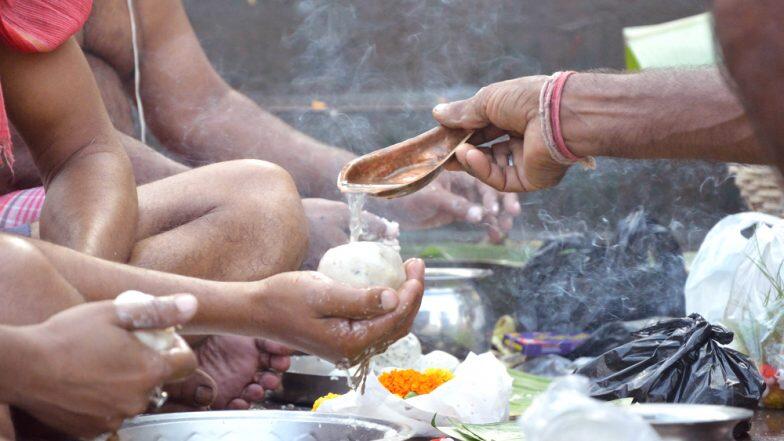
Tag: Śrāddha

  • Hindu Death Ceremonies Day One Two Details Meaning

    Hindu Death Ceremonies Day One Two Details Meaning

    Death is just a hairbreadth away from Life.

    What does happen just before death, at the time of Death and after death?

    For the first two points and signs of Death, according to Hinduism, please read my articles Signs of Death,Hinduism.

    What does Hinduism say on Life just afer death?

    Soul has five layers.

    Annamaya Kosa, the subtle body made of the essence of Food,

    Pranamaya Kosa, of Life’s breath,

    Manomaya Kosa, made of mind’s impressions,

    Vignanamaya Kosa, the subtle reposited impressions of Knowledge and

    Gnanamaya Kosa, the level of wisdom, discerned knowledge.

    The last one Anandamaya Kosa is an immediate Attribute of BrahmanThe Reality.

    When all the other Kosas( sheaths) , except Gnanamaya Kosa are dissipitated, the Gnanamaya Kosa gets merged, in case of Realized Souls, with Brahman or the knowledge that it is different from Brahman disappears.

    The Death ceremonies conducted for the first twelve Days in Hinduism, more specifically in the case of Brahmins,relate to these aspects.

    Once the life leaves the body it becomes Sava,without Auspiciosness,Shiva.

    The human body has two aspects,Sthula,Gross and Sookshma,Subtle.

    The physical frame is the gross aspect of Atman.

    Sookshma Sareera,Subtle body is a conglomeration of  the essence(Rasa) of Food(Anna),Prana(life energy),Mind(Manas),Knowledge(Vigyana) and Consciousness(Ananda).

    All these subtle aspects draw their nourishment from the  Five Gross elements,Earth,Water,Fire,Air and Ether(Prithvi,Appu,Agni,Vayu and Akasha).

    Each of these subtle essences nourish the body and facilitates the enjoyment,both pleasant and unpleasant,depending on one’s actions,Karma,by the Unrealized.

    Once Life ebbs away,the physical frame called Sava is cremated and the subtle body is called Pretha.

    The functions of the Sava ceases but the subtle body,Pretha remains,though it remains invisible.

    On the day of death,after the ceremonies are conducted at home ,officially christening the body as Pretha,washing it,removing everything worn,adorning with Vibhuthi or appropriate castemark,declaring the son and if the deceased had no son,the one who shall conduct the Andhima Karma,Final Rites is designated as such, along with symbolic fire which was lit as soon as the person died,the body is moved to the Crematorium,with the Grandson/s showing the light with a torch.

    At the crematorium,the body,before consigning to flames,is addressed as Pretha by the son,thanking the person for bringing up the children,declaring that the son would perform all Karmas to enable the Sookshma sareea to join the ancestors.

    At the crematorium the body which has sprung from the five elements,Earth,Water,Fire,Air and Ether is retuned.

    The body is laid on the ground and rites are performed and mantras chanted returning the body to Earth.

    Water is filled ( half pot),son walks around the body in an anticlockwise direction three times,a hole is made in the pot at each perambulation(total three) and water is allowed to flow to the earth signifying the return to Water.

    Fire is lit from the brazier to the body returning it to Fire in the condition the body came into being,that is bereft of anything.

    Air,Vayu is worshipped along with Aakasa,Ether praying they take their composition in the body.

    Food, in the form of Rice is offered to the body by relatives as the last food offered to the body stating that further food will be for the subtle body.

    If the Thithi when cremating is different from the Thithi when death occurred,the ashes/bones are collected by the son wearing Kandankathri Vegetable,( which incidentally is an antibiotic to prevent infections from the bones that mat may be found in the ashes),on the day of death and is consigned to ocean.

    There is no Theetu for the first two nazhikai from the time of death(40 minutes)

    The Kartha must take bath after entering house,( he must enter the house  after washing his feet outside the the house,so must the others)

    He should change to fresh Dhoti,not new and take light refreshments,no meals.

    The light which was lit at the time of death near the body must be kept burning till 12th Day ceremony is complete.

    Food is not to be prepared at home and it can be received from relatives.

    Sandhyavandana is not to be performed for the first two days,the day of death and collection/immersion of ashes.

    It has to be performed from day three.

    If collection of Ashes is done on the same day of death,Sandhyavandana may be performed from the next day.

    No other Vaidika Karma must be performed till the 13th day function is over.

    The karmas to be performed from The Third day follows with meaning behind them

  • Seven Generations Name Hinduism Genealogy


    In Hinduism Seven Generations are being spoken of in all most all functions and ceremonies so much so to indicate some thing old and to insist on a practice being followed in the families the term seven generations are used and in some cases 14 generations are used.

    What is a generation in Hindu reckoning?

    A generation is normally taken as 60 years.

    Seven generations make it 420 years and Fourteen makes it 840 years.

    It is expected of a Hindu to member seven generations at least.

    Ideally Tharpana, Oblations offered to  Ancestors should cover these seven generations.

    But we often offer only for three.

    wp-1459993182048.jpeg
    Names identifying the Seven Generations, Genealogy.

    Many do not even remember the three generations!

    In Hindu ceremonies dealing with death, those dead are believed to move over to Pitru Loka, the domain of the dead ancestors.

    In a ceremony being performed immediately after one’s demise during the next 13 days after death,food in the form of a Rice ball is offered, Pinda Pradhaana.

    During this ceremony the one who is dead for whom the ceremony is being performed, the Pinda is moved over/joined to the earlier pindas offered to the earlier one, thus moving the earliest one to a higher Loka and no more Tharpana will be offered to him.

    What is the explanation of these seven generations?

    Ourselves,

    Father,

    Grand father,

    Great Grandfather,

    Great Grand father’s Father.

    Great grandfather’s Grand Father,

    His Father .

    The generation list includes their spouses.

    Tamil and Sanskrit have specific names assigned them.

    I have reproduced the image dealing the Names. in Tamil.

    With my limited knowledge of Sanskrit, I can identify,

    Ourselves,

    Pitha,

    Pithamaha

    Prapithamaha.

    Prapitha Maha Pitru,

    Prapithamaha Pithamaha,

    Prapithamaha Pithamaha.

    At Haridwar, the Brahmin priest maintain a Genealogy list , which covers the ancestors spanning over more than ten generations, in some cases going back further.

    These are kept to offer Oblations for those who want to perform Sraddha and Tharpana.

    As Haridwar has traditionally been a site, for death rites and also Shraaddha, amongst Hindus, it soon also became customary for the family pandits (priest) to record each visit of the family, along with their gotra, family tree, marriages and members present etc., grouped according to family and home town. And over the centuries, these registers became an important genealogical source for many families, part of splintered Hindu families, in tracing their family tree and family history as well, especially after the Partition of India in 1947, and later amongst the Indian diaspora,

    This custom is similar to Panjis or Panji Prabandh, the extensive genealogical records maintained among Maithil Brahmins in Bihar.

  • Inauspicious Death Days Tripada Dosha Parihara

    Hinduism states that there are days which are considered as inauspicious for Death.

    If one dies on these specified days, Parihara, Atonement is recommended.

    Pitru Dosha.jpg
    Pitru Dosha.

    Commonly held belief is that if the Pariharas are not done, more deaths would follow.

    I am not too sure about this.

    What I am certain is that these deaths bring in Pitru Dosha and Pariharas are necessary.

    The Days inauspicious for Death fall under three categories.

    Relating to the Nakshatras, Stars.

    Rohini, Dhanishta, Satabhisham, Purvabhadra, Revathi, Mrugasira, Punarvasu, Uttara, Chitra, Visakha, Uttarashada, and Magha.

    Thithis, Waxing and Waning of the Moon.

    Padyami, Vidiya, Shashti, Ashtami, Ekadasi, Dwadasi, Trayodasi, Chaturdasi and Amavasya.

    Days.

    Sunday, Tuesday, Friday and  Saturday.

    Some Smritis offer the following Parihara.

    • If a death has only one dosha the family members should leave the house for 1 month
    • If a death has two doshas the family members should leave the house for 6 months.
    • If a death has all the three types of doshams the family members should leave the house for 1 year.

    As this is not practical now a days, there are other Pariharas as well.

    1. Pitru Tarpan Pooja (Shraddha Pooja) needs to be done at home with 5 dolls  made of Darbha (Kusha Grass) & White Cotton.

    Prana Prathistapana ritual (infuse life in the Dolls) ceremony of the 5 dolls needs to be performed.

    After Pooja, these 5 dolls should be buried in sand or mud near River or Sea shore.

    Or perform Rudrabhisheka at home & offer food to   ancestors.

    This pooja needs to be done without fail, otherwise dosha will not be removed.

    1. Nakshatra Shanti pooja & Navagraha Shanti Pooja need to be done for nullifying  the affect of Dosha.
    1. Perform Mahamrityunjaya Homa/Japa  at  home  after the above pooja’s are done.

    Or Visit Gokarna  or other Pitru Parihara Sthalas and offer Sraddha.

    Nine Temples foe Pitru Dosha Parihara

    References.

    http://www.oursubhakaryam.com/DEATH%20DOSHAM.htm

    http://someshsastroworld.blogspot.in/2013/01/nakshatra-dosha-due-to-inauspicious.html

  • Soul Immortal Body Dies Why Sraddha Pinda?

    A reader posed an interesting question, which I am reproducing below.

    ‘a SMALL DOUBT sOUL IS NOT PERISHABLE. THERE IS REBIRTH AFTER DEATH. THEN WHY THESE SHARDHAMS AND PINDAS FOR THE EXISTING ONES. CURIOSITY OF VEDIC REFERENCES. WE ARE MOULD OF FLESH AND BONES AND WE HAVE NO REACH ON IMMORTALITY. CAN YOU DISCUSS. THANKS’

    I remember having written on this , in the passing, while on another article.

    As the issues involved are complex and many have the same doubt, I would like to clarify.

    True, the Atman is Imperishable, Immortal , timeless

    The Vedas and the Upanishads stress this point and the entire Indian Philosophy revolves on this concept of Atman

    The Bhagavad Gita states thus.

    Bhagavad Gita Verse Chapter 2.Sloka 20. on the Nature of Atman.

    Bhagavad Gita Verse on the Nature of Atman.jpg Bhagavad Gita Verse on the Nature of Atman, Self .Chap.2,Sloka20

    The body is the instrument through which the fruits of actions, the Karmaphalas are worn out.

    Body , being made of the five elements, earth,water, fire,air and ether returns to the respective elements after death.

    All things done or being done during the course of one’s life are directed towards this body, excepting the urge to realize Brahman, the Reality.

    Once the body dies a Hindu performs Sraddha , ceremonies for the dead by offering food .

    This concept of offering to  the departed is present in all Religions.

    Names might differ.

    If the body is perishable and the Soul is Immortal , what is the point in performing these rituals, like Tharpana, offering Pindas,and Sraddha?

    Though the body ceases to exist, the remnants of actions performed, Desired do not cease even after death.

    The thoughts remain as energy once created can not be destroyed and Thoughts and Thought processes are Energy.

    They have to be expended.

    Till such time the Subtle body remains.

    The Subtle Body is called as Sukshma Sareera.

    The Sukshma sareera exists even after death and is nourished by  the essenceFood, Water.

    This is applicable in both Stages, Life and afer Death

    The physical frame is sustained by the essence of Food(Anna Rasa) and so is the suskshma sareera.

    This is one of the reasons for some foods contributing to unidentified anxiety, despondence, fear etc.

    Also Food determines one’s disposition .

    For more on this Googe Food ramanan50.

    Now after the Physical frame ceases ,the Sukshma Sareera needs nourishment.

    And this is what we do by performing Sraddha and offering food to the departed,

    Now to the question.

    The dead are reborn.

    They have taken a new body and they eat.

    Would this not be enough to nourish the Physical body and the sukshma Sareera?

    No.

    The remnants of the earlier birth’s needs are not wholly met in the current birth.

    The bonds one had established during the earlier birth still linger and those are met only by the offerings from the people with whom we had bonded in the earlier birth.

    This non compliance of the Sraddha results in Pitru Dosha.

    Pitru Dosha does not merely indicate the anguish of the ancestors but also the needs of the Sukshma Sareera of the earlier birth( which forms a pat of the Sukshma Sareera of theis birth).

    When such needs have not been met, one faces unaccountable problems.

    These do not apply to realized souls or Brahma Gnanis.

  • Sita Performed Sraddha Cursed River

    The majority held belief is that women should not perform Sandhyavandana and death Rites.

    I differ from this view.

    Great Rishis have been women, like Maiteyi,Gargi,Kathyayani.

    These Rishis have composed Veda Sutras, Sukthas.

    Vedic wisdom is encapsulated in myriad hymns and 27 women-seers emerge from them.

    Ghosha, who has a definite human form. Granddaughter of Dirghatamas and daughter of Kakshivat, both composers of hymns in praise of Ashwins, Ghosha has two entire hymns of the tenth book, each containing 14 verses, assigned to her name. The first eulogizes the Ashwins, the heavenly twins who are also physicians; the second is a personal wish expressing her intimate feelings and desires for married life. Ghosha suffered from an incurable disfiguring disease, probably leprosy, and remained a spinster at her father’s house. Her implorations with the Ashwins, and the devotion of her forefathers towards them made them cure her disease and allow her to experience wedded bliss.

    The Rig Veda contains about one thousand hymns, of which about 10 are accredited to Maitreyi, the woman seer and philosopher.

    Gargi, the Vedic prophetess and daughter of sage Vachaknu, composed several hymns that questioned the origin of all existence. When King Janak of Videha organized a ‘brahmayajna’, a philosophic congress centered around the fire sacrament, Gargi was one of the eminent participants. She challenged the sage Yajnavalkya with a volley of perturbing questions on the soul or ‘atman’ that confounded the learned man who had till then silenced many an eminent scholar. Her question – “The layer that is above the sky and below the earth, which is described as being situated between the earth and the sky and which is indicated as the symbol of the past, present and future, where is that situated?” – bamboozled even the great Vedic men of letters.

    One is expected to have Upaveedha to learn the Vedas.

    These women composed Veda Sukthas.

    They could not have learnt the Vedas without Upaveedha.

    Hence they had to perform Sandhyavanda and other Karmic duties.

    I have a detailed article on this.

    Now there is Reference in the Ramayana and Garuda Purana that Sita offered Pinda to Dasaratha, her father in law at Gaya.

    There is reference to the city of Gaya and the Phalgu in the Ramayana in which it says that Sita had cursed the Phalgu River. There is an interesting story and the mythology states that on account of this curse, the Phalgu lost its water, and the river is simply a vast stretch of sand dunes.According to tradition, in the absence of Rama, his wife Sita offered pinda on its banks to Dasharatha father of Rama.

    The story goes that Rama, along with his brothers and Sita, came to Gaya to perform the sacred rites for his father, Dasaratha. When the brothers were bathing in the river, Sita was sitting on the banks, playing with the sand. Suddenly, Dasaratha appeared out of the sand, and asked for the Pindam, saying he was hungry. Sita asked him to wait till his sons returned, so that she could give him the traditional Pindam of rice and til. He refused to wait, asking her to give him pindams made of the sand in her hand.

    Having no other option, she gave him the Pindam he desired with five witnesses – the Akshaya Vatam, the Falguni River, a cow, a Tulsi plant and a Brahmin. Soon, Rama returned and started the rituals. In those days apparently, the ancestors would arrive in person to collect their share, and when Dasaratha did not appear, they wondered why. Sita then told them what had happened, but Rama could not believe that his father would accept pindams made of sand. Sita now mentioned her witnesses, and asked them to tell Rama the truth.

    Among the five, only the Akshaya Vatam took her side and told the truth, while the others lied, trying to take Rama’s side. In her anger, Sita cursed all of them thus: the Falguni river henceforth would have no water at Gaya; the Cow would no longer be worshipped from the front as all others are- only its backside would be worshipped; there would be no more Tulsi plants at Gaya and the Gaya Brahmins would never be satisfied, they would always be hungry and crave more and more. She then blessed the Akshaya Vatam saying that all who came to Gaya would perform the Pinda pradaanam at the Akshaya Vatam too.

    Sri Sita is said to have performed Sandhyavandanam including Dhyaanam and Japam (Vide page 97 of Notes on AyOdhya KhaaNDam of Srimad Vaalmiki Ramayanam by Sri C.R.Srinivasa Iyengar)

    View of Kanchi Acharya.

    I said that the twice-born must perform sandhyavandana with the well-being of women and other jatis in mind. I also explained why all samskaras are not prescribed for the fourth varna. Now we must consider the question of women, why they do not have such rituals and samskaras.

    Even though we perform the punyaha-vacana and namakarana of newborn girls and celebrate their first birthday, we do not conduct their caula and upanayana nor the other samskaras or vows laid down for brahmacarins. Of course, they have the marriage samskara. But in other rites like sacrifices the main part is that of the husband, though she (the wife) has to be by his side. In aupasana alone does a woman have a part in making oblations in the sacred fire.

    1. Why is it so?
    2. The rites performed before a child is born are intended for the birth of a male child (niseka, pumsavana, simanta). Does it mean, as present-day reformers and women’s libbers say, that Hindu women were downgraded and kept in darkness?
    3. What reason did I mention for the fourth varna not having to perform many of the samskaras?

    That these were not necessary considering their vocations and the fact that they can work for the welfare of the world without the physical and mental benefits to be derived from the samskaras. If they also spend their time in Vedic learning and in sacrifices, what will happen to their duties? So most of the samskaras are not necessary for them. They reach the desire goal without these rites by carrying out their duties.

    “Svakarmana tam abhyarcya siddhim vindati manavah“, so says the Gita. I have spoken to you about this earlier.

    Just as society is divided according to occupations and the samskaras are correspondingly different, so too there are differences between men and women in domestic life. Running a household means different types of work, cooking, keeping the house clean, bringing up the children, etc. By nature women can do these chores better than men. If they also take an active part in rituals, what will happen to such work? Each by serving her husband and by looking after her household becomes inwardly pure.

    In truth three is no disparity between men and women, nor are women discriminated

    against as present-day reformers allege.

    Work is divided for the proper maintenance not only of the home but the nation on the whole; and care has been taken not to have any duplication.

    There is no intention of lowering the status of any section in this division of labour.

    The body, in the case of certain people, is meant to preserve the mantras and there are samskaras which have the purpose of making it worthy of the same.

    Why should the same rituals be prescribed for those who do not have such tasks to carry out?

    Glassware to be sent by railway parcel is specially taken care of since it is fragile. Even greater care is taken in dispatching kerosene or petrol. If the same precautions are not taken in transporting other goods, does it mean that they are poorly thought of?

    Citation.

    http://en.wikipedia.org/wiki/Phalgu

    http://www.kamakoti.org/hindudharma/part18/chap2.htm

    Women performing Veda Samskaaras – By Kanchi Mahaswami