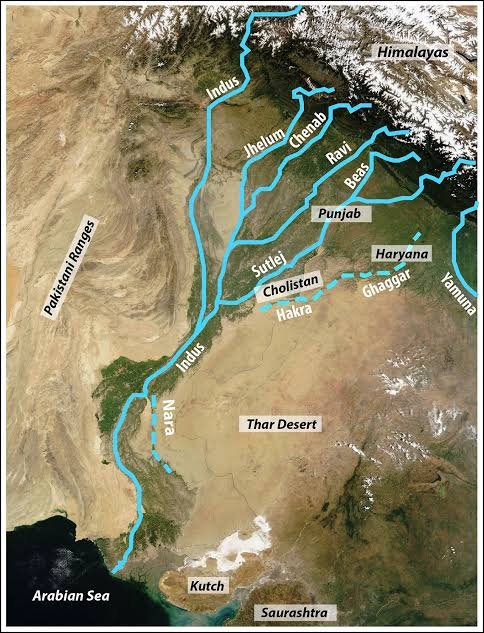
Tag: Sarasvathi valley

  • Pre Sanatana Dharma Shiva In South Predates Sanatana Dharma?

    A study of the Sanatana Dharma and Tamil throws some interesting questions.

    The Vedic Dharma seems, it has been held, to have originated in the North of Vindhyas, Sarasvati valley.

    Shiva as a Yogi.jpg Shiva as a Yogi.

    Recent studies, excavations of archeological sites relating to Hinduism, Sanatana Dharma around the world, from Australia to South America,Europe, Africa, Russia,China and information on the practices of the aborigines in various parts of the world,indicates that the Sanatana Dharma was prevalent in one form or another in all these places,

    Western scholars used this to invent the Aryan Invasion Theory, that is a Group called Aryans, invaded India thought the Khyber Pass in the Northern part of India and had influenced the thought processes of the people living in India.

    This Theory, deliberately floated by the British mainly, to subjugate India , now stands discredited.

    Please read my detailed Post on The Aryan Invasion Theory, Myth.

    The Aryan theory could not explain the references to the Sanatana Dharma in Tamil Literature, South India.

    Tamil language dates back to thousands of years and the Vedas quote them and they, in turn quote Tamil.

    The oldest Tamil site has been found in Pallavaram, Chennai .(dated around  a Million years.)

    ‘Archaeologists have discovered India’s oldest stone-age tools, up to 1.5 million years old, at a prehistoric site near Chennai. The discovery may change existing ideas about the earliest arrival of human ancestors from Africa ‘.

    https://ramanisblog.in/2015/06/01/million-year-tamil-site-pallavaram-chennai-dated-report/

    Lord Krishna participated in the Tail Sangam as an Invitee.

    Please refer my Post on this.

    He married a Pandyan Princess and had a daughter through her, and got his daughter arrived to a Pandyan Prince , gave her a dowry of one hundred Yadava families to provide her and her children with Milk and Curds.

    The Chera King Perunchotru Udiyan Neduncheralaathan participated in the Mahabharata War as the provider of food to both the Kaurava and Pandava armies.

    He had Tharpana performed for those who died in the War.

    Now comes the curious part.

    Lord Rama ‘s ancestor Satyavrata Manu migrated fro the Dravida Desa(South of Vindhya Mountains) with his sons and his son Ikshvaku founded the Ikshvaku founded the dynasty, named after him, Lord Rama Belongs to this dynasty.

    https://ramanisblog.in/2014/12/30/manu-ramas-ancestor-migrated-from-south-india-5000-bc/

    Shiva and His son Ganesha left, during the Great Flood, the time when Satyavrata Manu migrated to North, through the Middle east, traveling through europe, Africa,South America, North America((US), Central America, finally landing in the Arctic, where the Rig Veda was composed.

    Please refer my Post on this.

    Then they returned to India, then called the Bharata varsha and this entry was used to be denoted as the entry of the Aryans.

    The Artifacts, archeological finds, cultural similarities, Languages of the found around the world indicates this.

    Please read my posts on this.

    Now Six avatars of Vishnu are from the South.

    Matsya is from the Ocean and as such we can not ascribe a location on the earth.

    Kurma is in the Ocean again, but there is a Temple where Kurma avatar took place.

    Kurmnatha is housed in Sri Kurmam Temple, Srikakulam, Andhra Pradesh.

    Vamana Avatar was in Kerala and the place where Bali had his kingdom was on the banks of Narmada, where the capital of Bali was situuated.

    The place Varaha killed Hiranyakasipu is in Nepal, V(B0araha Kshetra), yet there is legend that Varaha is from Tirupati which is Adivaraha Kshetra.

    Narasimha is from Ahobilam ,Andhra Pradesh.

    Parashurama Avatar is from the South, Kerala.

    Kalki is expected to manifest in the South.

    https://ramanisblog.in/2014/08/20/six-vishnu-avatars-in-south-confirm-south-sanatana-dharma/

    Later Avatars from Lord Rama are from the North of Vindhyas.

    Now Shiva is not mentioned in the Vedas excepting in the Sri Rudram,

    ‘Nama sivaaya cha, Siva dharayacha’

    No special Sukthas directly addressed to Shiva are found.

    Shiva means Auspiciousnees , as he etymology goes.

    There is not much reference in the North of Vindhyas  of Shiva as much as Vishnu or Rama, Krishna.

    Shiva is considered to be Chief deity among the Tamils, though the early Tamil Literature has Gods assigned for each landmass as Murugan, Krishna, Kotravai(Durga)Varuna and Indra.

    But Shiva is taken as the First Siddha, followed by Agastya and others.

    The Thirumandiram of Thirumoolar contains the Yoga thoughts, Advatita and Tantric practices  that are unique.

    And this is much earlier to Ramayana and Agastya is referred to have founded Tamil , being handed over by Lord Shiva.

    Ravana entered into a treaty with a Pandya King.

    Many of the Tamil practices were incorporated by Apasthamba in the Vedic rituals, like the Mangalya Sutra.

    Though there are common factors between the Sanatana Dharma and the Tamils, yet there is a uniqueness in Tamil practices, which are, curiously enough, not against the Vedic practices but reinforces them.

    Many of the Avatars of Shiva have not been reported in the Literature of the North of the Vindhyas, though Puranas, mention Shiva avatars in the South,

    Shiva is described as Piravaa Yaakaip Periyon,The Eldest, though Unborn.

    He is considered as the First Guru, Adi Shiva, the First Siddha, the First Yogi.

    The sixty-four avatars of Shiva in Madurai are not mentioned in the North.

    The Agamas which came later to Vedas specified rules for the construction of Temples, though Temple worship is not mentioned in the Vedas.

    Tamil Kings followed this and one finds ancient temples, both for Vishnu and Shiva in the South in the Agama style.

    These temples, though the Agamas started with out the authority of the Vedas gained currency and helped Hinduism.

    Considering all these facts, I tend to think the worship of Shiva in the South preceded the Sanatana Dharma of the North.

    And one may note that the Rig Veda was composed in the Arctic.

    Sanatan Dharma in the south, Dravida seems to have preced the Sanatan Dharma fro the North of the Vindhyas.

    Inputs welcome.

  • What Is Wrong With Indian History? This

    If you want to subjugate a people, you have to destroy their language, make them lose their respect for their culture.

    This is not mine,

    Indian Influence in Souh East Asia.jpg
    Indian Influence in Souh East Asia.
    Greater India: The expansion of Indian culture and influence both in Central Asia and the South East towards the countries and islands of the Pacific is one of the momentous factors of world history.
    (image source: A Survey of Indian History – By Sardar Kavalam Madhava Panikkar).

    A gist of what Macaulay spoke in the British Parliament about the introduction of English as a medium of instruction in India.

    We have people like Max Mueller who were planted by the Church to destroy the Sanatana Dharma from within.

    Read my posts on these subjects.

    Indian History, as I was taught some 45 years ago was thus.

    There was Vedas ,ancient texts, they were concerned with Religion, many gods were worshiped,

    There were Mythologies of Ramayana and Mahabharata, Rama and Krishna  who were worshiped as Gods.

    The Vedas and Puranas were oppressive.

    Then Buddha came along.

    Aryans invaded through the Khyber Pass.

    Alexander Invasion of India, he defeated Indian Kings and signed a treaty with Porus, forgiving him.

    Appointed Seleucus.

    Then there was Chandra Gupta Maurya and His dynasty.

    It goes on up to Harshavardhana.

    There is a gap of about 200 to 300 years.

    Then Kanishka.

    Later Mughals and the British.

    What is wrong with this?

    1.Vedas have been brushed as Religious texts, with no details about the high scientific and technical skills they possessed.

    2.No mention of the Vedic empires.

    3.There is a gap of about 300 years between Panini and Daruis.

    4.No mention of the Tamil and Southern Kingdoms which existed around the early Vedic age.

    5.Ramayana and Mahabharata were facts and not Fables, while Bible ,Christianity, Islam and the prophet were given the status of History.

    6.No mention of Sanskrit and Tamil, the two earliest languages of civilization.

    7.While there is mention of Alberoni, Fahien, Huansuang, there is no mention of courtiers sent from India abroad.

    8.Again there is a gap of about 200 years from Fahien in 400 AD to 600 AD when Harshavardhana came to power.

    9.From 800 AD to 1500 AD no mention of Indian History in detail regarding the South Indian Kings and their empires.

    10.No mention of Indian empire having been extended to South Asia during the entire History of India excepting bland statements that Indians had commercial contacts with Rome, and Some Tamil Kings conquered some portions of Indonesia,.

    11.No mention of the great Floods in Souh India which triggered off migration to Europe ans rest of the world from India.

    And that was how the early settlements in these areas began

    12.Ashoka is reported to be first King to have established contacts with Sri Lanka by sending his daughter/son, omitting the Tamil connection which was earlier by about 1000 years.

    I am providing information which is slightly better than what we were taught from the link I have provided below.

    The gaps in the improved version is also glaring.

    Less said about the western scholarship(?) the better.

    I shall be writing on the hidden History of India with evidence for these periods.

    Two technics were adopted in burying our culture.

    One is suppression of Facts and evidence, as in archeological finds and Tamil History.

    Second is wilful misinterpretation of facts as Max Mueller did.

    Readers may contribute with evidence.

    Rock Shelters of Bhimbetka (9000 BC to 7000 BC)*
    The earliest records of the Indian history exist in the form of the Rock Shelters of Bhimbetka. These shelters are situated on the southern edge of the central Indian plateau, in the foothills of the Vindhyan Mountains. There are five groups of rock shelters, each of them adorned with paintings that are believed to date from the Mesolithic Period right through to the historical period.Mehrgarh Culture (7000 BC to 3300 BC)*
    Mehrgarh is one of the most significant sites belonging to the Neolithic Age. At the same time, it is one of the oldest sites that indicate the introduction of the concept of farming and herding. Situated on theKachi plain of Baluchistan (Pakistan), it lies to the west of the Indus River valley. The site ofMehrgarh, spread over an area of 495-acre, was discovered in the year 1974.Indus Valley Civilization (3300 BC to 1700 BC)*
    The Indus Valley Civilization was discovered in the 1920s. The major events in the timeline of the Indus Valley are given below:Early Harappan Phase (3300 BC to 2600 BC)*
    The early Harappan Phase lasted for approximately 700 years, starting with the Ravi Phase. It is one of the three earliest urban civilizations and made use of an early form of the Indus script, known as Harappan script, for writing purposes. Around 2800 BC, the Kot Diji phase of the Indus Valley Civilization started.

    Mature Harappan Phase (2600 BC to 1700 BC)*
    The Mature Harappan Phase started around 2600 BC. Large cities and urban areas started emerging and the civilization expanded to over 2,500 cities and settlements. Urban planning, excellent sewage and drainage system, system of uniform weights and measures, knowledge of proto-dentistry, etc are some of the other elements that characterize the mature phase.

    Late Harappan Phase (1700 BC to 1300 BC)*
    The Late Harappan Phase began around 1700 BC and came to an end around 1300 BC. However, one can find many elements of the Indus Valley Civilization in later cultures.

    Vedic Period/Age (1700 BC to 500 BC)*
    The Vedic Period or the Vedic Age refers to the time of the compilation of the sacred Vedic Sanskrit texts in India. Situated on the Indo-Gangetic Plain, the Vedic Civilization formed the basis of Hinduism and the sIndian culture. The Vedic Period can be divided into the following two phases:

    Early Vedic/Rig Vedic Period (1700 BC to 1000 BC)*
    Early Vedic Period represents the time period when the Rig Veda was compiled. During this period, the king was believed to be the protector of the people, who took an active part in the government. The caste system started becoming rigid and the families started becoming patriarchal. The major events of this time are:

    • 1700 BC – Late Harappan and Early Vedic period coincide
    • 1300 BC – The end of Cemetery H culture
    • 1000 BC – Iron Age of India
    Later Vedic Age (1000 BC to 500 BC)*
    The emergence of the later Vedic period was marked with agriculture becoming the dominant economic activity and a decline in the significance of cattle rearing. The political organization changed completely, with the reduction in the involvement of people in the administration. The major events are:600 BC – The formation of Sixteen Maha Janapadas (Great Kingdoms)
    599 BC – The birth of Mahavira, founder of Jainism
    563 BC – The birth of Siddhartha Gautama (Buddha), founder of Buddhism
    538 BC – Cyrus the Great conquered parts of Pakistan
    500 BC – Earliest written records in Brahmi
    500 BC – Panini standardized grammar and morphology of Sanskrit, converting it
    into Classical Sanskrit. With this, the Vedic Civilization came to an end.Ancient India (500 BCE – 550 AD)Rise of Jainism and Buddhism
    Jainism or Jain Dharma is the religious philosophy that originated in the Ancient India. The religion is based on the teachings of the Tirthankaras. The 24th Tirthankara, Lord Mahavira, is credited with propagating the religion in the various parts of the world. Buddhism is based on the teachings of Lord Buddha, who was born as Prince Siddhartha Gautama. After attaining Enlightenment, Lord Buddha set on a task of teaching others how to achieve nirvana. His teachings were later propagated throughout the world by Emperor Asoka. The other major events of the Ancient Indian period are:

    333 BC – Darius III was defeated by Alexander the Great. The Macedonian Empire was established
    326 BC – Ambhi, King of Taxila surrendered to Alexander, Battle of the Hydaspes River
    321 BC – Chandra Gupta Maurya established the Maurya Empire
    273 BC – Emperor Ashoka took over the Maurya Empire
    266 BC – Ashoka conquered most of South Asia, Afghanistan and Iran
    265 BC – The battle of Kalinga, after which Emperor Ashoka embraced Buddhism
    232 BC: Ashoka died and was succeeded by Dasaratha
    230 BC – Satavahana Empire was established
    200 to 100 BC – Tholkappiyam standardized grammar and morphology of Tamil
    184 BC – Collapse of Maurya Empire with the assassination of Emperor Brihadrata, Establishment of the Sunga dynasty
    180 BC – Establishment of the Indo-Greek kingdom
    80 BC – Establishment of the Indo-Scythian kingdom
    10 BC – Establishment of the Indo-Parthian kingdom
    68 AD – Establishment of the Kushan Empire by Kujula Kadphises
    78 AD – Gautamiputra Satkarni took over Satavahana Empire and defeated Scythian king Vikramaditya
    240 AD – Establishment of the Gupta Empire by Sri-Gupta
    320 AD – Chandragupta I took over the Gupta Empire
    335 AD – Samudragupta took over the Gupta Empire and started expanding it
    350 AD – Establishment of the Pallava Empire
    380 AD – Chandragupta II took over the Gupta Empire
    399 to 414 AD – Chinese scholar Fa-Hien traveled to India

    Medieval Period (550 AD to 1526 AD)
    The medieval period can be divided into the following two phases:

    Early Medieval Period (Upto 1300 AD)
    606 AD – Harshavardhana became the King
    630 AD – Hiuen Tsiang traveled to India
    761 AD – First Muslim invasion by Mohammed Bin Qasim
    800 AD – The birth of Shankaracharya
    814 AD – Nripatunga Amoghavarsha I became Rashtrakuta king
    1000 AD – Invasion by Mahmud of Ghazni
    1017AD – Alberuni traveled to India
    1100s AD – Rule of the Chandelas, Cholas, Kadambas, and Rashrakutas
    1120 AD – Kalyani Chalukya Empire attained peak, Vikramaditya VI introduced Vikrama Chalukya Era
    1191 AD – First battle of Tarain between Mohammed Ghori & Prithivi Raj Chauhan III
    1192 AD – Second battle of Tarain between Ghauri and Prithivi Raj Chauhan III
    1194 AD – Battle of Chandawar between Ghauri and Jayachandra
    1288 AD – Marco Polo came to India

    Late Medieval Period (1300 AD to 1500 AD)
    1300 AD – Establishment of the Khilji Dynasty
    1336 to 1565 AD – Vijayanagar Empire
    1498 AD – First voyage of Vasco-da-Gama to Goa

    Post-Medieval Era (1526 AD to 1818 AD)
    The major events in the post medieval era are:

    1526 AD – Babur, the Mughal ruler of Kabul, invaded Delhi and Agra and killed Sultan Ibrahim Lodi
    1527 AD – Battle of Khanwa, in which Babur annexed Mewar
    1530 AD – Babur died and was succeeded Humayun
    1556 AD – Humayun died and was succeeded by his son Akbar
    1600 AD – East India company was formed in England
    1605 AD – Akbar died and was succeeded by Jehangir
    1628 AD – Jehangir died and was succeeded by Shah Jahan
    1630 AD – Shivaji was born
    1658 AD – Shah Jahan built Taj Mahal, Jamia Masjid and Red Fort.
    1659 AD – Shivaji defeated Adilshahi troops at the Battle of Pratapgarh
    1674 AD – Maratha Empire was established
    1680 AD – Shivaji died
    1707 AD – Aurangzeb died and was succeeded by Bahadur Shah I
    1707 AD – Maratha Empire broke into two divisions
    1734 AD – Pamheiba invaded Tripura
    1737 AD – Bajirao I conquered Delhi
    1740 AD – Bajirao I died and was succeeded by Balaji Bajirao
    1757 AD – Battle of Plassey was fought
    1761 AD – Third battle of Panipat ended the expansion of Maratha Empire
    1766 AD – First Anglo-Mysore War
    1777 AD – First Anglo-Maratha War
    1779 AD – Battle of Wadgaon
    1780 AD – Second Anglo-Mysore War
    1789 AD – Third Anglo-Mysore War
    1798 AD – Fourth Anglo-Mysore War
    1799 AD – Tipu Sultan died, Wodeyar dynasty was restored
    1803 AD – Second Anglo-Maratha War
    1817 AD – Third Anglo-Maratha War begins
    1818 AD – End of the Maratha Empire and British control over most of India

    Colonial Era (1818 AD to 1947 AD)
    The Colonial Era started with the British taking control over almost all the parts of India and ended with the freedom of India in 1947. The major events that took place during the Colonial Era are:..”

    *I have writtten articles on these.
    Refernce and citation.
  • Mass Production Building Materials Cosmetics Vedic Period


    While I have been writing articles on the advanced technologies developed by the ancient Indians,especially in the Vedic Times, I was curious to find out how they produced the various things they needed to sustain such a large civilization

    Look at what we come to know of the Life of the Vedic people from the Sarasvati Civilization.

    Sarasvathi Civilization Building in ruins.jpg
    “Granary,” a massive building with solid brick foundations with sockets for a wooden super structure and doorways.


    Town Planning: The excavations of the ruins showed a remarkable skill in town planning. The main streets and roads were set in a line, sometimes running straight for a mile, and were varying in width from 4 meters to 10 meters. Most of these roads and streets were paved with fire brunt bricks. On the either side of the street stood houses of various sizes which did not protrude into the streets. The main streets intersected at right angles, dividing the city into squares or rectangular blocks each of which was divided length wise and cross wise by lanes. Some buildings had a lamp post and a well. There was an elaborate drainage system which emptied into the river.

    The Drainage System: The Drainage System of the Indus Valley Civilization was far advanced. The drains were covered with slabs. Water flowed from houses into the street drains. The street drains had manholes at regular intervals. Housewives were expected to use pits in which heavier part of the rubbish will settle down while only sewerage water was allowed to drain off. All soak pits and drains were occasionally cleaned by workmen. In every house there was a well-constructed sink, and water flowed from the sink into the underground sewers in the streets. This elaborate drainage system shows that the Indus Valley people were fully conversant with the principles of health and sanitation.

    Houses: The houses were of different sizes varying from a palatial building to one with two small rooms. The houses had a well, a bathroom, and a covered drain connected to the drain in the street. The buildings were made of burnt bricks, which have been preserved even to this day. Sun-dried bricks were used for the foundation of the buildings and the roofs were flat and made of wood. The special feature of the houses was that rooms were built around an open courtyard. Some houses were double storied. Some buildings had pillared halls; some of them measured 24 square meters. It is assumed that there also must have been palaces, temples or municipal halls.

    Great Bath: One of the largest buildings was the Great Bath measuring 180 feet by 108 feet. The bathing pool, 39 feet long, 28 feet wide and 8 feet deep was in the center of the quadrangle, surrounded with verandahs, rooms and galleries. A flight of steps led to the pool. The pool could be filled and emptied by means of a vaulted culvert, 6 feet and 6 inches high. The walls of the pool were made of burnt bricks laid on edge, which made the pool watertight. The pool was filled with water from a large well, situated in the same complex. Periodic cleaning of the pool was done by draining off the used water into a big drain. The Great Bath building had six entrances. The Great Bath reflected the engineering genius of those ancient days.

    Great Granary: Another large building in the city was the Great Granary which was made about 45 meters long and 15 meters wide. It was meant to store food grains. It had lines of circular brick platforms for pounding grain. There were barrack like quarters for workmen. The granary also had smaller halls and corridors.


    Food: Specimens of wheat and barley show that they were cultivated in that region. Rice was also probably grown. There is evidence to show that date palms were grown in the area. Besides these, the diet of the people consisted of fruits, vegetables, fish, milk and meat of animals i.e. beef, mutton and poultry.

    Dress: From the sculptured figures it can be seen that the dress of men and women consisted of two pieces of cloth-one resembling a dhoti, covering the lower part, and the other worn over the left shoulder and under the right arm. Men had long hair designed differently. Women wore a fan shaped head dress covering there hair. The discovery of a large number of spindles showed that they knew weaving and spinning. Similarly it was concluded, by the discovery of needles and buttons, that the people of this age knew the art of stitching.

    Ornaments: Both men and women wore ornaments made of gold, silver, copper and other metals. Men wore necklaces, finger rings and armlets of various designs and shapes. The women wore a head dress, ear rings, bangles, girdles, bracelets and anklets. Rich people wore expensive ornaments made of gold while the poor had ornaments made of shell, bone or copper.

    Cosmetics: The ladies of Mohen-jo-daro were not lagging behind in styles as used by the ladies of the present day, when it came to the use of cosmetics and the attainment of beauty. Materials made of ivory and metal for holding and applying cosmetics prove that they knew the use of face paint and collyrium. Bronze oval mirrors, ivory combs of various shapes, even small dressing tables, have been found at Mohen-jo-daro and other sites. Women tied the hair into a bun and used hair pins made of ivory. Toilet jars, found at Mohen-jo-daro, show that women took interest in cosmetics.

    Furniture and Utensils: The furniture and utensils found at Mohen-jo-daro show a high degree of civilization because of their variety in kind and design. The beautifully painted pottery, numerous vessels for the kitchen, chairs and beds made of wood, lamps of different material, toys for children, marbles, balls and dice, indicate what people manufactured in those days.

    Conveyance A copper specimen found at Harappa resembles the modern Ekka (cart) with a top-cover. Bullock carts with or without the roof was the chief means of conveyance.

    Amusements and Recreation: The Indus Valley people liked more of indoor games than outdoor amusements. They were fond of gambling and playing dice. Dancing and singing were considered great arts. Boys played with toys made of terracotta, while girls played with dolls.

    This lifestyle requires Mass production.

    I have been able to find references about the Mass production of some items.

    I am searching for further evidence for other items.

    The people of the IVC manufactured bricks whose dimensions were in the proportion 4:2:1, considered favorable for the stability of a brick structure. They used a standardized system of weights based on the ratios: 1/20, 1/10, 1/5, 1/2, 1, 2, 5, 10, 20, 50, 100, 200, and 500, with the unit weight equaling approximately 28 grams (and approximately equal to the English ounce or Greek uncia). They mass-produced weights in regular geometrical shapes, which included hexahedra, barrels, cones, and cylinders, thereby demonstrating knowledge of basicgeometry.[20]

    The inhabitants of Indus civilization also tried to standardize measurement of length to a high degree of accuracy. They designed a ruler—theMohenjo-daro ruler—whose unit of length (approximately 1.32 inches or 3.4 centimetres) was divided into ten equal parts. Bricks manufactured in ancient Mohenjo-daro often had dimensions that were integral multiples of this unit of length.[21][22]

    Mehrgarh, a Neolithic IVC site, provides the earliest known evidence for in vivo drilling of human teeth, with recovered samples dated to 7000-5500 BCE.

    http://en.wikipedia.org/wiki/History_of_science_in_early_cultures#India

     Indus Sarasvathi Civilizaton

  • ‘Haran’ In Turkey Shiva Connection To Mesopotamia

    I have been studying archology related information, Astronomy to seek information about the spread of Sanatana Dharma throughout the world.

    And I also check the Linguistic affiliations along with Cultural similarities.

    Moon God Sin Insignia.jpg
    Insignia of the Moon God ‘Sin’ of Haran. Notice the crossed-legged posture akin to yogic semi-Padmasana of Shiva, the crescent moon and the winged-bulls which were the vehicles of the moon-god ‘Sin’.
    Mesopotamian Civilisation Map.jpg
    Mesopotamian Civilisation Map.

    The Sanatana Dharma civilisation, as distinct from the Sarasvati Valley civilisation has been dated as the oldest in the world.

    This coupled with the existence of Super Continents and reference to this by Tamil ,another ancient Language of India, the date of which is as old as Sanatana Dharama, had spurred me to dig deep into the subject.

    Based on this, it transpires that a Group from South India, the Dravida desa, left the South because of a Tsunami (referred to by the Puranas and Tamil literature repeatedly) , led by Shiva and His son Ganesha moved through the Middle East , Europe,Africa, to Arctic before traveling back to Saraswati Valley through Russia, and Iran, while another led by Satyavrata Manu, the ancestor of Lord Rama moved to Ayodhya to found the Ikshvaky Dynasty(Ikshvaku was the son of Satyavrata Manu).

    I have been following this trail in conjunction with the immigration and settlements in Europe and elsewhere.

    I have been able to find references, evidence, cultural links and archeological finds.

    I have posted articles on all  these, under Hinduism.

    Now to Mesopotamian Connection.

    Located near the Turkish- Syrian border in the middle of an arid plain, Haran is one of the oldest Mesopotamian settlements.

    The settlement of Haran is mentioned in a treaty which was enacted in the Temple of Sin (Sin was the Mesopotamian Moon God) at Haran in thereign of Hammurabi (1728-1686 BC). Several Assyrian kings describe rebuilding this temple. The last king of Babylon, Nabonidus (556-539 BC) also rebuilt the Temple of Sin. Excavations have revealed a large mud-brick building which dates to the end of the 3rd millennium BC. It is thought this might be the predecessor to the temple of the Sumerian and Mesopotamian Moon-God Sin.

    The insignia of the Moon God Sin bears a remarkable likeness to that of the Vedic God Shiva. In fact, Shiva is also known as Som-nath (सोमनाथ) which means ‘Lord of the Moon’. Shiva’s insignia includes the crescent moon and the bull called ‘Vrishabha’ or ‘Nandi’ who was the vehicle of Lord Shiva.

    The earliest known form of the name ‘Sin’ is ‘Suen’ which may well be a distortion of the Sanskrit ‘Shivam’ – the name of the Vedic Moon God. What is even more interesting is that ‘Haran’ (हरन), is another name for Lord Shiva.

    ..Sin /ˈsn/ (Akkadian: Su’en, Sîn) or Nanna (Sumerian: DŠEŠ.KI, DNANNA) was the god of the moon in the Mesopotamian mythologyof Akkad, Assyria and Babylonia. Nanna is a Sumerian deity, the son of Enlil and Ninlil, and became identified with Semitic Sin. The two chief seats of Nanna’s/Sin’s worship were Ur in the south of Mesopotamia and Harran in the north.’..

    Mesopotamian Deities.jpg
    Mesopotamian Deities.

    “The Mesopotamian literary corpus is one of the oldest literatures in the world. It is infused with the divine, because religion played a crucial part in the way Mesopotamians expressed their thoughts about human life. Mesopotamian religion was polytheistic, with a pantheon consisting of hundreds if not thousands of gods of varying importance. This website offers information about the fifty most important gods and goddesses and provides starting points for further research.’..


    The IVC has been tentatively identified with the toponym Meluhha known from Sumerian records; the Sumerians called them Meluhhaites. It has been compared in particular with the civilizations of Elam (also in the context of the Elamo-Dravidian hypothesis) and with Minoan Crete (because of isolated cultural parallels such as the ubiquitous goddess worship and depictions of bull-leaping).[108] The mature (Harappan) phase of the IVC is contemporary to the Early to Middle Bronze Age in the Ancient Near East, in particular theOld Elamite period, Early Dynastic to Ur III Mesopotamia, Prepalatial Minoan Crete and Old Kingdom to First Intermediate Period Egypt.

    After the discovery of the IVC in the 1920s, it was immediately associated with the indigenous Dasyu inimical to the Rigvedic tribes in numerous hymns of the Rigveda. Mortimer Wheeler interpreted the presence of many unburied corpses found in the top levels of Mohenjo-Daro as the victims of a warlike conquest, and famously stated that “Indra stands accused” of the destruction of the IVC. The association of the IVC with the city-dwelling Dasyus remains alluring because the assumed timeframe of the first Indo-Aryan migrationinto India corresponds neatly with the period of decline of the IVC seen in the archaeological record. The discovery of the advanced, urban IVC however changed the 19th-century view of early Indo-Aryan migration as an “invasion” of an advanced culture at the expense of a “primitive” aboriginal population to a gradual acculturation of nomadic “barbarians” on an advanced urban civilization, comparable to the Germanic migrations after the Fall of Rome, or the Kassite invasion of Babylonia. This move away from simplistic “invasionist” scenarios parallels similar developments in thinking about language transfer and population movement in general, such as in the case of the migration of the proto-Greek speakers into Greece, or the Indo-Europeanization of Western Europe.

    It was often suggested that the bearers of the IVC corresponded to proto-Dravidians linguistically, the breakup of proto-Dravidian corresponding to the breakup of the Late Harappan culture. Today, the Dravidian language family is concentrated mostly in southern India and northern and eastern Sri Lanka, but pockets of it still remain throughout the rest of India and Pakistan (the Brahui language), which lends credence to the theory. Finnish Indologist Asko Parpola concludes that the uniformity of the Indus inscriptions precludes any possibility of widely different languages being used, and that an early form of Dravidian language must have been the language of the Indus people. However, in an interview with the Deccan Herald on 12 August 2012, Asko Parpola clarified his position by admitting that “Sanskrit has also preserved a very important part of the Indus heritage” and that even Sangam Tamil had possible influences of the Brahmins .

    Proto-Munda (or Para-Munda) and a “lost phylum” (perhaps related or ancestral to the Nihali language) have been proposed as other candidates for the language of the IVC.Michael Witzel suggests an underlying, prefixing language that is similar to Austroasiatic, notably Khasi; he argues that the Rigveda (composed by the Indo-Aryans after the decline of the Harappans) shows signs of this hypothetical Harappan influence in the earliest historic level, and Dravidian only in later levels, suggesting that speakers of Austroasiatic were the original inhabitants of Punjab and that the Indo-Aryans encountered speakers of Dravidian only in later times.

    Citation.

    Based on data prepared by the HEA-funded AMGG project.

    http://oracc.museum.upenn.edu/amgg/index.html  and

    http://en.wikipedia.org/wiki/Indus_Valley_Civilization

    http://vediccafe.blogspot.in/2014/12/the-ancient-city-of-haran-in-turkey.html

  • Atlantis People Descendants Of Shiva Ganesha Muruga

    One can not wish away the concept of legends of Lemuria ,Atlantis.

    They are found in many a civilization’s legends,the civilizations set apart by distance and cultural practices.

    Descriptions and references are found in Greek,Latin,Spanish, Nordic, Sanskrit and Tamil.

    1.From the Hindu texts it may be inferred that it was inhabited by the descendants of Shiva, Ganesha and Subrahmanya.

    .Shiva with Trident.jpg
    Shiva in Atlantis .Shiva with Trident.

    Tamil literature speaks of  the great Tsunamis, repeatedly emphasized in Sangam Literature , about 5000 old and this is backed by the Puranas.

    Or the Tamil literature might be backing up the Purana.

    Lord Rama’s ancestor, Vaivasvatha Manu left from the Dravidian South for the Saraswathi valley and his successor’s founded the Ayodhya Kingdom.

    Manu left by the Arabian sea route and traveled to the Sarasvathi river initially.

    Shiva with his offspring Ganesha and Subrahmanya, referred to as Murugan in Tamil, left by the Arabian sea through the Arabian peninsula to settle down in the Europe, Africa and Latin American countries.

    Manu’s descendants also spread towards the north and north-east through Iran, Russia and went as far as the Arctic.

    The Rig Veda is reported to have been complied in the Arctic.

    2.References found in the Hindu Texts indicate that the people who left by the Arabian sea through the middle east mingled with the local people in those area and so were treated as Milechas by the Sarasvati Valley people.

    There seems to have been a constant war going on between these two Groups and those in the region of the Atlantis were referred to as Asuras, the powerful.

    3.Asuras are different from the Rakshasas who lived in the southern part of  thepresent India from SriLanka down wards, eastwards.

    Ravana is one such Rakshasa.

    This is mentioned in Tamil Literature  while speaking about Lemuria Continent.

    The Vedic and Purana texts  refer them as Southerners, Dravida.

    4.There have also been a clashes between the Lemurians and the Atlantis people.

    This again is mentioned n the Puranas as the clash between the Asuras and Rakshasas.

    5.In the Ramayana Sugreeva was asked to search for Sita in Peru and the Nazca lines are the Trishula Marks of Shiva.

    Plato’s description of Atlantis.

    But when the divine portion began to fade away in them, being diluted too often and too much by admixture with mortal blood, and the human nature began to preponderate, they became unable to control their behavior and became unseemly… and grew visibly debased…

    Then, Zeus, the god of gods, who rules by law… seeing that an honorable race was in a most wretched state, and intending to punish them, that they might be purified and improve… gathered all gods together and spake as follows:…”…

    There is a story which even you have preserved, that once upon a time Phaethon, the son of Helios, having yoked the steeds in his father’s chariot, because he was not able to drive them in the path of his father, burnt up all that was upon the earth, and was himself destroyed by a thunderbolt. Now, this has the form of a myth, but really signifies a declination of the bodies moving around the earth and in the heavens, and a great conflagration of things upon the earth recurring at long intervals of time: when this happens, those who live upon the mountains and in dry and lofty places are more liable to destruction than those who dwell by rivers or on the sea-shore; and from this calamity the Nile, who is our never-failing savior, saves and delivers us.

    When, on the other hand, the gods purge the earth with a deluge of water, among you herdsmen and shepherds on the mountains are the survivors, whereas those of you who live in cities are carried by the rivers into the sea; but in this country neither at that time nor at any other does the water come from above on the fields, having always a tendency to come up from below, for which reason the things preserved here are said to be the oldest.

    The fact is, that wherever the extremity of winter frost or of summer sun does not prevent, the human race is always increasing at times, and at other times diminishing in numbers. And whatever happened either in your country or in ours, or in any other region of which we are informed–if any action which is noble or great, or in any other way remarkable has taken place, all that has been written down of old, and is preserved in our temples; whereas you and other nations are just being provided with letters and the other things which States require; and then, at the usual period, the stream from heaven descends like a pestilence, and leaves only those of you who are destitute of letters and education; and thus you have to begin all over again as children, and know nothing of what happened in ancient times, either among us or among yourselves.

    As for those genealogies of yours which you have recounted to us, Solon, they are no better than the tales of children; for, in the first place, you remember one deluge only, whereas there were many of them; and, in the next place, you do not know that there dwelt in your land the fairest and noblest race of men which ever lived, of whom you and your whole city are but a seed or remnant. And this was unknown to you, because for many generations the survivors of that destruction died and made no sign.

    For there was a time, Solon, before that great deluge of all, when the city which now is Athens was first in war, and was preeminent for the excellence of her laws, and is said to have performed the noblest deeds, and to have had the fairest constitution of any of which tradition tells, under the face of heaven.’

    Solon marveled at this, and earnestly requested the priest to inform him exactly and in order about these former citizens.

    ‘You are welcome to hear about them, Solon,’ said the priest, ‘both for your own sake and for that of the city; and, above all, for the sake of the goddess who is the common patron and protector and educator of both our cities. She founded your city a thousand years before ours, receiving from the Earth and Hephaestus the seed of your race, and then she founded ours, the constitution of which is set down in our sacred registers as 8000 years old.

    As touching the citizens of 9000 years ago, I will briefly inform you of their laws and of the noblest of their actions; and the exact particulars of the whole we will hereafter go through at our leisure in the sacred registers themselves. If you compare these very laws with your own, you will find that many of ours are the counterpart of yours, as they were in the olden time.

    In the first place, there is the caste of priests, which is separated from all the others; next there are the artificers, who exercise their several crafts by themselves, and without admixture of any other; and also there is the class of shepherds and that of hunters, as well as that of husbandmen; and you will observe, too, that the warriors in Egypt are separated from all the other classes, and are commanded by the law only to engage in war; moreover, the weapons with which they are equipped are shields and spears, and this the goddess taught first among you, and then in Asiatic countries, and we among the Asiatics first adopted.’

    Citation:

    http://ascendingpassage.com/plato-atlantis-critias.htm

    http://www.lost-civilizations.net/horse-sacrifice-atlantis-indies-4.html#long

    Related.

    http://ramanisblog.in/2014/07/31/search-sita-in-peru-nazca-lines-sugreeva-ramayana/

    http://ramanisblog.in/2014/08/09/ramas-ancestor-manu-dravida-bhagavatha-purana/