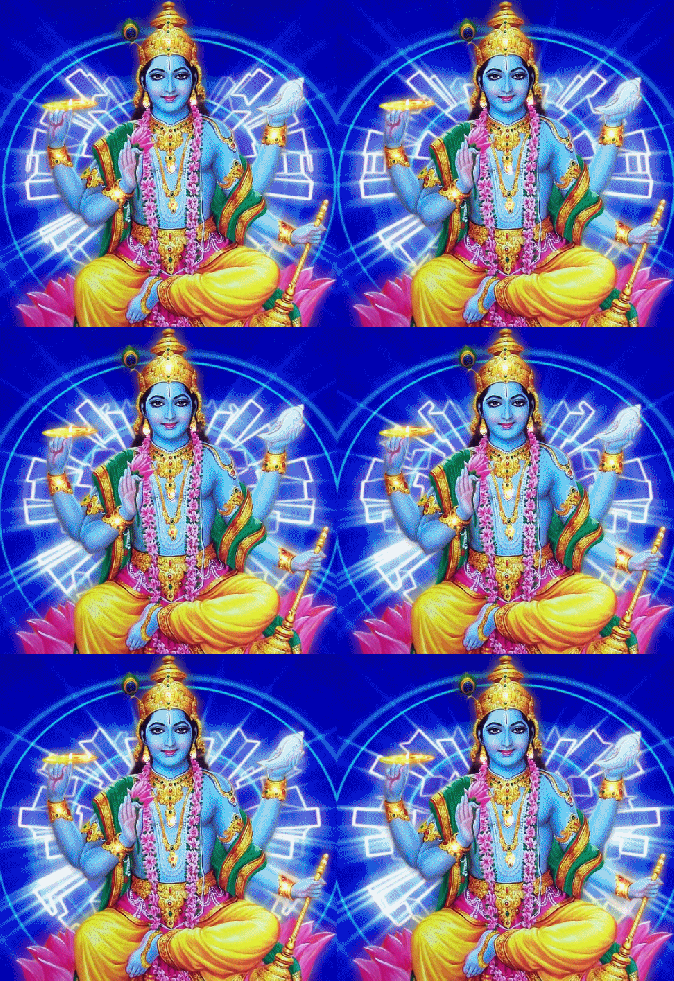
Tag: Rama date

  • Rama Krishna Before Ramayana Mahabharata Why How

    Rama Krishna Before Ramayana Mahabharata Why How

    One comes across references to Krishna in texts which precede the period of Lord Krishna.
    Reference is found in the Upanishads like Chandogya and Sveteswara and Rig ,Yajur and Atharva Veda.

    Vedas are eternal,not composed by humans,Apauresheya.

    But Krishna’s period was in Dwapara Yuga.

    We are in Kali Yuga.
    Kaliyuga has a span of 4,32,000 years;Dwapara Yuga 8,64,000 years.
    And Treta Yuga when Rama lived was  before Dwapara Yuga,that is about 1200,000 years!

    Than how is it that the name of Rama is found in the Vedas?
    Vedas have an Upanishad Rama Rahasya Upanishad.
    I am providing link to my article towards the close of this article.
    Similarly, reference to Lord Krishna in earlier texts, including the Vedas.
    Vedas predate both Rama and Krishna and they had Upanayana ceremony performed for them and they were doing Sandhya vandana.
    Such being the case, historically speaking, reference to Rama and Krishna in earlier texts is an anamoly.
    How does one resolve this?
    One may note that Rama was called as Dasaratha Rama to identify him from Parashuram,who was called Bhargava Rama.
    Krishna was named as such because he was black, Krishna in Sanskrit means Black.
    It may be noted that Draupadi is called Krishna I, because she was black.
    And Krishna is mentioned in Srimad Bhagavadham,Vishnu Purana and other Puranas as Vasudeva Krishna.
    This is to differentiate Vasudeva Krishna from other Krishnas who might have preceded him.
    Another point is that in Hindu thought,Time is Cyclic and not Linear.
    That is  there is no such thing as Yesterday, Today and Tomorrow.
    It is our Mind, because of the limitation imposed by it by Space and Time,that sees Time,which is a continuous Stream ,as yesterday, today and tomorrow.
    That implies that whatever has happened is,had happened,is happening,and will happen tomorrow All at the same time.
    For more please check my articles on Time non Linear, Rama’s death precedes Krishna’s by 200 years,on Quantum physics.
    So with reference to the question on hand about Time anamoly regarding Rama and Krishna,they existed in the past,exist at present and will exist in future.
    This is the explanation taking reference to Time and Quantum physics.

    Chandogya upanishad III.17.6

    taddhaitadghor āṅgirasaḥ kṛṣṇāya

    devakīputrāyoktvovācāpipā sa eva sa babhūva

    so’ntavelāyāmetatt

    rayaṃ pratipadyetākṣitamasyacyu

    tamasi prāṇasam̐śitamasīti tatraite dve ṛcau bhavataḥ ॥

    Ghora Âṅgirasa, after having communicated this (view of the sacrifice)

    toKrishna, the son of Devăkî — and he never thirsted again (after other

    knowledge)–said: ‘Let a man, when his end approaches, take refuge

    with this Triad: “Thou art the imperishable,” “Thou art the

    unchangeable,” “Thou art the edge of Prâna.”‘

    Almost all scholars have assented that Devakiputra Krishna is described here

    as the disciple of Ghora Angirasa. But the sceptics reject this attribution

    because the teachers of Krishna were Gargamuni and Sandipani in the Puranas.

    But the biggest problem with this assumption is that the original text does

    not say so. It is Sankaracarya, who in his commentary on the above-mentioned

    Upanisad, said that Krishna was the disciple of Ghora Angirasa. The passage

    has to be studied in reference to its context, which is given below. The

    Chandogya describes here man’s life in the form of soma-sacrifice; the natural

    function: eating, drinking, procreating and the cardinal virtues are described

    as the rewards of the sacrifice. When Ghora Angirasa said (Uktva) this, he

    also told (uvaca) Krishna Devakiputra – for he had become free from desire:

    “In the final hour one should take refuge in these three thoughts: You are the

    Indestructible (asita); Your are the unshaken (acyuta); Your are the very

    essence of life (prana).”

    The teachings which Krishna heard from Ghora Angirasa, is more or less the

    same which He taught to Arjuna in the Gita [XVI 1-2]. Ghora too already

    addressed Krishna as Acyuta, the infallible. In the Gita we find this term

    being used thrice, and each time Arjuna addresses Krishna as Acyuta [Bg. 1.2,

    11.42, 18.73.] Therefore, the self-evident quality of the quote demonstrates

    the analogy. But there is not any evidence in other texts of any Krishna, as

    the son of Devaki, besides our Krishna Yadava.

    The same work has another mention in 8.13.1:

    syama cavalam prapadye savalac syama prapadye.

    “Through the mercy of Shyama, I seek the shelter of His internal potency,

    the hladini-shakti. And through the mercy of this potency I seek the

    shelter of Shyama.”

    Here, Krishna is mentioned by his epithet Syama which means blackish, used in the

    Puranic literature for the Lord. The Sanskrit word prapadye-surrender, appears two

    times, in the same sense as the Gita.

    The epithet bhagesam is found in the Svetasvatara upanishad 6.6:

    bhaga-opulence; Isa-Lord. This Sanskrit word is a synonymous with Bhagavan, a

    title used for Krishna in the Gita and Puranas.

    The Mundaka upanishad 1.3 reads:

    kasmin bhagavo vijnate sarvam idam vijnatam bhavati:

    “When Bhagavan becomes known, then everything knowable becomes known.”

    Here the word Bhagavan is clearly used in the same ontological sense that the

    Puranas and Gita use for Krishna.

    In the above quoted list of 108 Upanisads, there is the Narayana upanishad,

    which says:

    atha puruso ha vai narayano ‘kamayata prajah srijeti –

    “The Purusa Narayana, desired to create the living beings.” (1)

    The same sruti text (4), says:

    brahmanyo devakiputra

    “The Brahman absolute is the son of Devaki (Krishna).”

    Here the same Devakiputra epithet is ascribed to Krishna as in the Chandogya

    and smriti literature. Also the Rig Veda’s Purusa is identified with Narayana

    and then with Krishna. The same ontological derivation is found in the Gita

    and Puranas.

    Indications of Devakiputra Krishna are also found in the Vasudeva Upanisad

    devaki-nandano ‘khilam anadayat

    “The son of Devaki fills the entire world with delightful bliss”.

    The words are indicatives and the same name of the text considers Krishna the same

    as Vasudeva. By a direct reading of these verses, show analogy is drawn with

    Vasudeva-Krishna and Devaki’s son.

    The Mahanarayana Upanisad mentions Vasudeva Krishna, recognized as

    Vishnu-Narayana:

    narayanaya vidmahe vasudevaya dhimahi tan no visnu pracodayat.

    “We meditate on Narayana who is the son of Vasudeva and on Him we

    should contemplate. Because He is Vishnu”.

    In the Purusabodhini Upanisad:

    eko devo nitya mukto bhakta vyapi hrdy antarama

    The one Godhead is eternally engaged in many sports (pastimes) in

    relation with His devotees”.

    But how is this eko devo who performed lilas? The same book explains:

    gokulasya mathura mandale… dve parsve candravali radhika ca –

    “His place is the land of Gokula in the Mathura mandala. On two sides he

    has Radha and Candravali.”

    The quote alludes to the same geographical area and the gopi associates of Krishna

    lila indicated in the Puranic texts.

    Gopala-tapani-upanisad, a treatise on glories of Lord Krishna, says that the own

    theme of this work is Krishna in the same way as in Puranic texts:

    Sac-cid-ananda-rupaya krsnayaklista-karine

    namo vedanta-vedyaya Gurave budhi-saksine:

    “I offer my respects unto Krishna, who has a form of bliss, eternity and

    knowledge. Understanding Him means understand the end of Vedas and

    He is the supreme Guru.” (1.1)

    This Upanisad is part of the Atharva-Veda.

    Another interesting work from the above list of Upanisads is the Krsna-upanisad.

    This text is part of Rig-Veda

    Om Krsno vai sac-cidananda-ghana

    krsna adi-purusah krsna purusottamah…

    Kali-upanisad or Kali-santarana. In states as follows:

    hare krsna hare krsna

    krsna krsna hare hare

    hare rama hare rama

    rama rama hare hare

    iti sodasakam namnam kali-kalmasa-nasanam natha parataropayah

    sarva-vedesu drsyate:

    “These sixteen words – Mahamantra- Hare-Krishna-Rama – are especially

    meant for counteracting the contamination of Kali. To save oneself from

    the contamination of Kali, there is no alternative but the chanting of this

    Mahamantra, even after searching through all the Vedas.”

    Hare is the vocative of Hari, which means “Oh Lord Hari!” Another meaning is

    the vocative of the word Hara, which means Radha, the internal sakti of Hari.

    However the word is used, the direct reading of the text indicates a

    relationship with Krishna because the epithet Hari is used for Krishna.

    Therefore the literal translation means, “Oh Lord Hari – Krishna!” or “Oh the

    energy of Lord Krishna!”

    Till now ,we quoted from the various upanishads, now let us look the other vedic literatures.

    Evidences from the Brahmanas, Samhitas and Aranyakas

    The Maitrayaniya samhita of Yajur Veda makes allusions to Krishna in the

    Narayana gayatri similar to the Mahanarayaniya Upanisad. (There are other

    references of the same Narayana gayatri in the Narayana sukta, that it has

    another verse:

    rtum satyam param brahma purusa krsna pingalam

    urdhvaretam virupaksam visvarupaya namo namah:

    The text has the adjectives for Krishna satyam-truth; param-supreme; brahma-

    Absolute; purusam-Male, personality, used in the same ontological sense as in the

    Bhagavata Purana and the Gita. Unfortunately, I do not have an accurate reference

    of this quote on hand.

    Indications that the Vrisni dynasty is part of the Yadu clan, to which Krishna

    belonged, are found in the Taittiriya Samhita 3.2.93, Taittiriya Brahmana

    3.10.9.15 and the Satapatha Brahmana 3.1.1.4. We find other evidences that

    disclose the identity of Krishna in the srutis, which refer to Radha, the

    principal gopi girlfriend of Krishna, in the following Samhitas: Vajasana

    1.4.83, Katha 6.34, Taittiriya 3-10 and Madhyandina 3.9.

    Jaiminiya Upanisad-Brahmana: we find evidences that indicate names of

    devotees of Krishna: Krsna Harita – “Captivated by Krishna” (The teacher Krishna-

    Harita is also mentioned in the Aitareya Aranyaka 3.2-6 and the Sankhyayana

    Aranyaka 8.10.); Krsna-datta – “Given by or to Krishna”; Krsna-dhrti – “Determined in

    Krishna”; Krsna-rata Lauhitya – “Delighting in Krishna, who is dark and

    reddish” (Lauhitya). And there is another evidence: The epithet of Krsna-dhrti

    is adjective of Satyaki, the Yadava hero friend and relative of Krishna. (KLD

    P: 268). Later, there is another reference [1.6.1] that indicates the relation

    with Krishna in which the Vrisnis and Andhakas, Krishna’s family stemming from

    the Yadava clan, are mentioned in the same text.

    Kausika Brahmana 30.9 also mentions Krishna in relation to the sage Angirasa,

    the same sage mentioned in the Chandogya Upanisad quoted before.

    Reference and citation.

    https://sites.google.com/view/arya-samaj/quotations-in-the-sruti-and-smriti/lord-krishna-is-definitely-mentioned-in-the-vedas-and-upanishads

    Rama Rahasya Upanishad

    Rama’s Death precedes Krishna’s by 200 Years

  • Rama Sethu Adams Bridge Description Al Biruni and Foreign Historians.

    I have written on Ramayan being history also Lord Rama being a historical figure.

    I have provided proof based on,

    Archaeology,

    Astronomy,

    Astro Archeology,

    Indian and foreign literature,

    Kings’ List of Sumeria which mentions Dasaratha,Rama and Bharatha as kings,

    Rama’s Chapel in Ur, Iraq,

    References in African legends where Rama tribe still exist,

    References from Atlantis legends

    And more.

    Though Indian authors right from Kalidasa,Kalhana have been writing on Ramayana stating it is History, Indians tend to dismiss them because they are written by Indians!

    So I am providing references from some foreign sources about the authenticity of Ramayana.

    Will be sharing more.

    Description by Al Biruni.


    Next a great bay in which Single Dib lies, i.e. the island Sarandib (Ceylon). On the coast is Ummalnara, then Ramsher (Rameshar?), opposite Sarandib; the distance of the sea between them is 12 farsakh. Between Ramsher and Setubandha 2 farsakh. Setu Bandha means bridge of the ocean. It is the dike of Rama, the son of Dasaratha which he built from the continent to the castle Lanka. At present it consists of isolated mountains between which the ocean flows...

    Al Biruni,1030 CE

    Al – Biruni- 1030 CE

    References to Ramayana by other foreign writers.

    ▪ Marco Polo- 1271 CE

    ▪ Ludovico de Varthema- 1470 CE

    ▪ Asiatic Society- 1799 CE

    ▪ William Fordyce Mavor- 1807 CE

    ▪ Charles O’Conor- 1819 CE

    ▪ A J Valpy- 1825 CE

    ▪ Arnold Hermann- 1833 CE

    ▪ William Yates- 1846 CE

    ▪ Thomas Horsfield- 1851 CE

    ▪ George Scharf- 1856 CE

    ▪ Clements Robert Markham- 1862 CE.

    Reference and citation.

    https://www.quora.com/What-is-the-scientific-proof-that-the-Ramayana-had-actually-happened/answer/Nagarjun-Nagu?ch=10&share=4170d22c&srid=pNfl

    The above link provides a consolidated view on Ramayan being History from sources including http://www.ramanan50.wordpress.com.