Tag: Rajaraja cholan

  • Ancient French Chinese Kings In Thanjavur Big Temple

    I have been trying to date Indian Legends, Mythology, Epics and the Vedas through Archaeology,Culture, Language,literary sources and Astronomy.

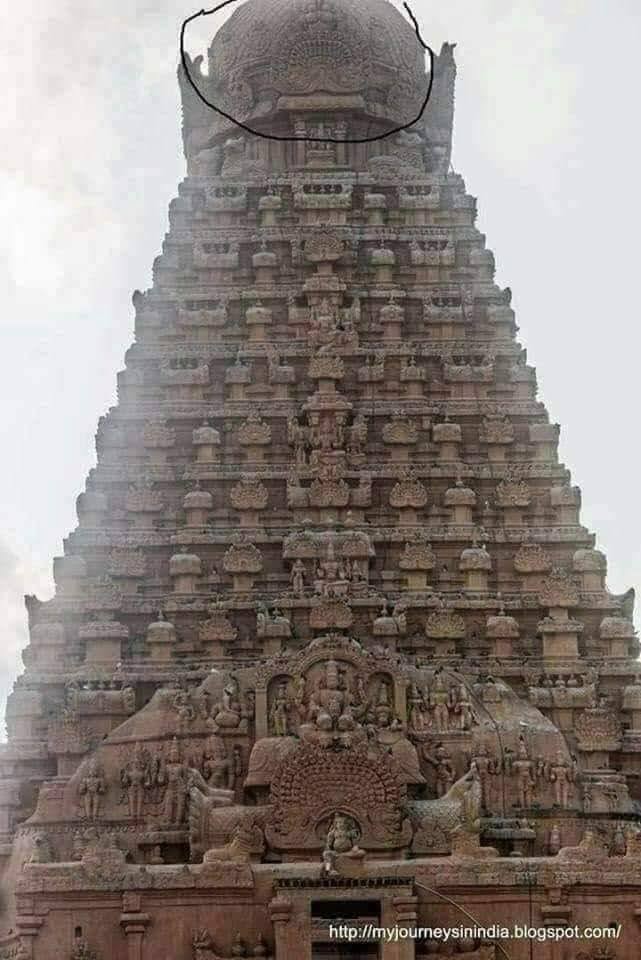
    Tanjore Big Temple.image.jpg
    Thanjavur Big Temple

    I did not think of looking into architecture in the Temples of India.

    I did not bother to check whether the Temples had any reference to other cultures of the world.

    It looks they do.

    Sculpture of French King in Thanjavur Temple.image.jpg Sculpture of French King in Thanjavur Temple.

    Yesterday I received an interesting Video from my brother’s daughter through Whatsup

    This post is a follow up of this information.

    Scroll down for Video.

    In the Thanjavur Brahadeeswara Temple, also known as the Big Temple, one come across cultures which do not represent Indians,

    Early Indians did not wear shirts.Nor did the keep their hair long, they were clean-shaven.

    And they definitely did not wear hats.

    Women did not wear high heels shoes/footwear.

    Present History tells us that there were no modes of Travel to reach foreign lands, especially through land, save the Horses.

    We find, in The Thanjavur Big Temple a sculpture showing an Image carved in the Gopuram  ( Temple Tower)of a distinctively western looking Man with Hair flowing, wearing a hat.

    And he is seen wearing a short-sleeved shirt.

    The Big Temple was built in the year 1010 AD.

    There was Robert , of the same period, King of France during that time.

    The sculpture bears an uncanny resemblance to him.

    There is another sculpture which is definitely Chinese, which shows a Man with a flowing beard and this is a mirror split image of a Chinese Emperor.

    I have written post on the name of Lord Rama’s name being found in Sumerian King’s List.

    That the Tamils were the ancestors of the Chinese and the Chinese  worshiped Shiva.

    And Lord Nataraja was the  Guardian of Chinese Buddhism.

    I have also traced the origins of Sumerians, Aztecs and Mayans to Sanatana Dharma and Tamils.

    Possible explanations.

    1.The world was well-connected, despite History’s assertions that only by 1500 AD India, then called Bharatvarsha was connected to the west.

    In the absence of swift mode of transport fo which I am yet to get evidence , I am inclined to discard this theory.

    2.That Tamil Kings carved sculpture of Foreign Kings in the Temple.

    Carvings in Temples are usually of,

    Gods,

    Kings who built the temple or ancestors,

    Events from the Puranas and Ithihasas and

    in exceptional cases Natya(dance) poses in Chidambaram Nataraja temple and elsewhere  and life situations as found in Khajuraho.

    It is also customary to sculpt the Devotees of Gods, like Nayanmars or Azhwaras, Rishis.

    But never a Foreign King or a commoner who does not have an important role in building the temple.

    I surmise that the people of India were present throughout the world as the ancestors of world races and these images were a representation of these ancestors, whose exploits could have reached the Indian shores over a period of time because, as of now, we have no evidence to suggest the people could have traveled in the same period from one end of the world to another.

    I shall change my theory when I come across irrefutable evidence that ancient Indians/Tamils had a faster mode of Transport than Horses and ships.


  • Tambaram Stone Age Settlement Rajendra Chola Inscriptions

    The areas around Tambaram, especially the stretch from Nemilicherry, Nanmangalam , and the route from nanmangalam is declared as archeological area.

    I investigated this.

    This is the information.

    Tambaram,now a bustling suburb of Chennai was a settlement of Stone Age People.

    Implement of the Stone Age and Iron Age have been found here for a radius of 10km from Old Tambaram.

    A 13th Century inscription of  Rajaraja Chola and his son Rajendra Chola have been found(1000 AD).

    Stone Age Hand Axe, Tambram.image.jpg
    Stone Age Hand Axe, Tambram, Chennai

    The area then was called Thondai Nadu.

    Aathondai Flower.Image,jpg
    Aathondai ,Capporis zeylanicaFlowers Used by the Pallava Kings.

    Tambaram is referred to as  Taamapuram.

    It’s still earlier name was Gunaseelpuram

    Kunrathur near Tambaram is the birthplace of Sekkizhar who compiled the 63 Nayanmars ‘(Devotees of Shiva) lives, calling the work as Periyapuranam.

    This was first inaugurated during the reign of Rajaraja Chola.


    . One of the famous battles of Pallava history was fought in this region. The later Cholas, the Pandias and the Vijayanagar kings also ruled this region. Even the flowers in the jungle are connected with our history. During February and March the beautiful pink and white flowers of the aathondai or thondai creepers (Capparis zeylanica)1 adorn the campus. The region of thondai nadu comprising mainly Madras and Chinglepet districts derives its name from this flower from which garlands of the famous Pallava kings were made.

    About 200,000 years ago people of the Old Stone Age (Lower Paleolithic Culture) roamed about Tambaram. They fashioned rough stone implements out of quartzite and used them for hunting and skinning wild animals. These implements or artifacts are called ‘ the hand axes of Madras industry.’ . The primitive men did not know the use of wooden handles for their stone axe-heads but used their hands instead. The first hand axe was picked up at Pallavaram over a century ago, and within the campus, several artifacts have been picked up by students4 and members of staff .


    Around 300 B.C., there were people of the Iron Age living in Tambaram area and they built their burial monuments in the form of dolmens and stone circles which are called Megaliths5 (big stones). Fine examples of such Megalithic Monuments can be seen about 100 metres east of the Great Southern Trunk Road near Guduvancheri railway station.

    Tambaram region must have been a flourishing country during the later Chola period which lasted for about 250 years after 1000 A.D. Tamil inscriptions of the Cholas are found in Manimangalam, Tiruneermalai, Tirusoolam and Kunrathoor. At Kunrathoor, the birth-place of Sekkilar, one Kaasyappa was the local doctor (Vaidya) 8 and some lands were set apart for his services. Inscriptions at Tiruneermalai refer to certain merchants from Pammal showing that this village near Pallavaram existed even then. Inscriptions at Manimangalam of Rajadhiraja I (1018-1054) give us details of a war with Ceylonese kings. Rajadhiraja defeated one Veerasalaamaygan of Ceylon, carried away his wife and sister and cut off the nose of his mother. This sort of barbaric behaviour seems to have been very common in those days even though the kings were supposed to follow Manu’s Dharma Sastra. Stories of such mutilations and abductions have been handed down to us in epics like the Ramayana. The inscriptions of Kulothunga I (1070-1120), the hero of Kalingathu parani, are found at Tirusoolam near Pallavaram and of the inscriptions of Kulothunga III there are several in this area.

    At Pammal, on the basement of a ruined Siva temple, two Chola inscriptions not heretofore noticed were copied by the students. One is dated in the reign of Tribhuvanachakravarti Sri Rajarajadeva, and the other, in the reign of Virarajendra.

    The inscription of the time of Rajaraja (III) is incomplete. It refers to an endowment for burning a lamp at a temple at Pammal. The inscription mentions that the village of Pammal belonged to Surathurnadu. It may be interesting to note that Surathurnadu was a territorial division probably named after Tiruchuram. Tiruchuram happens to be the old name of the apsidal Chola temple near Pallavaram, which is now called Tirusulam.

    The second inscription at Pammal is dated in the 35th year of the reign of Virarajendra Chola. If Virarajendra is Rajendra III, the king who succeeded Rajaraja III, then this is probably the latest reported inscription of the reign of Rajendra III.

    The inscription is complete and refers to an endowment of land by Panchanadhivaanan Nilakangarayan and to its exemption from taxes. The endowment is made to the temple of Azhaga Perumal by the Sri Vaishnavas.

    Of special interest was the fact that this inscription refers to Tambaram, which is also called Gunaseelanallur. Tambaram is referred to here as Taampuram.


    A a newly discovered Chola inscription on the basement of the Ahatisvara temple in Perungalatur gives the old name of the village as Perunkulatur, that is, the village of the big tank.

    Pandya inscriptions are found at Kunrathoor, Tirusoolam and Tiruneermalai. Temple building activity which started during the Chola period continued during the Vijayanagar period in this area and inscriptions of the Vijayanagar kings of the 14th to the 17th centuries are found here. This brings us to the modern period.

    This find will be one of the references for my theory that the Sanatana Dharma was in Dravida desa , if not originated from it.


    References.

    1.S. Gamble, Flora of the Presidency of Madras (Calcutta, 1957), p. 33.
    2 Nandikkalambakam (Tamil), (Madras, 1961), p. 66.
    3 V. D. Krishnaswami, ‘ Stone Age India ‘, Ancient India (1947).
    4 The largest hand axe was picked up by Mitran Devanesen when he was a student here in the Pre-University class.
    5 N. R. Banerjee, ‘ Megalithic problem of Chinglepet district in the light of the recent exploration’, Ancient India, (1956), pp. 22-32.
    6 V. Rangacharya, Inscriptions of the Madras Presidency, Vol. i (Madras, 1919), p. 411.
    7 E. Hultzsch, South Indian Inscriptions, Vol. I (Madras, 1890), p. 152.
    8 K. V. Raman, The Early History of the Madras Region (Madras,1957), p. 184.
    9 E. Hultzsch, South Indian Inscriptions, Vol. 3, Part I (Madras, 1899), p. 53.
    10 Annual Report of Epigraphy (1932-33), p. 75.

  • First Chola King From Kasyapa Gotra Manu Dynasty.

    I had posted an article that the Tamil Chola Kings were the descendents of Lord Rama’s Ikshvahu Dynasty and posted the list of Kings.

    I have come across information on the origin of the term ‘Chola’ and the founder of Chola Dynasty.

    There seems to have been three distinct Cholas.

    King Rajaraja Chola

    1.The Pre Sangam Cholas belonging to Ikshvahu Dynasty.

    2.The later Cholas, of whom the Great Rajaraja Chola was one.He built the Thanjavur Brahadeswara temple  and established an Empire extending from the Godavari Basin in the north to Sri Lanka,then called Elam.( Fifth century BC to Third Century AD),

    3.Rettapadi Cholas, who ruled in and from what is now called Andhra Pradesh.

    The word Chola, according to Col.Gerini, is from the Sanskrit word Kaala, or Kola meaning black, indicating that the ancestors of the Cholas were pre historic Dravidians who were black.The word Kola became Chola, avers Gerini.

    But Tamil Grammar does not lend to this view.

    Another view is that the word Chola came from the word ,’Choozh,சூழ்’, meaning ‘surround.

    The earlier group of the Cholas were possibly Nomads ,traveling widely in around Tamil Nadu and later when they formed a Kingdom, the term became Chola.

    Scholars think, rightly so, that this explanation is quite labored.

    There is yet another explanation.

    The name Chola is the name of the Dynasty by itself,

    The first King named, according to Kanyakumari epigraph ,, founChola Varman founded the Chola Dynasty.

    Chola Varman started chasing Raksasa Rajanijaran, who assumed the shape of a Deer .

    He chased the Deer and killed it.

    Then he took bath in the River Cauvery.

    On not being able to find a Brahmin anywhere nearby, he brought Brahmins from the north, provided them with lands and cows and ensured that they performed the Yagnyas.

    The land became prosperous, the Tamil word for this is ‘ செழித்தது’

    This word became Cholas .

    Chola Varman’s successors stated using this term ever since.

    Chola Varman is from the Surya Vamsa, Solar Dynasty( to which Lord Rama belonged).

    He is the descendant of Manu.

    He was from the Kashyapa Gotra.

    This information is from the Kanakumari Epigraphs.

    Many Tamil Scholars do not agree to this stating that one need accept information contained in the epigraph or Copperplates to be true because they are found there.

    Second objection is that the narration of one turning into a deer is not possible.

    The same scholars quote the same Kanyakumari epigraph to validate information on the other Cholas .

    They also accept the Anbil, Uthiramerut epigraphy.

    But when one finds a reference to Sanatana Dharma, they immediately find curious arguments to deny the facts.

    The theory that Cholavarman founded the Chola dynasty seems to tally with my theory that Vaivastha Manu left from Dravida Desa to North because of a Tsunami to found Ikshvahu Dynasty.

    I shall be writing another version from Thiruvaalkaadu Plates.

    And that seems to be more credible and backed by cross reference to Purana list of Ikshvaku,Puri Dynaties.

    Please read my post Rama’s ancestors Dravida.

    Citation.

    First Rajaraja Chola by K.D. Thirunavukkarasu, published by Ananda Vikatan Press.

    Tamil Chola Kings Descendants of Manu Rama