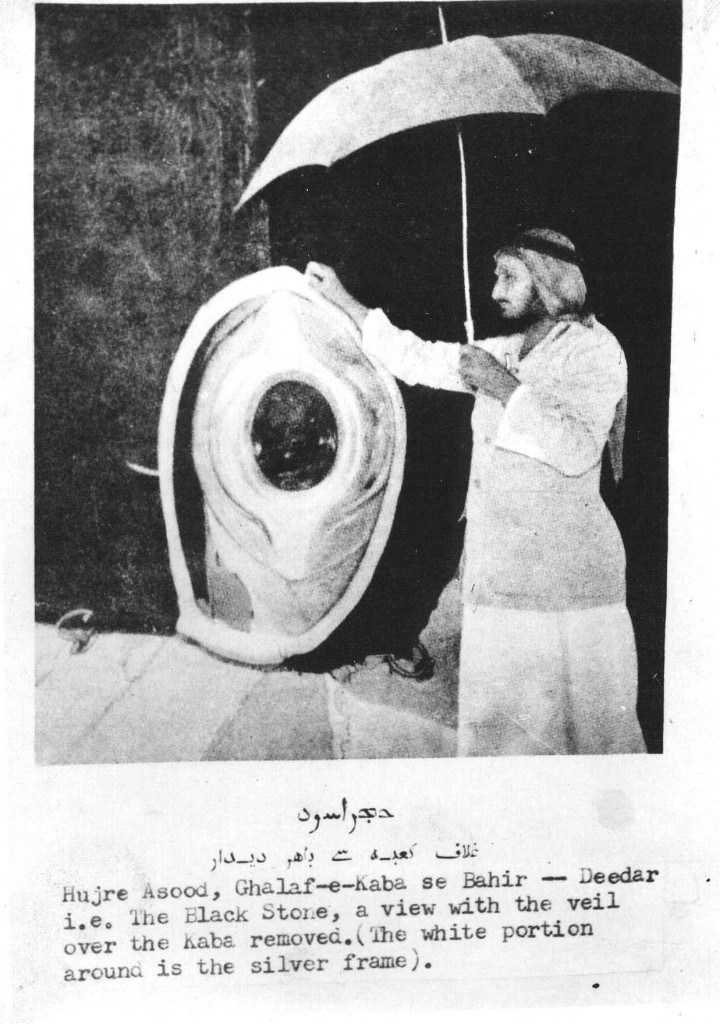
Islamic texts are cagey about the description of the Idol worshipped in in Kaaba.
There were 360 Idols before The Prophet in Mecca.
They were worshipped by the Arabs.
These were destroyed on the orders of the Prophet.
I have written on Pre Islamic Arabia.
The Worship of Many God’s, Polytheism was practiced.
The Religious concepts were from Sumeria,Sassanian empire,Iran and from Greece.
All these were derived from Santana Dharma.
I have written on the influence of Santana Dharma on all these civilisations from whom the Pre Islamic Deities were derived.
Please check under Hinduism category in this site in the drop down Menu.
Or Google the search term,for example Sumeria Hinduism +ramanan 50.
I reproduce the description of The Idol at Kaaba from a Travelogue of 1829.
‘It is an irregular oval, about seven inches in diameter, with an undulated surface composed of about a dozen smaller stones of different sizes and shapes, well joined together with a small quantity of cement and perfectly well smooth; it looks as if the whole had been broken into as many pieces by a violent blow and then united again.”
Below is the Video of the Idol worshipped in Kaaba.
‘described in Western literature in the 19th century, Swiss traveler Johann Ludwig Burckhardt visited Mecca in 1814 and provided a detailed description of the Black Stone in his 1829 book Travels in Arabia:
While I was researching the Middle wast Sanatana Dharma connection I stumbled into the history of Yemen and the fact that the pre-Islamic ancestors of the Middle east were the Parthians and Sassanians.( I ssall be posting on these Empires)
‘During Minaean rule, the capital was at Karna (now known as Sa’dah). Their other important city was Yathill (now known as Baraqish). The Minaean Kingdom was centered in northwestern Yemen, with most of its cities lying along Wādī Madhab. Minaean inscriptions have been found far afield of the Kingdom of Maīin, as far away as al-Ūlā in northwestern Saudi Arabia and even on the island of Delos and Egypt. It was the first of the Yemeni kingdoms to end, and the Minaean language died around 100 C’
Now the Parthians were from Persia .
Partha is the name of Arjuna and the Puranas state that Arjuna conquered Persia.
The Sassanians were from the Empire of Iran, Persia before Islam took over.
The Sassanians .
Some of the recent excavations have discovered the Buddhist, Hindu and Jewish religious sites in the empire. Buddhism and Hinduism were competitors of Zoroastrianism inBactria and Margiana.(wiki)
Hence the premise that the Arabs were Nomads and had no known History of Islam is incorrect.
The Arabs were the descendants of Sanatana Dharma, more specifically from Dravida region of India.
I shall be dealing with this when I write on the Pre Islam History of Saudi Arabia..
‘The Indians’ influence can be seen in the architecture of Aden as well as the food, music, and local slang. An example of such a widely-eaten, Indian food delicacy is zorbian, a spicy rice dish mixed with meat. Such expressions like “Khabar Dal,” which means “don’t do it again”, “Banis,” which translates as “cold water” and “Shoki,” or “the police” are all one-time Indian phrases now used commonly.’
Buildings with a distinct Indian character can be spotted in Aden’s old quarters like Tawahi and Crater.
There is also an Indian lane in Crater.
The Alpinaan market, named after an Indian dealer, is widely known within and outside Aden.
In fact, the economic and social impact of the large Indian community so astonished French sociologist Arthur de Gobineau that he remarked about Aden in 1855: “We have seen an Indian city on Arab land.”
According to Massoud Amchosh, professor of comparative literature at the University of Aden, “in the forties of the last century, Aden gained some attributes of Indian cities that distinguish it from the rest of the cities in the Arabian Peninsula”.
1. Shree Hingraj Mataji Mandir: Built sometime in the early 1900s, this temple is located in a picturesque mountainous location in a large cave in the Khusaf Valley, in the Crater area of Aden. This is the only temple in Aden where a regular ‘puja’ or worship is performed by the members of the Indian community every Friday evening. Since the past couple of years a congregation is also held once a month for performing the Ayyappa puja. The day-to-day maintenance of the temple is done by the Indian Association in Aden.
2. ‘Sheikh Othman’ Hanumanji Temple: The temple was built in 1882 and was spread over an area of five acres in the Sheik Othman district. It reportedly used to have a garden with a pool which was used by the devotees for bathing. It also had two lodgings for the Indian community. The temple no longer exists now.
3. Shree Shankar Hanuman Temple: It was built in the nineteenth century and was located inside a large cave in the Dashmi Bazar, Khusaf Valley in the Crater area. The temple no longer exists now.
4. Shree Ramchanderji Temple: This temple was built in 1875 by the Indian military officials and is located near the Police Academy College (Fattha Camp) in the Tawahi district of Aden. The temple is currently in a defence area and is not open to public.
5. Shree Trikamraiji-Haveli Temple: This temple was constructed in 1862 and was located in the Hassan Ali Street of the Crater region. It was called the ‘Haveli Temple’ as it was housed in a double storeyed building with a ‘Bharat Library’ attached to it. Several shops and residences have come up in the area of the temple, but the temple itself is intact and is kept locked.
You must be logged in to post a comment.