Tag: Meru

  • Sri Chakra How to Draw Details with Slokas Explanation In English Hindi

    Sri Chakra How to Draw Details with Slokas Explanation In English Hindi

    Sri chakra is a sacred geometric diagram that represents the cosmos and the divine mother. It is used as a tool for meditation and worship in Hinduism, especially in the Sri Vidya tradition.

    Definition of Sri Chakra ,Geometrical description.

    “Chathurbhih Srikanthaihi Shivayuvathibhihi Panchabhirapi

    Prabhinnaabhihi Shambhornavabhirapi Moolaprakruthibhihi!

    Chathushchathvaarimshadvasudalakalaashrathrivala-ya

    Thrirekhaabhihi Saardham Thava Sharanakonaaha Parinathaaha!”

    Literal Meaning: “ The angles of Thy abode (the Srichakra) which is made up of the nine moolaprakrithis or basic triangles ( the nine primary causative forces of the Universe) consisting of the four distinct Shiva triangles (with apex upwards) kept apart from the former by the bindu, with the eight-petalled lotus, the lotus of sixteen petals with the three circles around and the three lines, are counted as forty-four triangles.”

    Comprising nine interlocking triangles, it embodies complex symbolism. Four upward triangles signify Shiva, while five downward triangles represent Shakti, encompassing the cosmic and human realms around a central point called the bindu. This configuration is sometimes termed the “Navayoni Chakra”.

    The Sri Yantra holds great significance in the Shri Vidya school, central to its worship. It symbolizes the union of masculine and feminine divine energies. The triangles, varying in size, form 43 smaller triangles in concentric levels, mirroring the cosmos. The power point (bindu) stands as the cosmic center, encompassed by concentric circles with lotus petal patterns denoting creation and life force. These elements, set within an earth square, depict a temple with doors to different regions of the universe.

    In the Shri Vidya tradition, the Sri Yantra represents the core of devotion. Each triangle and level is associated with specific aspects of divinity, culminating in a structure known as the nava chakra. Its projection into three dimensions results in the Maha Meru, symbolizing the philosophy of Kashmir Shaivism.

    Sri Yantra also represents the union of Masculine and Feminine Divine. Because it is composed of nine triangles, it is known as the Navayoni Chakra.

    These nine triangles are of various sizes and intersect with one another. In the middle is the power point (bindu), visualizing the highest, the invisible, elusive centre from which the entire figure and the cosmos expand. The triangles are enclosed by two rows of (8 and 16) petals, representing the lotus of creation and reproductive vital force. The broken lines of the outer frame denote the figure to be a sanctuary with four openings to the regions of the universe

    Together the nine triangles are interlaced in such a way as to form 43 smaller triangles in a web symbolic of the entire cosmos or a womb symbolic of creation. The 12 and 15 sides of the four upward and five downward triangles also correspondingly symbolise, on the physical plane, the 12 sidereal zodiac signs of the Sun and 15 ‘nityas’ phase-signs of the Moon.[7] This is surrounded by a lotus of eight petals, a lotus of sixteen petals, and an earth square resembling a temple with four doors.[1]

    The Sri Yantra is also known as the nava chakra because it can also be seen as having nine levels. “Nine” comes from” Nava” of Sanskrit. Each level corresponds to a mudra, a yogini, and a specific form of the Deity Tripura Sundari along with her mantra. These levels starting from the outside or bottom layer are:

    Trailokya Mohana or Bhupara, the outermost square with four gates. It represents the Earth plane and acts as a protective boundary for the inner levels.
    Sarva Aasa Paripuraka consists of a sixteen-petal lotus. It signifies fulfillment of all desires and aspirations.
    Sarva Sankshobahana features an eight-petal lotus. It represents the stirring or agitation of the mind, symbolizing the initial stages of spiritual awakening.
    Sarva Saubhagyadayaka, composed of fourteen small triangles, this level is associated with bestowing auspiciousness and good fortune.
    Sara Arthasadhaka, composed of ten small triangles, it pertains to fulfilling worldly desires and material goals.
    Sarva Rakshakara, composed of ten small triangles, represents protection and safety from harm.
    Sarva Rogahara, composed of eight small triangles, it signifies healing and protection from ailments, both physical and spiritual.
    Sarva Siddhiprada, composed of 1 small triangle, representing accomplishment, spiritual attainment, and realization of one’s true self.
    Sarva Anandamaya, a point or bindu at the center of the yantra. It symbolizes pure consciousness, infinite bliss, and the ultimate unity of all existence.
    The two-dimensional Sri Chakra, when it is projected into three dimensions is called a Maha Meru (Mount Meru). The Sri Yantra is the symbol of Hindu tantra, which is based o

    https://en.m.wikipedia.org/wiki/Sri_Yantra

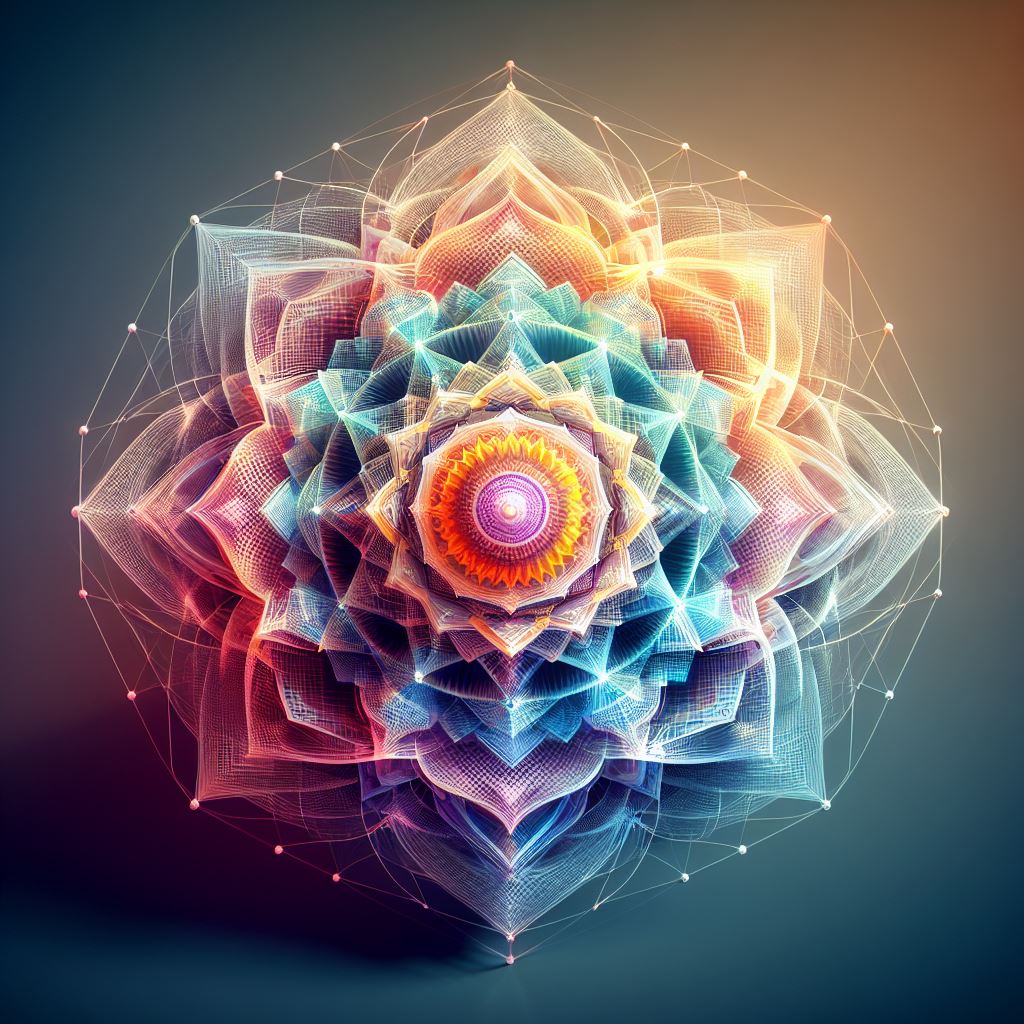
    Sri chakra by Bing GPT 4

    Some more inputs.

    The outermost part of Sri Chakra is a square (Caturasra) of three lines (Trirekha) which are one inside the other. Each square has an opening in the middle on all the four sides. This is known as Bhupura which represents the Earth plane. Inside the Bhupura are three concentric circles (girdles) known as Trivalaya (Three Girdles). The space between the Bhupura and the Trivalaya form the Trailokyamohana Chakra. The outermost line of the square has 10 Siddhi devis. The middle line has 7 Matrika devis and Mahalakshmi. The innermost line has 10 Mudra devis. Also these devis are Prakata Yoginis.

    https://greenmesg.org/sadhana/sri_vidya/sri_chakra.php

    Sri Chakra is a sacred diagram that represents the cosmos and the human body. It is composed of nine interlocking triangles that form 43 smaller triangles. It also has two rings of lotus petals, one with eight petals and one with 16 petals. Sri Chakra is considered to be a powerful tool for meditation, worship, and manifestation.

    There are different methods to draw Sri Chakra, depending on the tradition and the level of accuracy. Some methods are based on geometric constructions, while others are based on intuitive guidance. Here are some resources that can help you learn how to draw Sri Chakra:

    चतुर्भिः श्रीकण्ठैः शिवयुवतिभिः पञ्चभिपि
    प्रभिन्नाभिः शम्भोर्नवभिरपि मूलप्रकृतिभिः ।
    चतुश्चत्वारिंशद्-वसुदल-कलाश्च्-त्रिवलय-
    त्रिरेखभिः सार्धं तव शरणकोणाः परिणताः

    caturbhih srikanthais sivayuvatibhih pancabhir api
    prabhinnabhih sambhor navabhir api mulaprakrtibhih
    catus catvarimsad vasudalakalasra trivalaya
    trirekhabhis sardham tava caranakonah parinatah


    With the four of Shiva and of Shiva maids five,
    And severally the nine of prime nature, with eight and sixteen petals,
    Three circles and three lines are thus complete
    The forty-three elements that make up your finalized angular refuge.
    .
    This verse refers to the well-known Sri Chakra. The term “Chakra” suggests a global unit of consciousness. It is represented as a circle for two-dimensional convenience, but it is meant to be more than a circle. It consists of triangles with their bases placed conversely trying to interpenetrate each other from opposite sides. On the plus side, the numerator set of inverted triangles represents the masculine principle of Shiva. The lower set of upright triangles, on the denominator side, evidently represents the feminine counterpart of the numerator set.


    A rectangle can be imagined by us to join the apexes of the base angles of the two reciprocal sets of triangles. A circle can be considered as the limit of a polygon of infinite sides; similarly, at the opposite limit, a triangle would be the most elementary polygon. A series of alternating odd and even numbers could be so arranged with the four first digits on the first line, one less – three – on the next, and so on, until we form with these numbers a triangle; thus, polygons and numbers have between them a relationship. If we should consider a polygon with an infinite number of sides as a fully matured form of consciousness, all the other elements, starting from a triangle, could be united as inclusively contained within the two limits of a triangle and a circle. In the fourth line of this verse, the “finalized angular refuge” suggests the same maturity of finalization described in Verse 7 as the “autumnal full moon face”. The lower and upper limits, respectively, could be recognized between the triangle and the circle and thereafter the three circles could be treated as three grades of further maturation and abstraction.


    The Pythagoreans worshipped the tetraktys, which is a triangle, numerologically understood. The polygon of infinite sides becomes a circle by maturation of the triangle. The triangles are seen to have their apexes on a vertical parameter or axis, some of them in ascending, and some in descending order. We can count four such apexes from the top as we descend along the vertical axis; similarly, we can count five apexes in an ascending order. When translated into three-dimensional or four-dimensional space, as in conics and solid geometry, we can see somehow the forty-three elements under reference here. Hilbertian mathematics speaks in terms of choses mathématiques – mathematical things – which are treated as elements or units, by which the structure of mathematics as a whole is revealed. Within the scope of an endless series of numbers, it is possible to arrange them so as to obtain all the polygons possible in geometric figures. Adding together the four of Shiva and the five of the Shiva maids gives us nine points or apexes which touch the vertical axis. These nine are referred to as of the order of “Prime Nature”. Nature (Prakrti) is the negative counterpart of the Spirit (Purusha) of Samkhya philosophy. Although Advaita Vedanta is against the dualistic treatment of Nature and Spirit as rival absolutes; here, in order to distinguish the function of Shakti from that of Shiva, for the sake of argument at least, the notion of a Prime Nature (Mulaprakriti) is retained. This is to be treated not as a doctrinal, but as an epistemological and methodological necessity. Thus we have found some raison d’être for the apexes and the triangles in this verse.


    The base angles, in turn touched by the circumscribing circle, are to be treated as the petals of a flower or the radiating lines of the points of a compass. This circle could be divided into eight divisions of forty-five degrees each. We could further subdivide it into sixteen, because space could be four-dimensional or multidimensional, according to the fraction of a right angle that we treat as a unit. If the circle is treated as a cross- section of space, and if we treat the inner circle and the outermost circle as the limits of what is conceptual and what is perceptual within consciousness; and if we put in an intermediate circle which participates on both sides, we can roughly see the significance of the three concentric circles. The outermost circle represents the limit of the horizontal maturation of this geometrical figure, which combines a horizontal as well as a vertical gradation of elements. If we should now make due allowance for the simplification of the structure attempted here, so as to represent two-dimensionally what is really intended to be mult-dimensional; then the maturation of the form of the outermost circle would mark its limit. Since the two orthogonal axes within the circle are equalized, it would mean that there is a harmony between the two tendencies of horizontalization and verticalization, within which Absolute Consciousness with a negative perspective can be said to operate. Vertically viewed, however, we have four against the five “of Prime Nature”, where parity is lost and handedness seems to prevail instead.


    Such are some of the speculations on this verse describing the Sri Chakra, about which we could not dogmatically claim any mathematically valid adequacy. Like time and space articulated with each other, we have to imagine something similar to what Henri Bergson has described in the following passage:


    “Across time and space, which we had always known to be separate and, for that very reason, structureless, we shall perceive, as through a transparency, an articulated space-time structure. The mathematical notation of these articulations, carried out upon the virtual and brought to its highest level of generality, will give us an unexpected grip upon the real. We shall have a powerful means of investigation at hand, a principle of research which, we can predict, will not henceforth be renounced by the mind of man, even if experiment should impose a new form upon the theory of relativity.”


    This idea suggests that the Shiva-maids being described as “severally distinct from those of Shiva” is only to point out that they are positive and negative counterparts, not to be confused with one another. Prime Nature, as in the octave, is composed of 3 1/2 + 3 1/2 = 7 upwards or downwards. Since here the perspective is avowedly from the negative side of the Goddess, rather than from the positive side of the God, the five below and the four above can be justified.


    The finalization is both horizontal and vertical. A circle represents the harmonious integration of vitalistic and pure tendencies in the Beauty of the Absolute Goddess.


    The eight and sixteen petals refer to points of the compass, as we have said. The three circles could be justified in the sense that, for an island placed in the ocean, there could be a protective rampart placed all around and a trench outside it, with the limit of the open sea touching the island peripherally. Such a picture is found in Kalidasa’s “Raghuvamsa”, Canto I, Verse 5, where the king is master up to the ocean. Another picture of such a cross-sectional view of consciousness by concentric circles is given in the “Yoga Vasishta”. Ref.

    http://www.advaita-vedanta.co.uk/index.php/content/229-saundarya-lahari-verse-11

    The above link doesn’t support https.

    स्रीयन्त्र ज्ञानेश्वरी समरशत्र
    चत्वारि श्रीकण्ठाश्रिता शिववाती
    अश्विनीभ्रमराविद्युत्सुधामयी स्यादत्र गृहिणी ।
    भूमे चत्वारिंशद्वह्निवज्रात्समालोचनाकलनी
    द्युतिः शक्तिदिव्या पञ्चशतं पञ्चखण्डेष्वपि ते युवा ॥

    उक्त प्राचीन संस्कृत श्लोक के अनुसार स्रीचक्र के अपेक्षाकृत बिंदु के अतोदेश में रखे चौचक्बद्ध केंद्र के आसपास चारो दिशाओं में वर्तमान हैं अष्ट पिंड के सहित 30 xxxxत्रिकोणों से सहित 44 xxxxछोटे xxxxत्रिकोण हैं।

    xxxxनव योनि चक्र कहलाते ह्यूयी होते हैं क्योकि इसमें नौ xxxxत्रिकोण सहित रचना होती है।

    इन नौ xxxxत्रिकोणों का आकार भिन्न-भिन्न होता है और वे एक दूसरे xxxxmilते हैं। मध्य में आधारबिंदु (बिंदु) होता है, जो सर्वोच्च, अदृश्य, अज्ञेय केंद्र को दर्शाता है, जहां पूरी आकृति और ब्रह्मांड का विस्तार होता है। बाहरी xxxxत्रिकोणों के बीच बिंदु के साथ आठ पंख वाले कमल, सोलह पंख वाले कमल और समतलि वर्ग की तरह के तीन वृत्त होते हैं, जो सृजन और जीवन शक्ति को दर्शाने के लिए होते हैं। इन तत्वों को पृथ्वी वर्ग में स्थानित किया गया है, जो विभिन्न ब्रह्मांड के क्षेत्रों में द्वार है।

    श्री विद्या परंपरा में, स्री यंत्र पूजा की मूलभूतता को प्रतिष्ठित करता है। प्रत्येक xxxxत्रिकोण और स्तर को दैवीयता के विशेष पहलुओं से जोड़ा जाता है, जो सर्वोच्च स्तर, योगिनी और देवता त्रिपुरा सुंदरी के एक विशेष रूप के साथ समाप्त होते हैं। इन सर्वेक्षणों का प्रकार तीन आयाम की एक संरचना में परिणत होने से क्रमित होता है, जिसका नाम नव चक्र है। इसका त्रिमात्रिक आयाम महामेरु को प्रकाशित करने का परिणाम होता है, जो कश्मीर शैववाद के तत्व की दर्शनशास्त्र को प्रतिष्ठित करता है।

    स्री यन्त्र छठस्थान की कन्वर्ज़ प्रतीक है जो ब्रह्मांड और मानव शरीर को दर्शाता है। इसमें नौ xxxxत्रिकोण होते हैं और यह “नवयोनि चक्र” के रूप में जाना जाता है।

    इन नौ xxxxत्रिकोणों का आकार भिन्न-भिन्न होता है और वे एक दूसरे के क्रमिक संपर्क में होते हैं। मध्य में पावनबिंदु (बिंदु) होता है, जो स्पष्टता, अनंत, अद्वयी केंद्र को दर्शाता है, जिसे पूरी आकृति और ब्रह्मांड का संचार प्रवृत्ति म्हणून माना जाता है। xxxxत्रिकोणों को बाहरी कोट में दोनों पक्षों के छेद स्थापित करने के लिए उपयोग किया जा सकता है, यह है “Pixel संरचना” को “व्रिमन्धित” करणारा आहे, “विस्तार ान किंवा अंतर्निहिटिंग” म्हणून। “Mahabharatoire Historicale” की केंद्रीय xxxxत्रिकोणे संचारांची प्रतिमा म्हणून प्रतिष्ठित केली जाते. त्रिकोण, तीन xxxxmils ने प्रगतीपथाची प्रमुख विधा, म्हणून तीन वापरिता त्रिकोण संपन्न असतात. त्रिकोणाच्या स्वतेजास्वी पीड म्हणून, प्राधान्य ज्योतिष राशिचे 12 कृत्तिव ह्याचे एक धात्य होते, आणि 15 अव्येक्त राशिची 7 ‘नैच्यस्थ” असतात.[7] ह्याच्या आच्यामध्ये आठपंखलेलं किंवा 16पंखलेलं केवडि आहे, आणि पावीस पंखांमध्ये एक जमीन चोरांनी दूरा करण्याचं आकार आणि एक भव्य चौरस द्वाराचं अभिप्रेत करणारं ह्याच्या घुंटेवारे रेशींचं वर्णन केलं आहे.[1]

    स्री चक्र ही आपले निरंतर / बा निरंतर अटीस सेतून आपल्या अटेजबाजूंन केवळ एक चाणा असा बरं करते. बाह्य प्रांगणाचे पदार्थ बीपनारी वाचवून व्यापून घेतले जाते, असेच त्रिधा चार सुर. सिंचाना आणि केंद्रित केलेल्या त्रिकोणांमाने दिसणारे नक्षेप चारंगट किंवा दिसाना विसारल्या जातात. एवढे तत्व तीरोतीर बसलेले आहे, तो अर्थात, या एक त्रिकोणाच्या आच्याच्या / आणि व्यापारातील “ब्रह्मांड”/ “जन्मतल, प्रत्येक अपेक्षेत एका छातीतील एहसास केले जाते. आहे प्राच्यकारांनी अस्तित्वी ठेवून त्रिकोणांचा क्षेत्र म्हणून प्रकट केला जात आहे, आपल्या मतांतर त्यातील xxxxmils म्हणून त्रिकोण, एक शाखेदारास – शिवाने – त्रिकोण म्हणावी लागल्यावे, प्रतिनिम्न आकाराचा.

    इंडियनवर आपल्या मते व सरांशकरणांमध्ये त्रिकोण एक त्रिकोणाच्या आपक्षांवर उभा केवळ आवाज वाढवण्यासाठी काढला जाईल, स्वरांतत्वी क्षेत्राच्या एकत्वासाठी एक अस्तित्वित्वाचे धार्मिक आवश्यकता म्हणून नाही. या संदर्भातील शिव म्लेच्छित किंवा शक्ति म्लेच्छित असावीत त्यांच्या अस्तित्वांमधील विदग्धीची सोय नाही. “Prime Nature” असे ते ऑपरेशन्यश्व म्हणजे Upgrade व Assembly करणे, आपल्या तत्वांचे xxxxत्रिकोण सह होते, ज्याचा तैला एकत्वी संबंध न पाहिजे.

    translation by Jetpack AI.Please point out inaccuracies

  • Meru Mountain Hinduism Pico Cao Grande Gabon Africa Where Lemuria Atlantis Met

    Meru Mountain Hinduism Pico Cao Grande Gabon Africa Where Lemuria Atlantis Met

    I have written earlier that the ancient Texts of Hinduism lend themselves to minimum four interpretations.

    1.The literary,word by word meaning.

    2.The Philosophical meaning.

    3.The Scientific meaning and

    4.Tantric meaning which espouses the Geometric and Sound combined Concept for Spiritual upliftment.

    All texts lend themselves to this approach.

    I shall write on this shortly.

    Hence each Concept in Hinduism has at least four interpretations.

    So is the case with Meru.

    Meru ,for example ,is described ,in Lalitha Sahasranama thus.

    ‘Sumeru Mandala Madhyastha Sriman Nagara Nayikaa’

    Of Lalitha Devi it describes,

    ‘The one who dwells in the city of SriChakra(Sri Nagara),which is located in the Meru Mountain.

    Let us look at the Geographical approach.

    Mount Meru has been suggested to be in Arctic,Tanzania,Kashmir,apart from being a Tantric Concept.

    Ayodhya, Mathura,Pandyaa Kingdoms, not to speak of the Holy places, Rivers, Mountains and even the Species that thrive in these locations.

    At the same time one gets the impression that the areas mentioned are not in The Earthand are located in some other location ,Planet, under the Ocean.

    And we have the Lokas, the abode of Beings confusing.

    We have , for example, the Surya Loka, Chandra Loka.’

    Meru in Arctic

    Mount Meru is an active stratovolcano located 70 kilometres (43 mi) west of Mount Kilimanjaro in the nation of Tanzania.

    And there is a Town Meru in the neighboring Kenya!

    3.Meru is also identified Mount Meru or Sumeru with the Pamirs, north-west of Kashmir.

    Meru in Tanzania

    Mount Meru is also theorised somewhere near Sumeria,the term Sumeria from Meru ,Sumeru.

    There are extensive descriptions of Meru in the Puranas.

    There is a parallel system of Hinduism in the south of Vindhya ranges,called Dravida Desa,where the Tamils lived around 230 million years ago.

    Please refer my article Lemuria Home of Tamils.

    There are three concepts regarding this landmass.

    Lemuria,

    Its outer portion MU and

    Kumarikandam.

    Lemuria and Kumarikandam seem to have slightly different landmass,while there is agreement that  MU formed the periphery of the land of Tamils.

    Detailed research was carried out by James Churchward.

    You may read my articles on Kumarikandam,Lemuria and MU.

    Though there are references in ancient Tamil Texts,they are few.

    A text of Yoga and Advaitha,which predates Patanjali,Thirumandhiram by Thirumoolar,A Siddha , is presumed to be over 3000 years old.

    Thirumandhiram has 3000 poems,which deal with Spirituality,Yoga ,Shiva and Advaitha.

    Thirumandhiram is subjected to scientific research in the US.

    A poem refers to Meru.

    It refers Meru as a Mountain a Mountain whics was located at the point where the Equator,and the Zero degrees of Longitude and Latitude converge and it was devoured by the Ocean.

    I checked the information with the present Geographical areas.

    The result is that Mount Meru seems to have been near the Gulf of Guyana.

    To be exact, the intersection of  zero degrees latitude and zero degrees longitude falls about 380 miles (611 kilometers) south of Ghana and 670 miles (1078 km) west of Gabon. This location is in the tropical waters of the eastern Atlantic Ocean, specifically, the Gulf of Guinea.

    The Gulf of Guinea is part of the western edge of the African tectonic plate. Most notably, according to the theory of continental drift, this may have been the location where South America and Africa were once joined.

    The equator has a mark of zero degrees latitude and the prime meridian one of zero degrees longitude, but where do these two lines meet? The simple answer is that they intersect in the Gulf of Guinea, just off the western coast of Africa.’

    Source. https://www.thoughtco.com/prime-meridian-and-the-equator-intersect-4070819

     It is the place where South America and Africa Continents join.

    The equator is at zero degrees latitude. 
    It is the starting point for measuring latitude.


    The equator runs through the top of South America, through the middle of Africa and then Indonesia and north of New Guinea.

    The Meru Mountain must be, based on this,should have been among middle of Africa,Indonesia and North of New Guinea.

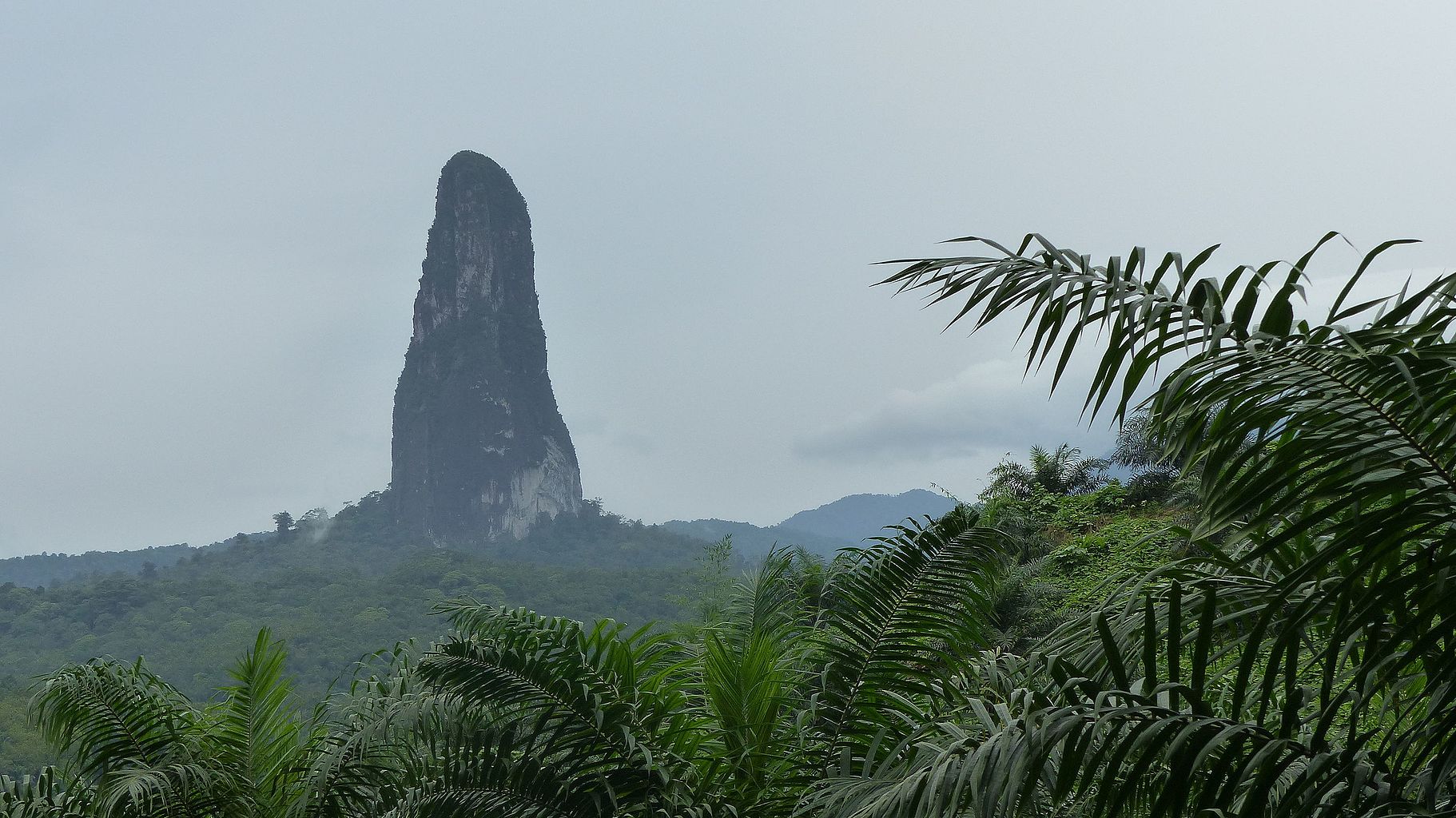
    Pico Cao grande mountain seems to fit the bill ,though it is slighly off the mark in longitude and Latitude

    More exploration under the sea in the nearby areas needed.

    Pico Cão Grande

    The Pico Cão Grande (Portuguese for “Great Dog Peak”) is a landmark needle-shaped volcanic plug peak in São Tomé and Príncipe, in the south of São Tomé Island in Obo National Park. It rises dramatically over 370 m (1,000 ft) above the surrounding terrain and the summit is 668 m (2,175 ft) above sea level.

    São Tomé Island, at 854 km2 (330 sq mi), is the largest island of São Tomé and Príncipe and is home to about 157,000 or 96% of the nation’s population. This island and smaller nearby islets make up São Tomé Province, which is divided into six districts. The main island is located 2 km (1¼ miles) north of the equator. It is about 48 kilometres (30 miles) long (North-South) by 32 kilometres (20 miles) wide (east-west). It rises to 2,024 metres (6,640 feet) at Pico de São Tomé and includes the capital citySão Tomé, on the northeast coast. The nearest city on mainland Africa is the port city of Port Gentil in Gabon located 240 kilometres (150 miles) to the east.

    https://en.m.wikipedia.org/wiki/São_Tomé_Island

    0.1180° N, 6.5660° E

    Is this the place where Atlantis and Memuria met?

    The poem runs thus,

    1394. ஊரும் உலகமும் ஒக்கப் படைக்கின்ற

    பேரறி வாளன் பெருமை குறித்திடின்
    மேருவும் மூவுல காளி யிலங்கெழுந்
    தாரணி நால்வகைச் சைவமு மாமே.

    (ப. இ.) ஊர் உலகம் உடல் உறுப்பு உண்பொருள் எல்லாம் கருவியின்றிக் கலந்தியக்கும் கருத்தளவானே படைத்தருள்கின்றவன் சிவன். அவன் இயல்பாக விளங்கும் முற்றுணர்வுடைய பேரறிவாளனாவன். அவன்றன் அளவிலாப் பெருமையை நாமறிந்த அளவில் குறிப்போமானால் மேருவாகிய பொன்மலையும், மூவுலகையும் ஒருங்கு ஆளும் அவன் (சிவபெருமான்) படைத்தருளும் உலகமும், சுத்தம், மிகுசுத்தம், மார்க்கம், கடுஞ்சுத்தம் என்னும் நால்வகைச் சைவமும் ஓர் புடை ஒப்பாகச் சொல்லலாம். அசுத்தம் – மிகுசுத்தம். நால்வகைச் சைவமும் சிவபெருமானின் நின்றே தோன்றுவன. துளக்கமில்லாத சிவபெருமானின் அளத்தற்கரிய பெருமையினுக்குப் பொன்மலையொப்பாகும். எங்கும் நீக்கமற நிறைந்து நிற்கும் இயல்பினுக்கு நிலவுலகம் ஒப்பாகும். தவறாது திருவடிப்பேறாம் மெய்ப்பயன் தருதற்கு நால்வகைச் சைவம் ஒப்பாகும். சுத்தம் – உண்மை, இயற்கை, நால்வகைச் சைவம் வருமாறு: இயற்கைச் செந்நெறி, மீ இயற்கைச் செந்நெறி, மெய்யுணர்வுச் செந்நெறி, மெய்கண்டார் செந்நெறி என்பன. இவற்றை முறையே, சுத்த சைவம், அசுத்த சைவம், மார்க்க சைவம், கடுஞ்சுத்த சைவம் எனவும் கூறுப. அசுத்தம் என்பதில் ‘அ’ அப்பால் என்பதன் முதலெழுத்தாகும். எனலு மொன்று. செந்நெறி எனினும் சிவனெறி எனினும் ஒன்றே.

    (அ. சி.) நால்வகைச் சைவம் – சுத்த சைவம், அசுத்த சைவம், மார்க்க சைவம், கடுஞ்சுத்த சைவம். மேரு – பூமியின் மத்திய இரேகையும் நிரட்சர ரேகையும் சேரும் இடத்தில் இருந்து கடல் கொண்டடொழிந்த மேரு மலை. சுமேரு – வட துருவம் (North pole.) குமேரு – தென் துருவம் (South pole.) இங்கே நிலைதவறாமைக்கு உவமையாக வந்தது. மூவுலகு – பரந்து விரிந்த தன்மைக்கு உவமை. சைவம் – மெய்ப்பயன் தருவதற்கு உவமை.’

    Source. http://www.tamilvu.org/slet/l4100/l4100pd2.jsp?bookid=118&pno=541

  • Mount Meru Shambala And Stargate

    One of the axioms of Hinduism, Sanatana Dharma is that what is in Microcosm is in the Macrocosm and Macrocosm is in the Microcosm.

    That whatever one finds in the Universe, not just the Earth, is in the Human being.

    Knowledge in Hinduism is based on this concept.

    Knowledge is not some thing one acquires from outside but within.

    Here it would be of interest to recall a Paradox of Zeno.

    If you possess Knowledge , you do not need to seek it.

    If you do not possess Knowledge and seek for it, you will not be able to identify it as you do not possess knowledge.

    Kailash Mountain
    Mount Kailash, Himalayas

    Hindus Conception of World
    The World as described in the Purans,Meru

    The Sri Chakra of Devi.The Devi's Sri Chakra.iamge.jpg
    Sri Chakra

    So in both the cases Knowledge is impossible!

    Hinduism states that Knowledge is the removal of Ignorance, Avidya.

    Knowledge is Absolute and is an attribute of the Reality, Brahman.

    I had touched on this in a few posts and will be discussing in detail later.

    Now to what we find in the Universe , in the ultimate analysis, is made of these Five Elements,

    Earth, Water, Fire ,Air and Ether.

    These Five elements are present in the Human body.

    I have posted articles on how the Fire element(Agni) functions in the Human body in various functions like Digestion.

    And one can find the mental stages in spiritual developments, like attaining Chandra Stage is also found as the Moon in the Universe.

    The examples are many.

    One such is the term Meru.

    Meru is explained in the Tantra Shastras as a Highly evolved stage of spiritual development.

    Lalitha Devi is described as Meru Mandala Madhyastha Sriman Nagara Nayika’

    It is also explained in the Hindu texts as being present in the The Universe.

    ‘Sadaputa presents the Bhuloka or Jambudvipa and Meru as well as other islands and seas as flat. According to Surya Siddhanta it is round like and upside-down bowl.

    With Meru on the top it is in the center. One reason mathematically it is so, is that the planets are having degrees north and south and they should not “crash into” Bhuloka. If the planets crash into Bhuloka then we take Bhuloka as a “subtle” land or as “symbolic” of other things. Bhu is this land, bhavah is outer space, sva is upper spaces as in the Gayatri mantra, where we chant, om bhur bhuvah svah tat savitur varenyam. Above the Bhuloka planetary system is Bhuvarloka, and above that is Svargaloka, the heavenly planetary system'(hare krisna.com)

    The current location of Mounrt Meru is variously placed at Mount Everest, Kailash, Arctic, Arkaim in Russia and in Peru.

    In Japanese Buddhist philosophy, a giant mountain called Mount Sumeru (Shumisen) was believed to stand at the center of the world.”

    Meru’s description in the Mahabharata.

    “Dhritarashtra said.—“Thou art intelligent, O Sanjaya, and acquainted with the truth (about everything). Thou hast duly given a description of the island in brief. Tell us now of the island in detail. Tell us now of the dimension of the expanse of land that lies in the portion looking like a hare. Thou mayst then speak of the portion resembling peepul tree.”


    According to Vasubandhu’s Abhidharmako?abh?syam, Sumeru is 80,000 yojanas tall. The exact measure of the yojana is uncertain, but some accounts put it at about 24,000 feet, or approximately 4 1/2 miles. It also descends beneath the surface of the surrounding waters to a depth of 80,000 yojanas, being founded upon the basal layer of Earth. Sumeru is often used as a simile for both size and stability in Buddhist texts.

    Please read my posts on this.

    Like Meru there is this concept of Shambala, a place 0f Perfection in Tibetan Buddhism.

    Shambala.

    ON TOP OF THE COSMIC MOUNTAIN...  {A Representation of the Gate}.Image.jpg
    The City on the Edge of Forever
    by Aaron Ross Spring 1992.ON TOP OF THE COSMIC MOUNTAIN…
    {A Representation of the Gate}


    Tibetan texts appear to show historical facts about Shambhalla. The data recorded in these texts give names, dates and corresponding events occurring in the outside world. The Hindus and Buddhist alike regard Mount Meru, located in the Himalayas, as the location of Shambhalla. It is the center of the cosmos, having its roots in hell and its summit in heaven.

    The mountain peak houses a magnificent central palace radiating a powerful, diamond like light, which is the home of Indra, King of Hindu gods.

    Legends tell of her slopes being studded with glittering gemstones and thick with trees heavy with delicious fruit. She is circled by seven rings of golden mountains, each separated from the other by one of seven circular oceans. This entire superstructure rises from an outer ocean, and is flanked by four main continents, each with two subcontinents.

    The southern continent, Jambudvipa, corresponds to the physical earth. Each of the other continents represents a nearby planet upon which transmigrating souls following the yellow light-path may be reborn.

    Tibetan religious texts tell us that the technology of Shambhalla is supposed to be highly advanced; the palace contains special skylights made of lenses which serve as high-powered telescopes to study extraterrestrial life, and for hundreds of years Shambhalla’s inhabitants have been using aircraft and cars that shuttle through a network of underground tunnels.

    On the way to enlightenment, Shambhallans acquire such powers as clairvoyance, the ability to move at great speeds, and the ability to materialize and disappear at will.

    Andrew Tomas, author of ‘Shambhalla, Oasis of Light’, writes,

    This remarkable kingdom reputedly exists both above and below ground, with a network of tunnels hundreds of miles long. Cars of strange design flash along their length and they are illumined by a brilliant, artificial light which affords growth to the grains and vegetables and long life without disease to the people.

    Hebrew legends speak of a place called Luz which is described as an underground city near a sacred mountain called the ‘abode of immortality’.

    Some Tibetans think Shambhalla might be in Tibet, perhaps in the Kunlun mountains; others point toward the region around Mongolia and Sinkiang province of China. Others believe it to in Siberia or some other part of Russia. Some lamas claim that it is hidden in the frozen Artic. Others believe Shambhalla only exists in an parallel universe or higher dimension.

    In the years between 1923 and 1928, Nicholas Roerich, led an expedition across the Gobi Desert to the Atlai mountain, a journey which covered 15,500 miles across 35 of the world’s highest mountain passes.

    It is rumored that he may have been on a mission to find and return what was said to be part of the sacred ‘Chintamani Stone,’ which was believed to be part of a magical meteorite from the solar system in the constellation of Orion. According to Lamaist legend, a fragment of this stone from what may be the star Sirius, is sent wherever a spiritual mission vital to humanity is set up, and is returned when that mission is completed.

    The stone is said possess occult properties, capable of giving telepathic inner guidance and effecting a transformation of consciousness to those in contact with it.

    Whether he retrieved the stone or not is not known, but what we do know for certain is that he was sent in search of it by the League of Nations. Just in the fact that he was sent on this expedition lends credibility to the existence of the Shambhalla legends.

    Roerich was a man of great creditability.

    To his credit, he was a philosopher, author, explorer, member of the Theosophical Society, member of the League of Nations, influential in the FDR administration and was the pivotal force behind placing the Great Seal of the United States on the American dollar. He also produced hundred of paintings capturing the essence of the area and its people.

    Roerich strove to link all scientific and creative disciplines to advance true culture and international peace, citing the power of art and beauty to accomplish such a feat. In honor of his efforts, in 1935 The Roerich Peace Pact was established, which obligated nations to respect museums, cathedrals, universities and libraries as they did hospitals, and became part of the United Nations organizational charter.

    In his travels through China and Mongolia to the borders of Tibet, Roerich met with a lama that described Shambhalla to him.

    According to this famous explorer, Roerich was told,

    ‘Great Shambhalla is far beyond the ocean. It is the mighty heavenly domain. It has nothing to do with our Earth… Only in some places, in the Far North, can you discern the resplendent rays of Shambhala.’


    The Star Gate.


    Thousands of miles in height, Meru is located somewhere beyond the physical plane of reality, in a realm of perfection and transcendence. Symbolic representations of Mount Meru are commonly found in Tibetan mandalas, contemplative diagrams designed to aid meditators in focusing.

    It is said that Meru has its roots in hell, and its summit in heaven. Meru is surrounded by seven rings of golden mountains, each separated from the other by one of seven circular oceans. It is crowned by a golden palace wherein Indra, king of Hindu gods, resides. This entire superstructure rises from an outer ocean, and is flanked by four main continents, each with two subcontinents.

    The southern continent, Jambudvipa, corresponds to the physical earth. Each of the other continents represents a nearby planet upon which transmigrating souls following the yellow light-path may be reborn. However, it is said that all of these worlds are undesirable, for they are non-human worlds inhabited by sheep, cattle, or horses. The teachings of Buddhism clearly state that existence as a human being is the only way to achieve Buddhahood, so rebirth in any other form (including that of a deva or demigod) is a distraction from the path to enlightenment.

    According to legend, somewhere in the northwest region of Jambudvipa lies a land called Shambhala. This is a magical land which is shaped like an eight-petalled lotus flower. It has been ruled by priest-kings for many thousands of years; in fact, the legend of Shambhala predates the introduction of Buddhism into Tibet. In the aboriginal Bon religion, Shambhala is known as Olmolungrung, and is based on the square instead of the circle.

    Shambhala forms a gateway between the physical and spiritual realms. It is endowed with riches, and is ideally suited for the habitat of enlightened souls. They are not attached to the fruits of karma, and are but one step from Buddhahood. This is the realm to be sought for rebirth if one desires the swiftest path to nirvana.

    In the Tibetan Buddhist version of the apocalypse, barbarians will overtake the earth at the end of the Kali Yuga, the present age. It will be necessary for the king of Shambhala to join forces with the gods to wage war on the barbarians.At this time, armies will be sent forth from the city, the location of which has been kept secret for millenia. Order will be restored on earth, and the wisdom which Shambhala has been holding will be dispensed to the peoples of the world(Tibetan Buddhism)


    Citation and References/

    http://www.thelivingmoon.com/42stargate/03files/Mount_Meru.html


    http://www.bibliotecapleyades.net/sociopolitica/sociopol_shambahla06.htm#Chapter Two


  • Meru Arctic, Kashmir, Tanzania ,Celestial?

    Mount Meru is mentioned in all the Puranas, especially while talking of the Evolution of The Universe.

    Jambudvipa lies in the middle of all Mortal Realms and in its center is the lofty Mt. Meru, bright as gold. Its height is 84,000 yojanas, and it extends 16,000 yojanas below the earth; its width at the top is 32,000 and at the base is 16,000 yojanas.

    -Kurma Purana.

    Name Width Height/Depth
    Sumeru (Sineru) mountain 80,000 yojanas 80,000 yojanas
    Sea 80,000 yojanas 80,000 yojanas
    Yugandhara mountains 40,000 yojanas 40,000 yojanas
    Sea 40,000 yojanas 40,000 yojanas
    Iṣadhara (Isadhara) mountains 20,000 yojanas 20,000 yojanas
    Sea 20,000 yojanas 20,000 yojanas
    Khadiraka (Karavīka) mountains 10,000 yojanas 10,000 yojanas
    Sea 10,000 yojanas 10,000 yojanas
    Sudarśana (Sudassana) mountains 5,000 yojanas 5,000 yojanas
    Sea 5,000 yojanas 5,000 yojanas
    Aśvakarṇa (Assakaṇṇa) mountains 2,500 yojanas 2,500 yojanas
    Sea 2,500 yojanas 2,500 yojanas
    Vinadhara (Vinataka) mountains 1,250 yojanas 1,250 yojanas
    Sea 1,250 yojanas 1,250 yojanas
    Nimindhara (Nemindhara) mountains 625 yojanas 625 yojanas
    Outer Sea 32,000 yojanas relatively shallow
    Cakravāḍa (Cakkavāḷa) mountains(circular edge of the world) 312.5 yojanas 312.5 yojanas


    Mount Meru is also considered Divne and is ver Holy for the Sakthi Upasakas.

    Lalitatha Sahsranama  referrs  ‘Meru Mandla Madhyastha’

    This house is described in detail in the Brahmaanda Purana,”In that house of Chintamani all is Chintamani.”This house having an extent of a thousand yojanas is above the world system.


    The Rudrayaamala says,”In that Chintamani house of a thousand yojanas in extent.


    “The house which is on Meru is smaller in size. ‘

    https://ramanisblog.in/2014/04/17/lalitha-devis-abode-chinatmani-gruham-details/


    There are views that this Mountain is terrestrial.

    Some Hindu traditions place it in The Arctic.

    1.There is evidence that the Rig Veda was composed in the Arctic.

    I have  a post on this.

    Bal Gangadhar Tilak subscribes to this view.

    The Arctic region today, comprises of kilometers thick sheets of Ice spread for miles together, with hardly any land or vegetation on it.. But, what if the North Pole, at some time in its history, did support land as well as vegetation???
    My research, turned up evidence that North Pole INDEED boasted of a continent right until the Miocene Period which however, got submerged during the subsequent Ice-Ages (!!). According to latest geological evidence, the last Glacial period closed about 10,000 years ago and the geographical distribution of land then, was radically DIFFERENT from what it is at present..”

    Mount Meru as the Center of the Earth.jpg
    Mount Meru as the Center of the Earth.

    2. Mount Meru in Tanzania.
    We have a Mountain by the name Meru in Tanzania.

    Meru in Central Asia, Korean Legend.jpg
    A Korean world map centered on the legendary Mount Meru in Central Asia.”A Korean world map centered on the legendary Mount Meru in Central Asia.” by Unknown – http://www.saudiaramcoworld.com/issue/200504/the.leek-green.sea.htm. Licensed under Public Domain via Wikimedia Commons – http://commons.wikimedia.org/wiki/File:A_Korean_world_map_centered_on_the_legendary_Mount_Meru_in_Central_Asia..jpg#mediaviewer/File:A_Korean_world_map_centered_on_the_legendary_Mount_Meru_in_Central_Asia..jpg

    Mount Meru is an active stratovolcano located 70 kilometres (43 mi) west of Mount Kilimanjaro in the nation of Tanzania.

    And there is a Town Meru in the neighboring Kenya!

    3.Meru is also identified Mount Meru or Sumeru with the Pamirs, north-west of Kashmir.

    4.The Meru is Celestial.

    Hindu Tantra shastras maintain that Meru is a spiritual Plane of Existence.

    Buddhism and Jainism say the same.


    Tibetan Buddhism regards Meru as the Center of the Universe and believes it to be beyond the physical plane, in a realm of perfection and transcendence. Symbolic representations of Meru are frequently found in Tibetan and Bhutanese mandalas designed to aid in meditation.’.

    5.Surya Siddhanta View.

    Surya Siddhanta is a highly accurate astronomical treatise br the Hindus.

    It says, of Meru thus,


    Suryasiddhanta once says square root of 10 is value of ‘pi’, but root of 10 is merely a crude value of ‘pi’ for teaching students and should never be used for any serious purpose. Any siddhanta must never abuse the basic laws of mathematics. The value of ‘pi’ is 3.14159265……., and not root of 10. In Vedic mathematics, there were formulae for computing ‘pi’ with 12 or 32 digit accuracy. Fot 12 digits, ‘pi’ = SQRT {2* (18000^2) / (65656565 – OCTAL 666)} ; Octal 666 is number for Satan in Biblical mathematics and is therefore subtracted.

    Earth’s equatorial circumference is 1600 * ‘pi’ = 5026.5482457… yojanas, whereas Manda-paridhi of sun is 5040 yojanas (5039.990052). One degree (amsha0 of manda paridhi is sun’s paridhyamsha (= paridhi + amsha) = 5040 / 360 = 14 yojanas (13.9999723667) per degree. The diameter of manda-paridhi is 5040/pi = 1604.278659816 yojanas or 34.112669 kms, which is the distance of the centre of Manda-paridhi from Earth’s equatorial surface. it is equal to the height of Mt Meru (Mt Kenya = 5.199 Kms) and a mysterious term equal to 28.913669002241621530835902160508 Kms. It is equal to sum of four components :

    d1 = R * sin(180 degrees / 42000) = 28.6231184335656015… Kms
    d2 = R * sin(180 degrees / 4200000) = 0.2862311846025405641566… Kms
    d3 = R * sin(180 degrees / [4200000 * 71]) = 0.004031425135247426…. Kms
    d4 = R * sin(180 degrees / [4200000 * 71 * 14 ]) = 0.000287958938 Kms

    The actual centre of all universes is 28.913669002241621530835902160508 Kms higher than the tip of terrestrial Mt Meru (Mt Kenya) and is Divine Mt Meru.’

    I have written an article that


    1.Lord Vishnu’s Nabhi as the center of our Milky way Galaxy verified.

    “The Galactic Center cannot be observed at visible, ultraviolet, or x-ray wavelengths because interstellar dust obscures the line of sight. All scientific information about it comes from observations of gamma ray, hard X-ray, infrared, and radio wavelengths. The precise astronomical location of the Galactic Center at approximately 3 degrees Sagittarius (sidereal) was first verified in 1918 by Harlow Shapley. However its energetic connection to the earth was not realized until 1932 when Karl G. Jansky, an engineer working for Bell Telephone, was investigating the source of the static interference with overseas telephone lines. He discovered that the interference was due to radio waves being emitted from the center of the galaxy. The source of the radio waves appears to be located almost exactly at the Galactic Center, and may coincide with a super massive black hole. This black hole has the equivalent mass of 4 million suns and is the source of most of the gravitational energy in our galaxy. Thus the Galactic Center is the Sun around which our Sun rotates.’

    Considering all these facts I tend to surmise that the Physical Meru is in the Arctic ( I have a post that the inside of the Earth is not hollow) ans also a spiritual plane.

    After all what is In the Microcosm is in the Macrocosm.

    Citation.

    http://decodehindumythology.blogspot.in/2011/12/heaven-at-north-pole.html ( Image and a portion of the Text quoted)


  • Borobudur Buddhist Temple Designed As Sri Chakra Meru

    The Borobudur Temple, Yogyakarta, Java, Indonesia, is a venerated Buddhist Shrine.

    Borobudur Buddha Shrine, aerial View.jpg
    Borobudur Buddha Shrine, aerial View.Resembles The Sri Chakra


    Image Credit.http://www.vanamaliashram.org/

    Borobudur, or Barabudur, is a 9th-century Mahayana Buddhist Temple in Magelang, Central Java, Indonesia. The monument consists of six square platforms topped by three circular platforms and is decorated with 2,672 relief panels and 504 Buddha statues.[1] A main dome, located at the center of the top platform, is surrounded by 72 Buddha statues each of which is seated inside a perforated stupa. It is the world’s largest Buddhist temple,[2][3] as well as one of the greatest Buddhist monuments in the world.[4]

    Sri Meru Yantra.jpg
    Sri Meru Yantra.

    Built in the 9th century during the reign of the Sailendra Dynasty, the temple was designed in Javanese Buddhist architecture, which blends the Indonesian indigenous cult of ancestor worship and the Buddhist concept of attaining Nirvana.[4] The temple also demonstrates the influences of Gupta art that reflects India’s influence on the region, yet there are enough indigenous scenes and elements incorporated to make Borobudur uniquely Indonesian.[5][6] The monument is both a shrine to the Lord Buddha and a place for Buddhist pilgrimage. The journey for pilgrims begins at the base of the monument and follows a path around the monument and ascends to the top through three levels symbolic of Buddhist cosmology: Kāmadhātu (the world of desire), Rupadhatu (the world of forms) and Arupadhatu (the world of formlessness). The monument guides pilgrims through an extensive system of stairways and corridors with 1,460 narrative relief panels on the walls and the balustrades. Borobudur has the largest and most complete ensemble of Buddhist reliefs in the world’.

    Ganesha Statue in Borobudur.jpg
    Ganesha Statue in Borobudur.

    In Indonesian, ancient temples are referred to as candi; thus locals refer to “Borobudur Temple” as Candi Borobudur. The term candi also loosely describes ancient structures, for example gates and baths. The origins of the name Borobudur, however, are unclear.

    The Temple has 1460 relief panels and 504 effigies of Buddha in its complex.

    If seen from the air and from the small reproduction of it in the museum and it was made in the form of a Hindu Meru which is a vertical representation of the Sri Yantra. Apparently this was the shape of a Buddhist mandala. The height of the whole edifice before renovation was 42 meters. Now it is only 34.5 meters  since the lowest level has been used as a supporting base.

    Two ancient Ganesha statues are  at the entrance but there was a pool in front of the hotel in which you found a statue of Lakshmi which had a striking resemblance to the Chinese goddess of prosperity called Kuan.

    Borobudur Buddhist Temple.