Lord Vishnu took the Avatar of Varaha, a wild Boar, to kill Hirayaksha, brother of Hiranyakasipu.
Hiranyaksha rolled the Vedas and hid them under the Ocean.
The Varaha dug deep, restored the Vedas and killed Hirayaksha.
The place Varaha killed Hiranyakasipu is in Nepal, V(B0araha Kshetra.
Varahakshetra
Baraha Kshetra, Nepal
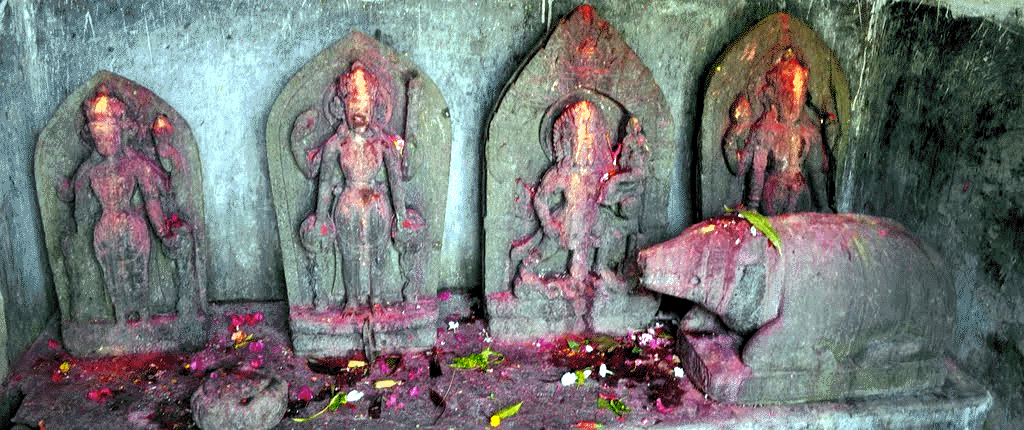
Varahakshetra, at the confluence of the Saptakoshi and Koka rivers, is 20 km from a town in eastern Nepal – Dharan. . Here, the Boar- Varaha,
an incarnation of Lord Vishnu has been said to have killed the demon-Hiranyaksha.
Varaha with Bhu Devi Mahabalipuram.
In addition to the main shrine dedicated to Varah, there are many towards the temples with images from the Varaha in Varahakshetra.
Every year on the to begin Magh (November), a religious fare is celebrated.
Varaha Avatar Temples of Lord Vishnu
There are numerous temples dedicated to the Varaha Avatar of Lord Vishnu. Among them the popular ones are
Varaha Lakshmi Narasimha Swamy Temple or Simhachalam Temple in Andhra Pradesh
Ancient Varaha Temple in Hampi
The famous Tirumala Venkateswara Temple is also known as Aadhi Varaha Kshetra, and it is believed that Venkateswara Swamy should be worshiped after worshipping Lord Varaha Murthy in the temple.
Dev’s fingers fell in Prayag, now called Allahabad.
It is a shame we now call the place as Allahabad, which has no bearing to our culture.
Lord Shiva , stricken by grief at the death of His consort, was roaming the skies,with Sat’s body, or what remained of Her Body after she immolated Herself.
This is the temple where as per the legend Sati’s fingers had fallen.
Swami Brahmananda(Rakhal), first president of Ramakrishna math, spiritual son and one of the best student of Sri Ramakrishna paramahamsa, saw the goddess here as a small child with three Jatas. Trijata
It is famously called as Mata ji ka temple (or Lalita ) by the locals. Prayaga means Prakrishta Yaga, that means it is the place where Lord Brahma did a very great Yaga.
Hence its name became Prayaga.
Prayaga is considered as one of the Sapta mokshapuras.
Ths is where the Rivers Ganges, Yamuna and Sarasvati meet, Trveni Sangam
Alopi Devi Prayag.Where Dev’s Fngers Fell
This place is also called as Theertharaj, that means king of all theerthas.
Taxis are available to travel from Varanasi to Prayaga(Allahabad) or from Prayaga(Allahabad) to Varanasi.
Allahabad is very big railway junction which is at 6 km distance from Alopi temple: http://indiarailinfo.com/arrivals/455.
Allahabad airport is at 17 km distance from Alopi mata temple
Lord Vishnu, unable to bear His Brother In Law suffering with His(Vishnu) sister’s Body, threw His Sudarshan Chakra and the Body , cut into pieces and fell in different pieces of on the ground.
Devi is called Madhaveswar Devi 0r Alopi(Disappeared).
“The origin of the name, Alopi (disappeared) Bagh lies in the Hindu belief that when after the death of his wife Sati, the grieving Lord Shiva travelled through skies with her dead body.
Lord Vishnu, to relieve him from this agony, threw his Chakra at the corpse, resulting in the fall of various parts of the body at various places in India, which were sanctified by the touch of the Goddess’ body parts and hence were thereby deemed holy places for pilgrimage.
The last part fell at this location thereby named as “Alopi” (where disappearance was concluded)and the holiest of all.”
Another Legend.
Once upon a time in that forest happened to pass a marriage procession.
Marriage processions, in those days used to be the most vulnerable targets of robbers as they used to return loaded with gold and other riches.
While deep into the jungle this marriage party found itself surrounded by robbers, robbers after killing all the men and looting the wealth turned to the ‘doli’ or carriage of the bride.
To their dismay when they unveiled the carriage they found there was no one inside.
The bride had magically disappeared. The word went around, history became legend and legend became myth.
A temple came up at the site where this incident had happened and locals started worshiping the bride as “Alopi Devi” or the ‘virgin goddess who had disappeared’.
However, this story provides no convincing explanation as to why the place would be deemed so holy.
‘There are more things in Heaven and earth’, said Shakespeare.
There are instances where Science fails to reason it out but instead of admitting it says it is a natural phenomenon.
Some brand of Atheists say they do not believe in God but Nature.
What is it they call Nature?
Panakalu Narasimha, Mangalgiri
Stones,Rivers,Tress, Forests or The Ocean?
It is better to believe and looks more rational to believe in an Entity than believing in Tress or Forests per se.
Let me leave these Geniuses to their Intelligence.
Many, in fact my son calls me superstitious, but some times I come across things which I can not explain
I have narrated some of these in my posts under Paranormal.
Though I am not a religious person in the strictest t sense of the term, I believe in Reality as es-pounded by Adi Shankaracharya and I am an Advaitin by conviction, with little time for Temples and Gods.
I do visit temples and in fact blogged about them.
The reason is that it gives me pleasure to visit these places whenever I feel like and I do not Pray but enjoy the visit.
I have posted on this.
Now to the issue at hand.
Of around six thousand posts I have written I have not written a single post about Anjaneya,Hanumanji
This morning I recollected an incidence on Hanuman and posted an article ‘Hanuman Sheds tears of Joy’
Then out of the blue I wanted to write on Sundara Kandam Parayan.
I did.
Usually I do not watch Television in the afternoons.
Today I just switched on the TV, a Tamil Channel which was set earlier by some one at my Home.
The screen opened with the Giant Image of Anjaneya baring his chest to reveal Lord Ram.
It was the Producer’s Logo for His Film in Tamil!
When I went for my usual nap, as is my habit, I hunted for any book or magazine.
I came across a Tamil Magazine of June 2006(Gnana Aalayam), which featured my article.
As I skipped through it , I came across a brief outline of Panakalu Narasimha temple, where The God Narasimha drinks Panaka, Jaggery water Daily.
I want to share this with my readers.
Here it is.
“It is said that here, god is self-existent. In the temple, there will be no statue of the god, but there is only mouth, widely opened to 15 cms. The mouth is covered by metal face of the god. The temple will be opened till afternoon only, with the belief that devatas will perform pujas in the night. The God takes jaggery water as offering by a conch. The Jaggery water is actually poured into the mouth of the Lord, a gargling sound is clearly audible as if the Lord is actually drinking it and the sound becomes shriller and shriller as and when the Lord is drinking. The sound will come to a stop after sometime and the balance of the jaggery water is thrown out. This phenomenon happens not once in a day but is a recurring feature during the course of the day as and when devotees offer panakam (jaggery water). It will be interesting to note that even a single ant is not traceable near the Lord nor around the temple in spite of the offering of so much jaggery water. As the offering of the panakam to the Lord is peculiar, the Lord here is called panakala Narasimhaswamy. There is a legend about the offering of the panakam (jaggery water) to the Lord. It is said that the hill was once a volcano. Sugar or jaggery water, it is said, neutralizes sulphur compounds found in a volcano and prevents a volcanic eruption.
Behind the temple there is the temple of Sri Lakshmi, to the west of which there is a natural cave. It is believed that it will lead to Undavalli caves on the banks of the Krishna river and the sages used to go to take bath in Krishna River. Now, the cave is very dark and the way could not be seen. We can reach the temple through steps-way on foot and also by road-way. The steps to the temple were constructed by Sri Channapragada Balarama Dasu in 1890. In 2004, ghat road had been constructed through which the pilgrims can reach the temple easily. ”
Mangalagiri means The Auspicious Hill. This place is one of the 8 important Mahakshetrams (sacred places) in India. The eight places where Lord Vishnu manifested himself are (1) Sri Rangam (2) Srimushnam (3) Naimisam (4) Pushkaram (5) Salagamadri (6) Thothadri (7) Narayanasramam (8) Venkatadri.Thotadri is the present Mangalagiri. Lakshmi Devi has done tapas on this hill. That’s why it got this name (The auspicious hill). There are three Narasimha Swamy temples in Mangalagiri. One is Panakala Narasimha Swamy on the hill. Another one is Lakshmi Narasimha Swamy at the foot of the temple. Third one is Gandala Narasimha Swamy at the top of the hill.
This shape of the hill looks like an elephant. From all the directions, the hill appears in the elephant shape only. There is an interesting legend to show as to how the mountain came into existence. Pariyatra, an ancient king had a son Hrasva Srungi visited all holy and sacred places to regain normal bodily stature and finally visited this holy place of Mangalagiri and stayed for three years performing penance. All the Devathas (Gods) advised him to stay at Mangalagiri and continue to do penance in praise of Lord Vishnu. The father of Hrasva Srungi came with his retinue to take back his son to his kingdom. But Hrasva Srungi took the shape of an elephant to become the abode of Lord Vishnu who is locally known as Panakala Lakshmi Narasimhaswamy.
12.Panguni-Narasimha Dwadasi, Sukla Paksha Dwadasi for varaha.
13.Kaanthi Vrata;Sukla Paksha Dwithitiyai( second day after New Moon) for Krishna.On this Thithi Krishna/Balarama are to be worshipped and Silver idols of each is be donated .
* New Moon to Full Moon Sukla Paksha
Full Moon to Nwe Moon-Krishna Paksha.
Tamil Months and corresponding English Months.
The number of days in a month varies between 29 and 32.
The following list compiles the months of the Tamil Calendar.
Note: The Sanskrit months above would start one month ahead of Tamil months since the Tamil calendar is a solar calendar while the Sanskrit calendar is a lunisolar calendar.
It is of interest to note that these Vratas cover all the Avataras of Vishnu.
All the Vratas are to be followed on Dwdasi, whic is natural, as Lord Vishnu is associated with number 12-he is one among the 12 Adithyas,His Dwadasa Naama’Om Namo Bhagavathe Vasudevaaya’ contains twelve Aksharas or letters in Sanskrit and Sri Vaishnava practice is to keep everything inmultiples of Twelve including the cheer(things offerd in Marriages.
But the greates Vrata of Vishnu is Ekadasi, which is Symbloic of Lord Shiva!
Sathya Narayna Vrata and others are not found in the Purans, may be they are from the Smritis or by tradition



You must be logged in to post a comment.