Thiruvannamalai is about a Billion years old,Tirupati 2100 Million Years, An archeological site near Chennai containing Advanced Tamil Civilization, Agastya crossed Vindhyas around 5000 BC,
Tamil language is estimated to be 74, 0000 years old(It should be dated earlier on the available evidence) and they quote the Vedas, they in turn Tamil!
Yet we would date the Rig Veda around 5000 BC!
Now there is a find in Rakhigarhi, Haryana which is dated around 6000 BC.
Well, some people might be happy to date Indian History by 1600 AD when the British came to India!
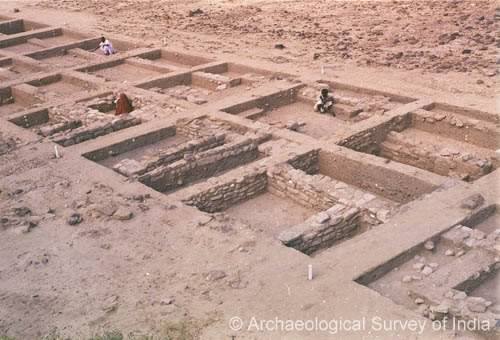
‘ Rakhigarhi, Haryana, Harappan site,India.
Latest research has put the date of the origin of the Indus Valley Civilisation at 6,000 years before Christ, which contests the current theory that the settlements around the Indus began around 3750 BC.
Ever since the excavations at Harappa and Mohenjo-daro in the early 1920s, the civilisation was considered almost as old as those of Egypt and Mesopotamia.
The finding was announced at the “International Conference on Harappan Archaeology”, recently organised by the Archaeological Survey of India (ASI) in Chandigarh.
Based on their research, BR Mani, ASI joint director general, and KN Dikshit, former ASI joint director general, said in a presentation: “The preliminary results of the data from early sites of the Indo-Pak subcontinent suggest that the Indian civilisation emerged in the 8th millennium BC in the Ghaggar-Hakra and Baluchistan area.”
“On the basis of radio-metric dates from Bhirrana (Haryana), the cultural remains of the pre-early Harappan horizon go back to 7380 BC to 6201 BC.”
Excavations had been carried out at two sites in Pakistan and Bhirrana, Kunal, Rakhigarhi and Baror in India.
..
The Harappan or Indus Valley Civilisation is one of the three oldest urban civilisations, along with Egypt and Mesopotamia, but it is the least understood. Its script is yet to be deciphered, and the knowledge of social structures and life during that period is scant. Rakhigarhi promises to change this as new discoveries continue to be made. It is one of the few Harappan sites which has an unbroken history of settlement—Early Harappan farming communities from 6000 to 4500 BC, followed by the Early Mature Harappan urbanisation phase from 4500 to 3000 BC, and then the highly urbanised Mature Harappan era from 3000 BC to the mysterious collapse of the civilisation around 1800 BC. That’s more than 4,000 years of ancient human history packed into its rich soil.
Until now, experts believed that Mohenjo-daro in Pakistan was the largest among the 2,000 Harappan sites known to exist in India, Pakistan and Afghanistan. The archaeological remains at Mohenjo-daro extend around 300 hectares. However, with the discovery of two more mounds, adding to the seven mounds already discovered, the total area of the archaeological site of Rakhigarhi now measures 350 hectares. The two newly-discovered mounds spread over 25 hectares each and are situated to the east and west of the main site. Unfortunately, much of the mounds have been destroyed for cultivation.
..
The Indus Valley Tradition is divided into four eras, and each era can be divided into various phases. A phase is an archaeological unit possessing traits sufficiently characteristic to distinguish it from all other units similarly conceived Each phase can be subdivided into interaction systems.
Date range (BCE)
Phase
Era
7570-6200
Bhirrana (aceramic Neolithic)
Early Food Producing Era
7000-5500
Mehrgarh I (aceramic Neolithic)
5500-3300
Mehrgarh II-VI (ceramic Neolithic)
Regionalisation Era
5500-2600
3300-2600
Early Harappan
3300-2800
Harappan 1 (Ravi Phase)
2800-2600
Harappan 2 (Kot Diji Phase, Nausharo I, Mehrgarh VII, Rakhigarhi)
2600-1900
Mature Harappan (Indus Valley Civilization)
Integration Era
2600-2450
Harappan 3A (Nausharo II)
2450-2200
Harappan 3B
2200-1900
Harappan 3C
1900-1300
Late Harappan (Cemetery H); Ochre Coloured Pottery
Localisation Era
1900-1700
Harappan 4
1700-1300
Harappan 5
1300-300
Painted Gray Ware, Northern Black Polished Ware (Iron Age)
If you want to subjugate a people, you have to destroy their language, make them lose their respect for their culture.
This is not mine,
Indian Influence in Souh East Asia. Greater India: The expansion of Indian culture and influence both in Central Asia and the South East towards the countries and islands of the Pacific is one of the momentous factors of world history. (image source: A Survey of Indian History – By Sardar Kavalam Madhava Panikkar).
A gist of what Macaulay spoke in the British Parliament about the introduction of English as a medium of instruction in India.
We have people like Max Mueller who were planted by the Church to destroy the Sanatana Dharma from within.
Read my posts on these subjects.
Indian History, as I was taught some 45 years ago was thus.
There was Vedas ,ancient texts, they were concerned with Religion, many gods were worshiped,
There were Mythologies of Ramayana and Mahabharata, Rama and Krishna who were worshiped as Gods.
The Vedas and Puranas were oppressive.
Then Buddha came along.
Aryans invaded through the Khyber Pass.
Alexander Invasion of India, he defeated Indian Kings and signed a treaty with Porus, forgiving him.
Appointed Seleucus.
Then there was Chandra Gupta Maurya and His dynasty.
It goes on up to Harshavardhana.
There is a gap of about 200 to 300 years.
Then Kanishka.
Later Mughals and the British.
What is wrong with this?
1.Vedas have been brushed as Religious texts, with no details about the high scientific and technical skills they possessed.
2.No mention of the Vedic empires.
3.There is a gap of about 300 years between Panini and Daruis.
4.No mention of the Tamil and Southern Kingdoms which existed around the early Vedic age.
5.Ramayana and Mahabharata were facts and not Fables, while Bible ,Christianity, Islam and the prophet were given the status of History.
6.No mention of Sanskrit and Tamil, the two earliest languages of civilization.
7.While there is mention of Alberoni, Fahien, Huansuang, there is no mention of courtiers sent from India abroad.
8.Again there is a gap of about 200 years from Fahien in 400 AD to 600 AD when Harshavardhana came to power.
9.From 800 AD to 1500 AD no mention of Indian History in detail regarding the South Indian Kings and their empires.
10.No mention of Indian empire having been extended to South Asia during the entire History of India excepting bland statements that Indians had commercial contacts with Rome, and Some Tamil Kings conquered some portions of Indonesia,.
11.No mention of the great Floods in Souh India which triggered off migration to Europe ans rest of the world from India.
And that was how the early settlements in these areas began
12.Ashoka is reported to be first King to have established contacts with Sri Lanka by sending his daughter/son, omitting the Tamil connection which was earlier by about 1000 years.
I am providing information which is slightly better than what we were taught from the link I have provided below.
The gaps in the improved version is also glaring.
Less said about the western scholarship(?) the better.
I shall be writing on the hidden History of India with evidence for these periods.
Two technics were adopted in burying our culture.
One is suppression of Facts and evidence, as in archeological finds and Tamil History.
Second is wilful misinterpretation of facts as Max Mueller did.
Readers may contribute with evidence.
”
Rock Shelters of Bhimbetka (9000 BC to 7000 BC)*
The earliest records of the Indian history exist in the form of the Rock Shelters of Bhimbetka. These shelters are situated on the southern edge of the central Indian plateau, in the foothills of the Vindhyan Mountains. There are five groups of rock shelters, each of them adorned with paintings that are believed to date from the Mesolithic Period right through to the historical period.Mehrgarh Culture (7000 BC to 3300 BC)*
Mehrgarh is one of the most significant sites belonging to the Neolithic Age. At the same time, it is one of the oldest sites that indicate the introduction of the concept of farming and herding. Situated on theKachi plain of Baluchistan (Pakistan), it lies to the west of the Indus River valley. The site ofMehrgarh, spread over an area of 495-acre, was discovered in the year 1974.Indus Valley Civilization (3300 BC to 1700 BC)*
The Indus Valley Civilization was discovered in the 1920s. The major events in the timeline of the Indus Valley are given below:Early Harappan Phase (3300 BC to 2600 BC)*
The early Harappan Phase lasted for approximately 700 years, starting with the Ravi Phase. It is one of the three earliest urban civilizations and made use of an early form of the Indus script, known as Harappan script, for writing purposes. Around 2800 BC, the Kot Diji phase of the Indus Valley Civilization started.
Mature Harappan Phase (2600 BC to 1700 BC)*
The Mature Harappan Phase started around 2600 BC. Large cities and urban areas started emerging and the civilization expanded to over 2,500 cities and settlements. Urban planning, excellent sewage and drainage system, system of uniform weights and measures, knowledge of proto-dentistry, etc are some of the other elements that characterize the mature phase.
Late Harappan Phase (1700 BC to 1300 BC)*
The Late Harappan Phase began around 1700 BC and came to an end around 1300 BC. However, one can find many elements of the Indus Valley Civilization in later cultures.
Vedic Period/Age (1700 BC to 500 BC)*
The Vedic Period or the Vedic Age refers to the time of the compilation of the sacred Vedic Sanskrit texts in India. Situated on the Indo-Gangetic Plain, the Vedic Civilization formed the basis of Hinduism and the sIndian culture. The Vedic Period can be divided into the following two phases:
Early Vedic/Rig Vedic Period (1700 BC to 1000 BC)*
Early Vedic Period represents the time period when the Rig Veda was compiled. During this period, the king was believed to be the protector of the people, who took an active part in the government. The caste system started becoming rigid and the families started becoming patriarchal. The major events of this time are:
1700 BC – Late Harappan and Early Vedic period coincide
1300 BC – The end of Cemetery H culture
1000 BC – Iron Age of India
Later Vedic Age (1000 BC to 500 BC)*
The emergence of the later Vedic period was marked with agriculture becoming the dominant economic activity and a decline in the significance of cattle rearing. The political organization changed completely, with the reduction in the involvement of people in the administration. The major events are:600 BC – The formation of Sixteen Maha Janapadas (Great Kingdoms)
599 BC – The birth of Mahavira, founder of Jainism
563 BC – The birth of Siddhartha Gautama (Buddha), founder of Buddhism
538 BC – Cyrus the Great conquered parts of Pakistan
500 BC – Earliest written records in Brahmi
500 BC – Panini standardized grammar and morphology of Sanskrit, converting it
into Classical Sanskrit. With this, the Vedic Civilization came to an end.Ancient India (500 BCE – 550 AD)Rise of Jainism and Buddhism
Jainism or Jain Dharma is the religious philosophy that originated in the Ancient India. The religion is based on the teachings of the Tirthankaras. The 24th Tirthankara, Lord Mahavira, is credited with propagating the religion in the various parts of the world. Buddhism is based on the teachings of Lord Buddha, who was born as Prince Siddhartha Gautama. After attaining Enlightenment, Lord Buddha set on a task of teaching others how to achieve nirvana. His teachings were later propagated throughout the world by Emperor Asoka. The other major events of the Ancient Indian period are:
333 BC – Darius III was defeated by Alexander the Great. The Macedonian Empire was established
326 BC – Ambhi, King of Taxila surrendered to Alexander, Battle of the Hydaspes River
321 BC – Chandra Gupta Maurya established the Maurya Empire
273 BC – Emperor Ashoka took over the Maurya Empire
266 BC – Ashoka conquered most of South Asia, Afghanistan and Iran
265 BC – The battle of Kalinga, after which Emperor Ashoka embraced Buddhism
232 BC: Ashoka died and was succeeded by Dasaratha
230 BC – Satavahana Empire was established
200 to 100 BC – Tholkappiyam standardized grammar and morphology of Tamil
184 BC – Collapse of Maurya Empire with the assassination of Emperor Brihadrata, Establishment of the Sunga dynasty
180 BC – Establishment of the Indo-Greek kingdom
80 BC – Establishment of the Indo-Scythian kingdom
10 BC – Establishment of the Indo-Parthian kingdom
68 AD – Establishment of the Kushan Empire by Kujula Kadphises
78 AD – Gautamiputra Satkarni took over Satavahana Empire and defeated Scythian king Vikramaditya
240 AD – Establishment of the Gupta Empire by Sri-Gupta
320 AD – Chandragupta I took over the Gupta Empire
335 AD – Samudragupta took over the Gupta Empire and started expanding it
350 AD – Establishment of the Pallava Empire
380 AD – Chandragupta II took over the Gupta Empire
399 to 414 AD – Chinese scholar Fa-Hien traveled to India
Medieval Period (550 AD to 1526 AD)
The medieval period can be divided into the following two phases:
Early Medieval Period (Upto 1300 AD)
606 AD – Harshavardhana became the King
630 AD – Hiuen Tsiang traveled to India
761 AD – First Muslim invasion by Mohammed Bin Qasim
800 AD – The birth of Shankaracharya
814 AD – Nripatunga Amoghavarsha I became Rashtrakuta king
1000 AD – Invasion by Mahmud of Ghazni
1017AD – Alberuni traveled to India
1100s AD – Rule of the Chandelas, Cholas, Kadambas, and Rashrakutas
1120 AD – Kalyani Chalukya Empire attained peak, Vikramaditya VI introduced Vikrama Chalukya Era
1191 AD – First battle of Tarain between Mohammed Ghori & Prithivi Raj Chauhan III
1192 AD – Second battle of Tarain between Ghauri and Prithivi Raj Chauhan III
1194 AD – Battle of Chandawar between Ghauri and Jayachandra
1288 AD – Marco Polo came to India
Late Medieval Period (1300 AD to 1500 AD)
1300 AD – Establishment of the Khilji Dynasty
1336 to 1565 AD – Vijayanagar Empire
1498 AD – First voyage of Vasco-da-Gama to Goa
Post-Medieval Era (1526 AD to 1818 AD)
The major events in the post medieval era are:
1526 AD – Babur, the Mughal ruler of Kabul, invaded Delhi and Agra and killed Sultan Ibrahim Lodi
1527 AD – Battle of Khanwa, in which Babur annexed Mewar
1530 AD – Babur died and was succeeded Humayun
1556 AD – Humayun died and was succeeded by his son Akbar
1600 AD – East India company was formed in England
1605 AD – Akbar died and was succeeded by Jehangir
1628 AD – Jehangir died and was succeeded by Shah Jahan
1630 AD – Shivaji was born
1658 AD – Shah Jahan built Taj Mahal, Jamia Masjid and Red Fort.
1659 AD – Shivaji defeated Adilshahi troops at the Battle of Pratapgarh
1674 AD – Maratha Empire was established
1680 AD – Shivaji died
1707 AD – Aurangzeb died and was succeeded by Bahadur Shah I
1707 AD – Maratha Empire broke into two divisions
1734 AD – Pamheiba invaded Tripura
1737 AD – Bajirao I conquered Delhi
1740 AD – Bajirao I died and was succeeded by Balaji Bajirao
1757 AD – Battle of Plassey was fought
1761 AD – Third battle of Panipat ended the expansion of Maratha Empire
1766 AD – First Anglo-Mysore War
1777 AD – First Anglo-Maratha War
1779 AD – Battle of Wadgaon
1780 AD – Second Anglo-Mysore War
1789 AD – Third Anglo-Mysore War
1798 AD – Fourth Anglo-Mysore War
1799 AD – Tipu Sultan died, Wodeyar dynasty was restored
1803 AD – Second Anglo-Maratha War
1817 AD – Third Anglo-Maratha War begins
1818 AD – End of the Maratha Empire and British control over most of India
Colonial Era (1818 AD to 1947 AD)
The Colonial Era started with the British taking control over almost all the parts of India and ended with the freedom of India in 1947. The major events that took place during the Colonial Era are:..”
Why there are no temples discovered in Indus Valley and Sarasvati Valley?
If what has been written in the Puranas about Hindu Gods is true why is it that the Temples dedicated to Gods are not found in these ancient sites?
This is the gist of comments I have been receiving on the Temples of India and the history of Sanatana Dharma.
Angkor Vat Temple.
A Sample.
‘Then why does the harappan people worship only mother goddess and peepal tree.Why didnt they construct any temples.’
I shall reply on Mother Goddess and Peepal Tree in another Post.
The Vedas do not sanction group or community worship.
It does not believe in institutionalizing Religion.
Religion , according to the Vedas is intensely personal.
It does not believe in numbers game for the Religion.
And In Hinduism there is no such thing called Super Natural.
Every thing is natural.
Any thing we call us super natural by the others is only Natural, being a part of Nature and the most the Puranas would go about in describing them is ‘wonderful,astonishing”, ‘Aascharyam’ ,that’s all.
Every thing was taken as Natural.
So every thing including the exploits of Rama and Krishna were taken as part of exhibition of valour and though people considered Rama and Krishna as super Heroes even during their times, no body was in awe of them and people, even ordinary one at that, would challenge them.
Take the instance of a washer-man commenting on Rama’s acceptance of Sita after she was brought back from Lanka!
They were treated as humans while they lived though revered.
And since people of that era were able to acquire powers by penance the ability to travel t will to various planes of existence and other powers which we call now as super natural today, they were not over awed by the exploits of these Gods.
What they have been taught is that any one can attain these powers by character, penance and above all realizing The Self.
These extra qualities acquired are but impediments to the ultimate Goal of Realizing the Self.
The Vedas are for self-realization and as such calls for personal upliftment.
So they did not build any temples for the Gods.
But the Gods were propitiated by Yajnyas and Homas.
Hence there is no evidence of temples in Harappa, SaraswathiValley.
Some references are found about Temples for Mother Goddess.
I am researching into this and shall share the information.
And there is no sanction about building temples in the Vedas, no word about temples at all.
The construction of Temples came later, inspired by the Agamas, which are post-Vedic.
However the oldest temple in the world , on record to-day, is found in Tamil Nadu.
‘The Subrahmanya Temple at Saluvankuppam, Tamil Nadu, is a shrine dedicated to the Hindu deity Murugan. Archaeologists believe that the shrine, unearthed in 2005, consists of two layers: a brick temple constructed during the Sangam period (the 3rd century BC to the 3rd century AD) and a granite Pallava temple dating from the 8th century AD and constructed on top of the brick shrine. The Archaeological Survey of India (ASI) team which conducted the excavation believe that brick temple could be the oldest of its kind to be discovered in Tamil Nadu. However, noted Indian archaeologist R. Nagaswamy is critical of this claim owing to lack of references to the shrine in the popular literature of the period.’
The temple of Angkor vat and Changu Narayan temple came later
‘The Agamas are non-vedic in origin [4] and have been dated either as post-vedic texts or as pre-vedic compositions. In theMalay language the word Agama literally means ‘religion’. Agama traditions have been the sources of Yoga and Self Realization concepts in the Indian subcontinent, including Kundalini Yoga and encompass traditions of asceticism. Tantrism includes within its fold Buddhist and Jaina tantras suggesting that Hindu, Jaina and Buddhist tantrism developed separately after arising from common sources of Tantric elements. The Agamic tradition, in general, has been dated to the pre-Mauryan period as references to the tradition are found in later vedic literature of Atharvaveda.’
‘The pagoda style temple has several masterpieces of 5th and 12th century Nepalese art. According to legends Changu Narayan temple existed as early as 325 A.D. in the time of Licchavi King Hari Datta Verma and it is one of Nepal’s richest structures historically as well as artistically. In the grounds there is a stone pillar inscription of great importance recording the military exploits of King Man Deva who reigned from 496 A.D. to 524 A.D. The first epigraphic evidence of Nepalese history found in the temple premises during the reign of the Licchavi King Mandeva dating back to 464 A.D. shows that Changu had already been established as a sacred site in the 3rd century A.D. It is the earliest inscription known in Nepal. The temple was restored during the lifetime of Ganga Rani, consort of Siva Simha Malla who reigned from 1585 to 1614.’
‘
According to one legend, the construction of Angkor Wat was ordered by Indra to act as a palace for his son Precha Ket Mealea. According to the 13th century Chinese travelerDaguan Zhou, it was believed by some that the temple was constructed in a single night by a divine architect.
The initial design and construction of the temple took place in the first half of the 12th century, during the reign of Suryavarman II (ruled 1113 – c. 1150). Dedicated to Vishnu, it was built as the king’s state temple and capital city. As neither the foundation stela nor any contemporary inscriptions referring to the temple have been found, its original name is unknown, but it may have been known as “Varah Vishnu-lok” after the presiding deity. Work seems to have ended shortly after the king’s death, leaving some of the bas-relief decoration unfinished.[6] In 1177, approximately 27 years after the death of Suryavarman II, Angkor was sacked by the Chams, the traditional enemies of the Khmer. Thereafter the empire was restored by a new king, Jayavarman VII, who established a new capital and state temple (Angkor Thom and the Bayon respectively) a few kilometers to the north.
The construction of these temples, with stones in an area where no stones or Mountains were available is a testimony to the fact that the ancient knew quarrying and more importantly transporting heavy materials like a single stone of nearly 180 tons to the roof of the temple which is 216 feet in the year 1000 AD.
It is the Thanjavur Brhadeeswara Temple in Tamil Nadu.
There are temples where the rays of the Sun touch the idol at the sanctum on a particular day of the year.
1000 pillars Halls, Stone pillars producing the Seven Notes of the Carnatic Music, cave temples ..the list is endless.
The cities were laid out in a systematic pattern in south India.
In the Centre was a temple, with a Pond.
The city was surrounded by square-shaped streets around the temple complex, all the streets leading to the Temple.
This can be seen in many temples in many cities of Tamil Nadu, notable examples being Madurai, Sri Rangam Srivilliputhur, Chidambaram.
These cities had a resting place for Travelers at regular intervals on the highways, at every Kaatham, about 16 Kilometers.
This may be seen on the road from Madurai to Srivilliputtur.
Each city , at the outskirts , had a small water tank meant for animals.
A stone column was erected for the animals to relieve their itching!
Such a civilization should have had great cities.
Many have sunk as in Lemuria where the Tamil Sangam 1 and 2 were held, in Then Madurai ( South Madurai and Kavatapuram)
We had Indraprastha now called Delhi,Pataliputra, now Patna
I had a look at some of the ancient cities of India which are to be discovered in full.
If people can look around places where tanks had been located with the satellite imagery they would find more cities.
Here is a List, which, of course, is not exhaustive.
I shall be writing on each of them in detail.
Readers may also contribute.
Dholavira – Located in Gujarat, India. Indus Valley Civilization city
Lothal – Located in Gujarat, India – early city of the Indus Valley Civilization
Surkotada – Located in Gujarat, India – early city of the Indus Valley Civilization
Pattadakal – Located in Karnataka, South India. Now a UNESCO World Heritage site.
Vasai-Located in India, former capital (1533-1740) of the Northern Provinces of Portuguese India
Aror is located 8 kilometres east ofRohri in present daySindh, Pakistan. It had served as the ancient capital ofSindh and was oncelocated on the banks of Indus River. The city was once the prime nucleus centre of commerce and trade. The main languages spoken by the people are Hindi language, Urdu language, Punjabi language and Sindhilanguageand the religion followed were Hinduism, Islam and Sikhism.Kannauj
Kannauj was one of the most beautiful ancient cities in India that was ruled by different rulers. The city was described as a city which raised its head to the skies and which in strength and beauty might boast of being unrivalled. Kannauj has incessantly served as a place of immense historical significance. The city had, much later, become a new district of the Uttar Pradesh on September 18th, 1997.Bairat
Bairat is a much celebrated and momentous town in the northern Jaipur of Rajasthan. It is located 52 kilometres north of Jaipur and 66 kilometres west of Alwar.
Kalibangan
Kalibangan is a town situated in Hanumangarh district of Rajasthan. The town is precisely located upon the banks of Ghaggar River. This ancient city of India has been considered as the third important city amongst all the excavated Harappan sites, under the Indus valley civilization. The city had received its name from the innumerable pieces of terracotta bangles that were excavated here.
Sagala
Sagala is believed to be the modern day Sialkot, and it had once served as a great centre of trade and commerce, filled with business prospects.
Sitanagaram
Sitanagaram is a small and humble and ancient site located in the Guntur district of Andhra Pradesh.
Hansi is a town in theHisar district of Haryana. The ancient city ofHansi is known to possess five gates to enter Delhi. It majestically incorporate the Delhi Gate at the East,Hisar gate at the West,Gosain gate at North-West,Barsi Gate at South andUmra Gate in thesouth west direction.Kumbhoj
Kumbhoj is the name of an ancient town located in the Kolhapur district of Maharashtra.Kalpi
Kalpi is an ancient city of India, in Jalaun district of Uttar Pradesh. Kalpi rather seizes stronghold from its sisterly counterparts, due to being conceived as the birthplace of sage Ved Vyas. The city of Kalpi is also renowned for its art of paper making.
Bhinmal
Bhinmal is a town in the Jalore district of Rajasthan. Bhinmal had once served as the capital of ancient Gujarat. The earlier name of Bhinmal was Bhillamala.
Tamralipta
Tamralipta is the name of another important ancient city of West Bengal. Now the place is however identified as Tamluk. Tamluk derives its name from the Sanskrit word Tamra Lipta meaning ‘full of copper’.
Urayur
Urayur is an ancient city located in Tiruchirappalli, Tamil Nadu.
Dwaraka
Dwaraka is another ancient city situated in Gujarat. According to Hindu mythology, Dwaraka was the dwelling place of Lord Krishna. The meaning of the word Dwaraka is a ‘door’.
Ujjain
Ujjain is located on the banks of Shipra River in Madhya Pradesh. According to Hindu mythology, Shipra had originated from the much admired churning of the oceans by the Gods and the Demons, with Vasuki, the serpent, serving as the rope. Osiyan is another ancient city that is approximately located at a distance of 65 kilometres from Jodhpur in Rajasthan. The city houses a number of temples and is presently a famous tourist spot.
Bayana
Bayana is a town in the Bharatpur district of Rajasthan.
The ancient name of the city wasSripatha orSriprashtha orShantipura. The city is claimed to have been discovered rather accidentally by an asura namedBanasura.Chunar
Chunar is in the Mirzapur District of Uttar Pradesh.
You must be logged in to post a comment.