Tag: Hindu Temple

  • Hindu Temple Ruin Star Gate In Mexico?

    I have written some posts on the influence of Sanatana Dharma, Hinduism in Guatemala.

    Also on the temples of Hanuman, his Makartahdwaja in Honduras, Chichen Itza resembling the Sanctum of Chidambaram Nataraja Temple.

    And on the 1000 pillars of Madurai Meenakshi Amman  Design being found in Chichen Itza Guatemala.

    Now I have come information that there is a temple among the ruins North Guatemala.

    Though the ruins are in a bad shape, the Hindu Temple structure is clearly identifiable.

    The temple design seems , to me, a one on the lines of Orissa Temples, especially the Konark Sun Temple.

    I had written on the fact Kulothunga Chola’s descendant built the Konarak Sun Temple.

    Considering the impact of Tamils in the Mayan area, the information that there is a ruin resembling Hindu temple adds to the evidence that Sanatana Dharma was present in Central America.

    There are also speculations that there is a Star Gate in the Area.

    This resembles the Dharma Chakra of Buddhism and Kala Chakra of Hinduism.

    Hindu Temple ruins in in Mexico?jpg
    Hindu Temple ruins in Mexico? Image credit.www.iherp.com


    Kaala Chakra In Mexico?.jpg.
    Kaala Chakra In Mexico. Image credit.ww.pinterst.com/pin/240238961346254217

    The above picture is about 90 years old. It has been circulated around my family for its entire existence, but has always been kept secret. Just recently, it was handed down to me along with the story I’m about to tell you.

    My great uncle, a self-proclaimed explorer and amateur archeologist, traveled across the entire Americas during his later years in the mid-1910s. During one of his expeditions around North Guatemala, he heard a tale of an ancient forgotten city and extinct civilization that had been around for thousands of years from some of the locals around this area. He decided to investigate further and gathered a team of local hands, along with his wife and travel companion, who most of the time was the person taking photographs as “evidence” of their discoveries.

    During those days and even today, most of the land around the northern part of Guatemala is a vast jungle with dense forest and wild life. His expedition to the site lasted almost two weeks by foot, during which time they suffered many hardships. At the end of the two weeks, they finally reached their destination. At first, it looked like a regular white sand beach that had been eroded continuously for thousands of years. But as they kept walking, they were able to see from the distance the ruins that had been carved into the cliffs of the beach, along with what seemed to be an arch, but later uncovered as a circle of some sort. Once they entered the ancient city, the writing on the walls and items left behind by its inhabitants seemed to be of a much more advanced race than that of the Mayans or Aztecs that also lived nearby. The one odd thing noted by him was that on most of the scriptures carved into the wall seemed to resemble a modern day alphabet, but none that he could decipher during his short stay.

    Upon his return to the civilized and modern part of Guatemala, he was greeted by many locals who were curious at his findings. Word traveled quickly and it spread all the way to the Guatemalan government, who quickly confiscated all of the items brought back, along with almost all of the film that was taken during the expedition, of which this picture is the last remaining evidence.

    The path to reach this city has since been forgotten through time and swallowed by the deep vegetation in the forest. But according to my great uncle, the knowledge within those walls would alter the history of humanity as we know it.’


    Citation and reference.

    http://www.iherp.com/Public/Blog/Detail.aspx?uid=150343


    https://ramanisblog.in/2015/08/05/madurai-temple-design-1000-pillars-tikal-guatemala-chichen-itza/

    https://ramanisblog.in/2015/04/09/konarak-sun-temple-built-by-kulothunga-chola-i-descendant/

  • Womb The Home Garbha Griha Temple Sanctum

    Womb The Home Garbha Griha Temple Sanctum

    One is born from a woman, ends up in Earth.

    Hinduism accords the respect these deserve.

    A woman is called Gruha Lakshmi, one who brings Prosperity to Home.

    Tamil calls her Illal, one who owns/rules the Home.

    Lord Balaji In Garbha Graha, Tirupati.jpg
    Lord Balaji In Garbha Graha, Tirupati.

    Similarly Earth is given the respect it deserves for it supports from Birth to Death.

    Earth is eulogized as Mother and there are Vedic Sukthas in praise of the Earth, Bho Suktham.

    There is Neela Suktham, Neela is considered to be the consort of Lord Vishnu.

    Such being the case, there is no wonder in Hinduism calling the Sanctum Sanctorum of a Temple as Garbha Gruha, Gharbha meaning The Womb and Gruha, the Home.

    Tamil calls The Gharbhagriha as Karuvarai, meaning ‘where the Foetus stays’

    One’s first Home is the womb.

    A Hindu temple consists of an inner sanctum, thegarbha griha or womb-chamber, where the primary idol or deity is housed along with Purusa. The garbhagriha is crowned by a tower-like Shikhara, also called the Vimana. The architecture includes an ambulatory for parikrama(circumambulation), a congregation hall, and sometimes an antechamber and porch.

    The Hindu temple architecture reflects a synthesis of arts, the ideals of dharma, beliefs, values and the way of life cherished under Hinduism. It is a link between man, deities, and the Universal Purusa in a sacred space.

    In ancient Indian texts, a temple is a place for Tirtha – pilgrimage.It is a sacred site whose ambience and design attempts to symbolically condense the ideal tenets of Hindu way of life. All the cosmic elements that create and celebrate life in Hindu pantheon, are present in a Hindu temple – from fire to water, from images of nature to deities, from the feminine to the masculine, from kama to artha, from the fleeting sounds and incense smells to Purusha – the eternal nothingness yet universality – is part of a Hindu temple architecture.

    ….

    Garbhagriha or Garbha gruha (garbha gṛha) (Sanskrit: गर्भगॄह) is the sanctum sanctorum, the innermost sanctum of a Hindu templewhere resides the murti (idol or icon) of the primary deity of the temple. Literally the word means “womb chamber”, from the Sanskritwords garbha for womb and griha for house. Only ‘priests’ (pujari) are allowed to enter this chamber.

    Although the term is often associated with Hindu temples, it is also found in Jain and Buddhist temples…

    In temples with a spire or vimana, this chamber is placed directly underneath it, and the two of them form the main vertical axis of the temple. These together may be understood to represent the axis of the world through Mount Meru. The garbha griham is usually also on the main horizontal axis of the temple which generally is an east-west axis. In those temples where there is also a cross-axis, the garbha gṛha is generally at their intersection.

    Generally the garbhagriha is a windowless and sparsely lit chamber, intentionally created thus to focus the devotee’s mind on the tangible form of the divine within it. Entrance to the garbha grha may be restricted to priests who perform the services there…

    In the Dravida style, the garbhagriha took the form of a miniature vimana with other features exclusive to southern Indian temple architecture such as the inner wall together with the outer wall creating a pradakshina around the garbhagriha. The entrance is highly decorated. The inner garbhagriha or shrine became a separate structure, more elaborately adorned over time.

    More often garbhagriha is square and sits on a plinth, its location calculated to be a point of total equilibrium and harmony as it is representative of a microcosm of the Universe. In the centre is placed the image of the deity.

    But sometimes, for the temples of feminine deities, the garbagriha is rectangular. For example in the temple of Varahi Deula in Chaurasi.

    The present structure of most of these temples is a two-storeyed vimana with a square garbhagriha and a surrounding circumambulatory path, an ardha-mandapa and a narrower maha-mandapa.

    https://en.wikipedia.org/wiki/Garbhagriha

    https://en.wikipedia.org/wiki/Hindu_temple_architecture

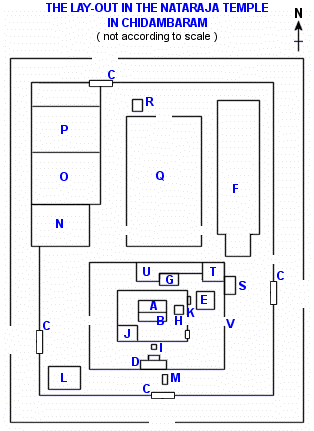
    Natarja ,  Chidambaram Plan Image Credit.  http://natarjatemplechidambaram.blogspot.in/

  • Balamon Cham Brahmins Of Vietnam

    That the Sanatana Dharma spread world-wide is a fact.

    Equally true is that the Varnas of Hindus spread (Brahmins, Kshatriyas, Vaisyas and Sudras).

    The Kingdoms of Vietnam , Bali,Cambodia,  and Indonesia trace their ancestry to Sanatana Dharma.

    Fiji has Manu’s Portrait in the Parliamentary Hall.

    Brahmins' Attitude.jpg
    Brahmins’ Attitude.

    Australian Aborigines perform Shiva’s Third Eye dance and some of them wear Srivaishnava marks on their forehead even today.

    Lord Rama’s Kingdom was spread over this area.

    Tamil Kings who were the followers of Santana Dharma also conquered these Nations ans established their rule there.

    The left their mark, social, cultural and religious.

    This may by noticed by looking at the Hindu Temples in these regions and the cultural similarities in the region.

    These intermingled Buddhism, which arrived here later and what we have a curious mixture of Hindu and Buddhist practices in the area.

    However the Brahmin group maintained a `distinct identity and they still live there.

    The Champa civilization was located in the more southern part of what is today CentralVietnam, and was a highly Indianized Hindu Kingdom, practicing a form of ShaiviteHinduism brought by sea from India. Mỹ Sơn, a Hindu temple complex built by the Champa is still standing in Quang Nam province, in Vietnam.

    The Champa were conquered by theVietnamese and today are one of the many ethnic minorities of Vietnam. Hindu temples are known as Bimong in Cham language and the priests are known as Halau Tamunay Ahier.

    The Balamon Hindu Cham people of Vietnam make up only 25% of the overall Cham population (the other 75% are Muslims or Cham Bani). Of these, 70% belong to the Nagavamshi Kshatriya caste (pronounced in Vietnamese as “Satrias”), and claim to be the descendants of the Champa Empire. A sizeable minority of the Balamon Hindu Cham are Brahmins.

    In any case a sizable proportion of the Balamon Hindu Cham are considered Brahmins.

    Hindu temples known as Bimong in the Cham language and the priests Halau Tamunay Ahier.

    The exact number of Tamil Hindus in Vietnam are not published in Government census, but there are estimated to be at least 50,000 Balamon Hindus, with another 4,000 Hindus living in Ho Chi Minh City; most of whom are of Indian (Tamil) or of mixed Indian-Vietnamese descent. The Mariamman Temple is one of the most notable Tamil Hindu temples in Ho Chi Minh City. Ninh Thuan and Binh Thuan Provinces are where most of the Cham ethnic group (~65%) in Vietnam reside according to the last population census. Cham Balamon (Hindu Cham) in Ninh Thuan numbered 32,000 in 2002 inhabiting 15 of 22 Cham villages.[27] If this population composition is typical for the Cham population of Vietnam as a whole then approximately 60% of Chams in Vietnam are Hindu


    Citation.

    http://www.hinduhumanrights.info/hindus-of-vietnam/

    https://en.wikipedia.org/wiki/Hinduism_in_Southeast_Asia#Indonesia

  • Garuda Vishnu’s Mount Increases Weight Every Stage Nachiyar Koil

    There are quite a few strange things/events associated with Hindu Temples in India.

    There are Temples where Snake comes and offers pooja to Shiva, Sun bathes Idols on a specific day,temple emerges from the sea at a fixed Time,where Crows do not fly over the temple Tower..the list goes on.

    Scroll down for Video.

    Kal Gaudan in Procession,Nachiyar Koil.Image.jpg
    Kal Gaudan in Procession,Nachiyar Koil, Tamil Nadu Image credit The Hindu http://www.thehindu.com/features/friday-review/history-and-culture/unique-drama-unfolds-during-procession/article4244915.ece

    Now add one more to this list.

    During street procession (Margazhi and Panguni),  English Month December,an unbelievable event takes place at the Nachiyar Koil. While only 4 people carry Lord Garuda out of his Sannidhi, as the Lord goes out of each Layer and prakaram, he is said to increase in weight, that 8 people, 16 and then 32 people are required to carry Lord Garuda out of the temple. Finally, when the Lord is taken outside the temple, Garuda increases in weight so much that 128 people are required to carry the Lord. On his way back, it is said that Garuda mount decreases in weight and finally when he is back in the Sannidhi, only 4 people are required to carry him.


    This happens every year.

    Nachiar Kovil or Thirunarayur Nambi Temple in Thirunarayur, a village in the outskirts of Kumbakonam in the South Indian state ofTamil Nadu, is dedicated to the Hindu god Vishnu and his wife Lakshmi. Constructed in the Dravidian style of architecture, the temple is glorified in the Divya Prabandha, the early medieval Tamil canon of the Azhwar saints from the 6th to 9th centuries AD. It is one of the 108 Divyadesam dedicated to Vishnu, who is worshipped as Srinivasa Perumal and his consort Lakshmi as Nachiyar. The temple is the place where god Vishnu is believed to have initiated Pancha Samskara (religious initiation) to Thirumangai Azhwar. The temple follows Thenkalai mode of worship.

    The temple is believed to have been built by Kochengat Cholan of the late 3rd century AD, with later contributions from Medieval Cholas and Vijayanagar kings.

    This is the 71st Temple built by Kochengat Cholan, the first Temple for Vishnu, the other 70 Temples having been built for Lord Shiva.

    Legend.

    The sage Medhavi was doing penance at this place. While taking a bath in the river, he found an image ofChakrathazhwar entwined with Yoga Narasimha. A divine voice asked him to install the image in his hermitage and worship it. The goddess Lakshmi, the consort of Vishnu chose to grow in the hermitage and appeared to the sage in the form of a small girl and requested him to take care of her. Vishnu traveled in search of Lakshmi on his vehicle Garuda, the eagle. Garuda found the presence of Lakshmi in the hermitage. Vishnu appeared to Medhavi, pleased by the latter’s devotion and asked his daughter to be married to him. The sage happily married Lakshmi to Vishnu and requested him to stay in his place, which Vishnu accepted.There is another local legend that king Kochengat Cholan was once defeated and he was advocated to seek the blessings of Vishnu, which he obliged.

    Prominence to Goddess.

    Nachiyar Koil is one of the few Divyadesams where the goddess has prominence over Vishnu. Some of the other temples where the such female dominance are observed areAndal Temple at Srivilliputhur, Azhagiya Manavala Perumal Temple at Woraiyur and Pundarikakshan Perumal Temple in Thiruvellarai. While Srivilliputhur is called Nachiyar Thiru Maaligai, Thirunaraiyur is called Nachiyar Koil.[2]

    Vishnu was of the view that during Kali Yuga, men would have to listen to women. Hence he decided that he would first set an example and listen to goddess here. During all festive occasions, the first rights are reserved for Nachiyar, who moves ahead, while Srinivasa follows her. Even the food is first served to Nachiyar and then to Srinivasa. Being a temple where goddess has prominence, Vishnu is located slightly by the side and goddess has the prominent position inside the sanctum.

    How to Reach Nachiyar Koil and Temple Timings

    Nearest Airport. Tiruchi,Tamil Nadu.

    Railway Station.Kumbakonam.

    Bus Station,.Kumbakonam. Nachiyar Koil is called Thirunaraiyur.

    It is eight Km from Kumbakonam.Buseses are available.

    Deity            : Thiru Naraiyur Nambi, Srinivasa Perumal Standing Posture facing East
    Goddess       : VanjulaValli
    Azhvaar       : Thirumangai Azhvaar-110 verses
    Temple time : 630am –12.30pm and 430pm-830pm
     Contact      : Gopinathan Bhattar@ 94435 97388 / 0435 2467167( Check the Mobile number)
    Bus : Buses every 15minutes from Kumbakonam (Tiruvarur bound). Auto from Kumbakonam Railway Station will cost Rs. 200/-
    Citation.
  • Vishnu Feet In Humayun Tomb

    I have been  searching for information on the Saudi History for the Pre Islamic period.

    It is difficult to come by.

    All the information relates to the Saudi Kingdom and the founding of the Royal Family of Saudi Arabia.

    No information at all about the ancient Arabia, while one knows from the Sanskrit and Tamil Classics that there was a close interaction between the People of India and of Arabia.

    The nation says it has over 10,000 (?) historical sites , but they are coy about what they contain.

    I am trying to collate a lot of information on the subject and shall come out with a comprehensive article on Saudi Arabian History.

    As it happens with me,  I stumbled to some information which is worth writing about.

    Lord Vishnu’s Feet have been found on Humayun Tomb.

    And the Humayun tomb was built on a Vishnu Pada Temple.

    Stephen Knapp had published a Photo of this.

    Here it is.


    Vishnu’s footprint’ in the so-called Humayun Tomb, New Delhi. This photo is reproduced from page 78 of “The World of Ancient India,” translated into English (from G. Le Bon’s original French book published in the 19th century) by David Macrae, Tudor Publishing co., New York, 1974.

    This photo proves that the so-called Humayun mausoleum is an ancient Hindu temple palace. Inquiries with archaeologists in Delhi drew a blank They have never seen these footprints, which indicates that they are heir to a lot of non-information and mis-information. Humayun is not at all buried in Delhi. According to Farishta’s chronicle (English translation by John Briggs, Vol. II, page 174) Humayun is buried in Agra, while according to Abul Fazal (Elliot & Dowson, Vol. VI, page 22) Humayun lies buried in Sirhind.

    Vishus Feet in Humayun Tomb
    Vishus Feet in Humayun Tomb, Delhi,India. Image from Stephen Knapp.


    Humayun was buried in Purana Qila, but, according to some scholars, the emperor’s remains were removed from there to a supurdgah or temporary tomb in Sirhind when Hemu advanced upon Delhi in 1556 and the Mughals had to vacate the city. He was re­buried in the Sher Mandal again when Akbar defeated Hemu, and was moved into the mausoleum erected in 1569 by his widow, Haji Begum, also known as Bega Begum, at an estimated cost of rupees fifteen lakhs…

    Humayun Tomb from Hindu Temple.jpg
    Ancient Temple Pillars were used as construction material. A view of Humayun Tomb’s rampart.

    A photo reproduced from page 78 of ‘The World of Ancient India’ English shows that the site where the so called Humayun Tomb stands today was the site of an ancient Vishnu Temple. The book ‘World of Ancient India’ was translated from Dr. Gustave Le Bon’s original French work by the name ‘Les Monuments de L’Inde’ published in Paris in 1893. The English Translation was published by David Macrae, Tudor Publishing Co., (New York) in 1974. ‘Vishnu Pada’ (विष्णुपद) or ‘Vishnu Charan’ (विष्णुचरण) temples are significant in context of the legend that Vishnu in the form of Vamana strode across the world and planted his feet at three sites on earth.

    Hindu Art in Humayun Tomb.jpg
    Notice the ‘elephant head’ engravings at the bottom of the pillar – a characteristic of Vedic and Hindu art.Hindu Art in Humayun Tomb

    ...Dr. Gustave Le Bon writes that the site of the Humayun Tomb was the site of an ancient Vishnu Temple. Here is the photograph of the Vishnu footprint slab that had still survived until 1893 at the Humayun Tomb site. The photograph was captioned in the French version and then translated in ‘The World of Ancient India’ as ‘Vishnu’s Footprints at Humayun Tomb’.

    Pillars in Humayun Tomd.jpg
    The white quartz structure which is a remnant of the ancient temple is far more eroded than the red-sandstone rectangular structure dating to Moghul times. Sandstone erodes faster than quartz. The fact that the sandstone piece is in better shape than the quartz structure proves that the quartz pillars are much older than the sandstone piece.

    Either this is correct or the materials from the Hindu temples were used to construct the tomb.

    There is no denying this fact, as the images reveal.

    Citation.

    Vedic Cafe

    India Picks