Tag: Haj

  • Worshipping At Kaaba Not Allowed Contemptible -Allah

    Worshipping At Kaaba Not Allowed Contemptible -Allah

    Religions which preach Idolatry as Sinful often end up in Idolatry.

    That too of the founder,as in the case of Christianity,where people worship Idols of Jesus,Mary and a Symbol ,the Cross, +.

    Islam , propounded as a Monistic or Single Reality based, we find Muslims worshipping at Darghas.

    Jainism is performing Mahamasthaka Abhisheka for Vardhamana Mahaveera at Sravana Belagola.

    Buddhism worships the Buddha in an Idol.

    Judaism offers prayers to the Wall.

    This is because human mind needs an object to focus, religious sanctions notwithstanding.

    It is human Nature,Swabhava.

    One of the sacred duties of A Muslim is visit to Mecca.

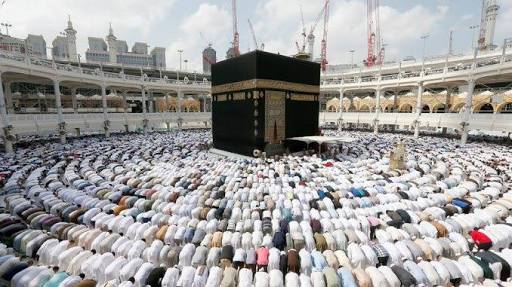
    Millions visit Mecca and worship at the Kaaba.

    I was curious as to how a Religion which decries idol all worship,permits worship at Kaaba.

    Worship At Kaaba Video

    It appears that Worship at Kaaba, touching and Kissing the Object is not allowed.

    Here are excerpts and Link.

    In the pictures you can clearly see people prostrating to Kabah. Allah the Great says,

    “And to Allah prostrate all that is in the heavens and all that is in the earth, of the moving (living) creatures and the angels, and they are not proud.” (16:49)

    Yet who do these polytheists prostrate to? They prostrate to Kabah. Another verse describes monotheists,

    “And those who spend the night in worship of their Lord, prostrate and standing.” (25:64)

    Allah the Great prohibited prostrating to His creation:

    “And from among His Signs are the night and the day, and the sun and the moon. prostrate yourselves not to the sun nor to the moon, but prostrate yourselves to Allah Who created them, if you (really) worship Him.” (41:37)

    People stopped prostrating to sun and moon and instead started to prostrate to Kabah. They left one Shirk for another and refused to worship Allah the Great. These Muslim polytheists really dislike to worship Allah the great alone but worship with him Kabah. And those who disdain, dislike worship of Allah the Great and worship beside Him Kabah, graves, Saints, Imams, Prophets, Trees, Idols, Allah the great tells them,

    “And your Lord says, “Call upon Me; I will respond to you.” Indeed, those who disdain My worship will enter hell [rendered] contemptible.“ (40:60)

    A video example of Kabah worship is also available here. Please people are making Tawaf of Kabah. At 0:35 onwards you can see the polytheistic Muslims kissing, huging, clinging to Kabah and this is exactly same as what the Sufi’s and Shia’s do on to the graves of their saints. This is manifest Shirk and every Muwahid will agree that tawaf of Kabah, kissing, hugging, clinging, rubbing the beard and cheeks on walls of Kabah is Shirk.’

    Reference and citation.

    https://ahlaltawheed.wordpress.com/2014/03/08/the-greatest-threat-to-tawheed-is-kabah-worship/

  • Sapthapadi Sarasvathi Navagraha Tamil Sangam Pre Islamic Arabia

    The word Arava means ‘Horse’ in Sanskrit and Sthan means ‘land’ as in Afghanistan, Turkistan, Kurdistan, Ghabulisthan, Kazakstan.


    Arabia comes from the word Arvasthan.

    Mecca houses the Shiva Linga.image.jpg
    Mecca and Shiva Linga Thanjavur,Tamil Nadu.


    Saravsathi Sculpture i British Museum, from Saudi Arabia..jpg
    Saravsathi Sculpture i British Museum, from Saudi Ar


    This image from pre-Islamic Saudi Arabia, displayed at the British Museum, shows goddess Sarasvati riding a swan carrier.


    Probably no other country in the world has deliberately written off a 2,500 year period of their own history by systematically stamping out and snapping all links with the past. They have wiped the memories of pre-Muslim era off their minds. So while they chose to remain ignorant of their past ironically enough it is they who dub the pre-Muslim era as a period of ignorance.


    King Vikramadithya’s Empire included what is now called Saudi Arabia.

    Please read my Post Vikramadhiya’s Empire.

    Mecca houses Shiva Linga  and 786 is Om Flipped ,read my post on this.


    ” Lord Shiva and Mata Parvati  are our parents .


    Lord Shiva is the first messenger of Muslims  and  we  do not deny this fact.”UHF Muslim preacher said,


    “Our first Prophet of God Shiva ‘, is accepted and the truth is right”.


    Jamiat Ulema chief Mufti Muhammad Ilyas 

    http://www.saharasamay.com/nation-news/676568891/lord-shiva-is-first-muslim-prophet-says-mufti-muhammad-ilyas.html


    In Istanbul in Turkey, there is a famous library called Makteb-e-Sultania which is reputed to have the largest collection of ancient West Asian literature.

    In the Arabic Section of that library is an anthology of ancient Arabicpoetry.

    That anthology was compiled from an earlier work in A.D. 1742 under the orders of the Turkish ruler Sultan Salim.

    The anthology is known as SAYAR-UL-OKUL. It is divided into three parts, the first part contains biographic details and the poetic compositions of pre-Islamic Arabian poets.

    The second part embodies accounts and verses of poets of the period beginning just after Prophet Mohammad up to the end of Banee- Ummayya dynasty.

    The third part deals with later poets up to the end of Khalifa Harun-al-Rashid’s times.

    Incidentally “Banee” means “Vanee” and Ummayya as in Krishnayya are Sanskrit names.

    Abu Amir Abdul Asamai, a distinguished Arabian bard who was the Poet Laureate of Harun-al-Rashid’s court has
    compiled and edited the anthology.

    The first modern edition of Sayar-ul-Okul anthology was printed and published in Berlin in A.D. 1864.

    A subsequent edition was published in Beirut in A.D. 1932.

    This work is regarded as the most important and authoritative anthology of ancient Arabic poetry.

    It throws considerable light on the social life, customs, manners and entertainment forms in ancient Arabia.

    The book also contains an elaborate description of the ancient Mecca shrine, the town and the annual fair known as OKAJ which used to be held there every year.

    This should convince readers that the annual Haj of the Muslims to the Kaaba is only a continuation of the old fair and not a new practice.

    But the OKAJ fair was far from a carnival.

    It provided a forum for the elite and learned to discussthe social,religious,political, literary and other aspects of the
    Vedic culture then pervading Arabia.

    Sayar-ul-Okul asserts that the conclusions reached at those discussions were widely respected throughout Arabia. Mecca, therefore, followed the Varanasi tradition of providing a seat for important discussions among the learned while the masses congregated there for spiritual bliss. The principal shrines at both Varanasi in India and at Mecca in Arvasthan were Shiva temples. Even to this day the central object of veneration at both Mecca and Varanasi continues to be the ancient Mahadeva emblems. It is the Shankara stone which Muslim pilgrims reverently touch and kiss in the Kaaba.

    As the pilgrim proceeds towards Mecca he is asked to
    shave his head and beard and to don a special sacred attire.
    This consists of two seamless sheets of white cloth. One is to
    be worn round the waist and the other over the shoulders.
    Both these rites are remnants of the old Vedic practice of
    entering Hindu shrines, clean-shaven and with holy seamless
    spotless white sheets.

    The main shrine in Mecca which houses the Shiva emblem is known as the Kaaba. It is clothed in a black shroud.
    This custom could also originate from the days when it was thought necessary to discourage its recapture.

    According to encyclopaedias Britannica and Islamia the Kaaba had 360 images.

    Traditional accounts mention that one of the deities among the 360 destroyed, when the shrine was stormed, was that of Saturn, another was of the moon and yet another was one called Allah.

    In India the practice of Navagraha puja that is worship of the nine planets is still in vogue.

    Two of these nine are the Saturn and the moon.

    Besides, the moon is always associated with Lord Shankara. A Crescent is always painted across the forehead of the Shiva emblem. Since the presiding deity at the Kaaba shrine was Lord Shiva i.e. Shankara, the crescent was also painted on it. It is that crescent which is now adopted as a religious symbol of Islam. Another Hindu tradition is that wherever there is a Shiva shrine the sacred stream of Ganga that is the Ganges must also co-exist. True to that tradition a sacred fount exists near the Kasba. Its water is held sacred because it was regarded as but another Ganga since pre-Islamic times. Muslim pilgrims visiting the Kaaba shrine go around it seven times.

    In no other mosque does this perambulation prevail. Hindus invariably perambulate around their shrines.

    This is yet another proof that the Kaaba shrine is a pre-Islamic Shiva temple where the Hindu practice of perambulation is still meticulously observed.

    Allah is a Sanskrit word. In Sanskrit Allah, Akka and Amba are synonyms. They signify a goddess or mother.

    The term Allah appears in Sanskrit chance while invoking goddess Durga i.e. Bhavani.

    The Islamic word Allah for God is therefore not an innovation but the ancient Sanskrit appellation retained and continued to be used by Islam.

    The seven perambulations too are significant. At Hindu wedding ceremonies the bride and bridegroom go round the sacred fire seven times, the Sapthapadi.

    The practice of seven perambulations around the Kaaba shrine in Mecca is, therefore, a Hindu Vedic custom.

    It is also a proof that Mecca was Makha or the shrine of the sacred fire around which worshippers made seven perambulations.

    SAYAR-UL-OKUL tells us that a pan-Arabic poetic symposium used to be held in Mecca at the annual Okaj fair in pre-Islamic times.

    All leading poets used to participate in it.
    Poems considered best were awarded prizes.

    The best poems engraved on gold plate were hung inside the temple. Others etched on camel or goat skin were hung outside. Thus for
    thousands of years the Kaaba was the treasure-house of the best Arabian poetic thought. This tradition was of immemorial antiquity.

    But most of the poems got lost and destroyed during the storming of the Kaaba by prophet Mohammed’’s forces.

    The custom of conducting a Poets’Conclave is of Tamil Origin and it is called Tamil Sangam.

    Tamil History is split as Sangam Era and later Poems.

    Obviously this indicates the Dravidian’s influence in the Middle east.

    This must have happened when Shiva and His son Ganesha left the South due to a Tsunami and traveled towards the Middle east

    Please read my post on this.

    SAYAR-UL-OKUL is a poem by UMAR-BINE-HASSNAM
    (Poetic Title: ABBUL-HIQAM meaning Father of Knowledge).
    He was an uncle of prophet Mohammed. He refused to get converted to Islam.

    He died a martyr at the hands of Muslim fanatics who wanted to wipe out non-Muslims.

    This poem was adjudged as the best in the annual fair at Kaaba.

    This was a Hymn on Shiva.

    Refer my Post on this

    Citation.


    http://defence.pk/threads/exclusive-was-pre-islamic-arabia-hindu-nation-un-told-arabian-tales.265608/


    I shall be posting a detailed article on the History of Kaaba.

    In the meanwhile, I would like to share a Poem, Stuthi on Lord Shiva by Umar-Bin-E-Hassham, an Uncle of Prophet Muhammad.

    Muhammad’s uncle was one of the resident priests of the Shiv temple known as “Kaaba”.”

    https://ramanisblog.in/2015/02/09/shiva-sthuthi-by-prophets-uncle-umar-bin-e-hassham/