Tag: Ganesh Chaturthi

  • Ganapathi Homa Procedure Mantras Text Details

    Ganapathi Homa Procedure Mantras Text Details

    Ganpathi Homa is most auspicious Homa and is performed when,

    One ventures into new business,

    Moves to a new house,

    To succeed in Endeavour which is plagued by difficuties,

    Ill health and for

    Any auspicious occasion.

    The ideal day is Krishna Paksha,waning Moon,Chaturthi ,the othe days ,Shukla Paksha,Waxing Moon,Chaturthi,Panchami,Sashti,Sapthami and Poornima

    Ideal time between 4.30 am and 6.30 am.

    This article is meant for those who would like to know what the details are in performing Ganapathi Homa.

    This article is prepared by checking  with various sources and therecare differences in practice,though there is no difference in the Moola Mantra and Ahuthi.

    The differences might be in the introductory ,concluding mantras and procedures.

    The Homa is to performed by facing East or North.

    Feeding Brahmins and the poor recommended.

    There is bound to be errors in this article.

    Please offer corrections with source.

    But as general information and to help people follow the Homa,this article will be useful.

    Materials required.

    One homa kundam (a copper container with preferably a square shaped base). If a homa

    kundam is not available, one can dig a square shaped pit in the ground (with 1-2 foot sides

    and half to one foot deep) and arrange a few layers of bricks around the pit. It is symbolic of

    the mooladhara chakra.

    • A small idol of Ganesha. If you have none, use a metallic coin or any metallic object.

    Actually, you can do without any idol and just invoke Mahaganapathi in fire.

    • Dry coconut halves (available in Indian stores)

    • Ghee from cow’s milk (clarified butter from cow’s milk). It is available in Indian stores. If

    unable to find, just get some butter and melt it in low heat. After it melts, some black stuff

    will separate from the melted liquid. Filter out the black deposit and use the liquid. It will

    solidify after a time. Before the homam, melt it again and use it.

    • A mixture of various auspicious materials, from the havan samagri (available in India

    stores), if possible.

    • Some sesame seeds, some mamra/murmura (puffed white rice), some nuts, some mildly

    popped corn and other materials that can be offered in fire. Small fruits are also fine. All

    these are optional. The absolute minimum needed is coconut pieces and ghee.

    • A wooden spoon/ladle to put ghee into the fire

    • Some akshatas. Those can be made by mixing raw (uncooked) white rice grains with a drop

    of sesame oil (or some other oil) and a pinch of turmeric powder. Instead of turmeric powder,

    one can also use vermilion (kumkum) powder used for the dot on the forehead.

    • Some darbhas (dried blades of sacred grass). Check with a local temple priest to find out how

    to procure them. If darbhas are unavailable, you may think of creative alternatives. For

    example, find some other dry grass or dry leaves or just thin twigs and pray to your ishta

    devata before the homam to make them acceptable.

    • A small container to light a sesame oil/ghee deepam (lamp). A candle can also be used as an

    alternative, though it is better to burn ghee and sesame oil than wax.

    • A wick to place in oil to light the fire.

    • A match box to light fire

    • An incense stick (agarbatti) if available and a holder to stick it to (a banana can be used

    instead)

    • Camphor and a container or plate for lighting camphor and offering haarati

    • Some flowers, if available.

    • Some food that you can offer to god. Preferably onion, garlic, spices and too much of chillies

    should be avoided. Fruits are also fine.

    • Some honey, if available.

    • Some milk, if available.

    • One tumbler or cup to store water. It should preferably be made of silver or copper or clay. If

    unavailable, you may use steel or glass.

    One spoon (preferably silver or copper) and two small bowls (preferably silver or copper).
    Preparation for Ganapathi Homa.

    Instead of arranging homa kundam directly on the floor, place a wood plank or something on

    the floor, wrapped with aluminum foil (or some such thing), and put 4 bricks of the same

    height on it and place the homa kundam on the bricks. Thus, there is some air and a wooden

    plank under the homa kundam and the floor does not get heated up.

    (2) If you want easy cleaning, place some aluminum foils on the floor all around the plank

    containing homa kundam. If ghee or something is spilled in that area, it is easy to clean.

    (3) If you want, you can also cover the interior of homa kundam with some aluminum foils, so

    that it is easy to clean.

    (4) Mix a little honey and a little ghee (e.g. half spoon each) and make a paste. Keep it aside.

    (5) Make a couple of different food items you can offer to god. You can just use rock sugar

    candy or raisins or dates or fruits also. Try to not use eggs, meat, onion or garlic in that food.

    (6) Cook a little plain white rice. I put a few grains of rice and a little water in a small container

    and put it in microwave oven before my homam and cooked rice is ready at the end when I

    need it.

    (7) Fill water in the tumbler/cup and place the spoon in it. Put one small empty bowl next to it.

    Fill the other small bowl with water.

    (8) Make a seat for yourself in front of the homa kundam. Ideally you should be facing east, i.e.

    homa kundam should be on the east from you. On the east of the homa kundam, place a small

    plate or a wooden plank, make a pile of some rice grains on it and place the idol on it. You

    can decorate based on your ability and taste.

    ॐ सर्वेभ्यो गुरुभ्यो नमः ||.
    ॐ सर्वेभ्यो देवेभ्यो नमः ||.
    ॐ सर्वेभ्यो ब्राह्मणेभ्यो नमः ||
    प्रारंभ कार्यं निर्विघ्नमस्तु | शुभं शोभनमस्तु |
    इष्ट देवता कुलदेवता सुप्रसन्ना वरदा भवतु ||
    अनुज्ञां देहि ||

    At Shrii Ganesha Vedi
    २ आचमनः Achamana,Purification of the senses and Mind.

    ॐ केशवाय स्वाहा | |
    ॐ नारायणाय स्वाहा | |
    ॐ माधवाय स्वाहा | |
    (sip one spoon of water after
    each of the above three mantras)

    ॐ गोविंदाय नमः ||. ॐ विष्णवे नमः ||.
    ॐ मधुसूदनाय नमः ||. ॐ त्रिविक्रमाय नमः ||.
    ॐ वामनाय नमः ||. ॐ श्रीधराय नमः ||.
    ॐ हृषीकेशाय नमः ||. ॐ पद्मनाभाय नमः ||.
    ॐ दामोदराय नमः ||. ॐ संकर्षणाय नमः ||.
    ॐ वासुदेवाय नमः ||. ॐ प्रद्युम्नाय नमः ||.
    ॐ अनिरुद्धाय नमः ||. ॐ पुरुषोत्तमाय नमः ||.
    ॐ अधोक्षजाय नमः ||. ॐ नारसिंहाय नमः ||.
    ॐ अच्युताय नमः ||. ॐ जनार्दनाय नमः ||.
    ॐ उपेंद्राय नमः ||. ॐ हरये नमः ||.

    श्री कृष्णाय नमः ||

    प्राणायामःPranayaama,Purification of the Life Force.

    ॐ प्रणवस्य परब्रह्म ऋषिः | परमात्मा देवता |
    दैवी गायत्री छन्दः | प्राणायामे विनियोगः ||

    ॐ भूः | ॐ भुवः | ॐ स्वः | ॐ महः |
    ॐ जनः | ॐ तपः | ॐ सत्यं |
    ॐ तत्सवितुर्वरेण्यं भर्गोदेवस्य धीमहि
    धियो योनः प्रचोदयात् ||

    ३ पुनराचमन
    (Repeat aachamana 2 – given above)

    ॐ आपोज्योति रसोमृतं ब्रह्म भूर्भुवस्सुवरोम् ||
    (Apply water to eyes and understand that you are of the
    nature of Brahman)

    ४ संकल्पः
    (Stand and hold a fruit in hand during sankalpa) Sankalpa is Right determination. For more details please read my article on Sankalpa /Sankalpa for US.
    ॐ श्रीमान् महा गणाधिपतये नमः ||.

    श्री गुरुभ्यो नमः ||.
    श्री सरस्वत्यै नमः ||.
    श्री वेदाय नमः ||.
    श्री वेदपुरुषाय नमः ||.
    इष्टदेवताभ्यो नमः ||.
    कुलदेवताभ्यो नमः ||.
    स्थान देवताभ्यो नमः ||.
    ग्राम देवताभ्यो नमः ||.
    वास्तु देवताभ्यो नमः ||.
    शचीपुरंदराभ्यां नमः ||.
    उमामहेश्वराभ्यां नमः ||.
    मातापितृभ्यां नमः ||.
    लक्ष्मीनारायणाभ्यां नमः ||.

    सर्वेभ्यो देवेभ्यो नमो नमः ||.
    सर्वेभ्यो ब्राह्मणेभ्यो नमो नमः ||.
    येतद्कर्मप्रधान देवताभ्यो नमो नमः ||

    ||अविघ्नमस्तु ||

    शुक्लांबरधरं देवं शशिवर्णं चतुर्भुजम् |
    प्रसन्नवदनं ध्यायेत् सर्व विघ्नोपशांतये ||

    सर्वमंगल मांगल्ये शिवे सर्वार्थ साधिके |
    शरण्ये त्रयंबके देवी नारायणी नमोऽस्तुते ||

    सर्वदा सर्व कार्येषु नास्ति तेषां अमंगलं |
    येषां हृदिस्थो भगवान् मंगलायतनो हरिः ||

    तदेव लग्नं सुदिनं तदेव ताराबलं चंद्रबलं तदेव |
    विद्या बलं दैवबलं तदेव लक्ष्मीपतेः तेंघ्रिऽयुगं स्मरामि ||

    लाभस्तेषां जयस्तेषां कुतस्तेषां पराजयः |
    येषां इन्दीवर श्यामो हृदयस्थो जनार्दनः ||

    विनायकं गुरुं भानुं ब्रह्माविष्णुमहेश्वरान् |
    सरस्वतीं प्रणम्यादौ सर्व कार्यार्थ सिद्धये ||

    श्रीमद् भगवतो महापुरुषस्य विष्णोराज्ञाय प्रवर्तमानस्य
    अद्य ब्रह्मणोऽद्वितीय परार्धे विष्णुपदे श्री श्वेतवराह कल्पे
    वैवस्वत मन्वन्तरे भारत वर्षे भरत खंडे जंबूद्वीपे
    दण्डकारण्य देशे गोदावर्या दक्षिणे तीरे कृष्णवेण्यो उत्तरे
    तीरे परशुराम क्षेत्रे (samyukta amerikA deshe St Lewis grAme
    or Australia deshe Victoria grAme or Bahrain deshe)
    शालिवाहन शके वर्तमाने व्यवहारिके विकरम नाम संवत्सरे
    उत्तरायणे/दक्षिणायणे, अमुक मासे, अमुक पक्षे, अमुक तिथौ,
    अमुक नक्षत्रे, अमुक वासरे सर्व ग्रहेषु यथा राशि स्थान
    स्थितेषु सत्सु येवं गुणविशेषेण विशिष्टायां शुभपुण्यतिथौ
    अस्माकं सकुढुम्बानां मम कार्यक वाचिक मानसिक ज्ञात अज्ञात
    समस्त पापक्षयद्वारा चिन्त शुद्ध्यर्थं करिष्यमाण सकल कार्येषु
    निर्विघ्नता पूर्वक सर्वाभिष्ठसिद्ध्यर्थं काम्ना विशेषेतु अमुक
    काम्ना Replace with whicheverकन्याः विवाह कार्य or
    वर अन्वेषणे सिद्धयर्थं orविध्याभ्यास सफलार्थे
    orपरदेश गमन सिद्ध्यर्थे orमोक्ष सिद्ध्यर्थे
    श्री महागणपतिं प्रीत्यर्थं श्री महागणपति होमं करिष्ये |
    तदा आदौ शान्त्यर्थं पुण्याः वाचनं निर्विघ्नता सिद्ध्यर्थं
    गणपथि पूजनं करिष्ये ||

    इदं फलं मयादेव स्थापितं पुरतस्तव |
    तेनमे सफलावाप्तिर् भवेत् जन्मनि जन्मनि ||

    (keep fruits in front of the Lord)
    (Keep yantra in the north of homakunDa.
    Keep the ashhTha dravya in the south of the Homa kuNDa)

    ५ आवाहनं

    मोदके विघ्नेशं आवाहयामि (put axata/tulasi in Modak)
    प्रतुके उर्विं आवाहयामि (put axata/tulasi in Jaggery)
    लाजेषु दिनेशं आवाहयामि (put axata/tulasi in Rice flakes)
    सत्त्कुनि अग्निं आवाहयामि (put axata/tulasi in Appam)
    इक्षौ सोमं आवाहयामि (Put axata/tulasi in Sugarcane)
    नालिकेरे ईशानां आवाहयामि (put axata/tulasi in Coconut)
    तिले हरिं आवाहयामि (Put axata/tulasi in black sesame)
    कदलिफले ब्रह्मणां आवाहयामि (Put axata/tulasi in Bananas)

    ध्यायामि | ध्यानं समर्पयामि ||
    आवाहनं समर्पयामि | आसनं समर्पयामि ||
    पाद्यं समर्पयामि | अर्घ्यं समर्पयामि ||
    आचमनीयं समर्पयामि | स्नानं समर्पयामि ||
    वस्त्रं समर्पयामि | यज्ञोपवीतं समर्पयामि ||
    गंधं समर्पयामि | धूपं आघ्रापयामि ||
    दीपं दर्शयामि | नैवेद्यं निवेदयामि ||
    मन्त्रपुष्पं समर्पयामि | सकल पूजार्थे अक्षतान् समर्पयामि ||

    (Mix all of these and take 8 hand fulls)

    मुद्रा
    (Show mudras as you chant )

    निर्वीषि करणार्थे तार्क्ष मुद्रा (to remove poison)
    अमृति करणार्थे धेनु मुद्रा (to provide nectar )
    पवित्री करणार्थे शंख मुद्रा (to make auspicious)
    संरक्षणार्थे चक्र मुद्रा (to protect)
    विपुलमाया करणार्थे मेरु मुद्रा (to remove maayaa)

    Offer Gandha, Chandana etc. Sprinkle water around.
    Chant OM vaM 108 times. It is the amRita bIjaM
    Treat it is as amRita and offer dhUpaM and dIpaM
    and naivedhyaM

    ६ अग्नि पीट पूजा

    (In the Homa kuNDA draw shrI Keep some banyan leaf sticks
    or dharbha and tiirtha. Then arrange the wooden pieces on top.
    The agni should be brought by a lady (Sowbhaagyavathi). It can be brought
    with camphor or ghee and the fire should not get extinguished)

    बलं वर्धन नाम्नां अग्निं प्रतिष्ठापयेत्

    (Now do piiTha puuja, pouring ghee for each mantra)

    १. ॐ आदार शक्त्यै नमः ||
    २. ॐ मूल प्रकृत्यै नमः ||
    ३. ॐ कूर्माय नमः ||
    ४. ॐ अनन्ताय नमः ||
    ५. ॐ पृथिव्यै नमः ||
    ६. ॐ इक्षु सागराय नमः ||
    ७. ॐ रत्न दीपाय नमः ||
    ८. ॐ कल्प वृक्षाय नमः ||
    ९. ॐ मणि मण्डपाय नमः ||
    १०. ॐ रत्न सिंहासनाय नमः ||
    ११. ॐ श्वेत छत्राय नमः ||
    १२. ॐ धर्माय नमः ||
    १३. ॐ ज्ञानाय नमः ||
    १४. ॐ वैराग्याय नमः ||
    १५. ॐ ऐश्वर्याय नमः ||
    १६. ॐ अधर्माय नमः ||
    १७. ॐ अज्ञानाय नमः ||
    १८. ॐ अवैराग्याय नमः ||
    १९. ॐ अनैश्वर्याय नमः ||
    २०. ॐ सर्व तत्व पद्माय नमः ||
    २१. ॐ आनन्द कन्दाय नमः ||
    २२. ॐ सांविन्नलाय नमः ||
    २३. ॐ प्रकृतिमय दलेभ्यो नमः ||
    २४. ॐ विकारमय केसरेभ्यो नमः ||
    २५. ॐ पञ्चाशद्वर्ण कर्णिकायै नमः ||
    २६. ॐ पृथिव्यात्मने परिवेशाय नमः ||
    २७. अं अर्क मण्डलाय अर्थप्रद द्वादश कलात्मने नमः ||
    २८. उं सोम मण्डलाय कामप्रद षोडष कलात्मने नमः ||
    २९. रं वह्नि मण्डलाय धर्मप्रद दश कलात्मने नमः ||
    ३०. सं सत्वाय नमः ||
    ३१. रं रजसे नमः ||
    ३२. तं तमसे नमः ||
    ३३. मं मायायै नमः ||
    ३४. विं विध्यायै नमः ||
    ३५. आं आत्मने नमः ||
    ३६. अं अन्तरात्मने नमः ||
    ३७. पं परमात्मने नमः ||
    ३८. सं सर्वतत्वात्मने नमः ||
    ३९. ॐ तीव्रायै नमः ||
    ४०. ॐ ज्वालिन्यै नमः ||
    ४१. ॐ नन्दायै नमः ||
    ४२. ॐ भोगदायै नमः ||
    ४३. ॐ कामरूपिण्यै नमः ||
    ४४. ॐ उग्रायै नमः ||
    ४५. ॐ तेजोवत्यै नमः ||
    ४६. ॐ सत्यायै नमः ||
    ४७. ॐ विघ्न नाशिन्यै नमः ||
    ४८. ॐ श्रीं ह्रीं क्लीं ग्लौं गं नमो भगवते सर्व भूतात्मने
    सर्व शक्तिर् कमलासनाय नमः ||

    ७ प्राण प्रथिष्ठा

    ॐ एकदन्ताय नमः ||(pour water thrice)
    गणक ऋषिः गायत्रि छन्दः श्री महागणपतिं देवता
    महागणपति प्रीत्यर्थ होमे विनियोगः

    ||ंअहा गणपति न्यास ||

    ॐ गणानां त्वा इति मंत्रस्य घृत्समद ऋषिः.
    गणपतिर्देवता | जगति छंदः ||
    महा गणपति न्यासे विनियोगः ||

    गणानांत्वेति अंगुष्ठाभ्यां नमः ||
    गणपतिं हवामहे इति तर्जनीभ्यां नमः ||
    कविं कवीनां इति मध्यमाभ्यां नमः ||
    उपवश्त्रम इति कनिष्ठिकाभ्यां नमः ||
    आन: शृण्वन्नूतिभिः सीदसादनमिति करतलकरपृष्ठाभ्यां नमः ||

    ||एवं हृदयादि न्यासः ||

    ॐ भूर्भुवस्सुवरोम् | इति दिग्बन्धः ||

    गणानांत्वायै शिरसे स्वाहा | ||
    गणपतिमिति ललाटाय नमः ||
    हवामहे इति मुखाय नमः ||
    कविं कवीनामिति हृदयाय नमः ||
    उपमश्रवस्तमम् इति नाभ्यै नमः ||
    ज्येष्ठराज्य इति कट्यै नमः ||
    ब्रह्मणां इति ऊरुभ्यां नमः ||
    ब्रह्मणस्पत इति जानुभ्यां नमः ||
    आ नः शृण्वन् इति जठराभ्यां नमः ||
    नूतिभिः इति गुल्फौभ्यां नमः ||
    सीदसादनम् इति पादाभ्यां नमः ||

    ८ दिग्बन्धन
    (Show mudras)

    ॐ भूर्भुवस्सुवरोम् | इति दिग्बन्धः.(Snap fingers circle head
    clockwise and clap hands)

    दिशो बद्नामि||
    (Shut off all directions i.e. distractions.
    So that we can concentrate on the Lord.)

    ९ ध्यानं

    ॐ ॐ (Repeat 15 times)
    Close eyes and bring Lord Ganesha’s image in your mind and chant

    श्री गणेशाय नमः ||
    श्री गणेशाय नमः ||
    श्री गणेशाय नमः ||

    विनायकं हेमवर्षं पाशांकुशधरं विभुं |
    दययोर् गजाननं देवं भालचंद्र समप्रभं ||

    ॐ सहस्रशीर्षा पुरुषः सहस्राक्षः सहस्रपात् |
    स भूमिं विश्वतो वृत्वा अत्यतिष्ठद् दशाङ्गुलम् ||

    श्री विनायकाय नमः ||. ध्यानात् ध्यानं समर्पयामि ||

    १० आवाहनं

    स्वात्म संस्थं अजं शुद्धं अध्य गणनायक |
    हरण्यां इव हव्याश्म अग्न्यावा आवाहयाम्यहं ||

    ॐ ह्रिं भूर्भुवस्सुवरोम् ||

    आवाहितो भव | स्थापितो भव | सन्निहितो भव |
    सन्निरुद्धो भव | अवकुण्ठितो भव | सुप्रीतो भव |
    सुप्रसन्नो भव | सुमुखो भव | वरदो भव |
    प्रसीद प्रसीद ||
    (show mudras to Lord)
    Ahuthi.Pour Ghee gently into the Fire with Homa Spoon(avilable at Pooja materials shop) or fold Mango leaf vertically and pour ghee through it.

    Pour ghee after ‘Swaha’

    Perform this 108 times.

    For Ganapathy Homa there are Veda mantras.I am providing two mantras.Any one of them will do.

    The first Mantra is used more.

    1.Om Hreem GumKleem  Kleem Gaa Ganapathaye varavarada Sarvajaname Vachamaanaya Swahaa.

    2.Gannantgva Ganpathigum Havaamahe Kavinkaveenaam

    Jyestarajam Brahmanaan Brahmanasthapatha Aana Srunvann Udhibhissidasanam Swaha.


    Suggested chanting 1008 times.

    Poornahuti  Mantra

    Poorna Ahuthi.

    ॐ इतः पूर्व प्राण बुद्धि देह धर्मार्धिकारतो जागरत् स्वप्न
    सुशुप्त्य अवस्तासु मनसा वाचा कर्मणा हस्ताब्यां पद्भ्यां
    उदरेन शीर्ष्णा यद्कृतं यदुक्तं यत्स्मृतं तत् सर्वं
    ब्रह्मार्पणं भवतु स्वाहा | स्वाहा | ||

    ब्रह्मार्पणं ब्रह्म हविर् ब्रह्माग्नौ ब्रह्मणा हुतम्

    ब्रह्मैव तेन गन्तव्यं ब्रह्म कर्म समाधिना ||

    ॐ लम्बोदराय नमः ||. तृप्तिरस्तु ||


    Now, you have to prepare a package for poornaahuti (“complete offering”). The normal

    procedure is to place a full dry coconut, some metal coins, some turmeric, some sandalwood,

    some kumkum, some akshatas, samples of some of the materials used in homam as offerings and

    tie the cloth. We have a special wooden ladle called “srk”. We pour a little melted ghee in the

    hole in srk, place the poornahuti package on it and place the other normal wooden ladle on top of

    it, then say the poornaahuti mantra and drop the poornaahuti package in fire. Then, while reading

    “Rudra Chamakam”, we pour the ghee in srk into fire.

    For a simple homam with a small fire, the following is suggested. Place a few akshatas, one coin,

    little sandalwood powder, turmeric powder, kumkum powder, samples of materials offered

    earlier, in a dry coconut half. Make everyone attending the homam touch it and then say the

    moolamantra given earlier 4/8/12 times while holding the poornaahuti in hand. Then place it on

    the wooden ladle, say the mantra below and then place the coconut half in fire carefully with

    hand (if you drop it on a small fire, it can extinguish the fire and also materials from the coconut

    can spill everywhere in the homa kundam).

    When offering poornaahuti, imagine that you are completely surrendering yourself to

    Mahaganapathi. Poornaahuti basically means “complete surrender”. The full (or half) coconut

    used in the poornaahuti is a symbol of one’s head, i.e. ego (“I-ness”), which is to be sacrificed

    (surrendered) to Mahaganapathi. Without that inner sense of surrender, an elaborate poornaahuti

    ritual has no purpose.

    Spread the burning dry coconut pieces that are already in the homa kundam and re-arrange them

    around this new dry coconut half (poornaahuti), so that it can catch fire. Then take a little ghee

    into the ladle and pour it slowly inside and along the edges of the dry coconut half while reading

    the third verse from “Rudra Chamakam”. It is given below.

    śaṃ ca’ me maya’śca me priyaṃ ca’ me‌உnumaśca’ me kāma’śca me saumanasaśca’ me bhadraṃ ca’ me śreya’śca me vasya’śca me yaśa’śca me bhaga’śca me dravi’ṇaṃ ca me yantā ca’ me dhartā ca’ me kṣema’śca me dhṛti’śca me viśva’ṃ ca me maha’śca me saṃvicca’ me ṅñātra’ṃ ca me sūśca’ me prasūśca’ me sīra’ṃ ca me layaśca’ ma taṃ ca’ me‌உmṛta’ṃ ca me‌உyakṣmaṃ ca me‌உnā’mayacca me vātu’śca me dīrghāyutvaṃ ca’ me‌உnamitraṃ ca me‌உbha’yaṃ ca me sugaṃ ca’ me śaya’naṃ ca me ṣā ca’ me sudina’ṃ ca me ||’

    Don’t pour too much ghee if you don’t want much smoke. Just take one teaspoonful of ghee in

    the wooden ladle and manage with it.

    Uttarangam.

    om prajä×pateÞ na tvadeÞtänyaÞnyo viçvä× jäÞtäniÞ pariÞ tä ba×bhüva| yatkä×mäste juhuÞmastanno× astu

    va×yað syä×maÞ pata×yo rayéÞëäm| svähä÷| prajäpataya idaà na mama||

    om bhüù svähä÷| agnaya idaà na mama||

    om bhuvaùÞ svähä÷| väyava idaà na mama||

    om suvaùÞ svähä÷| süryäyedaà na mama||

    yada×syaÞ karmaÞëo’tyaré×ricaàÞ yadväÞnyü×namiÞhäka×ram| agniñöaÞt svi×ñöaÞkådvidvän sarvaà

    svi×ñöaàÞ suhu×taà karotuÞ svähä÷| agnaye sviñöakåta idaà na mama||

    om bhürbhuvaÞssuvaùÞ svähä÷| prajäpataya idaà na mama||

    Now do pranaayaamam again. The procedure of pranaayaamam is explained earlier.

    Now, make three offerings to the fire god, asking for forgiveness for any mistakes committed

    knowingly or unknowingly, while using fire as the medium. Read the following and offer a drop

    of the ghee in the fire at each “swaahaa”.

    anä÷jïätaà yadäjïä×taà yaÞjïasya kriÞyateÞ mithu×| agne÷ tada×sya kaÞlpaÞyaÞ tvað hi vettha×

    yaÞthäÞtatham| svähä÷| agnaya idaà na mama||

    puru×ñasammito yaÞjïo yaÞjïaù puru×ñasammitaù| agne÷ tada×sya kaÞlpaÞyaÞ tvað hi vettha×

    yathäÞtatham| svähä÷| agnaya idaà na mama||

    yatpä×kaÞträ manasä déÞnada×kñäÞ na| yaÞjïasya× maÞnvate× martä×saù| agniÞñöaddhotä÷

    kraÞtuÞvidvi×jäÞnan| yaji×ñöho deÞvän åÞtuÞço ya×jätiÞ| svähä÷| agnaya idaà na mama||

    Next, three offerings are made to the fire god, wind god and sun god. Read the following and

    offer a drop of the ghee in the fire at each “swaahaa”

    om bhüù svähä÷| agnaya idaà na mama||

    om bhuvaùÞ svähä÷| väyava idaà na mama||

    om suvaùÞ svähä÷| süryäyedaà na mama||

    One final offering to Prajapati is made to beg for forgiveness for various mistakes made in the

    homam, with respect to pronunciation, actions, procedure, devotion, materials used etc. Read the

    following and offer of drop of ghee.

    asmin homakarmaëi madhye sambhävita samasta mantralopa tantralopa kriyälopa bhaktilopa

    çraddhälopa niyamalopa niñöhälopa dravyalopädi samasta doña präyaçcittärthaà sarva

    präyaçcittähutià hoñyämi| om bhürbhuvaÞssuvaùÞ svähä÷| prajäpataya idaà na mama||

    An offering to Vishnu and an offering to Rudra must be made before the homam can conclude.

    Read the following two lines and offer a drop of ghee for each line. Think of Vishnu and Shiva.

    om çré viñëa×veÞ svähä÷| viñëave paramätmana idaà na mama||

    om namo ruÞdräya× paçuÞpata×yeÞ svähä÷| rudräya paçupataya idaà na mama||

    After making an offering to Rudra, wash the hand once. You can sprinkle a little bit water on the

    right palm for that purpose.

    The fire god (Agni) has carried all our offerings to various gods. So the final offering is to him.

    Read the following and offer a drop of ghee in the fire.

    saptaÞ te× agne saÞmidhaù× saÞptajiÞhväù sapta åña×yassaÞptaù dhäma× priÞyäëi×| saÞpta hoträ÷ saptaÞ

    dhätvä× yaÞjaÞntiÞsaÞptayonéÞräpå×ëasvä ghåÞteÞnaÞ svähä÷| agnaye saptavata idaà na mama||

    we will not need any more ghee. Take the ghee container and place it in the northern side

    of the homa kundam. Take some water in a spoon and sprinkle it around the homa kumdam as

    shown in the figure.

    The Mantra.

    adiÞte’nva×maàsthäù|

    anu×maÞte’nva×maàsthäù|

    sara×svaÞte’nva×maàsthäù|

    deva× savitaùÞ präsä×véù|

    This is similar to what we did at the beginning, but the mantras to say are

    different.

    When sprinkling water, start from A to D to C to B  to A as in the figure.

    Homa kunda. Image.
    Homa kunda. From bottom left A,clockwise B,C and D.(A to D North,D to C East, C to B South,B to A West)

    Now, take the darbhas placed at the beginning outside the homa kundam on the western side (or

    new darbhas, if you did not place any darbhas along the boundaries due to lack of darbhas),

    apply a little ghee to them and place the tips in fire. When they catch fire, remove them from the

    fire, place them in a container and let the whole darbhas burn. The black ash you get is called

    “rakshaa” (protection). At the end of the homam, you can apply a little rakshaa to the forehead of

    the idol and then a little to your own forehead and the foreheads of others. This is believed to

    protect from evil forces. You can store the rakshaa for future use on important occasions.

    Now, read the moolamantra 12 times again. If you have time, you can do anga nyaasam and kara

    nyaasam also again. This is just meditation, without any offerings made into fire.

    Then, get a little milk in a cup or a tumbler. If you don’t have milk, use water. Keep your right

    palm horizontal, with the palm facing up. Make an upward vertical circle with thumb and index

    finger. Pour a little milk in the palm. Then angle the palm slightly and make the milk drop from

    the palm through the tips of middle and ring fingers into the homa kundam. While doing that, say

    the following:

    Om Hreem GumKleem  Kleem Gaa Ganapathaye varavarada Sarvajaname Vachamaanaya Swahaa.

    Repeat this 12 times. At the end, throw away the milk remaining in the cup/tumbler and

    don’t use it.

    Suddhanna Bali.

    Now, we have to offer bali (sacrifice to other demigods – associates of Mahaganapathi). Get the

    cooked white rice (or banana slices or something like that). Just place a small token amount as

    bali. You need to place bali in six different places outside the homa kundam. First, place it on the

    east of the homa kundam. Then on the west, then on the north, then on the south and finally two

    more on the east (a little north to the previous bali(s) placed in the east). The order and positions

    can be found in Figure 3. While offering balis in six places, the following sentence should be recited..

    om sri mahägaëapati pärñadebhyo namaù| balià samarpayämi|

    The rice remaining after offering balis should be thrown away and not consumed. If cooked rice

    is not available, small banana slices can be used. Again, any banana piece left after removing

    some slices bali should be thrown away


    Uddvaasana,Taking Leave.

    Take a couple of darbhas in your right hand and a couple more darbhas with your left hand. Take

    some flowers or akshatas also if available. Hold the darbhas with the tips facing away from you

    and the bases in your hands. Now touch the two sides of the homakundam with the darbhas in

    the two hands. Then touch the idol with those darbhas and leave the akshatas and flowers on the

    god. Imagine that the energy from the homakundam has been transferred into the idol. To

    simplify this, you can also place your fists containing a few akshatas on top of the northern and

    southern sides of homa kundam and then deposit the akshatas in those fists at the feet of the idol.

    Say the following and show your heart with your hands. Imagine that Sri Mahaganapathi has

    exited the fire and the idol and entered your heart.

    asmänmürteçca agneçca çrémahägaëapatià yathästhänaà pratiñöhäpayämi

    Say the following and bow to the fire god.


    agneÞ naya× supathä× räÞye aÞsmän viçväni× deva vaÞyunä×ni viÞdvän| yuÞyodhya×smajju×huräÞëamenoÞ 

    bhüyiñöhäà× teÞ nama× uktià vidhema| agnaye namaù||.


    Conclusion.

    Say the following three verses. Think of Krishna and imagine that you are not the doer and

    Krishna is the doer who is acting through you. While you do it, place a few akshatas on the tips

    of the ring and middle fingers of the right hand, place the palm on the small deposit bowl and

    wash it such that the water and akshatas are deposited in the deposit bowl.

    mantrahénaà kriyähénaà bhaktihénaà hutäçana| yaddhutaà tu mayä deva paripürëaà

    tadastu te||

    präyaçcittänyaçeñäëi tapaù karmätmakäni vai| yäni teñämaçeñäëäà çré kåñëasmaraëaà

    paraà|| çré kåñëa kåñëa kåñëa|

    käyena väcä manasendriyairvä buddhyätmanä vä prakåteù svabhävät| karomi yadyat sakalaà

    parasmai näräyaëäyeti samarpayämi||

    Say the following finally. Imagine that Sri Mahaganapathi became pleased with your homam.

    Surrender the doership of the homam to Krishna and pray for peace. After this, you should not

    think of yourself as the doer of the homam just finished!

    anena divya maìgaÿa homena bhagavän sarvätmakaù çrémahägaëapatiù préyatäm| om tatsat|

    sarvam çré kåñëärpaëamastu| om çäntiù çäntiù çäntiù|.

    Krishnarrpananamasthu.


  • Ganesha Verse Latin Dwimukha Ganapati Janus Roman God

    Lord Ganesha Cult was present throughout the world.

    I had written on,

    Red Ganesha in Australia,

    Ganeshaya Namah inscription in Azerbaijan,

    Dwimukha Ganapati.jpg
    Dwimukha Ganapati, Two faced Ganesha

    Atlantis people were the descendants of Shiva, Ganesha and Subrahmanya,

    Golden Ganesha idol was unearthed in Kuwait,

    Ganesha’s mount, Mooshika was considered as a flying Machine y the Incas and there are paintings on this.

    There is a temple for Haridra Ganapati in Thailand,

    There is a view, a sound one at that  Dwimukha Ganapti ws worshiped as Janus by the Romans,

    I had written the Italian connection to Hinduism , in various articles including the one on aerial view of Vatican, being identical with Shiva Linga with Avudaiyar(Peeta)

    Janus.

    Two Faced Roman God, Janus
    Janus, Roman God.


    ‘In ancient Roman religion and myth, Janus (/ˈnəs/; Latin: Ianus, pronounced [ˈjaː.nus]) is the god of beginnings, gates, transitions, time, doorways, passages, and endings. He is usually depicted as having two faces, since he looks to the future and to the past. It is conventionally thought that the month of January is named for Janus (Ianuarius), but according to ancient Roman farmers’ almanacsJuno was the tutelary deity of the month.

    Janus presided over the beginning and ending of conflict, and hence war and peace. The doors of his temple were open in time of war, and closed to mark the peace. As a god of transitions, he had functions pertaining to birth and to journeys and exchange, and in his association with Portunus, a similar harbor and gateway god, he was concerned with travelling, trading and shipping.

    Janus had no flamen or specialised priest (sacerdos) assigned to him, but the King of the Sacred Rites (rex sacrorum) himself carried out his ceremonies. Janus had a ubiquitous presence in religious ceremonies throughout the year, and was ritually invoked at the beginning of each one, regardless of the main deity honored on any particular occasion.’

    Note the similarities between Ganesha and Janus.

    Both are given the first place in worship.

    No special priest is required to perform Pooja  for both

    Both are associated with travel.

    We worship Ganesha before travel and there is a custom to break the coconut at the beginning or during the Journey.

    Many of you would have noticed luxury Bus drivers and heavy vehicle drivers breaking coconut in a roadside Ganesha temple.

    ‘anus frequently symbolized change and transitions such as the progress of future to past, from one condition to another, from one vision to another, and young people’s growth to adulthood. He represented time, because he could see into the past with one face and into the future with the other.. Hence, Janus was worshipped at the beginnings of the harvest and planting times, as well as at marriages, deaths and other beginnings. He represented the middle ground between barbarism and civilization, rural and urban space, youth and adulthood. Having jurisdiction over beginnings Janus had an intrinsic association with omens and auspices’

    All these are being the process of Gnapati worship.

    Latin Verse on Janus.

    Carmen Saliare

    As may be expected the opening verses of the Carmen, are devoted to honouring Janus, thence were named versus ianuli. Paul the Deacon mentions the versus ianuli, iovii, iunonii, minervii. Only part of the versus ianuli and two of the iovii are preserved.

    The manuscript has:

    (paragraph 26): “cozeulodorieso. omia ũo adpatula coemisse./ ian cusianes duonus ceruses. dun; ianusue uet põmelios eum recum“;

    (paragraph 27): “diuum êpta cante diuum deo supplicante.” “ianitos“.

    Many reconstructions have been proposed: they vary widely in dubious points and are all tentative, nonetheless one can identify with certainty some epithets:

    Cozeiuod orieso. Omnia vortitod Patulti; oenus es

    iancus (or ianeus), Iane, es, duonus Cerus es, duonus Ianus.

    Veniet potissimum melios eum recum.

    Diuum eum patrem (or partem) cante, diuum deo supplicate.

    ianitos.

    The epithets that can be identified are: Cozeuios, i.e. Conseuius the Sower, which opens the carmen and is attested as an old form of Consivius in Tertullian; Patultius: the Opener; Iancus or Ianeus: the Gatekeeper; Duonus Cerus: the Good Creator; rex king (potissimum melios eum recum: the most powerful and best of kings); diuum patrem (partem):father of the gods (or part of the gods); diuum deus: god of the gods; ianitos: the Janitor, Gatekeeper.’

    All are the Attributes of Ganesha.

    I may add that Jaanu is a term for Ears, Ganesha’s ear being huge(elephant’s)

    Janus in Ganesha.

    In 1806 Sir William Jones drew a close comparison between a particular form of Ganesha, known as Dwimukhi-Ganesha, and Janus, the two-headed Roman god. Jones felt the resemblance between Dwimukhi-Ganesha and Janus was so strong that he referred to Ganesha as the “Janus of India.” The Dwimukhi-Ganesha form is a very unusual depiction in which Ganesha is shown with the head of an elephant looking toward his right and a human head at his left. It was possessed of four arms. Nagar says that the Dwimukhi-Ganesha form was associated with the region around Bombay.

    There was no clear claim by Jones either that Ganesha was worshipped by the Romans or how Janus could have evolved from Ganesha as a prototype (or vice versa). Another early 19th century Indologist, Edward Moor, repeated the speculation by Jones, helping to keep the Janus idea alive Moor expanded the claims of an association based on functional grounds, noting that Janus, like Ganesha, was invoked at the beginning of undertakings, a liminal god who was the guardian of gates. Moor made various other speculations on the connection between Janus and Ganesha. These fanciful connections proposed by early Indologists no longer appear in modern academic reviews of Ganesha’s history.

    Ganesha is represented as having anywhere from one to five heads, so depictions with two heads are not reliable evidence of a connection with Janus. Representations of Ganesha with two heads are uncommon, and according to Nagar, textual references to the adoration of Ganesha with two heads are difficult to trace. There are no other examples of two-headed forms in which one head is human other than the Dwimukhi-Ganesha form. In the thirty-two mediation forms of Ganesha that are described in theSritattvanidhi only one has two heads (Dwimukhi Ganapati, the Ganapati with two faces), and both of those are heads of elephants, like all the other forms described.

    References and citations.

    https://en.wikipedia.org/wiki/Ganesha_in_world_religions#Speculation_related_to_Janus

    https://en.wikipedia.org/wiki/Janus#Position_in_the_pantheon


    Janus Image credit.By Loudon dodd – Own work, CC BY-SA 3.0, https://commons.wikimedia.org/w/index.php?curid=7404342

  • Haridra Ganapati For Black Magic   Impotency Wealth

    Haridra Ganapati For Black Magic Impotency Wealth

    Post Vedic period,myriad of deities were worshiped, overlooking the fact the core of the Vedic teaching that defines Reality as One without attributes,Nirguna Brahman.

    However, realizing  that the human Mind can not operate and concentrate on mere abstractions, the Vedas have also hinted at worship of Individual Gods..

    And there are two broad classifications of all the Vedic teaching .

    One is Karma Kanda,path of Action as explained in the Brahmanas..

    The other one is Gnana Kanda, which emphasizes Knowledge as a path of salvation, Path of Knowledge, as detailed in the Upanishads.

    People started leaning more towards the karma kanda and this was carried to the extreme by the Mimamsa system of Indian Philosophy.

    The Mimamsa believed  only in Karma, or action.

    In the process they lost sight of the Ultimate Reality through Gyana ,knowledge.

    Performance of rituals reigned supreme with dedication to many Gods.

    This led to distortion of Vedic thought and the number of deities became countless.

    People ere confused whom to worship because of the presence of numerous deities.

    This confused state paved the way for the advent of Buddhism and Jainism and Hinduism was losing ground.

    Adi Shankaracharya sorted out this confusion and established Six systems of worship,Shanmataha.

    For details on this please read my Post Six systems of worship Shankaracharya.

    They are,

    Ganapathya, worship of Ganesha, Ganapati,

    Saura, of Surya, the Sun,

    Saktha, of Devi,

    Saiva, of Shiva,

    Vaishnava, of Vishnu and

    Kaumaram , of Subrahmanya.

    Tantik sects of these six deities are also there.

    Ganapathya is devoted to Lord Ganesha, Protector and Remover of obstacles.

    There are various forms of Ganapati.

    Please read my posts on these.

    One such form is Haridra(Turmeric) Ganapathi.


    Turmeric is a symbol of prosperity and auspiciousness.

    Ganesha is worshiped by making an image of him by hand and perform Pooja to him in any function before going ahead.

    There is an interesting anecdote in the Vinayaka Puran,

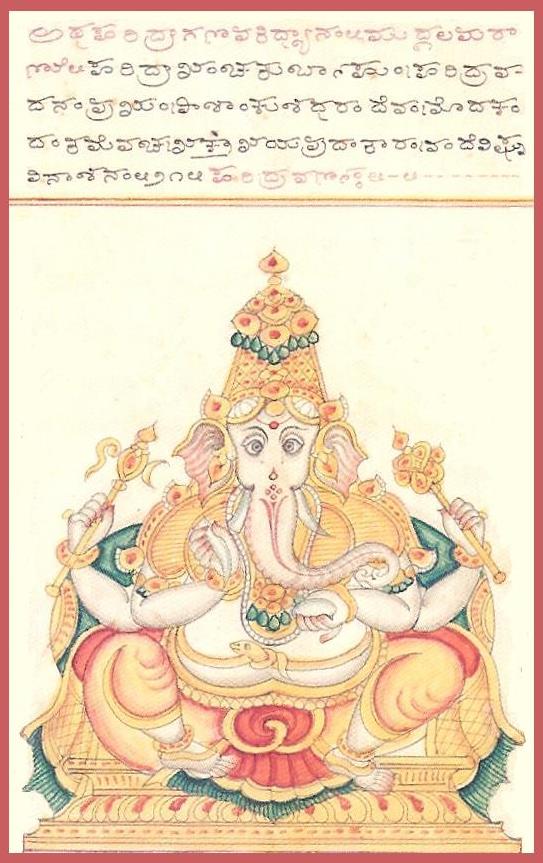
    Haridra Ganapati
    Haridra Ganapati, folio from the Sritattvanidhi (

    Goddess Parvati created Him with the turmeric she applied to her body while bathing and ordained that worship of Ganapathi in the form of turmeric is most aust auspicious.

    Worship of Ganapathi was done by making an image of Him with foams of the Sea by Lord Shiva, during his battle with Tripurantaka.

    Haridra Ganapathi worship is essentially a tantrik practice, though one can perform this pooja in a normal manner.

    Haridra Ganapati (Sanskrit: हरिद्रा-गणपति, Haridrā-gaṇapati, literally “turmeric Ganesha”) is an aspect of the Hindu God Ganesha(Ganapati).

    Haridra Ganapati is also known as Ratri Ganapati.

     Haridra Ganapati is depicted as yellow like turmeric and wears yellow garments.

    He is one of the most popular thirty-two forms of Ganesha

    (Please check my post on this).

    He is described as having three eyes. He sits on a golden throne. He is yellow-complexioned like turmeric and also wears yellow clothes. He has four arms and carries a pasha (noose), an ankusha (elephant goad), a modaka (sweet) and the danta (his own broken tusk) in his four hands. He draws his devotees closer by the noose, while goads them in the right direction by the ankusha.(Refer Niyotsava and the Mantra-maharnava)

    Haridra Ganapati has six arms and sits on a jewelled throne, in addition to his yellow colour and yellow vestments. His three right hands hold the ankusha and display the krodha-mudra (the gesture of anger) and abhayamudra (the gesture of protection). His left hands carry the pasha, a parashu (battle-axe) and displays the varadamudra (gesture of Granting Boons) -refer The Dakshinamnaya.

    Haridra Ganapati is described as turmeric-colored and flanked by two unnamed wives

    (Ajitagama)

    Haridra Ganapati is worshipped for wealth and well-being.

    He is also described to protect his devotees.

    Haridra Ganapati is the patron of the Haridra Ganapatya sect.

    The Haridra Ganapati followers consider him as leader of all deities including Brahma, Vishnu, Shiva.

    Worshipping Haridra Ganapati is believed to grant moksha(emancipation).

    These sectarians used to brand by iron the head of Ganesha and his tusk on their palms.

    Haridra Ganapati is a Tantric form of Ganesha. Special mantras and yantras are used in his worship.

    Rituals involving his worship generally are performed to fulfill material objectives, especially gaining boons related to sexuality.

    He is also associated with six rituals of abhichara (uses of spells for malevolent purposes) by which the adept can cause the target to suffer delusions, be overcome with irresistible attraction or envy, or to be enslaved, paralysed or killed.

    Reference and citation.

    1. T. A. Gopinatha Rao (1993). Elements of Hindu iconography. Motilal Banarsidass Publisher. p. 59. ISBN 978-81-208-0878-2.
    2. https://en.wikipedia.org/wiki/Haridra_Ganapati

    Image credit Haridra Ganapati. By Unknown – Folio from Sritattvanidhi, Public Domain, https://commons.wikimedia.org/w/index.php?curid=27496883

  • Krishna Invites Ganesha Rukmini Marriage Invitation Trinetra Ganesha Ranthambore

    Ganesha is the primary Deity of Hinduism.
    One may have the Trimurthis, Brahma, Vishnu and Shiva as the pillars of Hindu Dharma, yet it is Lord Ganesha who has the right of first pooja in every auspicious occasion.
    He is the remover of obstacles both empirical and transcendental.
    image

    Image credit. Official website Trinetra Ganesha Ranthambore.
    At the empirical level , he removes obstacles that occur and appear to be beyond one’s control.
    He is the sonn of Uma, consort of Lord Shiva.
    He is the nephew of Lord Vishnu and the elder brother of Lord Subrahmanya.
    He is decribed as celibate in the South, though there are a few temples where He is with His two Consorts Siddhi and Buddhi.
    In North India He is portrayed with Siddhi and Buddhi.
    Siddhi is the personification of Spiritual attainments while Buddhi is the Discriminating organ of Humans at a higher level than Intellect.
    At the transcendental level He removes ignorance and guides one in the path of self realisation.
    His shape resembles OM, Pranava.
    Vedas have dedicated an Upanishad to Him, Ganesha Upanishad.
    He represents the Yogic principles and the Great Tamil Poetess Avvayaar had written a Yogic Treatise on Ganesha, Vinayakar Agaval.
    He is the most easily accessible God.
    He does not need a temple.
    A Banyan Tree would do.
    He can be found on the banks of rivers/tanks.
    One can never find an Indian city or village without a Ganesha.
    His worship is very simple.
    No need for idols even.
    Turmeric moulded in His shape would do.
    Instead of flowers  Grass would do.
    Howold is Ganapati worship?
    It is older than Vedas.
    His worship is found in ancient civilisations.
    The oldest Ganapati temple , according to archeology, is in Tamil Nadu, dating back to 4 century AD.
    Shall write on this later.
    But considering the reference to Ganesha in the Vedas, Indian literature and the presence of Ganesha in ancient civilizations, there should be older temples.
    Now there is ancient Ganapati Temple in Rajasthan which is reported to be 6500 years old.
    Lord Krishna is said to have invited Him to attend his(Krishna’s wedding) with Rukmini.
    This is the Trinetra Ganesh Temple at Ranathampore.

    ‘ It is believed that the temple received the wedding invite of Lord Krishna and Rukmani’s marriage some thousands years back and since then, the people send their wedding invitations to the god. Ranthambore Ganesh Temple is around 6500 years old, visited by approximately one million people over 3-4 days during Ganesh Mela, held every year during Ganesh Chaturthi.

    ‘ The Trinetra Ganesha Temple in Ranthambore, Rajasthan is one the most well known oldest temple in Rajasthan and is the only temple in the world that contains all the family of the Lord Ganesha. The temple is arranged in the radiant fortress of Ranthambore. This temple is arranged at a separation of 12 kms from Sawai Madhopur.

    The story of this temple goes over to the year 1299 when a war broke out between King Hameer and Ala-ud-din Khilji at the Ranthambore fortification. The war proceeded for quite a while, and the sustenance stock of King Hameer was running low. Ruler Hameer was a vigorous enthusiast of Lord Ganesha. In the middle of every issues and strains, he always remembered to worship Lord Ganesha. Ruler Hameer saw Lord Ganesha in his dream and the Lord made a guarantee to him that all the issues that he was confronting would be sorted by the morning. In the morning, a symbol of Lord Ganesha as Trinetra (three eyes) was found embossed in one of the fortification’s dividers. As guaranteed by Lord Ganesha an inexplicable occurrence happened and the war got over.’

    The temple is about 12 kms from Sawai Madhopur and is well established in Ranthambhore fort.

    There are mainly five types of aartis taking place every day in this well known temple – Prabhat Aarti (early morning aarti), Sringar Aarti at 9 am, Bhog at 12 noon, Sandhaya Aarti during Sunset (6:30 in the Summer and 5:45 in the winters) and Shayan Aarti taking place at 8 pm. This is a prayer Corus followed by the priests of the temple and the devotees here.

    People send their wedding invitations to the god. Ranthambore Ganesh Temple is around 6500 years old, visited by approximately one million people over 3-4 days during Ganesh Mela, held every year during Ganesh Chaturthi.

    You can mail your letters or marriage invitations to Lord Ganesha at the address mentioned below:

    Sanjay Dadhich,
    Dadhich Sadan,
    Opp. Hotel hill View Ranthambore Road,
    Sawai Madhopur (Rajasthan) 322021.
    Landline No : +91 7462 220 655, +91 7462 228 01.
    Mobile No : +91 9414 045 263, +91 9784 407 076.
    NOTE:  Please send your marriage invitations 15 days prior to the occasion so that it can be offered to Lord Ganesha in time.

    Citation and references.
    Https://www.tourmyindia.com/blog/most-famous-ancient-ganapati-temples-in-india/

    http://www.trinetraganesharanthambhore.com/temple-history.html

  • Gowri Habba Hartalika Teej Festival Pooja Details

    Managla Gowri Vrata is celebrated with pomp and piety in India.

    This festival is clubbed with Ganesh Chaturthi and these two festivals together are called Gowri Ganesha Habba.

    Gowri habba is celebrated one day ahead of Ganesha Chaturthi.

    Parvathi as Gowri for Gowri habba.jpg Parvathi as Gowri for Gowri habba.

    Gowri Habba 2018.

    12 September.
    Pratahkal Gowri Puja Muhurat = 06:12 to 08:37
    Duration = 2 Hours 25 Mins
    Tritiya Tithi Begins = 18:04 on 11/Sep/2018
    Tritiya Tithi Ends = 16:07 on 12/Sep/2018
    Source.

    ‘It is a significant festival in parts of Karnataka, Andhra Pradesh and Tamil Nadu. It is known as Hartalika in the North Indian states of Uttar Pradesh, Bihar, Jharkhand, Rajasthan, Chhattisgarh, Maharashtra and Madhya Pradesh. Ma Goddess Gowri (Gauri), the mother of Ganesha and wife of Shiva, is worshiped throughout India for her ability to bestow upon her devotees courage and power. Hindu belief has it that Goddess Gowri is the very incarnation of Aadhi Shakthi Mahamaya. She is the Shakthi of Lord Shiva. It is believed that on Thadige, or the third day of the month of Bhaadra, Goddess Gowri comes home like any married woman comes to her parents’ house. The next day Lord Ganesha, her son, comes as if to take her back to Kailasa..

    However Gowri festival is observed on a Low key in Tamil Nadu and Kerala.

    On this day, married women, after bathing, wear new or smart clothes and dress up the girls of the family. Then they do the ‘sthapana’ of either jalagauri or arishinadagauri (a symbolic idol of Gowri made of turmeric). Beautifully painted and decorated clay idols of Goddess Gowri can be bought at the local market. The goddess’ idol is mounted in a plate, with a cereal (rice or wheat) in it. As this ‘puje’ or ritual is to be performed with ‘suchi’ (cleanliness) and ‘shraddhe’ (dedication), the women go to temples or to another person’s house, where it is performed according to set procedures or they can perform the ritual in their own homes.

    A mandapa, generally decorated with banana stem and mango leaves, is built around the idol. The Gauri is decorated with garlands, decorations made of cotton, and women have a ‘gauridaara’ (sacred thread with sixteen knots) tied to their right wrists, as blessings of gauri and as part of the vratha. Each of the sixteen knots is worshiped with mantras during the performance of the religious practice.

    An interesting part of the festival is offering the baagina. At least five baaginas are prepared as part of the vratha. Each baagina usually contains a packet of arshina (turmeric),kumkum, black bangles, black beads (used in the mangalsutra), a comb, a small mirror, baLe bicchoLe, coconut, blouse piece, dhaanya (cereal), rice, toor dal, green dal, wheat or rava and jaggery cut in a cube form. The baagina is offered in a traditional mora (winnow painted with turmeric). One such baagina is offered to Goddess Gowri and set aside. The remaining Gowri baaginas are given to the married women.

    Another specialty of this festival is that the ‘tavaru maneyavaru’ (the married woman’s parents and brothers) send gauri habbada mangaladravya to the married women of their family. Some send money as a substitute for mangaladravya. This good practice remains unchanged and keeps people closer. Newlymarried women give sixteen jothe baagina to sumangalis (married women) and obtain their blessings. One baagina is kept for Gauramma. The main food items in this festival’s feast are the delectable beLe hoLige/Kaayee-hoLige, Huggi/chitranna and Bajji.

    Newlywed couples are invited to the house of their in-laws and served with festive food. In the olden days, newlywed couples had to wait till Gowri Habba to consummate their marriage. The logic behind this practice is that if a child is conceived during Gowri Habba, which falls during the winter, the child would be born nine months later, during the summer, when it would be less prone to infections. This practice has been in place for years but has declined in recent times due to modernisation.

    For Vrata dtails and procedure with mantras, check the Link( audio link)

    Gowri Habba Vratha Prodcedure Mantras Audio

    Citations.

    https://en.wikipedia.org/wiki/Gowri_Habba