Tag: Black magic

  • Aghora Pasupatha Homa Evil Eye Protection Mukthi

    Aghora Pasupatha Homa Evil Eye Protection Mukthi

    Aghora Pasupathi Homa is a powerful fire ritual performed to worship Lord Shiva in his Aghora and Pasupathi forms, with the purpose of removing negative energies, evil eye afflictions, and disturbances from spirits, ghosts, and demonic forces, as well as to overcome enemies and for self-protection.

    It is also regarded as a part or form of the Aghorastra Homa.Through this Homa, sufferings are removed and it helps to bring protection, courage, the power to conquer negative forces, and peace in life.Protection:
    It grants protection from the evil actions of enemies, evil eye afflictions, and troubles caused by spirits, ghosts, and demonic beings.Courage and success:


    By obtaining the divine power of Aghora Rudra, it helps to overcome fear and negative thoughts.Self-defence:
    This Homa is very powerful for fighting against enemies and for one’s self-protection.

    Aghora Rudra:
    A fierce form of Lord Shiva with five faces.Aghorastra:
    This is considered one of the five weapons of Lord Shiva (such as Sivastra, Aghorastra, Pasupatastra, etc.).When there are afflictions like Bhrigu Shatkam and Bhrigvashtamam, and for those who seek liberation from a life of excessive luxury, this Homa is regarded as highly suitable.The effects include:

    Removal of disturbances from spirits, ghosts, demonic entities, and evil eye doshas.

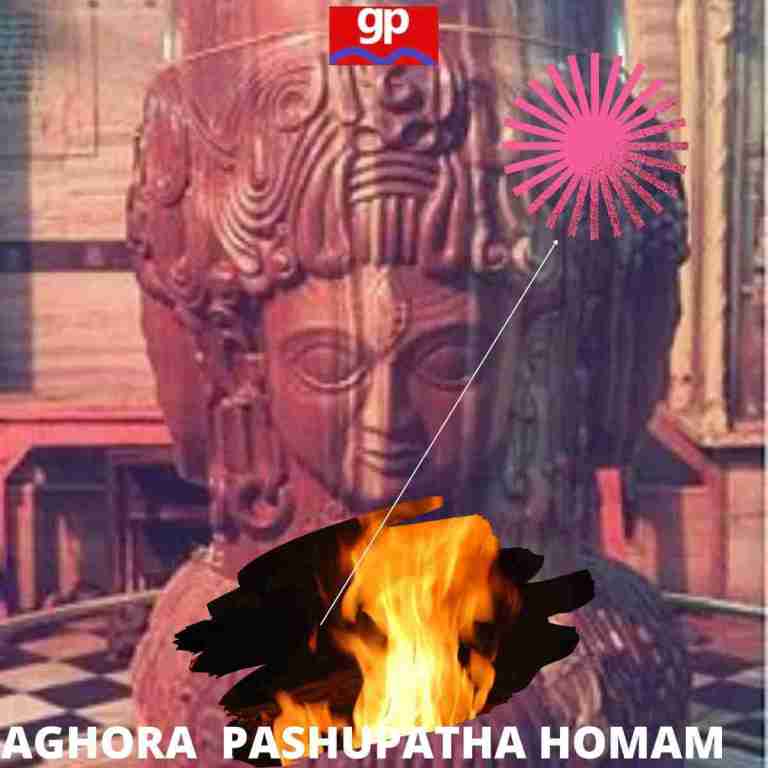
    From the top Bhairava,Natarajan, Thandan thottam,Near Kumbakonam.

    Dissolution of negative thoughts and fears, and increase of courage.

    Attainment of protection and success in life.

    In His fearsome form as Aghora Rudra, Lord Shiva destroys evil forces and offers His followers unbeatable protection. Additionally, Lord Aghora Rudra stands for fire energy, which transforms everything negative and cruel. According to legend, on Lord Krishna’s advice, Arjuna had prayed to Lord Shiva for the powerful sword known as Pashupatha or Pashupatastra during the Mahabharata’s battle of Kurukshetra. Lord Shiva was pleased with Arjuna and gave him the Pashupatha to assist him in defeating rivals and overcoming obstacles. Even though Arjuna did not deploy the Pashupatha, it is thought that Arjuna won the fight just by the nature of its presence. Performing the Aghora Pashupata Homam provides the participant with complete protection, protects the participant’s home and family, shows courage, health, and wealth, and aids in overcoming difficult circumstances, legal proceedings, and other issues. The Aghorastra Homam gains from protecting and eliminating the negative energy, even if the participant is unaware of the bad forces around them or if a hidden opponent harbors a malicious purpose.

    Agora Pasupatha Homam Benefits

    • Self-defense.
    • Reduce the number of barriers or hurdles.
    • development of positive energy to combat the negative aspects of society.
    • generation of positive energy in opposition to dark magic.
    • Both mental and physical stability.
    • eliminates the fear that comes from things, people, animals, machines, etc.

    Agora Pasupatha Homam, Timings, Benefits, and Procedure https://share.google/IO2qGcJGwyyvCc181

    To chant the Agora Pasupatha Homa mantra, follow these steps:

    Steps to Chant the Mantra

    1. Find a Sacred Space: Choose a clean and quiet place where you can focus without distractions. It’s preferable to have a sacred atmosphere.
    2. Prepare the Ritual Setup: If possible, set up a small altar with an image or idol of Lord Shiva, preferably in his Aghora form. You may also light a diya (oil lamp) and incense to create an auspicious environment.
    3. Purify Yourself: Take a bath and wear clean clothes. It’s traditional to wear white, but any clean attire is acceptable.
    4. Sit in a Comfortable Position: Sit in a cross-legged position (Padmasana or Sukhasana) on a mat or a comfortable surface, ensuring that your back is straight.
    5. Focus Your Mind: Take a few deep breaths to relax. Clear your mind of any distractions and concentrate on the purpose of your chanting.
    6. Chant the Mantra:
      • The primary mantra for the Aghora Pasupatha Homa is:
        ॐ पाशुपतये नमः
        (Om Pashupataye Namah)

      • Repeat the mantra with devotion and sincerity. It is recommended to chant it 108 times using a mala (prayer beads) to keep track.
    7. Visualize: While chanting, visualize the divine energy of Lord Aghora Rudra surrounding you and removing any negative energies or obstacles from your life.
    8. Conclude Your Chant: After finishing the chanting, spend a few moments in silence, thanking Lord Shiva for his blessings and expressing gratitude for the protection and guidance.

    Recommended Chanting Schedule

    • Daily Practice: Consistent daily chanting, particularly during the early morning hours (Brahma Muhurta), is believed to be highly effective.
    • During Auspicious Occasions: You can also chant during festivals related to Lord Shiva or on Mondays, which is considered sacred for Shiva worship.

    Note

    Maintain a focused intention and practice with sincerity, as the energy of the mantra is believed to manifest according to the devotion and concentration of the practitioner.

    Chant Agorebyo….chant and prefix it with each Namakam.

    Sree Rudram chanting is a revered Vedic hymn, primarily dedicated to Lord Shiva, known for its spiritual significance and powerful vibrations. This chant, found in the Krishna Yajurveda, consists of a series of invocations and praises, emphasizing the importance of Rudra, a fierce form of Shiva, as the embodiment of consciousness and the remover of obstacles. Devotees believe that regular chanting of Sree Rudram can lead to purification of the mind and soul, promote health, prosperity, and protection from negativity. The rhythmic recitation often includes specific intonations that enhance its mystical properties, making it a fundamental practice in various Hindu rituals and ceremonies.

    19,919,904 hits

  • ‘Uchchhishta Ganapathi Black Magic Vamachara Worship?

    ‘Uchchhishta Ganapti Worship is shrouded in mystery.
    Ganapati, meaning head of the Shiva Ganas which includes Nandi , Chandikeswara and Veerabhadra is traditionally worshiped as the embodiment of Pranava , OM.
    He is venerated in such a way there is an Upnishad dedicated to Him.
    Please read my article on this.
    There are 32 forms of Ganapati.
    One of them is Uchchishta Ganapati.
    This form of worship is believed to be a form of Vamachara(left handed worship), meaning Black magic worship)
    Description of the worship is provided in this article.
    This practice is attributed to Tantra Sastra.
    image

    My views.
    In Sanskrit Vama means ‘left’
    Shakti occupies the left portion of Shiva.
    The form of Shiva is Universe in Motion.
    Look at Nataraja.
    He represents Sruthi and Laya.
    Movement with harmony Uniformity(sruthi) and Rhythm(laya)
    Those who know music can tell you that sruthi and laya are described thus
    Sruthi Maatha(mother)
    Laya Pitha(Father)
    When these combine Uniform Motion is set.
    In Music , sound becomes Music.
    Now Devi occupies the left portion of Shiva.
    Shiva is Inert(Jata) Potential Energy.
    Shakti is Kinetic Energy , the Soul.
    One is ineffective without the other.
    Each complements the other.
    Kalidasa describes Shiva and Parvati as word and meaning.
    So does Abhirami Bhattar in Abhirami Andadhi.
    So the worship of Dynamic principle is Shakti Worship.
    Any God worshiped in this manner is Vamachara.
    That  belongs to Left, Devi.
    So the interpretation that the Uchchishta Ganapati is a Vamachara Worship is not sanctioned in the Sruthi.

    So are the rituals mentioned.
    The Mimamsa system of Hinduism gave undue and non sanctioned form of Rituals , so did the Vamacharins, that the Vedas declined because these wild practices and Buddhism came into being.
    It took the efforts of Adi Shankaracharya to cleanse the system and he established the Six Systems of Worship, Shanmatha.
    Please read my article on this.
    In South Ganapati is worshiped as a Brahmachari, save in some temples), while He is worshiped along with His two consorts in north India.
    The two consorts are Siddhi and Buddhi.
    Siddhi is Attainment and Buddhi is Discrimination.
    Ganesa is represented thus to convey that with the Grace of Ganesha one can direct Buddhi towards Self Realization and in the process attain Siddhi.
    So the Uchchishta Ganapati worship is not Vamachara or Black Magic.

    Uchchhishta Ganapati (Sanskrit: उच्छिष्ट-गणपति, Ucchiṣṭa Gaṇapati) is an Tantric aspect of the Hindu god Ganesha (Ganapati). He is the primary deity of the Uchchhishta Ganapatya sect, one of six major schools of the Ganapatyas. He is worshipped primarily by heterodoxvamachara rituals. He is depicted with a nude goddess, in an erotic iconography. He is one of the thirty-two forms of Ganesha, frequently mentioned in devotional literature. Herambasuta was one of the exponents of the Uchichhishta Ganapatya sect.


    Uchchhishta (“leftovers”). The word refers to the food left over at the end of a ritual, but in this context refers to its Tantric connotation. Uchchhishta is the food kept in the mouth, which is contaminated with saliva, thus ritually impure and a taboo in Hinduism


    he elephant-headed god is described to be reddish in colour in the Mantra-maharnava, while mentioned as dark in the Uttara-kamikagama.[2] Another description describes him to be blue in complexion.[3] The deity is described to have four or six arms. He is described to be seated, sometimes specifically noted in on padmasana (a lotus pedestal). TheUttara-kamikagama elaborates that he wears a ratna mukuta (jewelled crown) and has a third eye on his forehead.

    The Kriyakramadyoti mentions that the god carries in his six hands: a lotus (in some descriptions, a blue lotus),a pomegranate, the veena, an akshamala (rosary) and a rice sprig. As per the Mantra-maharnava, he carries a bana (arrow), a dhanus (bow), a pasha (noose) and an ankusha (elephant goad).The Uttara-kamikagama says that the god has four arms and holds a pasha, an ankusha and a sugarcane in three hands.

    Uchchhishta Ganapati,Nageswaraswamy Temple, Kumbakonam. The deities touch each other’s genitalia.

    Rao classifies Uchchhishta Ganapati as one of the five Shakti-Ganesha icons, where Ganesha is depicted with a shakti, that is, a female consort. The large figure of Ganesha is accompanied with smaller figure of the consort. The nude devi (goddess) sits on his left lap. She has two arms and wears various ornaments. In the Uttara-kamikagama, she is called Vighneshvari and is prescribed to be sculpted as a beautiful, young maiden. The fourth hand of Uchchhishta Ganapati touches the genitalia of the naked goddess. The Mantra-maharnava prescribes that the god should be depicted as though he is trying to have intercourse.

    The textual descriptions generally do not correspond to the sculptures of the deity. Uchchhishta Ganapati is always shown with a naked consort, who is seated on his left lap. The god is generally depicted with four arms and holds a pasha, an ankusha and a ladoo or amodak (a sweet), while the fourth arm hugs the nude goddess around her hip. She holds a lotus or another flower in the left hand.Instead of his hands, the tip of his elephant trunk touches the yoni (vagina) of the goddess. Occasionally, the goddess touches the lingam(phallus) of the god with her right hand. The god is depicted ithyphallic in the later icon. Such erotic imagery is restricted to his four-armed form..

    Cohen notes that many Ganesha icons are depicted with a shakti, seated on his left hip. She holds a plate of modaks in her lap and the god’s trunk reaches into it, to fetch the sweet. The trunk is taken as a symbolic of an “erotic bond” between Ganesha and the goddess. The Uchchhishta Ganapati takes the idea a step further, by eliminating the bowl of sweets and allowing the trunk to reach the goddess’ yoni. This erotic iconography reflects the influence of the Tantric Ganapatya (the sect that considered Ganesha as the Supreme Being) sects. The pomegranate is also a symbol of fertility, often represented in the icons of the sects.

    As per the Kriyakramadyoti, Uchchhishta Ganapati is worshipped as a giver of great boons. Rao notes that he is worshipped by “many” to gain the desired from the deity.[2] He is also regarded as the guardian of the country. Mediating over his form is said to impart control over the five sensory organs. A temple dedicated to Uchchhishta Ganapati exists in Tirunelveli, where he is worshipped as a giver of progeny.

    Uchchhishta Ganapati is the patron of the Uchchhishta Ganapatya sect, one of the six major schools of the Ganapatya sect. They follow Tantric Vamachara (“left-handed”) practices. The sect may have been influenced by the Kaula worship of Shaktism (Goddess-oriented sect).The iconography of the deity bears Kaula Tantric character. The erotic iconography is interpreted to convey the oneness of Ganesha and Devi (“The Hindu Divine Mother”). The sect also worships a Ganesha, who is depicted drinking wine and also its use in worship, a taboo in classical Hinduism .. Adherents of this sect wear red marks on their foreheads.This sect does not believe in caste and varna distinctions, disregards the orthodox Hindu rules of sexual intercourse and marriage and leaves the adherence of traditional Hindu rituals to the follower’s own will.

    As per Vamachara practices, the deity is worshipped when the devotee is in the Uchchhishta (“ritually impure”) state, that is, nude or with remnants of food (Uchchhishta) in his mouth.

    Uchchhishta Ganapati is also associated with six rituals of abhichara (uses of spells for malevolent purposes) by which the adept can cause the target to suffer delusions, be overcome with irresistible attraction or envy, or to be enslaved, paralysed or killed.[12]

    The Kanchi Ganesh shrine within the Jagannath Temple, Puri houses the icon of Uchchhishta Ganapati, also called Bhanda Ganapati and Kamada Ganapati, which was originally the patron icon of Kanchipuram (Kanchi), but was brought to Puri as war booty when the Gajapati king Purushottama Deva (1470–97) of Puri defeated Kanchi’

    Citation and reference.

    https://en.wikipedia.org/wiki/Uchchhishta_Ganapati


  • Coconut Arrested Disturbing Elections

    Coconut arrested in Maldives.
    A coconut sits on the beach in this undated Getty file photo. Authorities in the Maldives recently arrested a coconut on suspicion of it having tampered with the presidential election there.

    There have been instances of bizarre law Enforcement.

    We had a Goat being arrested for escaping the Police  turning a Goat from being Man ,a Bird arrested in the Middle East on charges of spying, Summons issued to Lord Rama in India on the Babar Masjid case.

    Read al this under ‘interesting and Funny’

    Now add this to your collection.

    Police in the Maldives have detained a young, husky and possibly cursed suspect for potentially rigging the vote in a critical election. So far, a police interrogation has revealed only one thing: The suspect is a hard nut to crack.

    That’s because the perp is a coconut.

    Minivan News, a Maldives newspaper, reports a young coconut was taken into custody Tuesday after police received reports that the suspicious fruit was loitering near the Guraidhoo Island School, a polling station to be used in the Sept. 7 presidential election.

    Islanders fear the coconut may have been associated with black magic or been imbued with a spell to influence the election.

    “The four-inch coconut had a ‘Sura‘ [Quranic verse] written in Arabic and was lying on the ground near the school, easy for the public to see,” a source with knowledge of the incident told Minivan News. Authorities brought in a “ruqyah,” or benevolent magician, who determined the coconut was fake and therefore posed no threat.

    Black magic and sorcery are often accused of having undue influence on the island nation. In July, school administrators refused to let elections officials place a ballot box in the building, fearing it would attract black magic and make students ill. CNM News reports that the school assented only after the government agreed to be responsible for anyone who was “struck by a spell or [fell] ill.”

    Source:

    http://www.huffingtonpost.com/2013/09/06/police-arrest-coconut-maldives-presidential-election_n_3880700.html?utm_hp_ref=weird-news

  • New York Voodoo Temple- Possessed Spirits.

    Photographer Shannon Taggart‘s lifelong fascination with the mysterious Haitian religion of voodoo has taken her to a basement apartment in Brooklyn, where she came face to face with people being possessed by mysterious spirits.

    What resulted from Taggart’s experience inside the Flatbush temple run by female priest known as Mambo Rose Marie Pierre is a series of captivating photos called Basement Voodoo, which show the members of her small congregation being taken over by the Loa – powerful spirits that mediate between humans and the voodoo deity, Bondye.

    Communicating with the Loa requires elaborate preparations specific to each spirit. While some of the Loa are harmless, others are considered wicked or belligerent.

    In order to call on any given spirit, a voodoo practitioner has to draw a symbol associated with that particular Loa in cornmeal on the floor, Time LightBox reported.

    This slideshow requires JavaScript.


     http://www.dailymail.co.uk/news/article-2213796/Shannon-Taggart-Machetes-trances-wild-dances-Fascinating-photos-shed-light-VOODOO-rituals.html#ixzz28awdtK7S 

    Enhanced by Zemanta