Tag: Advaita

  • Why Many Gods In Hinduism

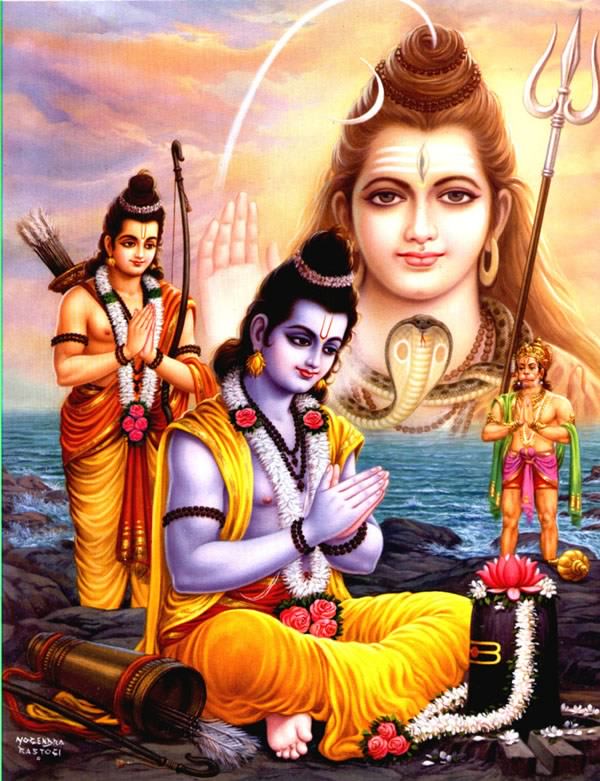
    I often encounter questions on Sanatana Dharma, called Hinduism, as to why there are many Gods in it and one is confused by this.

    Also  while the other Religions talk of Only One God, why is it that Hinduism talks of many Gods?

    I have been receiving a lot of queries on this and I am quoting one.

    Vishnu as kaala Purusha.jpg
    Lord Vishnu as Kaala Purusha

    “Usually, we all say God is one but in Hindu Dharma we have Brahma, Vishnu and Shiva for Creation, Preservation and Destroy. Why it is so? Why other religion is praying and naming one God. Can you please explain”

    As to other Religions , Christianity, Islam, they talk of God in an Impersonal way.

    Christianity talks of God as The Father and there are no descriptions or attributes except the generalities like All merciful and one who would condone your sins if you repent your sins through His Agent, Jesus Christ.

    Hinduism does not believe in Agents nor does it absolve you from the results of your actions, simply because you repent.

    One has to face the consequences of his actions, this includes the Avatars of Gods as well.

    Godhood is a Principle, Impersonal and Laws doe not distinguish between people.

    In Islam the same generalities.

    God is One who lays down the Rules,he punishes you if you do not follow Islam!.

    Hinduism is different.

    It knows Religion is an experience and it can not be dictated by Logic alone, even if the Logic is impeccable.

    The Truth, according to Hinduism, is One.

    It is called Brahman, The Reality.( This is different from Brahma , the Creator).

    This Brahman is without Attributes, it is a Principle , just as Gravity is.

    But it is difficult to know it through the Mind.

    Just as we can not know Gravity, we think we know Gravity, but what we really know is because of the feeling of Gravity.

    The scientific explanation is only an expression born out  of the feelings of Gravity.

    Imagine that we do not feel Gravity.

    Would we have tried to form  a Theory on Gravity?

    So even if the Reality is an abstract principle,it has to be made understandable to be of use to us.

    Hence even though the Reality Brahman is the Truth,Hinduism devised ways to reach/realize it.

    The Truth, The Brahman, the Reality is Knowable, to Be Known.

    That is the Truth.

    This knowledge about Brahman is called ‘Apara Vidya'( beyond this world of names and forms)

    The knowledge about Brahman and its attributes are called Apara Vidya.

    The general descriptions of Brahman  are Sat, the State of Being, Chit(Consciousness) and Ananda(Bliss)

    Apart from this, the Upanishads,a part of The Vedas, the scriptures of Hindus, try to explain the qualities of Brahman by excluding the attributes normally known to us stating that the Brahman is Beyond all this and also this.

    For example the Upanishads,describe Brahman as,

    ‘Neither Tall nor Short, nor of medium height,

    Neither Male, Female,nor transgender ,

    Neither the Knower nor the Known,

    Yet It is All of These’

    You would find this is difficult to comprehend even at the intellectual level.

    Knowledge, if it can not be understood or used is useless.

    Therefore Hinduism devised a way.

    If we have to Know, it must be easy for us to follow.

    The instrument to know is the Mind.

    The instrument to feel is the Heart.

    For those who want to have a glimpse , Hinduism provides  Gnana Yoga and Raja Yoga.

    Raja Yoga is the path of Yoga being practiced by many.

    Here one prepares the mind to understand Reality.

    Gnana Yoga prepares one to discern the Reality by developing Vairaagya, the discerning capacity to distinguish between practical knowledge,Para Vidya and the Apara Vidya.

    There are two more methods.

    Bhakti yoga, the path of Loving God.

    The other one is karma Yoga, the Path of Action.

    For loving God, one needs an object to concentrate for the Mind , to enable the Heart to feel it.

    So Gods have been named In Hinduism.

    It is difficult for the Humans to empathize with qualities which are not known to them.

    The emotional connect is strong in the case relationships.

    Father, Mother, Children, Wife, Children and relatives.

    And if one attributes Reality/God with the qualities of Humans , it is easy for the Humans to understand.

    So the Gods of Hinduism are attributed with Human qualities.

    Then why many Gods?

    Some love Mother, some Father, some Lover, some friends, some a master.

    God, in Hinduism, is portrayed with all these qualities.

    This makes it easy for Humans to relate to God than being asked to relate to an Impersonal God.

    Once people start this step, over a period time, they will be able to feel the Impersonal God and the concept of god with Attributes withers away.

    This first step is like LKG, while understanding, feeling Reality is like Phd..

    After reaching Phd, the LKG would seem to be of no use.

    But without that one could not have reached Phd.

    At another level, there are principles that represent the Physical world.

    Thus we have Brahma who represents the Potential energy, Vishnu, the Kinetic energy, and Shiva, the Potentio-Kinetic Energy.

    Similarly all the Gods present the Principles of Nature as well.

    Yet the fact that the Gods Rama ,Krishna, Shiva , Subrahmanya existed, as proved by Historical and astronomical Data, there is an unexplored area.

    In short, Hinduism talks of not only Monotheism but Monism as The Truth but devised a way to understand them by Gods with attributes..

    Kindly read my post Gods Hinduism, with name and form, Yes and No.

    Another point is that even thought Gods with Names and Forms are only a tool to understand Brahman, these Gods, when prayed deliver results, as Lord Krishna explains in the Bhagavad Gita.

    ‘What ever Form you worship, I deliver you the results in the form you worship”

    ( This is not a literal translation)

  • Mantrika Upanishad Essence of Vedas Advaita

    The Mantrika Upanishad appears in the Atharva Veda.


    Full of symbolism ans an integrated approach to all the Three Vedas ,a clear exposition of Advaita and Maya can be found in this Upanishad.


    I shall be posting an article explaining the concept.


    Lord Subrahmanya.jpg
    Lord Subrahmanya.


    Translation.


    Om ! That (Brahman) is infinite, and this (universe) is infinite.

    The infinite proceeds from the infinite.

    (Then) taking the infinitude of the infinite (universe),

    It remains as the infinite (Brahman) alone.

    Om ! Let there be Peace in me !

    Let there be Peace in my environment !

    Let there be Peace in the forces that act on me !

    1. The eight-footed immaculate Swan, bound with three cords, subtle and imperishable, to whom three ways lead, I see not though I see it everywhere.

    2. At the time all living beings are confounded (in the darkness of nescience) when (however) the pileless darkness is shattered (by the sun of saving knowledge). The sages established in Sattva behold the Absolute beyond Gunaa (right) in the sphere of gunas.

    3 (a). Contemplated by sages like Kumara, etc.; the Absolute is not otherwise capable of being perceived (at all).

    3(b)-4. The agent of superimposition the Unborn (Maya), the nescient eight-fold inveterate mother of modifications; thus it is extended and again prodded. The world under such power and guidance gives rise to the values of man.

    5. The Lord’s mighty Maya, having both a beginning and end, the creatrix, brings beings into existence; white, black and red (She) fulfils all desires.

    6. (The ignorant) experiences this non-objective Maya (whose real nature is) unknown (even) to sages like Kumara. The Lord alone freely following (Her) enjoys Maya (as Her Lord and Companion).

    7. He enjoys (Her) through both contemplation and action. He, the omnipresent one, sustains (Her) who is common to one and all, the yielder (of desired objects) and is enjoyed by the sacrificers.

    8. The magnanimous (sages) behold in (the sphere of) Maya the bird eating the fruits (of Karmas). The priests who have completed their Vedic training have declared the Other to be detached.

    9. The masters of the Rig-Veda, well-versed in the Shastras repeat what the Yajur-Vedins have declared. The adepts in Sama-Veda singing Brhatsama and Rathantara also (reaffirm this truth).

    10. (Vedic) sages like Bhrigu and the Bhargavas – these followers of the Atharva-Veda, practising the Veda, the mantras and the secret doctrines, in the sequence on Words, (all set forth the same doctrine).

    11-13. The faithful co-disciple, firm and accomplished, the red Bull, the sacrificial Remainder – as all these, in regard to Its immensity; and as Time, Life, the divine wrath, the Destroyer, the great Lord, the Becoming, Rudra, the Protector of Jivas, the Rewarder of the virtuous, the Lord of living beings, the Virat, the sustainer and the Waters (of life), is the all-Pervader lauded by beings magnified in the mantras and well-known to the Atharva-Veda.

    14. Some aver Him (the great Lord) as the twenty sixth (Principle); others as the twenty seventh; the masters of the Atharva-Veda and the Atharva Upanishads know the Spirits beyond qualities, as set forth in the Sankhya.

    15. The manifest and the unmanifest have been counted (together) as twenty four. (Some) declare Him non-dual; as dual; as three-fold; and similarly as five-fold.

    16. Those who see with the eye of wisdom, the twice-born, perceive Him as comprising everything from Brahma to sticks, as one only, pure through and through, all pervading.

    17. That in which this might manifold, moving and unmoving, is woven – in that very thing it also merges as the rivers do in the sea.

    18. In That in which the objects are dissolved, and, having been dissolved, become unmanifest, once more they attain manifestation; they are again born like bubbles.

    19. They come into being by virtue of causes supervised by individual selves that know ‘the field’. Such is the blessed Lord, so others repeatedly, declare.

    20. Those Brahmanas who (just) know Brahman – here only they are dissolved; and being dissolved they exist in the Avyakta. Having been dissolved they exist in the Avyakta – this is the secret doctrine.

    Om ! That (Brahman) is infinite, and this (universe) is infinite.

    The infinite proceeds from the infinite.

    (Then) taking the infinitude of the infinite (universe),

    It remains as the infinite (Brahman) alone.

    Om ! Let there be Peace in me !

    Let there be Peace in my environment !

    Let there be Peace in the forces that act on me !

    Om Shanti ! Shanti ! Shanti !
    Here ends the Mantrika Upanishad, as contained in the Shukla Paksha Yajur-Veda.


    Translated by A.G.Krishna Warrier, Published by The Theosophical Society of India.

    Citation.

    http://www.vedarahasya.net/mantrika.htm


  • Adi Shankaracharya Horoscope


    There is controversy over the Birth date of Adi Shankaracharya.


    While some date it BC other date it AD, corresponding to middle ages.


    Sharada Peeth (Sarvajnapeetha) temple, now in Pakistan-administered Kashmir.Image.jpg
    Sharada Peeth (Sarvajnapeetha) temple, now in Pakistan-administered Kashmir.


    I shall be posting a detailed article on this.


    Meanwhile based on Madhvacharya‘s Sankara Vijayas Anandagiri’s Chidvilasa, Punyasloka Manjari and  the Guru Parampara (succession of different

    persons who acted as the head preceptors of Sankara Mutts) list preserved in the Sringeri Kanchi Kamakoti Sankara Mutt, the date of birth of Adi

    Shankaracharya was fixed by the venerable astrologer Sri B.V.Raman.


    This is the Horoscope of Adi Shankaracharya.


    Adi Sankara was born on Vaisakha Suddha Panchami, at noon:


    Sukla paksheshu, panchamyaam, thithayaam, Bhaskara vasave; Madhyahnecho abhijinnama muhurhta, subha-veekshithae.


    Sankara Vijayam .


    Date of birth : March – 25 – 044 before Christ; Time : Mid-noon. Place : Kaladi (Kerala);Longitude = 76*–59” East and Latitude = 8*–29’ North.Ayanamsa = 6*–09’ .

    Lagna Sun Moon Mars Mercury Jupiter Venus Saturn Rahu Ketu
    99*22’ 8*12’ 69*12’ 332*36’ 24*06’ 303*36’ 03*-0


    Planetary Positions.


    Mars

    -9-

    Sun

    Mercury

    Venus

    Rahu

    -11-

    Moon

    -12-

    Jupiter Raasi Lagna
    -7- Leo
    Saturn Ketu Libra -3-
    Pisces Venus

    Rahu

    Taurus Sun
    Nava Amsa Mars
    Leo
    Moon Saturn

    Mercury

    Jupiter

    Ketu

    Libra

    Lagna

    Virgo

    Citation.


    http://jyothishi-pandit.blogspot.in/2010/05/horoscope-analysis-of-bhagavan-adi.html


  • No Advaita Visishtadvaita in Vedas Why

    If one studies, not merely reads, the Veda, one will know that there is no specific school of thought or ‘ism’


    One will find worship of nature in its Glory, starting from Water,(Mantra Pushpam),Fire (Agni Suktham,Rige Veda),Earth(Bhoomi Suktham)


    Vedas.Image,jpg.
    Vedas. Image source. http://www.trinetra.org.uk/#/vedas-what-are-they/4561706759


    On Time, Rathri Suktham,Kala Suktham,Ushas Suktham,


    On individual forces of nature, Surya Suktham,


    On Values, Samanasasya Suktham.


    On Gods,


    Vishnu Suktham,


    Sree Suktham,


    Durga Suktham.


    On the  world and on Monotheistic approach,


    Purusha Suktham,


    Narayana Sukham


    There is no specific system of worship or specific God promote as it were.


    Why?


    Hinduism is not founded by any one.


    Vedas express Truth as experienced by the Rishis and the Manta grasped by them from the Ether.


    As Lord Krishna puts it in the Bhagavad Gita, Reality or God reveals itself according to the disposition of the worshiper.


    Reality however remains One,.


    So on a cursory reading of the Vedas might give the impression that there are many Gods in mentioned in the Vedas.


    As experiencing Godhead is intimately personal, Vedas knew that thee is no Universal Solution to the seeker.


    One realizes God hood by His self enquiry and this depends on his tendencies or Vasanas,


    So, much like a Super market, Vedas contain what ever that has been grasped for selection by the Individual.


    That’s all.


    That is the reason why do not promote one God.


    Then why is it in the Veda Mantras on finds that Vishnu is the first God, in  NarayanaSuktham, Vishnu Suktham, Shiva in Sri Rudram, Lakshmi in Sree

    Suktham and Durga in Durga Suktham?


    In philosophy it is called ‘Henotheiism’- the practice of praising one God to the exclusion of the others.


    This has a Psychological element built into it,


    You will not agree that what you do or follow is not the best among the available.


    This reinforces faith and helps you spiritually.


    Similarly there is no specific leaning towards Advaita,Visishtadvaita or Dwaita as such in the Vedas.


    This is has come into being only after the commentators and the three Great Acharyas, Sankaracharya, Ramanuja and Madhwa,


    They did not say anything new or what is not said in the Vedas.


    Each interpreted the Mahavakyas of the Vedas from their stand point.


    And they found supporting arguments for their approach from the Vedas.


    Vedas , being an Ocean, it would provide you source for your approach.


    Therein lies its greatness,


    One more point one must bear in mind the time when these Achayas founded their Doctrines.


    Sankararacharaya came after Buddha, whose Buddhism promoted Nihilism or Sunya Vada.


    It is not practical to restore the Vedas with so many Gods as it were,for one without understanding, to have faith in the Vedas.


    From one Sankara said not Two Advaita, it is easy for one who had been saying that there is nothing to believe that there not two, Advaita


    Then came Ramanuja who established Qualified Non Dualism,not Dualism, Visishta Adavaita.


    Then Madhwa came along and founded Dwaita, Dualism.


    In essence there is no difference as far as the origin of these systems go.


    The difference lies in interpretations.


    Anticipating some bigots of Hinduism , there are slokas of Shiva by Vishnu and By Shiv of Vishnu.


    Read my post on these.


    Only those who do not understand the Vedas and Indian Philosophy would promote either Shaivisma or Vaishnavism.


    Ekam Sat, Vipra Bahuta Vadanti’


    The Truth is One,.


    The learned, Vipra(this is actually a dig at the so-called Scholars, Krishna uses this term and Pandita in the same sense in the Bhagavad Gita)


    Say It is many.


    Sivoham.


    Krishnarappnamasthu.


    Enhanced by Zemanta
  • Bells Theorem Hinduism Quantum Mechanics


    Hinduism states that things are not what they seem.


    Advaita interpretation of the Vedas say that what you see or perceive is because of your ignorance of Reality.


    The Reality is One and you are not different from it.


    You are conditioned by ignorance and your limitations which includes Space and Time , where as the Reality is beyond both of the


    Vaisheshika Theory of Atoms  says it differently.


    Atoms are configured in various permutations and combinations to present a view of different objects, that is the objects are differ because of the


    different structure of the Atoms constituting objects.


    Let us look this from practical Life.


    What you perceive is dependent on where you are , what you are and what your mental attitude is.


    For the same set of Object, each of us have a different perception.


    And the Attributes through which we recognize them  are, when they are broken down mean nothing.


    For example, the Attributes of a Rose.


    A rose is known by its smell, color,climates in which they are grown are some of the Attributes we have for a Rose.


    If you analyze these Attributes, you shall find they lead to nothing as such to recognize Rose as a Rose.


    The Rose we recognize is some thing more than the Attributes we ascribe.


    Even with out these Attributes we recognize a Rose.


    For more on this, please read my Posts on Perception, Do we see what we really see.


    Another example.


    We are familiar with Ultra Slow Motion cameras used in Cricket Matches.


    Umpires use this to determine to take decisions on the field.


    What is seen cleanly as ‘out’  is ‘not out’, when you refer these slow motion replays.


    Which fact that is presented is correct?


    Both are correct .


    It depends on the conditions and the perspective.


    This is what Hinduism has said about Five Thousand years ago.


    Quantum Theory is now nearing it, n , but not quite.


    Bells Theorem  proves that Quantum Mechanics can not explain all the events by their theory alone.


    Exactly what the Vedas say.


    I am providing some Links and excerpts to refer.


    Hinduism and Bell's Theory.
    Static Universe bell’s Theory


    No physical theory of local hidden variables can ever reproduce all of the predictions of quantum mechanics”


     There are variants of the Theorem with different meanings of “Local Realistic.” In John S. Bell‘s pioneering paper of 1964 the realism consisted in postulating in addition to the quantum state a “complete state”, which determines the results of measurements on the system, either by assigning a value to the measured quantity that is revealed by the measurement regardless of the details of the measurement procedure, or by enabling the system to elicit a definite response whenever it is measured, but a response which may depend on the macroscopic features of the experimental arrangement or even on the complete state of the system together with that arrangement. Locality is a condition on composite systems with spatially separated constituents, requiring an operator which is the product of operators associated with the individual constituents to be assigned a value which is the product of the values assigned to the factors, and requiring the value assigned to an operator associated with an individual constituent to be independent of what is measured on any other constituent. From his assumptions Bell proved an inequality (the prototype of “Bell’s Inequality”) which is violated by the Quantum Mechanical predictions made from an entangled state of the composite system. In other variants the complete state assigns probabilities to the possible results of measurements of the operators rather than determining which result will be obtained, and nevertheless inequalities are derivable; and still other variants dispense with inequalities. The incompatibility of Local Realistic Theories with Quantum Mechanics permits adjudication by experiments, some of which are described here. Most of the dozens of experiments performed so far have favored Quantum Mechanics, but not decisively because of the “detection loophole” or the “communication loophole.”


    Let me put it from a common example.


    All of us take decisions based on Available Data.


    We do not have all the choices to enable us to decide on an issue.


    We take decisions based on the Data, Information that is made available to us and we decide.


    This means the decisions we make are made on the basis of information available or made to be available to us and not All the Information.


    Hence our decisions, based on Choices are not fully correct as they have been preset with the limitations of the Choices being made available to us.


    Please read my post on Choice.


    “If the statistical predictions of quantum theory are true, an objective universe is incompatible with the law of local causes.”

    Although formidable at first glance, Bell’s Theorem seems simpler once key terms are understood.

    First, an “objective universe” is simply one that exists apart from our consciousness.

    In 1935, Albert Einstein, together with Nathan Rosen and Boris Podolsky proposed through flawless mathematical reasoning that if the quantum theory were correct, then ‘A change in the spin of one particle in a two particle system would affect its twin simultaneously, even if the two had been widely separated in the meantime’. And ‘simultaneous’ is a dirty word in the theory of special relativity, which forbids the transmission of any signal faster than the speed of light. Obviously, a signal telling the particle ‘what to do’ would have to travel faster than the speed of light if instantaneous changes were to occur between the two particles.

    The dilemma into which Einstein, Rosen and Podolsky dragged the quantum theory was a profound one, coming to be known as The ERP Effect.

    In 1964 Bell’s Theorem emerged as a proof that Einstein’s impossible proposition did in fact hold true: instantaneous changes in widely separated systems did occur.

    In 1972, Clauser confirmed the statistical predictions of quantum mechanics, working with an elaborate system involving photons, calcite crystals, and photo multiplier tubes The experiment has since been run several times with the same consistent results; Bell’s Theorem stands solid.

    The implications of Bell’s theorem
    are practically unthinkable

    Even for the physicists involved, the implications of Bell’s Theorem are practically unthinkable. Mathematics and experimentation have taken us where our logical mind cannot go. Imagine, two particles once in contact, separated even to the ends of the universe, change instantaneously when a change in one of them occurs!

    Slowly, new ideas are emerging to explain these unthinkable occurrences. One view is that, in some unexplainable way, the separated particles are still in contact although separated in space. This is the suggestion of the French physicist Bernard D’Espagnat. In 1979, writing about quantum reality, he said that “the entire notion of an external, fixed, objective world now lies in conflict not only with quantum theory, but in facts drawn from actual experiments…. in some sense all these objects constitute an indivisible whole.”

    Physicist Jack Sarfatti of the Physics/Consciousness Research Group proposes that no actual energy-requiring signal is transmitted between the distant objects, but ‘information’ is transmitted instead. Thus no violation of Einstein’s special theory of relativity occurs. Exactly what this information is is unclear, and it is a strange thing which might travel instantly and require no energy to do so.

    Nic Herbert, a physicist who heads the C-Life Institute, suggests that we have merely discovered an elemental oneness of the world. This oneness cannot be diminished by spatial separation. An invisible wholeness unites the objects that are given birth in the universe, and it is this wholeness that we have stumbled into through modern experimental methods. Herbert alludes to the words of the poet Charles Williams: “Separation without separateness, reality without rift.”


    Citation.


    Bell’s Theorem Stanford


    Hinduism and Bell’s Theory


    Bell’s Theorem   Wiki


    Enhanced by Zemanta