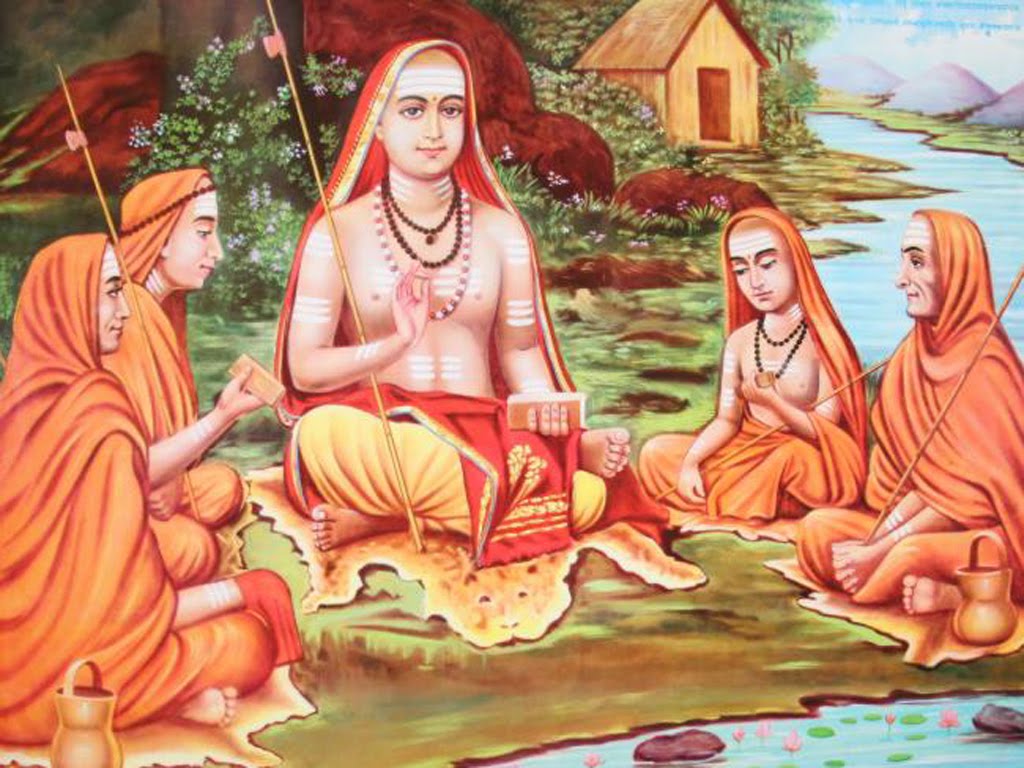
Tag: Advaita

  • Shankaracharya ‘Demon’, Madhwa Text. Sringeri Acharya on Advaita

    Shankaracharya ‘Demon’, Madhwa Text. Sringeri Acharya on Advaita

    I regret that I have to write on this. When people fail to understand the interpretation of Mahavakyas, result is Bigotry. I was barred from Madhwa FB group because I shared Siva Stuthi by Krishna. Unless people read All the Acharyas and understand Vedas, there is no point in professing Spiritually.I am by faith an Advaitin, deeply involved in Sri Vaishnavam,Andal occupies the centre spot in my Pooja room and I worship Sri. Raghavendra,despite some people suggesting that he spoke ill of my Acharya Adi Shankaracharya . As I follow Adi Shankaracharya,who propagated Ekam Sath and Abheda Vada, I do not hold any ill will towards other Acharyas.

    https://ramanisblog-in.cdn.ampproject.org/v/s/ramanisblog.in/2014/05/14/krishna-worships-shiva-stuthi-krishnas-caution/amp/?amp_gsa=1&amp_js_v=a6&usqp=mq331AQKKAFQArABIIACAw%3D%3D#amp_tf=From%20%251%24s&aoh=16412791917768&referrer=https%3A%2F%2Fwww.google.com&ampshare=https%3A%2F%2Framanisblog.in%2F2014%2F05%2F14%2Fkrishna-worships-shiva-stuthi-krishnas-caution%2F

    Harihara . Siva and Vishnu in one Form.

    https://ramanisblog-in.cdn.ampproject.org/v/s/ramanisblog.in/2014/05/14/shiva-worships-vishnu-kapaalikrit-vishnu-stuthi/amp/?amp_gsa=1&amp_js_v=a6&usqp=mq331AQKKAFQArABIIACAw%3D%3D#amp_tf=From%20%251%24s&aoh=16412793118265&referrer=https%3A%2F%2Fwww.google.com&ampshare=https%3A%2F%2Framanisblog.in%2F2014%2F05%2F14%2Fshiva-worships-vishnu-kapaalikrit-vishnu-stuthi%2F

    https://www.facebook.com/sathasiva.sriram/videos/1323019394544723/

    Sringeri Jagadguru on Advaita and Dwaita.
    On Siva and Vishnu.

    The text maNi manjari is a very important text for the Madhwas as it is written by nArAyana panDitAcharya who was son of Trivikrama panditacharya, a direct disciple of Madhwa himself. He is also the author of authentic biography of madhwa called Sumadhwavijaya.

    The views given below are for Sankara, his lineage, his philosophy as well as his disciples like padmapAda.

    Chapter 6

    Kali and other demons (the enemies of Devatas) were very happy to hear the plan of Dvpara (formerely Sakuni) and honoured Maniman with zeal and spoke to him thus.

    ‘O brother, salutations to you; take birth on earth and destroy the Vedas, puranas and other scriptures completely soon’.

    Being inspired or ordered in this way by Kali, Dvapara and other demons, Maniman made up his mind to be born on earth although he had fear of Bhimasena.

    When the mind is spoiled, some people will be fickle minded and they will readily accept our Mithyavada philosophy; those not influenced by us, will neglect it; and only some people will try to refute the theory.

    After studying the Vedas, he went on a journey in the northern direction and while he was crossing the river, he (Sankara) lost his sacred thread – Yajnopavita – but he continued his journey.

    Sankara said – ‘O, Sacred cord, you are leaving me; note that I have forsaken you earlier; of what use are you to me; who does not perform Vedic karmas (actions)’ So saying, he went away quickly.

    The highly learned sage, Paratirtha observed the demonic signs on the bachelor without sutra (sacred cord) and bent his head in disgust, and went away after sipping water thrice as penance for having seen such a wicked persons. …

    Sankara made out that the sage was aware of the demonic features in him, and hence he went to Badari after crossing river Godavari (Vrdha Ganga). There, he met a disciple of Paratirtha, by name Satyaprajnya) and told as follows:

    ‘I am the disciple of your master (Paratirtha) and I have come here on his permission’, but he did not trust his words.

    Satyaprajna found out at once that the bachelor was vile, devoid of all good qualities like devotion, detachment from worldly passions and in utter disgust, he abandoned him.

    Having experience in his previous birth (as Maniman) and due to strong memory in this birth, Sankara meditated on Brahman as attributeless and with identity of souls (which amounts to Sunya tattva of Buddhism).

    Once, the demons (Dvapara and others) approached him during a night and respected him and said ‘Sankaracharya, you are our solace’.

    ‘O pure minded padatalotyaja (ie. A person born in Kaladi village) we wish you happiness and prosperity. We think of you in full confidence, as our agent in our task of destroying the Vedas’.

    ‘We will enter the minds of the astikas (who have belief in Veda in form and make them helpful to you and love you. You start assassination the character of Vishnu by citing Vedas of wrong interpretation). So saying the demons went away. (Thus the teachings of Asuras from Stanza 24 to 39).

    Govinda Bhatta readily accepted him as his disciple. Sankara told him ‘We shall preach Sunyavada (Buddhism) in the guise of Vedanta or otherwise, the people will abuse us as Non Vaidikas. As such, I will study Brahmasutras under Brahmadatta (a sannyasi) to know the meaning and significance of the same’.

    The deceitful Sankara spread Buddhism only in the garb of Brahmasutras; he substituted the words ‘Sunya‘ and ‘Samvriti‘ (of Buddhism) respectively by words ‘Brahma’ and ‘avidya‘ (of Vedanta), the characteristics being the same.

    Five wicked persons by name Totaka, Padmapada, Jnanothama, Bijada became disciples of the deceit Sankara.

    Notes: They were wicked because they destroyed the minds of even the saintly persons by their perverted teachings.

    When his death was approaching, Sankara was suffering from veneral diseases, fever and deep breath. His voice became very feeble.

    The deceitful disciples, who were the enemies of Vedas, went to their dying master hastily and asked ‘revered master, what we have to do now?’

    Sankara told them ‘O Great Demons, I have almost done my duty; but the disciples of the Great Paratirtha have to be destroyed.’

    So saying to the Great Demons, who were capable of executing the instructions, Sankara called four other intelligent demons and told the following:

    ‘You go to Beejada and ask him what are the difficulties and sorrows I have to face in my future births’. They went in all the ten directions and came back to him.https://hinduism.stackexchange.com/questions/28629/do-followers-of-dvaita-really-believe-that-advaitins-are-deceitful-demons

    https://ramanisblog-in.cdn.ampproject.org/v/s/ramanisblog.in/2014/05/15/shankaracharya-intellectual-giant-complete-works/amp/?amp_gsa=1&amp_js_v=a6&usqp=mq331AQKKAFQArABIIACAw%3D%3D#amp_tf=From%20%251%24s&aoh=16412774371189&csi=1&referrer=https%3A%2F%2Fwww.google.com&ampshare=https%3A%2F%2Framanisblog.in%2F2014%2F05%2F15%2Fshankaracharya-intellectual-giant-complete-works%2F

  • World An Illusion Objects Altered By Us Quantum Proves Hinduism 

    Indian philosophy states that Consciousness (Chit) is all pervasive in living beings as well as non living.

    That is the reason non living Beings are called as Achalam, that is Non moving and those without Consciousness  (which we normally  associate with Life by calling those with Life as possessing Consciousness)and non living beings as without Consciousness because we presume that they have no Life.

    (for that matter even today we do not have an aaccurate definition of Life and Death) 

    Living being  are called as  Chalam , MOVING, movement being associated with movement . 

    When we we perceive, we have three components.

    The Perceiver (S), the Perceived (O) the object of Perception. 

    These alone would not do to complete the Process of Perception. 

    We need both the Perceiver and the Perceived to B complete the process of Perception. 

    This connection is called R. 

    So Perception  Is Subject Object Relationship . 

    This is expresses thus. 

    S➡O➡R. 

    Consciousness Is that which enables understanding or Perception. 

    This is the modern concept  of Perception . 

    According to Indian philosophy  especially  Advaita, propounded by Adi SShankaracharya states   that the external world of things of Names and Forms are mental Projections and Illusory. 

    However these objects with Names and Forms have relative existence.

    They are Real as far as or so long  or in so far as they remain connected ,as the Perceiver perceives them and do not have Absolute Existence.

    This theory is called Maya Vaada . 

    However the Perceived objects continue to Exist even if they are not perceived by one. 

    If one moves away from perceiving an Object,  still the Object  continues to Exist because it is perceived by someone else.

    This, again is relative . 

    In Western philosophy this school of Thought is called Objective Idealism. 

    Indian sschool of Thought Mimamsa  states that an Atom has a unique quality, apart from its ability to combine with other Atoms apart from the one with which it is in cconnection. 

    This Quality is called Visesha.

    This quality is the ability of the Atoms to combine with any other Atom other the one with which it is ccurrently interacting. 

    That is an Atom can be present at many places at the same time. 

    And Advaita and other texts state that you alter or perceive what you disposed or inclined to Perceive. 

    ‘Yathaa Bhaavo Thathaa Drishti’ 

    In short, one perceives objects, not as they are (if they Are) but what one is disposed or inclined to perceive:

    An Atom can be present at multiple locations at the same time.,that is An Object Can be present at the same time in many places. 

    The Perceiver, Consciousness  changes what one perceives.

    This is confirmed  by Quantum Mechanics.

    ‘QM has questioned the material foundations of the world by showing that atoms and subatomic particles are not really solid objects—they do not exist with certainty at definite spatial locations and definite times. Most importantly, QM explicitly introduced the mind into its basic conceptual structure since it was found that particles being observed and the observer—the physicist and the method used for observation—are linked. According to one interpretation of QM, this phenomenon implies that the consciousness of the observer is vital to the existence of the physical events being observed, and that mental events can affect the physical world. The results of recent experiments support this interpretation. These results suggest that the physical world is no longer the primary or sole component of reality, and that it cannot be fully understood without making reference to the mind.”

    From the Manifesto For a Post-Materialist Science

    The Manifesto linked above also says:

    :Studies of the so-called “psi phenomena” indicate that we can sometimes receive meaningful information without the use of ordinary senses, and in ways that transcend the habitual space and time constraints. Furthermore, psi research demonstrates that we can mentally influence—at a distance—physical devices and living organisms (including other human beings). Psi research also shows that distant minds may behave in ways that are non-locally correlated, i.e. the correlations between distant minds are hypothesized to be unmediated (they are not linked to any known energetic signal), unmitigated (they do not degrade with increasing distance), and immediate (they appear to be simultaneous). These events are so common that they cannot be viewed as anomalous nor as exceptions to natural laws, but as indications of the need for a broader explanatory framework that cannot be predicated exclusively on materialism.”

    To summarize, over the years the back-and-forth criticism of protocols, refinement of methods, and successful replication of this type of remote viewing in independent laboratories (Bisaha & Dunne, 1979; Dunne & Bisaha, 1979; Jahn, 1982; and Jahn & Dunne, 1986), has yielded considerable scientific evidence for the reality of the phenomenon. Adding to the strength of these results was the discovery that a growing number of individuals could be found to demonstrate high-quality remote viewing, often to their own surprise, such as the talented Hella Hammid.

    e declassified literature.

    Declassified documents also show that that the CIA kept tabs on other country’s developments with regards to individuals who could work with or break the mind/matter barrier. This document, titled “Research into Paranormal Ability To Break Through Spatial Barriers” is one such example.

    It states, “A total of 50 experiments in the ability to break through of spatial obstacles were conducted. . . . Of the 50 experiments, 25 were successful, 17 were videotaped and high speed photography were used in 6,” and goes into more detail about these individuals.

    The point is, there are no shortage of individuals who are able to do this, as well as mainstream scientific examinations under strict protocols where mind has been shown to influence matter at all levels, not just the quantum level.

    This is precisely why the American Institutes for Research concluded:

    The statistical results of the studies examined are far beyond what is expected by chance. Arguments that these results could be due to methodological flaws in the experiments are soundly refuted. Effects of similar magnitude to those found in government-sponsored research at SRI and SAIC have been replicated at a number of laboratories across the world. Such consistency cannot be readily explained by claims of flaws or fraud.

    Even as far back as 1985, a report prepared by the Army Research Institute disclosed that “the data reviewed in this report constitute genuine scientific anomalies for which no one has an adequate explanation for.”

    Another “proof,” for lack of a better term, is the mind-body connection. The results in this area are just as strong as those in the “hard sciences.”

    In 1999, a statistics professor at UC Irvine published a paper showing that parapsychological experiments have produced much stronger results than those showing a daily dose of aspirin helps prevent a heart attack.

    The placebo effect is another great example. As reported in Scientific American:

    As neuroscientist Fabrizio Benedetti, one of the pioneers of placebo research, puts it, there isn’t just one placebo effect but many. Placebo painkillers can trigger the release of natural pain-relieving chemicals called endorphins. Patients with Parkinson’s disease respond to placebos with a flood of dopamine. Fake oxygen, given to someone at altitude, has been shown to cut levels of neurotransmitters called prostaglandins (which dilate blood vessels, among other things, and are responsible for many of the symptoms of altitude sickness).

    The effectiveness of placebo has been proven time and time again, such as this Baylor School of Medicine study, published in the New England Journal of Medicine in 2002. It looked at surgery for patients with severe and debilitating knee pain. Many surgeons know there is no placebo effect in surgery, or so most of them believe. The patients were divided into three groups. The surgeons shaved the damaged cartilage in the knee of one group. For the second group they flushed out the knee joint, removing all of the material believed to be causing inflammation. Both of these processes are the standard surgeries for people who have severely arthritic knees. The third group received a “fake” surgery; the patients were only sedated and tricked into believing they had had the knee surgery. Doctors simply made the incisions and splashed salt water on the knee as they would in normal surgery. They then sewed up the incisions like the real thing and the process was complete. All three then groups went through the same rehab process, with astonishing results: The placebo group improved just as much as the other two groups who had surgery.

    You can read more about the mind-body connection in this CE article:

    This Is How Powerful The Mind-Body Connection Really.

    http://www.collective-evolution.com/2017/09/20/the-astonishing-link-between-quantum-physics-the-human-mind/

  • Advaita Ramayana Adhyaatma Ramayana  Pdf

    Advaita Ramayana Adhyaatma Ramayana Pdf

    Over a Thousand versions of Ramayana ,one of the two Great Epics of India,the other being Mahabharataha!

    Of these versions many are in Sanskrit in which it was composed and that too by the same author,Sage Valmiki.

    Some versions are meant for Higher Beings,some abridged,and some short and some stressing the Abstract Reality embodied in Lord Ramachandra,the Emperor of India.

    Ramachandra was also the Emperor of the entire landmass on Earth and He is mentioned in ancient texts of the world including the Sumerian Kings List.

    He was also referred to as RA and Rama worship is found in Americas ,Africas and ancient Europe.

    While there are various versions in Sanskrit, in regional languages of India and in the Far East,all of them are in agreement with the fact that he was a Historical personality and not a figment of imagination of a creative poet.

    Notwithstanding language barriers and the varied locations where/in which the Ramayana is composed,basic facts mentioned by Sage Valmiki in his Ramayana are adhered to.

    In some versions certain changes are made in the narrative to enhance the quality of the literary work and the poets ensure that hints are made available in the text that there are such variations from Valmiki Ramayana.

    While some of these versions enhance the quality of the work through characterisations,some provide more details in respect of Geography:some include the regional customs.

    As the very name Ramayana implies Ramayana is the ‘Path of Rama’.

    Rama Ayana meaning Path followed by Rama.

    The Path travelled by Rama during his life was marked as Ideal and as such is recommended for people as it is deemed to be the Righteous one.

    As Rama was not a fictional character,the writers felt that it would be more authentic to present Rama as the Ideal one to follow for He was Real.

    There are some versions which are subtle and they convey the message of various philosophical concepts of Hinduism that are to be practiced by one to Realize the Self,Brahman.

    One can read the Valmiki Ramayana as History and also as an explanation of Karma yoga and lokayata,the worldly way of performing one’s duties in accordance with Dharma,come what may.

    There are some versions that stress on the Divine aspect of Rama and emphasize Bhakti yoga,the Path of Surrender to God.

    Saint Tulsidas’s Ramcharitamanas belongs to this category where RamaBhakti takes priority and as Bhakti yoga implies Duality or Qualified Duality.

    Dwaita and Visishtadvaidha,are two aspects of the Reality,Brahman as explained in the Vedas.

    The other system Vedic Thought on Reality needs to be brought out.

    This Thought is Advaita,the system that explains the Reality as One,non dual, Advaita.

    This aspect is brought forth in Adhyaatma Ramayana.

    It is said to have been composed by Veda Vyasa,the compiler of the Vedas and the Puranas.

    There is also a view that Adhyaatma Ramayana was composed during the middle ages.

    Adhyaatma Ramayana stresses Advaita system of them,made popular later by Adi Shankaracharya .

    The Advatic thought runs through Adhyaatma Ramayana and the Rama Gita, where Rama’ discourse on Reality to Lakshmana is pure Advaidha.

    The term Adhyaatma Ramayana indicates it to be Advaidha.

    the Sanskrit scriptures have a very precise definition of the word spirituality (adhyatma): “aatmani adhi iti adhyatma”, meaning all that which is performed in accordance with the wishes of the soul (aatma)is spirituality.

    From Bhagavad Gita, 8.3 : अक्षरं ब्रह्म परमं स्वभावोऽध्यात्ममुच्यते । means:

    The indestructible, transcendental living entity is called Brahman, and his eternal nature is called adhyātma, the self.

    The text represents Rama as the Brahman (metaphysical reality), mapping all saguna (attributes) of Rama to the nirgunanature (ultimate unchanging attributeless virtues and ideals). Adhyatma Ramayana raises every mundane activity of Rama to a spiritual or transcendent level, the story into symbolism, thus instructing the seeker to view his or her own life through the symbolic vision for his soul, where the external life is but a metaphor for the eternal journey of the soul in Advaita terminology.

    The book is aimed to be used as a guide and a ready source of instruction for a spiritual seeker, as it presents the Ramayana as a divine allegory.

    Adhyaatma Ramayana has Seven Cantos,Chapters,4500 verses.

    Apart from this there are variations to Valmiki Ramayana in Adhyaatma Ramayana.

    These are,

    Comparison with Valmiki Ramayana

    In a study of Adhyatma Ramayana it is essential to know where it differs from the Valmiki Ramayana.

    Valmiki’s object seems to describe Rama as an ideal human character though he accepts him as an avatarof Maha Vishnu; but the divinity of Rama is always kept latent. This objective of Valmiki is made clear at the very beginning of the epic in verses 1 to 18 of Chapter 1 of Bala Kanda. Here Valmiki asks Narada the following questions:

    1. “Who in the world today is a great personage, endowed with all virtues, who is courageous, who knows the secret of Dharma, who is grateful, who is ever truthful and who is established in sacred observances”?

    2. “Who has great family traditions, who has got sympathy for all creatures, who is most learned, who is skilful, and whose outlook is ever kindly”?

    3. “Who is courageous, who has subdued anger, who is endowed with splendor, who is free from jealousy, who, when angry in the field of battle, is a terror even to the Devas”?

    In reply to this question, Sage Narada narrated in brief the entire Rama Katha which formed the basis for Valmiki to expand and make it a vast, beautiful and unique epic poem of great literary value which came to be called Valmiki Ramayana. (Narada’s brief exposition of Rama Katha to Valmiki is called ‘Sankshepa Ramayana’ which is used in many households for the purpose of daily recitation).

    The object of an epic which begins with such a description of its hero is obviously to give us a picture of human perfection. But this does not mean that Valmiki did not recognize divinity in his hero. When a person is described as a Deity, it happens that ordinary human beings start worshipping him and are not inclined to treat him as a role-model to imitate and follow. This probably must have been the reason for Valmiki to propound the divinity of Rama in subdued tones and paint him prominently as a great human being with all the human frailties and weaknesses so that the people at large may learn from his life.

    While Valmiki’s great epic is the saga of Rama in respect of its direct approach, Adhyatma Ramayana is a direct elaboration of its spiritual implications. In the former Rama is a great hero, in the latter he is a deity- Maha Vishnu, covered in thin apparel – held before all to worship. This is made clear in the very first chapter of the book entitled ‘Sri Rama Hridaya”.

    The text of Adhyatma Ramayana projects Rama as the Supreme Self; but while doing so it takes care to see that Rama is also a Personal Deity, the Supreme Isvara, who is to be prayed and sought after by all those who seek knowledge of non-duality. It teaches Bhakti of the most intensive type and stresses that through devotion to Rama alone the saving Jnana would arise in the Jiva. The teaching of the Adhyatma Ramayana is an extension of the declaration of the Svetasvatara Upanishad, “it is only in one who has supreme devotion to God and to his spiritual teacher that this truth – knowledge of the non-dual Self – when taught will shine”.

    Thus to establish Rama’s divine status, as an object of worship and devotion and to teach that Bhakti and Jnana are not only reconcilable but always go together is the prime object this great text. In order to achieve this objective, the Adhyatma Ramayana, while sticking to the main trends and incidents of the Rama Katha described in Valmiki’s epic, makes various deviations in the course of its extensive narration. A few such instances are cited below.

    ….

    The major alteration in the fact of the story found in the Adhyatma Ramayana is the introduction of a “Shadow Sita” throughout the period of her abduction. The real Sita disappears into fire just before the golden deer episode. Tulasidasa also follows the Adhyatma Ramayana in this respect.

    Compare Tulasi’s Sri Ramacharitamanasa, Aranya Kanda, Doha 23 and the Chopai: “When Lakshmana had gone to the woods to gather roots, fruits and bulbs, Sri Rama, the very incarnation of compassion and joy, spoke with a smile to Janak’s daughter (Sita):- Listen my darling, who have been staunch in the holy vow of fidelity to me and are so virtuous in conduct: I am going to act a lovely human part. Abide in fire until I have completed the destruction of the demons.”

    “No sooner had Sri Rama told Her everything in detail than she impressed the image of the Lord’s feet on Her heart and entered into the fire, leaving with Him only a shadow of Hers, though precisely of the same appearance and the same amiable and gentle disposition. Lakshmana, too, did not know the secret of what the Lord had done behind the curtain.”

    In the Adhyatma Ramayana, Sita emerges from the fire at the end of the war when the shadow Sita enters into it. (The whole drama is preplanned and enacted at the bidding of Sri Rama Himself).

    Other alterations in the Adhyatma Ramayana include: Ravana treats Sita with the respect due to a mother and Sri Rama establishes a Sivalinga at the site of the bridge to Lanka.

    The major contribution of the Adhyatma Ramayana lies in the casting of Rama in the role of the spiritual teacher and in the several exquisite hymns sung in praise of Rama. There are four occasions when Rama assumes the role of the teacher and gives philosophical disquisition.

    Rama reveals himself as four-handed Mahavishnu at his very birth, a feature that is not seen in Valmiki

    Sage Valmiki depicts Sri.Rama as an ideal man while admitting his divinity, whereas Sage Vyasa present him as the Supreme Being incarnate with the full remembrance of his divinity and the recognition of it by all wise men.

    In response to Lakshmana’s questions on different occasions he teaches knowledge, devotion and detachment, methods of worship and the way of emancipation. In reply to Kaushalya’s query, Rama teaches the three Yogas of Karma (action), Jnana (knowledge) and Bhakti (devotion).

    The well known Ramagita is part of Adhyatma Ramayana. It contains teachings on Advaita Vedanta. The real contribution of this work is in its repeatedly propounding the doctrine that Rama is Brahman the Absolute and that Sita is His Maya-shakti or Prakriti, thereby raising the personality of Rama to the highest level and providing a firm base to the worship of Rama.

    Ahalya the wife of Sage Gautama is in invisible form in the Valmiki Ramayana, whereas in the Adhyatma she has been depicted in the rock form.

    In the Ayodhya Kanda of Adhyatma Ramayana the section opens with a visit of Sage Narada to Sri. Rama to remind him of the purpose of his incarnation, which Sri. Rama acknowledges. All these incidents are not in Valmiki.

    In the Adhyatma, banishment of Sri Rama is accomplished by the Devas through Goddess Saraswathi, by possessing the two women i.e. maid servant Manthara and Kaikeyi. In Valmiki this incident is explained as a simple court intrigue.

    Sage Valmiki’s evil past has been explained in detail in Adhyatma, but not in the other.

    In Adhyatma, Lakshmana requests Rama to instruct him on the means of attaining Salvation. Rama also gives him an elaborate discourse on Jnana and Bhakti, conveying the quintessence of Vedanta. This is not there in Valmiki Text.

    According to Adhyatma, Ravana is aware of the fact that Sri. Rama in human form is Lord Vishnu incarnated to kill him. Ravana is also aware of the fact that destruction at Sri. Rama’s hand is easier way of gaining salvation than through spiritual practices (devotion through confrontation – an example for vidvesha bhakti).

    In Adhyatma – unknown to Lakshmana, Rama informs Sita that Ravana will be coming to abduct her, and that therefore he is handing her over to the Fire deity Agni for safe custody, till he takes her back again. In her place Maya Sita is left in Asrama, and it is this illusory Sita that Ravana abducts. This is unknown in the Valmiki.

    In Valmiki, it is Kabandha who advises Sri. Rama to make friends with Sugreeva and gives details about the place of his residence, whereas in Adhyatma it is ascetic Sabari who first tells Rama about Sugreeva and informs him that Sita is confined in Ravana’s palace.

    After the death of Vali it is Hanuman who consoles Tara in Adhyatma Ramayana, whereas in Valmiki Sri. Rama gives her an elaborate advice of philosophy of Vedanta and the practice of devotion, besides consoling her.

    In Adhyatma while Rama is staying at Mount Pravarshana after the coronation of Sugreeva, he gives an elaborate discourse to Lakshmana on the ritualistic worship of Lord Maha Vishnu (i.e Himself), thus revealing his identity with the Supreme Being openly.

    Swayamprabha comes to meet Rama and praises Him, identifying him as Supreme Being. According to the advice of Rama she goes to Badari to attain Mukthi.. This episode is absent in Valmiki.

    Sampati gives an elaborate discourse to the monkeys who meet him He quotes Sage Chandramas, while telling about the divinity of Sri. Rama. This incident is available in Adhyatma only.

    A conspicuous addition in the Adhyatma is Rama’s installation of the Sivalinga in Rameswara, before the construction of Sethu for the success of the enterprise. Rama also declares about the merit of Pilgrimage to Rameswara and Sethu Bandha here. These elaborations are not available in Valmiki.

    Sri Rama is well aware of his divinity during the Nagapasa missile episode and Garuda’s arrival to release them. In Valmiki, Rama is not aware of his Divinity till the end when Brahma imparts that knowledge to him.

    Kalanemi obstructs Hanuman while he is on his way to bring Mritasanjivani, a herb that can revive one who is almost dead. This incident is absent in Valmiki.

    Narada praises Rama after the death of Kumbakarna in Adhyatma. This is absent in Valmiki.

    Killing of Maya Sita by Indrajit and illusion created thereon by black magic is available in Valmiki but not in Adhyatma

    Before going to battle Ravana, for gaining invincibility in fighting, begins fire rite, as per the advice of his guru Sukra. This rite is blocked and stopped by the monkeys. These incidents are absent in Valmiki Ramayana.

    Rama cuts down the heads of Ravana repeatedly, but could not kill him. Vibhishana informs Rama that Ravana has got amrita deposited in his umbilicus and that until it is removed he cannot be killed. This is available in Adhyatma Ramayana. But in Valmiki Ramayana as per the advice of Sage Agasthya Rama chants Adhithya Hrudaya and worships Lord Soorya to kill Ravana.

    According to Adhyatma on the death of Ravana, his spirit, having luminosity of lighting enters into Rama and attains salvation. This explanation finds no place in Valmiki.

    After the death of Ravana, Sita’s fire ordeal is only to replace the Maya Sita by Rama. The whole event is given the appearance of a real ordeal in Valmiki.

    In Adhyatma Ramayana every one praises and chants the hymn on Rama starting from Vamadeva, Valmiki, Bharadwaja, Narada, Viradha, Sarabanga, Sutikshna, Agasthya, Viswamitra, Vasishta, Jatayu, Kabhanda, Sabari, Swayamprabha, Parasurama, Vibhishana, Hanuman etc. This is absent in Valmiki.

    Reference and block quote citation.

    Visit the following link for quality information on Hinduism.

    http://stotraratna.sathyasaibababrotherhood.org/adr2.htm

    For download of Adhyaatma Ramayana in Sanskrit with English Translation by MSri. Munilal

  • Zero Energy Universe Theory Quantum Agrees With Vedas Hinduism

    Zero and Infinity are two intriguing Concepts.

    Zero is the absence of everything,yet something.

    Infinity is beyond everything and potentially in everything.

    Zero,first invented by Indians,was named as Safir in Arabic,then it traveled  through Greek,French and finally landed as Zero.

    Sunya is the name in Sanskrit for Zero.

    Sunya is absence of everything .

    This resulted in a lot of arguments among Philosophers of ancient India.

    While the Buddhists claimed Sunya as Void,Adi Shankaracharya argues the abscence quality or Attribute itself is a Quality or Attribute.

    As such, he states that there can be no Sunya in the Buddhist sense but Sunya is our inability to comprehend the Attributeless and thus the Reality is non dual,Advaita and the Reality is not Sunya as Sunyavadins of Buddhism state.

    Be that as it may,

    What is origin of the Universe?

    This is a very complex and controversial question,which philosophers and scientists have been attempting to answer.

    With the advent of Quantum Theory and Particle Physics,it is clear that the Universe we Perceive is not the only Universe in Space Time.

    There are many Universes existing in different planes at different levels of Time and Space.

    Space and Time,as Immanuel Kant puts it ‘are the two spectacles through which the Human Mind Perceives’.

    The Universe which we Perceive is limited by our Concept of Time and Space and even this Concept is conitioned by our Mind ,which is shackled by Space and Time.

    More on this in another article.

    Now in the Universe we Perceive,we have objects,animate and Inanimate.

    As things which are born or begin must die or end according to traditional science,these should have had a beginning , must end.

    In that case what was there before the Beginning out of which things have evolved?

    Traditional Physics has various Theories ,all of them incomplete .

    Quantum Theory seems to have arrived at a Theory that validates Universality of Al Theories and the answer to the question of Constant Motion of the Universe and its dissolution.

    Aided by Particle Physics,the answer t o the question as to out of what the Universe was made and what remains ,has been arrived at.

    This is the Zero Energy UniverseTheory.

    The zero-energy universe hypothesis proposes that the total amount of energy in the universe is exactly zero: its amount of positive energy in the form of matter is exactly canceled out by its negative energy in the form of gravity.

    Pascual Jordan first suggested that since the positive energy of a star’s mass and the negative energy of its gravitational field together may have zero total energy, conservation of energy would not prevent a star being created by a quantum transition of the vacuum. George Gamow recounted putting this idea to Albert Einstein: “Einstein stopped in his tracks and, since we were crossing a street, several cars had to stop to avoid running us down”.

    The zero-energy universe theory originated in 1973, when Edward Tryon proposed in the Nature journal that the universe emerged from a large-scale quantum fluctuation of vacuum energy, resulting in its positive mass-energy being exactly balanced by its negative gravitational potential energy...


     पूर्णमदः पूर्णमिदं पूर्णात्पुर्णमुदच्यते

    पूर्णस्य पूर्णमादाय पूर्णमेवावशिष्यते ॥
     शान्तिः शान्तिः शान्तिः ॥
    Om Puurnnam-Adah Puurnnam-Idam Puurnnaat-Purnnam-Udacyate
    Puurnnasya Puurnnam-Aadaaya Puurnnam-Eva-Avashissyate ||
    Om Shaantih Shaantih Shaantih ||

    Meaning:
    1: OmThat (Outer World) is Purna (Full with Divine Consciousness); This (Inner World) is also Purna (Full with Divine Consciousness); From Purna comes Purna (From the Fullness of Divine Consciousness the World is manifested) ,
    2: Taking Purna from PurnaPurna Indeed Remains (Because Divine Consciousness is Non-Dual and Infinite).

    3: Om PeacePeacePeace. 

    Free Lunch Interpretation.

    A generic property of inflation is the balancing of the negative gravitational energy, within the inflating region, with the positive energy of the inflaton field to yield a post-inflationary universe with negligible or zero energy density.. it is this balancing of the total universal energy budget that enables the open-ended growth possible with inflation; during inflation, energy flows from the gravitational field (or geometry) to the inflation field—the total gravitational energy decreases (i.e. becomes more negative) and the total inflation energy increases (becomes more positive). But the respective energy densities remain constant and opposite since the region is inflating. Consequently, inflation explains the otherwise curious cancellation of matter and gravitational energy on cosmological scales, which is consistent with astronomical observations…
    Quantum Interpretation.

    Quantum Fluctuation.

    Due to quantum uncertainty, energy fluctuations such as an electron and its anti-particle, a positron, can arise spontaneously out of vacuum space, but must disappear rapidly. The lower the energy of the bubble, the longer it can exist. A gravitational field has negative energy. Matter has positive energy. The two values cancel out provided the universe is completely flat. In that case, the universe has zero energy and can theoretically last forever.

    The oldest Literature of the world The Rig Veda ,one of the four Vedas,the Religious Text of Hinus stztes this principle in Nasadiya Suktha.

    And Siddhas ,as explained in Tamil texts have called the origin of the Universe as ‘Poojayam’Zero’

    Another interesting Concept is that the Reality is Full.

    ‘That was Full,This was Full,Having Taken Full ot of Full,Full remains Full’

    Isavasya Upanishad.

    Now Zero when added to other numbers,those Numbers’ Value changes ,yet Zero never changes.

    1. And the Concept of Full is as complete or as incomplete as Zero.
    2. Zero is Infinity?
    3. Both are devoid  of Attributes ,beyond Attributes like Brahman,the Reality.

    Nasadiya Sukta with English translationEdit

    नासदासीन्नो सदासीत्तदानीं नासीद्रजो नो व्योमा परो यत् |

    किमावरीवः कुह कस्य शर्मन्नम्भः किमासीद्गहनं गभीरम् ॥ १॥

    न मृत्युरासीदमृतं न तर्हि न रात्र्या अह्न आसीत्प्रकेतः |

    आनीदवातं स्वधया तदेकं तस्माद्धान्यन्न परः किञ्चनास ॥२॥

    तम आसीत्तमसा गूहळमग्रे प्रकेतं सलिलं सर्वाऽइदम् |

    तुच्छ्येनाभ्वपिहितं यदासीत्तपसस्तन्महिनाजायतैकम् ॥३॥

    कामस्तदग्रे समवर्तताधि मनसो रेतः प्रथमं यदासीत् |

    सतो बन्धुमसति निरविन्दन्हृदि प्रतीष्या कवयो मनीषा ॥४॥

    तिरश्चीनो विततो रश्मिरेषामधः स्विदासीदुपरि स्विदासीत् |

    रेतोधा आसन्महिमान आसन्त्स्वधा अवस्तात्प्रयतिः परस्तात् ॥५॥

    को अद्धा वेद क इह प्र वोचत्कुत आजाता कुत इयं विसृष्टिः |

    अर्वाग्देवा अस्य विसर्जनेनाथा को वेद यत आबभूव ॥६॥

    इयं विसृष्टिर्यत आबभूव यदि वा दधे यदि वा न |

    यो अस्याध्य

    क्षः परमे 

    व्योमन्त्सो अङ्ग वेद यदि वा न वेद ॥७॥


    Then even nothingness was not, nor existence,
    There was no air then, nor the heavens beyond it.
    What covered it? Where was it? In whose keeping?
    Was there then cosmic water, in depths unfathomed?

    Then there was neither death nor immortality
    nor was there then the torch of night and day.
    The One breathed windlessly and self-sustaining.
    There was that One then, and there was no other.

    At first there was only darkness wrapped in darkness.
    All this was only unillumined water.
    That One which came to be, enclosed in nothing,
    arose at last, born of the power of heat.

    In the beginning desire descended on it –
    that was the primal seed, born of the mind.
    The sages who have searched their hearts with wisdom
    know that which is kin to that which is not.

    And they have stretched their cord across the void,
    and know what was above, and what below.
    Seminal powers made fertile mighty forces.
    Below was strength, and over it was impulse.

    But, after all, who knows, and who can say
    Whence it all came, and how creation happened?
    the gods themselves are later than creation,
    so who knows truly whence it has arisen?

    Whence all creation had its origin,
    he, whether he fashioned it or whether he did not,
    he, who surveys it all from highest heaven,
    he knows – or maybe even he does not know.

    -The Rig Veda

    Reference and citation.

    https://en.m.wikipedia.org/wiki/Zero-energy_universe


    Edit

  • Shankaracharya Misinterpret Vedas Misled, Shiva In Padma Purana?

    Shankaracharya Misinterpret Vedas Misled, Shiva In Padma Purana?

    Not for nothing Dr. Radhakrishnan, former President of India and a Philosopher said that ,

    ‘Indian Philosophy is not a view of Life, but a Way of Life’.

    It is one thing to read,study the Vedas and other Hindu Texts but it is another proposition to understand its soul and ethos.

    Mere Intellectual or Bhakthi approach would not help one to understand the spirit of Hinduism.

    Hinduism should be lived and practiced for years  to understand it in its multifarious aspects.

    Mere abstraction would remain just that, an intellectual Narcissism..

    Mere Bhakthi, or total surrender to God , though highly recommended, is likely to lead one into disappointment as this path is, though seems easy to say, is the toughest to practice.

    One must understand that Hinduism is a personal Religion in the sense that one can practice it the way it suits him, so long it is in conformity with the Vedas.

    As individuals are numerous, so are their mental attitudes.

    Hence Hinduism provides four paths to follow so that people of different mindsets can follow Spirituality.

    They are,

    Karma Yoga, Path of Action,

    Gnana Yoga, Path of Knowledge,

    Raja Yoga, Path of Mental and Physical Discipline and

    Bhakthi Yoga, the Path of total surrender.

    The fact that one is emphasized in the Vedas and other Hindu texts, when they speak of a particular path, does not mean that the other Paths are inferior.

    They are spoken this way so as to instill in the mind the conviction to follow the path that appeals to them and such sayings reinforces the attitude.

    The same logic applies to Nirguna Brahman,Reality without Attributes and Saguna Brahman,Reality with Attributes.

    (for details  please read my article God with names and forms Yes and No)

    This one can understand from the Vedas, Puranas, Ithihasas and the Slokas /Mantras.

    One would, in the same breath, the Vedas talk about Nirguna Brahman and Saguna Brahman.

    One would find the Reality being described as a principle, Nirguna, in the Mahavakyas thus,

    1. prajñānam brahma – “Prajña is Brahman” or “Brahman is Prajña”(Aitareya Upanishad 3.3 of the Rig Veda)
    2. ayam ātmā brahma – “This Self (Atman) is Brahman” (Mandukya Upanishad 1.2 of the Atharva Veda)
    3. tat tvam asi – “Thou art That” (Chandogya Upanishad 6.8.7 of the Sama Veda)
    4. aham brahmāsmi – “I am Brahman”, or “I am Divine” (Brhadaranyaka Upanishad 1.4.10 of the Yajur Veda)

    Then you find in the Narayana Suktha.

    Narayanam mahagyem Viswaathmaanam Parayanam,

    Vishnu Suktha,

    Vishnornukam veeryani pravosam..

    or the Sri Rudram,

    nama sivaya cha, Sivadharaaya Cha,

    where the Individual deities are  praised.

    or look a the Lalitha Sahasranama, where a portion is allotted for worshiping the Devi as Nirguna, the chapter being Nirguna Upasna and another Saguna Upasna where personal deity is worshiped.

    So both options are provided.

    Reading one and discarding the other is not compatible with the Vedas.

    Quoting Vedas in isolation lands one into situations and interpretations that run counter to Vedas themselves, as it has happened in the case of the Mimamsa.

    The Karma Kanda, the portion of the Vedas that deal with duties and performance of Yagas and Yagnyas, was carried to such an extreme that only the Karmas in the form of Yagnyas were followed and the Gnana and Bhakthi were totally omitted..

    And the performance of only Yagnas and sacrifices caused a revulsion among people and this one of the reasons for the raise of Buddhism.

    And many Gods were worshiped in the Yagnyas.

    It took all the Life of Shankaracharya to set matters right and establish the authority of the Vedas, by systematizing  worship into Shanmaha, Six systems of worship.

    And he reestablished the concept of Nirguna Upasna and also provided room for Saguna Upasna.

    Iswara concept found in Patanjali’s yoga Sutra was reinforced by him.

    Such being the case I was shocked to find an observation by Stephen Knapp who has done yeoman service to Hinduism by propagating Sanatana Dharma concept that Shankaracharya misinterpreted the Vedas!

    and

    he quotes Padma Purana and Siva Purana.

    We must point out that some spiritual authorities say that Shankaracharya was an incarnation of Lord Shiva who had been ordered by the Supreme Lord to cheat the atheists. The Shiva Purana quotes the Supreme Lord as ordering Shiva: “In Kali-yuga mislead the people in general by propounding imaginary meanings from the Vedas [Vedic literature] to bewilder them”:

    dvaparadau yuge bhutva

    kalaya manushadishu

    svagamaih kalpitais tvam ca

    janan mad-vimukhan kuru 1

    The Padma Purana also says that Lord Shiva would descend as a brahmana sannyasi and teach Mayavada philosophy in the verse:

    mayavada ashat shastram prachchanna

    boudhyam uchyate moya ebe godidam

    devi kalou brahmana murtina

    To do this, Shankara gave up the direct method of Vedic knowledge and presented an indirect meaning which actually covered the real goal of Vedanta. This is confirmed in the Padma Purana where Lord Shiva addresses his wife, Parvati:

    shrinu devi pravaksyami

    tamasani yathakramam

    yesham shravana-matrena

    patityam jnaninam api

    apartham shruti-vakyanam

    darshayal loka-garhitam

    karma-svarupa-tyajyatvam

    atra ca pratipadyate

    sarva-karma-paribhramsan

    naiskarmyam tatra cocyate

    paratma-jivayor aikyam

    mayatra pratipadyate

    “My dear wife, hear my explanations of how I have spread ignorance through Mayavada philosophy. Simply by hearing it even an advanced scholar will fall down. In this philosophy which is certainly very inauspicious for people in general, I have misrepresented the real meaning of the Vedas and recommended that one give up all activities in order to achieve freedom from karma. In this Mayavada philosophy I have described the jivatma and Paramatma to be one and the same.” 2

    The Padma Purana, in the quote that follows, describes how Lord Shiva tells his wife, Parvati, that he would appear in Kali-yuga to teach the impersonalistic philosophy, which is impious and merely a covered form of Buddhism. Yet, as explained next, there was a purpose for it.

    mayavadam asac-chastram

    pracchannam bauddham ucyate

    mayaiva kalpitam devi

    kalau brahmana rupini

    brahmanas caparam rupam

    nirgunam vaksyate maya

    sarvasvam jagato’py asya

    mohanartham kalau yuge

    vedante tu maha-shastre

    mayavadam avaidikam

    mayaiva vaksyate devi

    jagatam nasha-karanat

    “The Mayavada philosophy is impious. It is covered Buddhism. My dear Parvati, in the form of a brahmana in Kali-yuga I teach this imagined Mayavada philosophy. In order to cheat the atheists I mislead them by describing the Supreme Lord to be without any personal form or qualities.”

    Herein, Lord Shiva himself points out that to believe God has no form is not accurate and is equal to atheism. Even though this Mayavada philosophy was not good for pious people to hear because it would sway them toward an impersonalistic viewpoint, we should note that Shankara’s philosophy was just right for the time and circumstance. The Buddhists, who had spread throughout India and neglected the Vedas, believed in neither a soul nor a God and that, ultimately, the essence of everything is the nothingness or void wherein lies nirvana, freedom from all suffering. So considering how the Buddhists had followed a philosophy of what would generally be considered atheism for hundreds of years and would never have accepted a viewpoint which advocated a supreme personal God, Shankara’s was the only philosophy they would have considered. It was like a compromise between atheism and theism, but Shankara used portions of Vedic knowledge as the basis of his arguments. In this way, as Shankara traveled throughout India his arguments prevailed. Thus, Buddhism bowed and Vedic culture was brought back to prominence. Therefore, his purpose was accomplished, so much so that his Sariraka-bhasya is considered the definitive rendition of Vedanta even to the present day.’

    Totally wrong interpretation.

    If Bhaja Govindam is quoted to buttress the view that Shankaracharya was really only after

    Bhakthi to Vishnu, what about his nirvana Shatgam ,Manisha Panchakam, Soundarya Lahari,Kanakadhara Sthavam,Subrahmanya Bhujanga,Ganesha Pancharatnam?

    Shankaracharya should be studie in full an no in bits.

    And if proof is needed that there are interpolations in the Puranas, Padma Purana and Shiva Purana, this is it.

    This accusation against Shankaracharya is not new.

    He was also called a Pseudo-Buddhist for His Advaita!

    If Shankaracharya was misquoting the Vedas, then how come the Mahavakyas I have quoted above speak of Nirguna Brahmana and not Saguna Brahman, Reality without Attributes?

    ‘AUM
    That supreme Brahman is infinite, and this conditioned Brahman is infinite.
    The infinite proceeds from infinite.
    Then through knowledge, realizing the infinitude of the infinite, it remains as infinite alone-

    Mundaka Upanishad.

    Great indeed are the devas who have sprung out of Brahman.-Atarva Veda.

    ‘satyam jnanam anantam brahman
    “Brahman is of the nature of truth, knowledge and infinity” -Taittriya Upanishad.

    Reference and citation.

    http://www.stephen-knapp.com/complete_review_of_vedic_literature.htm

    Images credit.

    https://ribhuv.wordpress.com/tag/shankaracharya/