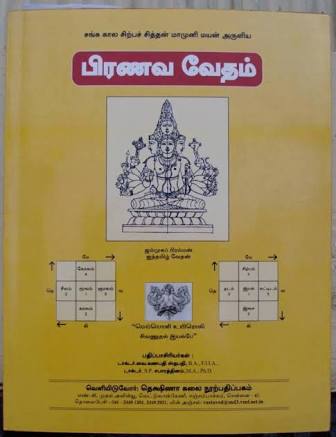
Tag: ஐந்திரம்

  • Three Hundred Million Years Pranava Veda Fifth of Nine Vedas Aindhiram Tamil?

    Three Hundred Million Years Pranava Veda Fifth of Nine Vedas Aindhiram Tamil?

    Vedas,the Scripture of Hindus, are quite ancient,have been transmitted,are being transmitted this even now and they are believed to be ‘Not Man-made’,Apauresheya’

    They are the inhaling and exhaling of Breath of Brahman,the Reality.

    This Reality is beyond speech,thought,time and space.

    To realise the Reality many paths have been set by people who have Realised It.

    These experiences are recorded in the Vedas.

    In the form of Mantras and Sukthas.

    Vedas provide solutions to mundane problems as well.

    Though the Reality is One and abstract,it can be realised by following procedures laid down in the Vedas.

    This path is a little difficult.

    This process is Called Nirguna Upasana,that is attempting to Realize Brahman as One Beyond Attributes.

    So another system was developed, taking into consideration the limited nature of Mind.

    This is Saguna Upasana.

    That is by praying to Individual Gods.

    As the Vedas have been transmitted orally,it is difficult to the date of origin.

    Taking some parameters like the Sanskrit used in Vedas,The oldest Veda,Rig Veda is currently dated around 5000 Years ago.

    This is way of the mark considering the facts that,

    Ramayana,which came much later is now dated at 5114 BC

    Mahabharata is dated around 5000 BC,

    (I have explained how Ramayana and Mahabharata are dated so close despite the information that these two are separated by thousands of years)

    The archeological evidence unearthed in India, Russia and all over the world ,sets the time line of Vedas by thousands of years.

    And fresh evidence points out that the Rig Veda was composed in The Arctic.

    That alone pushes it’s date back to Hyperborea,that to million years.

    And a million year old advanced Tamil site near Chennai, India refers to Vedas and Vedas refer to Tamil,an ancient language of India.

    Tamil and Sanskrit run parallel and compliment each other.

    The Vedas’ Date may be investigated from Tamil literature.

    And Tamil had a Religious system which includes Sanatana Dharma.

    In addition Tamil has systems not fully developed in the Vedas.

    For example the Vaasi Yoga by Lord Shiva,whose Disciple Panini wrote the Sanskrit Grammar.

    Patanjali,a disciple of Lord Shiva wrote the yoga Sutras,which is a prelude to Vaasi Yoga.

    Unfortunately Not much is known about Vaasi Yoga,though sufficient information is available for Seekers.

    The Tamils home land was Lemuria.

    It is dated around 300 million years ago.

    At the time of its existence,the sunken continent of Atlantis was in place.

    Lord Rama fought with Atlantis people to extend his Empire.

    Rama and the first Human being was Many.

    Many was from the South, Dravida Desa and migrated to Ayodhya due to a Tsunami.

    His son Ikshvsku founded the Surya vamsa, the Solar Dynasty.

    Manu’s daughter Ila founded the Chandra Vamsa,Lunar Dynasty.

    The Tamil philosophical system had a unique feature not found in the Vedas

    That of Siddha,Realized Souls.

    They are Realised souls much like the Yogins.

    It is worth mentioning that Yoga is not mentioned as a system in the Vedas.

    Patanjali’s Yoga Sutras came much later.

    But Shiva,who is considered as the first Siddha,Adi Siddha,in Tamil and is considered to have founded the Tamil language,along with Sanskrit.

    Shiva’s avatars are not found in detail in the north of Vindhya mountains,while South of Vindhya,the Dakshina pada, Dravida Desa details avatars, sixty four in number.

    The landmass which was the Tamils home is about 300 Million year old, Lemuria.

    These people and those adjoining Lemuria,The MU were highly advanced.

    Ancient Tamil Advaita is found in Thirumandhiram,by Thirumoolar.

    And the Tamils had and have a vast literature.

    The Sangam period saw some finest httpsliterature.

    It is currently dated around 3000 years ago.

    But consequent to the dating of Poompuhar,Tamil Nadu to 20,000 years ago,the history of Tamil Sangam goes farther back.

    The oldest Tamil literature available now is Tholkappiyam,a Book on Grammar and this belongs to second Tamil Sangam.

    There was an earlier Tamil Grammar Work Aindhiram,which was lost to a Tsunami.

    Aindhira is presumed to be Indra ,A Vedic Deity.

    He is reported to have written this grammar.

    Tholkappiyam indicates that it follows Aindhiram.

    It is worth noting that Valmiki was a Tamil Sangam poet.

    So was Tholkappiyar,who wrote Tholkappiyam.

    Now recent research Sri.Ganapathi Sthapathi states that Aindhiram was written by Mamuni Mayan.

    This treatise was lost due to Tsunami.

    This is the fist Veda from which the Four Vedas,Rig,Yajur Sama and Atharva sprang.

    The four Vedas were not perfect.

    Interesting concept.

    The basis for the concept rests on the following.

    1. Tamil land Lemuria was older.

    2.The Tamils had a distinct identity.

    3.The term Pranav’s Veda is referred in Bhagavathi and some Puranas.

    4.The Mayan civilisation sprang from Tamils.

    5.Mayan Sculpture and architecture follows Tamil systems.

    It is true that Mayan civilisation had its roots in Bharatavatsha,of which Tamils were a part.

    Tamils followed Sanatana Dharma.

    However they had distinct identity in worship.

    The Vedas speak of Fire Worship.But Tamil worship did not include fires worship at the beginning.

    However references to fire worship in the form Yagnyas are found from the days of Perunchotru Udhiyan Neduncheralaathan,a Cheers king,who donated areas for Dwelling of Brahmins.

    He also took part in the Mahabharata war.

    This places him in the Mahabharata Era.

    Madurai Meenakshi’s father took part in the Mahabharata war, fought along side the Pandavas.

    And as stated earlier Valmiki vwho wrote Ramayana was a Tamil Siddha and he wrote a Tamil poem.

    The Vaasi Yoga of Tamils preceded Patanjali’s Yoga Sutras.

    However the concept that the Pranav’s Veda is perfect and others are not so seems to be without basis.

    I had written in detail about thePranava Veda being imparted by Lord Subrahmanya to Shiva at Swamimalai,Tamil Nadu.

    On perusal of available material on the net ,Pranava Veda seems to concentrate more on Cosmology.

    The importance of OM and Light is stressed along with principles of Cosmos.

    There are also points of reference to Realisation,though not in vivid detail as found in the Vedas.

    That Aindhiram is the source for this text is hard to digest.

    Records available indicate that it is a book on Grammar and not a Scriptural text.

    And the Texts quoted from Pranav’s Veda seem to be more on Vaasthu,that is rules of architecture.

    The Pranava Veda texts also speak of Temple construction.

    Vedas do not speak of Temple Worship nor do they mention public Worship.

    Iswara Pranidhana concept was introduced by Patanjali in his Yoga Sutras.
    Prior to this individual deity worship is not found in Smritis.

    However one of the oldest temples in India ,Thiruvellarai was built by King Sibi,a Chola.

    He was the ancestor of Lord Rama and he had his second capital in what is now the NWFP of Pakistan.

    The concept of Building temple originated during the Period of Agama composition.

    Agama lays down rules for Temple construction and these are followed even today.

    Please refer my articles on Agama for details.

    The Agama System was after Sage Viswamitra.

    Sage Viswamitra banished his sons to Dravida Desa,for disobeying and questioning him .

    (Please refer my articles on this and other points mentioned in this article for details.

    I am providing a couple of links and more can be found in this site.)

    They found Tamil cultures to be quite advanced and their descendent Apasthamba formed the Apasthamba Sutra for The Four Vedas.

    This is followed till today by those living south of the Vindhya Mountains.

    Apasthamba also wrote Treatises on way of Living,called Gruhya Sutras.

    There he incorporated the non Vedic Concept of Thirumangalyam for women in marriage.

    Vedic marriage is complete when Sapthapathi is completed.

    No Maangalya Dhaarana is mentioned.

    So the best practices of Sanatana Dharma and Tamils, in the opinion of Apasthamba, were incorporated in Apasthamba Sutras.

    Hence there was a free flow of thoughts between Vedic and Tamil people.

    And there is no proprietary right over Vedas for Brahmins.

    Those who write on Pranava Veda speak of Pranava Veda as one that belongs to Viswamitra and People belonging to the Viswakarma community need not follow other Vedas and Pranava Veda is mainly addressed to Viswakarmas.

    Nothing can be farther from Truth.

    There is also a mention of names of Asuras and their characters were misinformation.

    This is also incorrect.

    Based on available resources it appears to me , that,

    Pranava Veda is Scripture ,

    It speaks of Pranava,OM and cosmology in detail as compared to Vedas,

    Siddha concepts are found in Pranava Veda,

    It deals more with Vaasthu and Sculpture and Architecture,

    It is in Tamil,

    It is not Aindhiram,

    Mamuni Mayon could have complied it,

    It is not Veda as is understood now in that it does not have enough material to call it as such

    And the origin of finding the manuscript from Saraswati Mahal is not backed up by facts,like where the the man who found them lived and how the texts are interpreted,other than some foundations repeating the same fact and references in Theosophy.

    I am yet to see Tamil Text of Pranava Veda.

    More research is needed to arrive at a firm objective conclusion.

    Will write more on Pranava Veda,It’s concepts,Mayasura,Mamuni Mayon,Mayan and Tamil civilisation,though I have written on the last mentioned.

    However,as per Russian Tradition there are Nine Vedas and only four were released to Bharathavarsha.

    The Rig Veda was composed in the Arctic.

    Krishn’a son Pradhyumna built a city in Por Baijn, Sibria,

    River Volga was the cradle of Vedic civilization

    Russia was called Rishi Varsha and also as Sthree Varsha, a country ruled by women,

    It belonged to Ila Varsha od Indian Puranas,

    Lake Baikal was Vaikanasa Theertha,

    Indra’s Amravathi was Arkaim,

    Swasthik Rig Vedic Mandala city was built in Russia.

    https://ramanan50-wordpress-com.cdn.ampproject.org/v/s/ramanan50.wordpress.com/2015/09/26/vedas-as-peruns-vedas-santees-in-russia/amp/?amp_js_v=a2&amp_gsa=1&usqp=mq331AQCCAE%3D#referrer=https%3A%2F%2Fwww.google.com&amp_tf=From%20%251%24s&ampshare=https%3A%2F%2Framanan50.wordpress.com%2F2015%2F09%2F26%2Fvedas-as-peruns-vedas-santees-in-russia%2F

    Pranava Veda.

    What we see above is called the “Five fold Veda.” This is the “source” Veda that presents the scientific manifestation process (Pranava Veda) and the four products of that manifestation (poetry, music, dance, and architecture).

    All of these “forms” (poetry, music, dance, architecture) are generated from the Unmanifest Space or Brahmam based on SPACE, TIME, SOUND and LIGHT which give rise to all aural and visual forms in the manifest world. In this science and technology, each of these manifest forms of paravastu or Vastu are governed by a common grammar of Kaala manaa (time units) called Taala maana.The dominant and all pervasive element in the creation of these forms is the concept and process of the unmanifest becoming manifest by its own creative nature.

    Based upon this theory of manifestation, and to signify the Five Fold Veda, the Shilpis have created a form with five heads. This form is called Vishwakarman. It represents the five Vedas, that is the Pranava Veda which is the instruction manual for how the Unmanifest (Vastu) turns Itself into Manifest creation (Vaastu) and the four products of that manifestation (poetry, music, dance and architecture).

    https://viswakarmasuvarnakar.jimdo.com/pranava-vedam/

    Pranava Veda, Theosophy angle.

    This material is provided by Dr. Guy Pettitt; below this table of contents is his introductory letter on this rare resource.

    The following links open .pdf files (usewww.adobe.com for the reader)

    With any problems, please contact the webmaster, vicktorya, at vsk @ makara . us (remove spaces)

    www.makara.us/05ref/01books/pranavavada/pv_toc.htm

    Lemuria 300 Million Years Old

    https://ramanisblog.in/2015/01/29/the-fifth-veda-pranava-veda/

    https://en.m.wikipedia.org/wiki/Mamuni_Mayan

    https://m.facebook.com/AUM.Vastu/posts/819583718074409

  • Tamil Grammar Tholkappiyam Refined Improved Sanskrit Grammar?

    Tamil Grammar Tholkappiyam Refined Improved Sanskrit Grammar?

    I have written an article that Panini’s Grammar on Sanskrit  was preceded by Ten works on Sanskrit Grammar,one of them being ‘Aindhiram.’

    There is a view that the Aindhiram was a Grammar work in Tamil belonging to either the first or second Tamil Sangam.

    The work is lost and Tholkaapiyam is the earliest work on Grammar in Tamil available now.

    Tholkaapiyar in his prelude to Tholkaapiyam states that he studied under A Brahmin,who was well versed in the Vedas.

    The name he gives is Athankottu Aasan.

    The term Aasan in Tamil means Teacher.

    Athankodu might mean the place he hailed from.

    So what Tholkaapiyar means is that he studied under a teacher who lived or from Athankodu.

    Might be,it is in the present Kerala,which was earlier a part of Tamil Kingdom called Chera Naadu.

    As Sage Agastya is mentioned repeatedly in Sangam literature and Tamil Legends,he is credited with The Tamil Grammar,

    Tholkaapiyam and Tholkappiyar is a disciple of Sage Agastya as mentioned in Sddha’s works in Tamil, I postulated that Agastya could have wriiten the Aindhira work on Sanskrit Grammar,which Tholkaapiyar quotes.

    He says ,

    அறம் கரை நாவின் நான்மறை முற்றிய‌

    அதங்கோட்டு ஆசாற்கு அரில் தபத் தெரிந்து
    மயங்கா மரபின் எழுத்து முறை காட்டி
    மல்கு நீர் வரைப்பின் ஐந்திரம் நிறைந்த‌
    தொல்காப்பியன்
     எனத் தன் பெயர் தோற்றிப்
    பல் புகழ் நிறுத்த படிமையோனே..

    ‘Me,Thokappiyan,who learnt the Aindhiram Grammar,which describes the functions and rules Word’

    நிலம் தரு திருவின் பாண்டியன் அவையத்து
    அறம் கரை நாவின் நான்மறை முற்றிய‌
    அதங்கோட்டு ஆசாற்கு அரில் தபத் தெரிந்து,’

    ‘I have learnt this from the one,who is well versed in The Vedas,in the presence of a Pandyan King’

    As Agastya had written a work on Tamil Grammar Agattiyam,which is lost,there was no need to write another Grammar in Tamil.

    Agastya was well versed in Sanskrit as well.

    He had written Rig Vedic Hymns,along with his wife Lopamudra.

    So an earlier Grammark work by him could have been in Sanskrit, which is,Aindhiram.

    That Aindhiram is a Sanskrit work is arrived at by scholars.

    The Aindra (of Indra) school of Sanskrit grammar is one of the eleven schools of Sanskrit grammar mentioned in Pāṇini’s Ashtadhyayi. It is named after Indra in allusion to Lord Indra, the king of Gods in Hindu mythologyArthur Coke Burnell, a renowned orientologist, in his 1875 book, “On the Aindra school of Sanskrit grammars” details this school. Burnell believed that most non-Pāṇinian systems of Sanskrit grammar were traceable to this school of grammar, believed to be the oldest and reputed to be founded by Indra himself…

    Burnell’s search for the Aindra school took him to Southern India where he came across the Tamil grammatical work Tolkappiyam. A preface of this work, written during the twelfth century CE by Ilampuranar describes the work as aindiram nirainda Tolkappiyam (‘comprising Aindra’). This, Burnell posits is an allusion to the pre-Pāṇinian Aindra school of grammar.

    Further, Burnell proceeded to do an exhaustive comparison of the Tokappiyam with two non-Pāṇinian schools of grammar, namely, the Katantra school of Sanskrit grammar and the Kaccayana, a Pali school of Southern India. Based on the comparisons and allowing for divergences due to the structural differences between Tamil and Sanskrit/Pali, Burnell concluded that the Tolkappiyam corresponds to the Katantra school minutely and across the board.

    He also demonstrated that many of the technical terms of the Tolkappiyam and of later Tamil grammars were merely simple translations of Sanskrit terms which he attributes to the Aindra school or the other pre-Pāṇinian texts.

    While his demonstration of the influence of Sanskrit on the Tolkappiyam has met with some approval, his attribution and approximation of all non Pāṇinian schools of Sanskrit grammar with the Aindra school has met with resistance.   SOme scholars have also taken a less committal line on the question of Sanskrit influence itself.[3]

    Having demonstrated the influence of the Katantra school on the grammars of Pali and Tamil and with the help of a linkage to the Aindra school that the Tolkappiyam afforded, Burnell proceeded to show the differences in the technical terms used by the Aindra school and those used by the Pāṇinians.’

     (     https://en.m.wikipedia.org/wiki/Aindra_School_of_Grammar )

    Tholkaapiyar says that he  is well versed in Aindhiram.
    ஆயிடைத்

    தமிழ் கூறும் நல் உலகத்து
    வழக்கும் செய்யுளும் ஆயிரு முதலின்
    எழுத்தும் சொல்லும் பொருளும் நாடிச்
    செந்தமிழ் இயற்கை சிவணிய நிலத்தொடு
    முந்து நூல் கண்டு முறைப்பட எண்ணிப்
    புலம் தொகுத்தோனே ‘

    Rough translation.

    I am embarking on writing a work in Tamil ,to streamline,செந்தமிழ் இயற்கை சிவணிய நிலத்தொடு

    முந்து நூல் கண்டு முறைப்பட எண்ணி,the language of Tamil,by compiling ,புலம் தொகுத்தோனே,that which is ancient.Now that,

    Tholkappiar learnt,Andhiram Grammar in Sanskrit and was a Scholar in Aidhiram,

    ஐந்திரம் நிறைந்த‌

    தொல்காப்பியன் எனத் தன் பெயர் தோற்றிப்
    பல் புகழ் நிறுத்த படிமையோனே..’Translation. Well versed in Aindhiram,me Tholkaapiyan.


    He  was well versed in Tamil and was knowledgeable in Tamil Litertaure,

    He was a disciple of Agastya,who wrote Vedic Hymns,a scholar in Sanskrit,Agathyam ,Tamil Grammar,

    Tholkaapiyar expresses his desire to streamline Tamil,

    It is highly probable that he wrote Tholkaapiyam ,refining Aindhiram as it was becoming obsolete,disappearing.

    Tamil Grammar Thokappiyam might be a refined,improved Aindhiram of Sanskrit Grammar.

    There are other views.

    Aindhiram is a Tamil work.

    R. Mathivanan; and 8th century B.C. by A.S. Gnanasambandam and V.T. Chellam.

    Panampaaranaar, in his introductory verse to Tolkappiyam, praises Tolkappiyar as Tolkappiyan well-versed in Aindram. R. Ragavaiyangar says that the study of Aindram, a grammatical work, was very popular during the time of Tolkappiyar and its study was neglected during the time of  Ilango Adigal, the author of Silappathikaram. Aindram lost its influence after the appearance of Astadhyayi, the grammar of Panini which became very popular ever since its inception and was learnt eagerly’

    (   http://risingsunweekly.blogspot.in/2012/01/age-of-tholkappiyam.html )

    Aindhiram is an ancient book on the science of vasthu sathra and tamil grammer – connected with Tholkappiyam  .It had two volumes.Unfortunately the volume one which deals with the phenetics of tamil grammer associated with Tholkappiyam (this volume of book was called ‘ANIDRA’) is lost in the course of history ,all that is remaining with us is an scientific book on vasthu sathra.’

    In Aintiram  ,The Science related to numerical order enables one to know the principles of role of number, space order nature of inner space and significantly know the potency of micro-structure. (atoms)

    -one of the grossly underrated scientific books in Tamil ,which was totally neglected for the last 100 years..

    -it also explains about the rationale for certain practices in our day to day life ,which have clear scientific reasons behind it,that we are totally unaware of…like where should we place our head while we sleep, practical stuff like that (for all those ppl who condemned lot of tamil traditions telling that they have no scientific evidence and are nothing but superstitious beliefs, this book was especially written for you guys) …stumbled across a small passage from Aindhiram book(English translation) which I would like to share

     Mayan’s Aintiram …page 347]  

    East: Sleeping with head resting in the East enhances memory, health and spiritual inclination. It is usually advised by Vastu Shastra Consultants to plan the children’s room in such a way that their Vastu sleeping direction comes out to be east. This leads to higher concentration and retention power.  

    South: Vastu Shastra highly recommends this direction as your usual sleeping position with head towards the South. This is believed to provide sound sleep and increase the wealth and prosperity in the household.

    (  https://www.quora.com/What-is-the-mystery-that-our-ancient-literary-work-Aindhiram-ஐந்திறம்-reveals-to-us )

    Reference and citation.

    https://ramanisblog.in/2017/04/13/early-sanskrit-grammar-before-panini-by-agastya-tholkaapiyar/

    *”Full verse,Nool Sirappu Paayiram,Tholkaapiyam text.

    வட வேங்கடம் தென் குமரி

    ஆயிடைத்
    தமிழ் கூறும் நல் உலகத்து
    வழக்கும் செய்யுளும் ஆயிரு முதலின்
    எழுத்தும் சொல்லும் பொருளும் நாடிச்
    செந்தமிழ் இயற்கை சிவணிய நிலத்தொடு
    முந்து நூல் கண்டு முறைப்பட எண்ணிப்
    புலம் தொகுத்தோனே போக்கு அறு பனுவல்
    நிலம் தரு திருவின் பாண்டியன் அவையத்து
    அறம் கரை நாவின் நான்மறை முற்றிய‌
    அதங்கோட்டு ஆசாற்கு அரில் தபத் தெரிந்து
    மயங்கா மரபின் எழுத்து முறை காட்டி
    மல்கு நீர் வரைப்பின் ஐந்திரம் நிறைந்த‌
    தொல்காப்பியன்
     எனத் தன் பெயர் தோற்றிப்
    பல் புகழ் நிறுத்த படிமையோனே..


    Edit