Tag: Garuda

  • Kashyapa Father of Vishnu Rudra Paediatrics Kashmir An Overview

    Kashyapa Father of Vishnu Rudra Paediatrics Kashmir An Overview

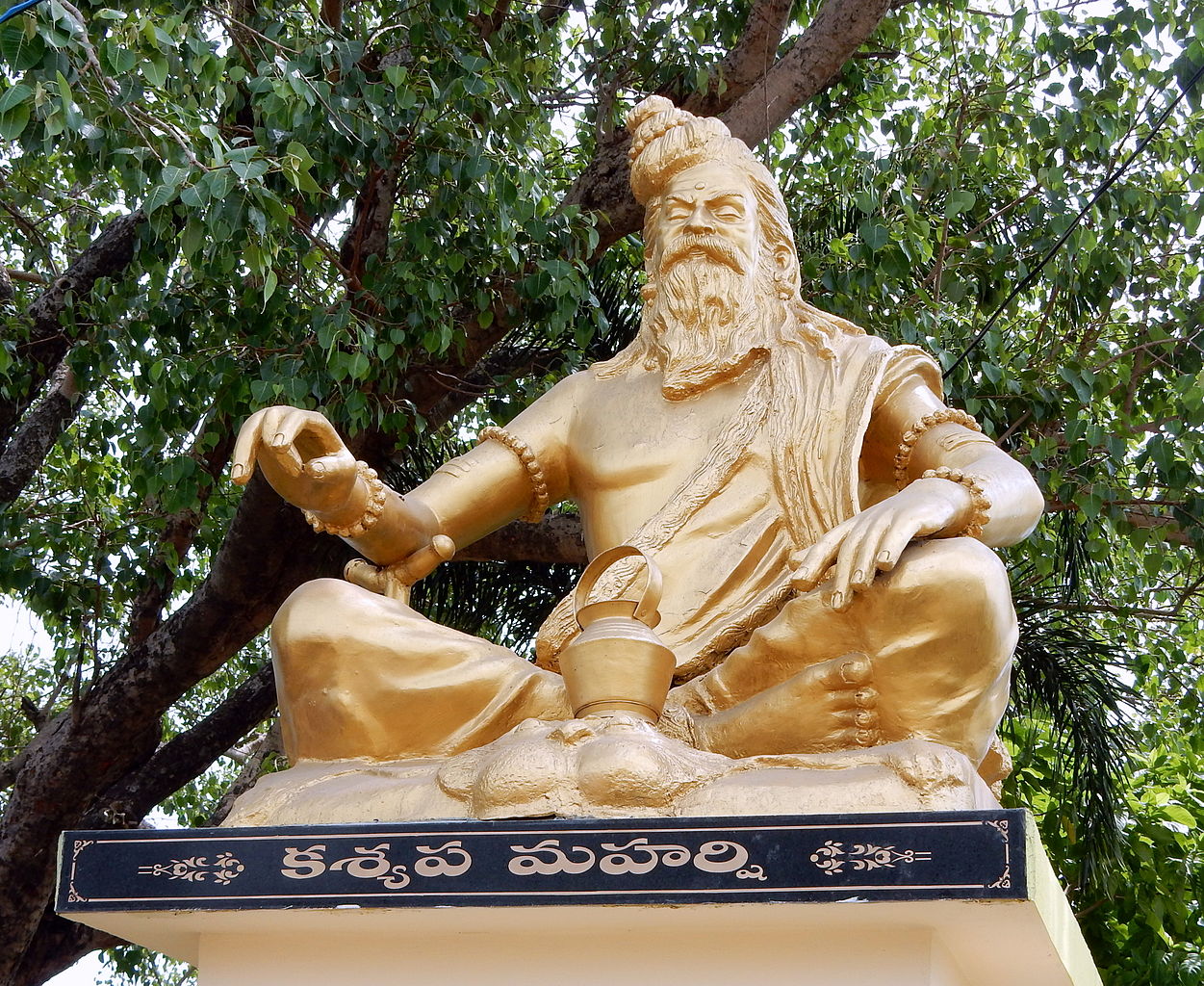
    Kashyapa,one of the Eternal Seven Seers, a Saptha Rishi,may in a sense be considered as the Grandsire of Humanity.

    The term Kashyapa means ‘tortoise’

    Undisturbed am I, undisturbed is my soul,
    undisturbed mine eye, undisturbed mine ear,
    undisturbed is mine in-breathing, undisturbed mine out-breathing,
    undisturbed my diffusive breath, undisturbed the whole of me.

    Thereafter rose Desire in the beginning, Desire the primal seed and germ of Spirit,
    O Kama dwelling with the lofty Kama, give growth of riches to the sacrificer, (…)
    Prolific, thousand eyed, and undecaying, a horse with seven reins Time bears us onward,
    Sages inspired with holy knowledge mount him, his chariot wheels are all the worlds of creatures.

    Kala [Time] created yonder heaven, and Kala made these realms of earth,
    By Kala, stirred to motion, both what is and what shall be, expand, (…)
    Kala created living things and first of all Prajapati,
    From Kala self-made Kasyapa, from Kala Holy Fire was born.

    — Atharvaveda, Book XIX, Hymns L51-5′

    One may recall the Koorma Avatar of Vishnu and the legend of Turtle/Tortoise is present in the formation of Earth in ancient legends.

    Seems there is a message here.

    Am looking into references in world religious texts and legends.

    Kasyapa is the most ancient Rishi listed in the most ancient Upanishad,Brihadaayanka Upanishad.

    Kasyapa is listed as a Saptha Rishi in the Rig Veda.

    Saptha Rishis are eternal and they remain,Along with Narayana in is Yogic Slumber,while the world is being withdrawn.(Pralaya).

    In Hinduism,there is no destruction of the Universe.

    The term Dissolution is used to convey the meaning of the Sanskrit word,Pralaya.

    Withdrawal may be nearer to the meaning of Pralaya.

    These Saptha Rishis preserve the Vedas and lay down the rules for Mankind in Ech Manvantara.

    Kashyapa is one among these.

    His progenies included Devas,the Heavenly Beings and the Asuras,the Beings of the Netherworld,Patala.

    Of his children, 12 Adityas,Lord Vishnu is One.

    Adityaanam Aham Vishnu’ -Bhagavad Gita.Vibhuthi Yoga.

    Rudra is also recorded as a son of Kashyapa and his wife Aditi.

    The Eleven Rudras.

    1. Nirriti
    2. Shambhu
    3. Aparajita
    4. Mrigavyadha
    5. Kapardi
    6. Dahana
    7. Khara
    8. Ahirabradhya
    9. Kapali
    10. Pingala
    11. Senani

    And Kasyapa  had the Eight Vasus among his 33 children.

    ‘Kashyapa was wedded to the famed mothers of Lokas viz. Aditi, Diti, Danu, Kaashtha, Arishta, Anayuvu, Khasa, Surabhi, Vinata, Taamra, Muni, Krodhavasa, and Kadru. His sons were the Dwadashadityaas viz. Dhata, Aryama, Mitra, Varuna , Amsha, Bhaga, Indra, Vivaswanta, Pusha, Parjanya, Twashta, and Vishnu.

    From Surabhi, Kashyapa was blessed with Ekadasha Rudraas viz.Angaraka, Sarpa, Niruti, Sadasaspati, Ajaikapaada, Ahirbhudnya, Jwara, Buvana , Ishwara, Mrityu and Kapali. From Surabhi, there were two daughters, viz. Rohini and Gandharvi; Rohini begot four daughters named Surupa, Hamsakali, Bhadra and Kamadu: Kamadu gave birth to Cows, Hamsakali begot Mahishaas; and Gandharvi begot Ashvas or horses; Surabhi also begot a Vrishabha/ Bull which was secured as ‘ Shiva Vahana’.

    From Aditi, Kashyapa Muni begot Indra and Devatas. Diti gave birth to Hiranya kashipu  as Kashyapa concluded the ‘Ati Raatra’ of the just finished Ashvamewdha Yagna; the new born was the younger brother of Hiranyaaksha. Their younger sister was Simhika the wife of Viprachit and their son was Rahu.

    His wives were the daughters of Daksha.

    His marriage and his offsprings may be interpreted by Cosmology and as an allegory of Astronomy as well.

    Available evidence points out to Kashmir as Kashyapa’s birth place and Kashmir is named after him.

    ‘Rishi. According to the ancient legends, he reclaimed that land from a vast lake, his school was based there, and the land was named after him.The name Kashmir, states Christopher Snedden, may be a shortened form of “Kashyapa Mir” or the “lake of the sage Kashyapa”, or alternatively derived from “Kashyapa Meru” or the sacred mountains of Kashyapa’

    Kasyapa in Russia.

    Caspian Sea.

    The word Caspian is derived from the name of the Caspi (Persian کاسی), an ancient people that lived to the west of the sea in Transcaucasia. Strabo wrote that “to the country of the Albanians belongs also the territory called Caspiane, which was named after the Caspian tribe(Kaswan, Kashyap Jat clans), as was also the sea; but the tribe has now disappeared”. Moreover, the Caspian Gate, which is the name of a region in Tehran province of Iran, is another possible piece of evidence that they migrated to the south of the sea.

    The root of the word Caspian can also be traced to Sanskrit.’

    Works of Kasyapa.

    • Kashyapa Samhita, also called Vriddajivakiya Tantra or Jivakiya Tantra, is a classical reference book on Ayurvedic pediatrics, gynecology and obstetrics. It was revised by Vatsya.
    • Kashyapa Jnanakandah, or Kashyapa’s book of wisdom, is a 9th century text of the Vaishnavism tradition. ( I do not agree with this date. Kasyapa can be dated much earlier).
    • Kasyapa dharmasutra, likely an ancient text, but now believed to be lost. The text’s existence is inferred from quotes and citations by medieval Indian scholars.
    • Kasyapa sangita, likely another ancient text, but now believed to be lost.
    • Kasyapasilpa, also called Amsumad agama, Kasypiya or Silpasastra of Kasyapa, is a Sanskrit treatise on architecture, iconography and the decorative arts, probably completed in the 11th century

    https://ramanisblog.in/2015/02/21/caspian-sea-kashyapa-sagar-of-hinduism/

    References and Citations.

    http://www.kamakoti.org/kamakoti/brahmandapurana/bookview.php?chapnum=12

    https://en.m.wikipedia.org/wiki/Kashyapa

    //ws-na.amazon-adsystem.com/widgets/q?ServiceVersion=20070822&OneJS=1&Operation=GetAdHtml&MarketPlace=US&source=ss&ref=as_ss_li_til&ad_type=product_link&tracking_id=ramasblog-20&marketplace=amazon&region=US&placement=8170305330&asins=8170305330&linkId=094ea6a59f84ff4dfd6819b5be30cae5&show_border=true&link_opens_in_new_window=true

    //ws-na.amazon-adsystem.com/widgets/q?ServiceVersion=20070822&OneJS=1&Operation=GetAdHtml&MarketPlace=US&source=ss&ref=as_ss_li_til&ad_type=product_link&tracking_id=ramasblog-20&marketplace=amazon&region=US&placement=B00P293PO2&asins=B00P293PO2&linkId=ea18983e9c484150128e37beb1a26b4a&show_border=true&link_opens_in_new_window=true

  • Thumb Sized Rishis Protect From Radiation Valakilyas

    ‘ वालखिल्या
    Valakhilyas are a group of divine sages, who are small of body, but great in their ascetic powers. Indeed, according to the Mahabharata, they are only as large as a thumb. Unlike the SaptaRishis, their names are not individually spelt out.

    When Kashyapa performed a sacrifice, all deities and sages were asked to contribute.

    Indra brought a whole mountain of trees for firewood, but the Valakhilyas were able to bring only a single twig amongst themselves.

    Lord Vishnu in Indonesia
    Vishnu in Garuda Vahana

    Indra made fun of them, and they cursed that his slayer would be born as the son of Kashyapa.

    The sages were the size of the thumb but were very powerful due to their piety, Brahmacharya and intense penance. Once, Indra and the Valakilyas were on their way to the ashram of Sage Kashyapa to attend a yajna.

    Indra, the king of celestial beings, was haughty and arrogant and this behavior often caused problems to the celestial world. On the way to the ashram, Valakilyas had fallen into water collected in a hoof mark left by a passing animal. Indra, who soon reached the spot, mocked at the tiny sages who were in a puddle and sped away.

    Sage Kashyapa received Indra but was a worried man because Valakilyas had not yet reached. Indra then jokingly narrated what had happened and asked Sage Kashyapa to not to wait for the tiny sages.

    Sage Kashyapa narrated how powerful the Valakilyas were and he also warned Indra that they might be performing a yajna to replace Indra as the king of Devas.

    Soon Indra and Sage Kashyapa reached the spot of the yajna and asked the Valakilyas to desist from it.

    The sages relented and said that the one to come from the yajna would Pakshindra, king of all birds, and that bird was Garuda.

    With the blessing of Valakilyas, Sage Kashyapa became the father of Garuda.

    As Indra made fun of them, they cursed that his slayer would be born as the son of Kashyapa.

    However, when Indra apologized and Brahma intervened on his behalf, they modified the curse that the son shall be initially an enemy of Indra, but later will become his friend.

    Valakhilya hymns, eleven in number, are the appendix of the eighth Mandala of the Rig Veda. But famous commentators like Sayana rejected them as interpolations. The Ramayana and the Mahabharata have a lot of references to the Valakhilya Rishis.

    Valakilyas in Tamil Literature.


    Ancient Sangam Tamil literature refers to Valakhilyas in Puranaanuru (verse 43), Tirumurugatrup patai (lines 16-109), post Sangam book Silappadikaram (Vettuvavari 15) and in the poems of middle age poet Arunagirinathar.

    The Rig Veda says that they sprang from the hairs of Prajapati Brahma. They are the guards of the Chariot of the Sun. They are also called the Kharwas. The Vishnu Purana describes them as pious, chaste and resplendent as the rays of the sun.

    Tamil literature is very clear in saying that the main task of the short and smart ascetics is to prevent human beings from being scorched. So they absorb the excess heat from the sun by travelling in front of him. Tamil books also add they were in turn given energy by Lord Skanda and Goddess Durga.

    Even the hunters in the forest pray to Durga for this. Another Tamil poet compares the sacrifice of the Valakhilyas to the sacrifice of the Emperor Sibi who gave his flesh to an eagle to save a pigeon. The famous story of Sibi was referred to in four Sangam Tamil books. Sibi was praised as the forefather of the famous and powerful Tamil Chola dynasty. The food of Valakhilyas is only wind.

    Citation and reference.

    http://swamiindology.blogspot.in/2011/12/valakhilyas-60000-thumb-sized-ascetics.html?m=1

  • 300 Million Year Old Brass Lamp With Garuda USA

    In the course of research into Sanatana Dharma,Hinduism, I stumble into things related to Hinduism which are mind-boggling and turns the History as we know it turn on its head.

    I was researching into Trishanku, Sothern Cross connection.

    30 Million Year Old Brass Lamp with Garuda.image.jpg
    30 Million Year Old Brass Lamp with Garuda found in West Virgnia,USA

    I came across information that a Brass Lamp was found in a lump of Coal and it had a Brass Bell with Hindu God Garuda, the Mount of Lord Vishnu .

    Hindu God Garuda.Image.jpg
    Hindu God Garuda, Mount of Lord Vishnu.

    The Brass Lamp was analysed and found to be Three Hundred  Million(300,000,000 years) years Old!

    The News.

    In 1944, as a ten year old boy, Newton Anderson dropped a lump of coal in his basement and found that it contained this bell inside. The bituminous coal that was mined near his house in Upshur County West Virginia is supposed to be about 300 million years old! What is a brass bell with an iron clapper doing in coal ascribed to the Carboniferous Period? According to Norm Sharbaugh’s book Ammunition (which includes several “coal anecdotes”) the bell is an antediluvian artifact.

    The Institute for Creation Research had the bell submitted to the lab at the University of Oklahoma. According to the Institute, the bell was delivered for analysis by the nuclear activation method.The nuclear activation analysis revealed that the bell contains a strange mix of metals, different from any known modern alloy, with an unusual mixture including copper, zinc, tin, arsenic, iodine, and selenium. While it is brass, it is not the brass alloy that has been used by our civilization since at least the rise of the Sumerian culture some six thousand years ago…..

    Genesis 4:22 states that Tubal-Cain was “an instructor of every artificer in brass and iron…” Perhaps when his civilization came to an end in the flood, this bell was buried with a mass of vegetation that became coal and ended up thousands of years later in Newt Anderson’s coal bin. The bell was prominently featured in the 1992 CBS docudrama production called Ancient Secrets of the Bible and is now part of the Genesis Park collection. Later on, Newton Anderson spent a great deal of time researching the demon atop the bell. He discovered similarities to the Babylonian Southwest Wind Demon and the Hindu deity Garuda. Garuda is sometimes depicted on top of bells, as is the Egyptian Isis. Demonic worship seems to take on similar forms in various cultures (like the Venus figurines from disparate lost cultures and the ancient fascination with pyramids), which doesn’t necessitate that they were culturally related. At our request, Mr. Anderson was examined by an expert polygraph specialist to further validate his claims.

    Man vs. Archaeology has examined & studied these artifacts first hand; the London Artifact, the iron cup in coal, and the brass bell in coal. These scattered remains totally demolish the Rough Stone Age, Polished Stone Age, Bronze and Iron Age classifications. But a large part of these findings, after appearing in many scientific publications, have either been ignored by evolutionist scientists or else hidden away in museum basements.’

    Deatils of the examiantion of the Bell.

    n the 1963–1964 timeframe, a man named Boris Bilas took the bell to the geology department at the University of Delaware at Wilmington, where it was studied and then returned. They confirmed that the bell was handmade. Anderson eventually moved to Florida and became a chemistry teacher. In 1973 he attended a presentation by Dr. John Morris of the Institute for Creation Research and brought the bell to John’s attention. Morris analyzed the artifact in the lab at the University of Oklahoma. He subsequently wrote (Morris, 2010), “Nuclear Activation Analysis determined it to be primarily of bronze with a curious admixture of zinc. A micro probe showed no residual traces of coal.”

    The fact that the bell’s metallurgical fingerprint is odd should not be surprising if, indeed, the bell is from pre-Flood times. It would not necessarily be expected to match any mix of known, post-Flood metal workings. The clapper inside the bell is composed of iron and it still rings beautifully. Genesis 4:22 states that Tubal-Cainwas “an instructor of every artificer in brass and iron…” These then were two of the metals with which craftsmen worked in the pre-Flood economy.

    Polygraph testimony

    As a creationist speaker I became intrigued by the story of the bell and managed to track down Newton Anderson in Greenville, SC. After some discussions I agreed to acquire the fascinating artifact from Anderson, but requested that he take a lie detector test to further validate his story. In 2007 I hired Stan Fulmer, an expert polygraph specialist who worked on death row cases. Anderson was found to be credible and he clearly passed the test. The polygraph examination report can be viewed online (Fulmer, 2007).

    The figure atop the bell

    Garuda Bell Clean

    Anderson spent a great deal of time researching the demon-like figure positioned atop the bell (Figure 2), sending inquiries to multiple universities. He discovered similarities to Pazuzu, the Babylonian Demon of the Southwest Wind, and the Hindu deity Garuda. Both the Babylonian Demon and the bell figurine have a telltale horn on their heads (partially broken off on the bell). Their narrow faces are eerily alike. Garuda (a beaked, flying god) is sometimes depicted on top of bells, as is the Egyptian winged goddess Isis.

    The wings and kneeling posture of the bell figurine are typical of the Garuda. Certain worship seems to take on similar forms in various cultures (like the Venus figures from disparate lost cultures and the ancient fascination with pyramids), which doesn’t necessitate that they were culturally related. Perhaps a spirit being (maybe even named “Pazuzu” or “Garuda”) was worshiped by a pre-Flood cult. After the earth’s populations began to grow again, this same spirit could have inspired similar religious worship in the Orient during more recent times. Critics of the bell artifact have seized on the similarity to Garuda bells (Figure 3) to suggest that the Anderson bell is of modern origin. A typical argument along these lines is presented by Hudson (2010). He argues that the bell is a Garuda bell, made of brass that could have come from pieces of scrap metal remanufactured by an artisan in India or elsewhere in Asia. He goes on to say: “All we have is the testimony of one person who says he found the bell when he was ten years old (over 60 years before he took the polygraph test). Polygraph tests are unreliable because they only tell us if someone thinks they are lying and there is no doubt that Mr [sic] Anderson believes he is telling the truth. Another intriguing possibility is that the bell appeared to be in coal but was actually in a concretion of coal slurry and coal lumps hardened over time so that it appeared to be inside a contiguous lump of coal.”

    Hudson presents a far-fetched scenario in which someone carried a Garuda bell from the Far East up into the mountains of West Virginia. Then it was accidentally dropped onto an exposed vein of coal, such that a coal slurry would quickly gather around it (before it could be contaminated with dirt, leaves, and such). A coal slurry consists of coal dust, particles, and water that is typically a by-product of coal mining. The slurry then completely buried the bell and eventually dried, hardening into a pure coal concretion that appeared to be a solid lump of coal when it was later mined!

    Anderson responded to this hypothesis by reminding me that the bell was not found in lignite (soft, brown coal), but came from a block of hard, black coal. Moreover, he was unaware of anyone in his community that was Hindu, of Indian descent, or had traveled to the Far East and returned with any artifacts.

    The bell is reported to be with the finder who has moved to Florida and was working as a Chemistry teacher.

    Citation Source.

    https://manvsarchaeology.wordpress.com/2012/02/01/creation-x-files-part-1/

    http://www.genesispark.com/essays/update-on-the-mysterious-bell-found-in-coal/

  • Garuda Vishnu’s Mount Increases Weight Every Stage Nachiyar Koil

    There are quite a few strange things/events associated with Hindu Temples in India.

    There are Temples where Snake comes and offers pooja to Shiva, Sun bathes Idols on a specific day,temple emerges from the sea at a fixed Time,where Crows do not fly over the temple Tower..the list goes on.

    Scroll down for Video.

    Kal Gaudan in Procession,Nachiyar Koil.Image.jpg
    Kal Gaudan in Procession,Nachiyar Koil, Tamil Nadu Image credit The Hindu http://www.thehindu.com/features/friday-review/history-and-culture/unique-drama-unfolds-during-procession/article4244915.ece

    Now add one more to this list.

    During street procession (Margazhi and Panguni),  English Month December,an unbelievable event takes place at the Nachiyar Koil. While only 4 people carry Lord Garuda out of his Sannidhi, as the Lord goes out of each Layer and prakaram, he is said to increase in weight, that 8 people, 16 and then 32 people are required to carry Lord Garuda out of the temple. Finally, when the Lord is taken outside the temple, Garuda increases in weight so much that 128 people are required to carry the Lord. On his way back, it is said that Garuda mount decreases in weight and finally when he is back in the Sannidhi, only 4 people are required to carry him.


    This happens every year.

    Nachiar Kovil or Thirunarayur Nambi Temple in Thirunarayur, a village in the outskirts of Kumbakonam in the South Indian state ofTamil Nadu, is dedicated to the Hindu god Vishnu and his wife Lakshmi. Constructed in the Dravidian style of architecture, the temple is glorified in the Divya Prabandha, the early medieval Tamil canon of the Azhwar saints from the 6th to 9th centuries AD. It is one of the 108 Divyadesam dedicated to Vishnu, who is worshipped as Srinivasa Perumal and his consort Lakshmi as Nachiyar. The temple is the place where god Vishnu is believed to have initiated Pancha Samskara (religious initiation) to Thirumangai Azhwar. The temple follows Thenkalai mode of worship.

    The temple is believed to have been built by Kochengat Cholan of the late 3rd century AD, with later contributions from Medieval Cholas and Vijayanagar kings.

    This is the 71st Temple built by Kochengat Cholan, the first Temple for Vishnu, the other 70 Temples having been built for Lord Shiva.

    Legend.

    The sage Medhavi was doing penance at this place. While taking a bath in the river, he found an image ofChakrathazhwar entwined with Yoga Narasimha. A divine voice asked him to install the image in his hermitage and worship it. The goddess Lakshmi, the consort of Vishnu chose to grow in the hermitage and appeared to the sage in the form of a small girl and requested him to take care of her. Vishnu traveled in search of Lakshmi on his vehicle Garuda, the eagle. Garuda found the presence of Lakshmi in the hermitage. Vishnu appeared to Medhavi, pleased by the latter’s devotion and asked his daughter to be married to him. The sage happily married Lakshmi to Vishnu and requested him to stay in his place, which Vishnu accepted.There is another local legend that king Kochengat Cholan was once defeated and he was advocated to seek the blessings of Vishnu, which he obliged.

    Prominence to Goddess.

    Nachiyar Koil is one of the few Divyadesams where the goddess has prominence over Vishnu. Some of the other temples where the such female dominance are observed areAndal Temple at Srivilliputhur, Azhagiya Manavala Perumal Temple at Woraiyur and Pundarikakshan Perumal Temple in Thiruvellarai. While Srivilliputhur is called Nachiyar Thiru Maaligai, Thirunaraiyur is called Nachiyar Koil.[2]

    Vishnu was of the view that during Kali Yuga, men would have to listen to women. Hence he decided that he would first set an example and listen to goddess here. During all festive occasions, the first rights are reserved for Nachiyar, who moves ahead, while Srinivasa follows her. Even the food is first served to Nachiyar and then to Srinivasa. Being a temple where goddess has prominence, Vishnu is located slightly by the side and goddess has the prominent position inside the sanctum.

    How to Reach Nachiyar Koil and Temple Timings

    Nearest Airport. Tiruchi,Tamil Nadu.

    Railway Station.Kumbakonam.

    Bus Station,.Kumbakonam. Nachiyar Koil is called Thirunaraiyur.

    It is eight Km from Kumbakonam.Buseses are available.

    Deity            : Thiru Naraiyur Nambi, Srinivasa Perumal Standing Posture facing East
    Goddess       : VanjulaValli
    Azhvaar       : Thirumangai Azhvaar-110 verses
    Temple time : 630am –12.30pm and 430pm-830pm
     Contact      : Gopinathan Bhattar@ 94435 97388 / 0435 2467167( Check the Mobile number)
    Bus : Buses every 15minutes from Kumbakonam (Tiruvarur bound). Auto from Kumbakonam Railway Station will cost Rs. 200/-
    Citation.
  • Ranganatha Moves Bala Sayanam Eagle Does Not Fly

    Lord Shiva advised Sage Vyargrapadha to worship Lord Ranganatha at SriRangam to enable Vyagrapada to attain Moksha (Vaikunta)


    Vyaghrapada was joined by Sage Patanjali in his journey.


    Because of  poor eyesight,the sages instead went southward, lost their way and reached KrupaSamudram (current Sirupuliyur).


    They prayed to Vishnu to come to Srirangam to grant them moksha.


    It is believed that Vishnu originally gave darshan (appeared) to the sages as Ranganatha, the form worshipped in the Srirangam temple.


    Because of their old age, the sages could not see the big image of the Lord clearly and hence the Lord appeared in a smaller form known as Bala Sayanam


    (smaller recline), a small kid in sleeping posture. Being the Lord in small form and the saint who worshiped was in the form of a tiger, this place is called Siru(small) Puli(Tiger)yur(Living place).


    It is believed that the deity of this place gave protection to the snake Shesha from his enemy Garuda (eagle)


    A special feature of this temple is that this is one of the only two Divya Desams where the Lord in Sayana Kolam (sleeping posture) is facing the Southern

    direction, the other being Lord Ranganatha of Srirangam.


    Garuda does not fly over this place-


    Fight between Garuda and Adhiseshan


    Once Garuda(the Vechile of the Lord) and Adiseshan(on whom rests the Lord) got into an argument as to who was more powerful and devoted to the Lord.

    Seeing Garuda a little arrogant, Lord Vishnu went in favour of the Serpant God. Worried that Garuda might be angered at this, Adiseshan seeks Lord’s

    protection, upon which Lord asks him to roll himself and lie under him. It is said that as a result of this anger, Garuda never flies over this place.

    There is another story that Adiseshan won the argument and since snakes were sworn enemies of Garuda, Adiseshan hid himself under the waters of the temple tank.There is since been a temple for Adisesha.

    A separate shrine for Sri Adhiseshan is present near to the pushkarani – known as Ananthalwar Temple.

    It is said that one will be relieved of Naaga Dosham if one visits this place. Unmarried people and childless couple can also visit this temple for solution


    How to reach Thiruchirupuliyur.


    It is located 2 km away from Kollumangudi. Kollumangudi is 40 km away from Kumbakonam and 10 km from Karaikal.


    It is also the junction of the Mayavaram – Tiruvarur high road.


    Airport. Tiruchirapalli.


    Bus/Railway Station.Mayiladuthurai,Thiruvarur.


    Citation,wiki.