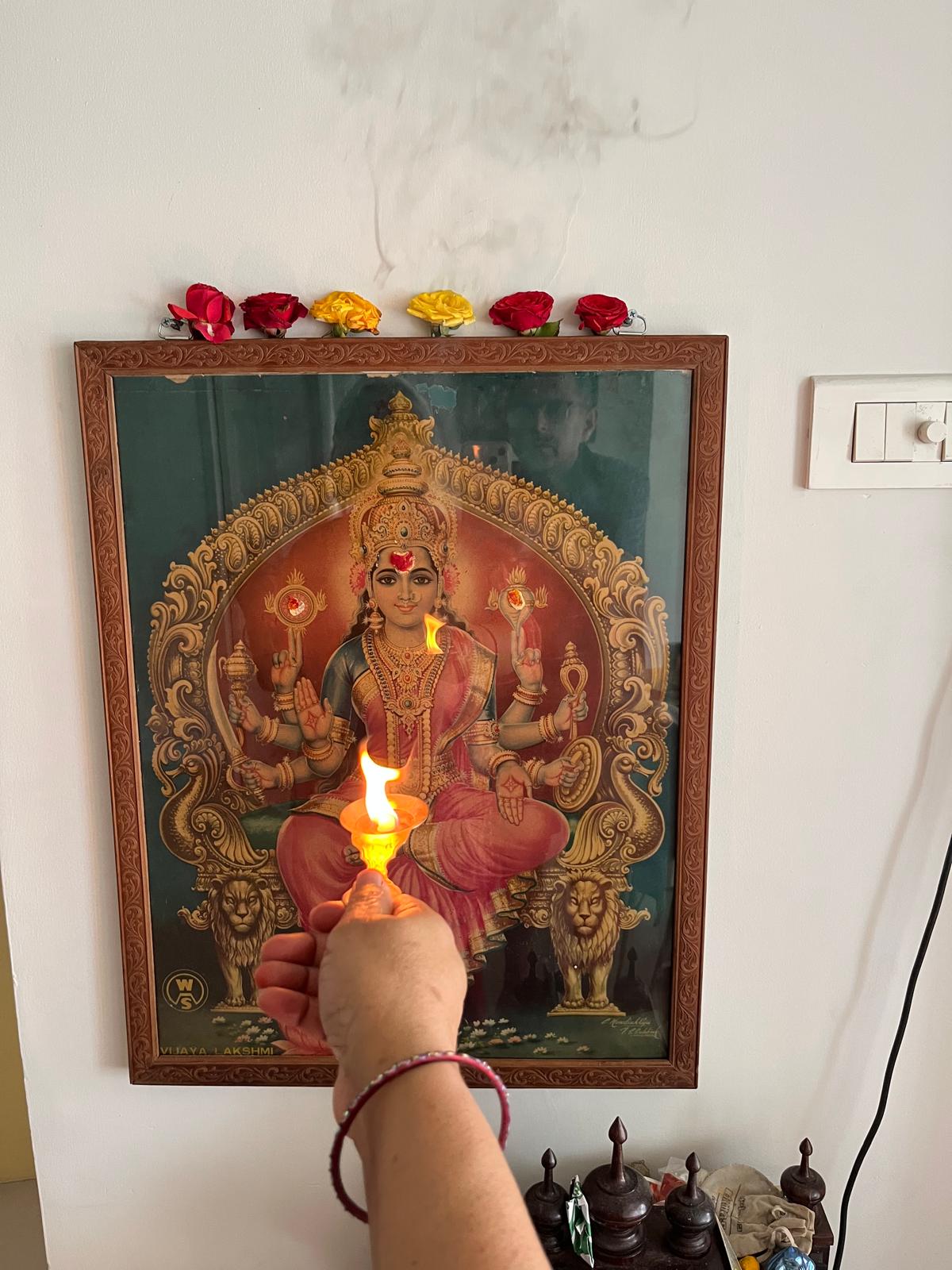
Apart from this Rama seems to have performed Chandi Homa to defeat Ravana.
This was performed after Indrajith performed a Secret Yaaga to defeat Rama.
After this Lakshmana was rendered unconscious by Inderjith.
‘Rama had performed “Chandi Homa” and invoked the blessings of Durga, who blessed Rama with secret knowledge of the way to kill Ravana. On the day of Ashvin Shukla Dashami, Rama defeated Ravana and rescued Sita. Thus it is termed as Vijaya Dashami. Based on the inferences from Valmiki’s Ramayana, Kalidas’s Raghuvamsa, Tulsidas’s Ram Charit Manas, and Keshavdas’s Ram Chandra Yas Chandrika as well as common perception in India, Rama, Sita, and Lakshmana returned to Ayodhya on the 30th day of Ashwin (19–20 days after Vijayadashmi). To mark the return of Lord Rama, in the evening, the residents of Ayodhya lit their city with millions of earthen lamps (called Deepak). Since then, this day is celebrated in India as Deepawali’
Benefits of Chandi Homa.
Chandi Homa can aid one in clearing off the obstacles and hurdles on the path to success.
Goddess Durga, the chief deity of this Homa will gift you with the power to balance one’s passion and dispassion, indulgence and denial.
With her blessing, one will be able to manifest your true divine Self that unites selfishness and selflessness.
By performing this Homa, one can invoke the energy of Goddess Durga, who will help you master your life!
Steps in Performing Chandi Homa.
A Chandi Homa is not an ordinary Homa and has to be performed by expert priests.
Duraga Sapthashati will be chanted.
Ganapathy pooja: Prayers are offered to the Lord Ganesha seeking his blessings. Worshipping Lord Ganesha clears all the obstacles and paves way for one’s success. So, before any auspicious beginning, Lord Ganesha is first addressed with pooja and prayers.
Kanya pooja: Kanya Pooja is one of the highlight of the Navaratri celebrations. Kanya pooja is a ritual of worshiping girls (aged 6 – 10) who haven’t attained puberty, symbolizing the Kanya Kumari (prepubescent) form of Goddess Chandi or Durga. This ritual is specially performed to recognize the divine feminine power vested in a girl child.
Anugna Sankalpam: Seeking the consent of the Goddess to perform the Yagna which is a sacred ritual. The ritual specifies for whom, where and when the yagna is performed.
Punyahavachanam: Purifying the mind, body and place before the yagna is performed. Water is sprinkled with mango leaves around the place with the chanting of Mantras.
Kalasa Sthaapana: Kalasa means a pot. It is made of metal and is filled with water and placed with Mango leaves immersed in the water. Pooja is made to this Kalasa invoking the blessings of the goddess.
Saptashati Parayanam: Chanting of Durga Saptashati Slokas (700 sanskrit poems) and worshipping the various forms of the Goddess. Bhairava Bhali (offering): After the chanting of Slokas, offering is made to Lord Bhairava (an incarnation of Lord Shiva) to signify the ritual.
Ganapathy pooja: Prayers are offered to Lord Ganesha before beginning the Yagna
Punyahavachanam: Pooja and mantras are chanted to purify the place and people who are performing the Yagna
Gho pooja: The Sanskrit word Gho means Cow. In Hinduism, Cow is considered to be a holy animal embodied with divine qualities. Pooja and prayers are offered to the cow before the yagna, seeking her blessings for prosperity.
Suhasini Pooja: Worshipping an elderly married woman (whose husband is alive) and performing Pada (traditional foot washing ceremony) pooja to invoke her blessings.
Dampathi pooja: Dampathi means couple. Prayers are offered to an elderly couple with Padha pooja.
Brahmachari pooja: A Brahmachari is an unmarried man. He is held in high esteem in Vedas and Puranas for several reasons. Padha pooja and prayers are offered to a Brahmachari seeking his blessings.
Chandi yagna: The fire ritual is performed with the chanting of Mantras and Slokas.
Sumangala Dravyaahuti: Auspicious materials such as Saree, turmeric, sandalwood powder, kumkum (vermillion) etc. are offered to the Goddess invoked in the Fire.
Purnaahuti: Any Yagna becomes complete only when this ritual is performed. Betel leaves, Betel nuts, Coconut, Kumkum (red colored auspicious powder), Turmeric, Flowers, Fruits, a coin, a small bag of herbs are put together in a silk cloth and tied. The bag is dropped into the fire seeking the blessings of the Almighty.
Maha Deeparadhana: A ritual to honor the Goddess. Lights are lit using camphor and are used to glorify the Goddess. It is also called Aarthi and is performed during the end of the pooja.
I wrote an article in July 2014, on the 68 Important Shiva Temples listed by Shiva Himself.
Yesterday I received a comment from a reader asking me the details about it.
Though my article contains information on this Shiva, it was sketchy because the place is Fullara, A Shakthi Peeta, where Devi’s Lower Lip fell.
So the accent of the article was more on Shakthi.
Shiva Linga in Cosmos.
In the list of 68 Shiva Temples provided by Shiva, the Attahasa is mentioned.
‘
Attahaas (Mahanaad),
Mahendra (Mahavrat),
Ujjain (Mahaakaal),
Marukot (Mahotkat),
Shankhakarna( Maha Teja)’
Lord Shiva in Meditation.
The apocalyptic laughter of Shiva is referred as Attahasa.
Some scholars are of the view that this a future manifestation of Shiva.
Shiva took the form of Attahasa in a mountain in the Himalayan Range.The sons of Shiva will also reside in the Attahasa mountain range in the 20th yuga.-Vayu Purana.
When the twentieth cycle of a yuga occurs, then I shall be known by the name Attahasa, the loudly launghing one – a form that people will adore. – (Linga Purana 1.24.94 – 95)
”
Atthas Peeta has the Devi‘s Lower Lip and She s worshiped as Fullara, Phullara Devi.
The temple is in Labhpur,Birbhum Disrict West Bengal,India.
Image of Devi and the Shiva temple is next to the Devi temple. It is a major pilgrimage and tourist attraction.
From Birbhum to Ahmedpur to Labhpur (6.5 miles). Attahas is just East of Labhpur, around 115 miles from Kolkata.
The temple of Bhairav is beside the temple of Maa Fullora or Phullara. A deity made of stone.
There are various legends on Mariamman, a form of Devi in South India.
Mariamman is believed to cure among other diseases, Smallpox.
Samayapuram Mariamman.
And also sores, ghouls, pustules and diseases.
Worship of Mariamman is prevalent in the Villages in Tamil Nadu, Karnataka and Andhra, though the worship is more prevalent in Tamil Nadu
Famous Samayapuram Mariamman Temple is near Tiruchi/Srirangam.
“Miracle Based : Mother Mariamman undergoes a fast for the welfare of mankind for 28 days from the last Sunday of Masi month-February-March. During these days no cooked preparation is offered as nivedhana but only some flour, orange, grapes and green coconut. For completing this fasting, abishek is offered to Amman only with flowers – Poo in Tamil and this event is known as Poo Choridal.”
”
The State of Tamil Nadu has several divine abodes of Goddess Shakthi. Shakthi cults prevalent in different ages are manifested in the temples. One of such divine abodes is Arulmighu Mariamman, Samayapuram in Trichy District. This Temple is known to occupy a prominent position among the temples dedicated to Goddess Shakthi. This temple is situated in beautiful land scape enriched by the Holy River Cauvery. The Temple is Situated in the Chennai – Trichy National Highway 15 K.M. from Trichy.
Trichy can be reached by train from Chennai, Madurai, and places, and also by airways from Chennai. The Goddess Mariamman is very powerful, devotees. wishes are fulfilled by the Goddess. Persons affected by Chickenpox and Smallpox come to this place, stay here and pray the Goddess for speedy recovery. Abisheka Theertham (Divine Water) is sprinkled on them after Pooja and they get recovered very quickly. There is a separate rest hall for their stay in the temple.
In ancient time This region was ruled by Chola Kings. Samayapuram is also known by the names Kannanur, Kannanpuram, Vikramapuram and Mahalipuram in ancient times. Flower sprinkling (Poochoridal) festival is conducted during the month of March and Chithirai Car festival is conducted during the month of April. Devotees offer prayer by rolling themselves around the temple prakaram (corridor) known as Angapradatchinam.
Samayapuram Mariamman Temple is one of the renowned Shakthi shrines of Tamilnadu. In recent times, the temple has gained a vast popularity. Devotees throng here from various parts of the country. The saying goes, “Samayapurthal will protect her devotees in times of need” (Samayapuram Mariamman Samayathil Kaappal – in Tamil). It is the faith of the people that Mariamman will protect them though they are far away from her in other places of the world.
This is one of the largest temples of the state earning high revenues for the Hindu Religious and Charitable Endowment with huge inflow of devotees. Thali the Mangal Sutra offered by women are the majority of the offerings in the Hundi of the temple. Diseases are cured without surgery in many cases. Many devotees visit this temple from Karnataka, as Mariamman resembles the Chamundeeswari of Mysore. There is also a story that Emperor Dasaratha visited Samayapuram to worship Mariamman.
She is reported to have given Darshan to a British Collector during the British Rule.Please read my article on this.
She is considered to be an Avatar of Durga.
Another version states that she was the wife of Jamadagni and mother of Parashurama and Parashurama accidentally cut of a cleaning woman while trying to fulfill his father’s orders to kill Jamadagni’s Wife(Renuka) because she sawa Gandharva in the reflection of River water while trying to get water for Pooja and thought for a fleeting moment how a Human being could be so beautiful!
Mariamman is worshiped as Sitala Devi in North India widely by many faiths in North India, West Bengal, Nepal, Bangladesh and Pakistan as the pox-goddess. She is the Goddess of sores, ghouls, pustules and diseases.
Goddess Durga has incarnated as little Katyayani, the daughter of sage Katyayan to destroy all arrogant evil demonic forces of the world, in her real form as Durga, she killed many demons that were sent by Kaalkeya.
A demon named Jwarasur, the demon of fever, started spreading incurable diseases to Katyayani’s childhood friends, such as cholera, dysentery, measles, smallpox etc. Katyayani cured the diseases of some of her friends. To relieve the world from all fevers and diseases, Katyayani assumed the form of Shitala Devi. Each of her four hands held a short broom, winnowing fan, jar of cooling water and a drinking cup. With her power, she cured all the children’s diseases. Katyayani then requests her friend, Batuk to go out and confront the demon Jwarasur. A battle ensued between the young Batuk and demon Jwarasur. Jwarasur succeeds in defeating Batuk. Then, Batuk, lying dead, magically faded into dust. Jwarasur was shocked that Batuk disappeared and wondered where he went. Then, what he doesn’t know that Batuk has assumed the form of an awful male figure. This person was three-eyed and had four arms. He held a battle-axe, sword, trident and demon head. He was pitch-black in color. His hair was flowing. Eyes blazed with fury. This figure wore a tiger-skin and a garland of skulls. Batuk assumed the form of Lord Shiva’s ferocious form, the terrible Bhairav. Bhairav reprimands Jwarasur and tells him that he is the servant of Goddess Durga (Katyayani). A long discussion ensued but then converted into battle. Jwarasur created many demons from his powers but Bhairav managed to destroy all of them. Finally, Bhairav wrestled with Jwarasur and killed him with his trident.
Shitala literally means “one who cools” in Sanskrit. Shitala is worshipped under different names in various parts of the subcontinent. Shitala is more often called Ma (‘mother’) and is worshipped by Hindus, Buddhists and tribal communities. She is mentioned in Tantric and Puranic literature and her later appearance in vernacular texts (such as the Bengali 17th century Shitala-mangal-kabyas, ‘auspicious poetry’) has contributed to strengthen her status.
Shitala is primarily popular among the people of North India. In some traditions she is identified with an aspect of Parvati, the consort of Shiva. Shitala is addressed as Mother, as a seasonal goddess (Vasant, i.e. Spring) and with honorific titles such as Thakurani, Jagrani (Queen of the World), Karunamayi (She who is full of mercy), Mangala (The Auspicious One), Bhagavati (The Goddess), Dayamayi (She who is Full of Grace and Kindness). The role of Shitala in South India is taken by the Goddess Mariamman, who is worshipped by the Dravidian-speaking people .
There is also a view that she is Draupadi of Mahabharata.
Yet another version states that she represents the betrayed women thus.
‘The popular mythology is her being Durgamma, daughter of a priest. She is allured into marriage by her dishonest husband. One day he expressed desire to consume the tongue of a cow. Durgamma realises that husband was a Brahmin in disguise. In her fury, she transformed into a Goddess, picked up a sickle and cut off the head of the imposter. That started off a betrayed wife cult. ”
I do not seem to find any Vedic or Ithihasa refernce to any of this, that Mariaamman being any of these mentioned in any of these legends.
The three forms of the female principles embodied in Durga, Lakshmi and Sarasvati are the expressions of Valour,Wealth and Knowledge needed for the Humans.
All the three have to stay together if one were to lead a successful Life.
Hindu festivals represent these principles and they remind one of these Life’s Truths.
Durga represents Valor, Lakshmi wealth and Sarasvati Knowledge.
The Nine days’ festival, Navaratri represents this.
I have written articles on the procedure Mantras and dates assigned to each Goddess.
There is a sacred text, called Devi Mahatmiyam in Markandeya Purana which delivers the results equivalent to accruing by reciting all the mantras of the three Devis.
Durga, Lakshmi, Sarasvathi.
The Devi (mother Goddess) killed Madhu and Kaidabha as Vishnu Maya (Thamasic-base), killed Mahishasura as Lakshmi (Rajashic form-materialistic) and killed Shumbha and Nishumbha in the form of Goddess Saraswathi (Sathvic-spiritual).
All the three are combined in this Stotra.
It consists of Chapters 74 to 86 (13 chapters) of the Markandeya Purana and has 700 stanzas.
This is known as Devi Mahatmya in South India, Chandi in West Bengal and as Durga Sapthasathi in the northern parts of the country including Varanasi.
How to do Devi Mahatmiya Parayan
There are two methods.
Trayangam is a method in which we need to chant three prayers – Devi Kavacham, Argala Stotram and Devi Keelakam followed by Navakshari Mantram.
Navangam is a method for which nine prayers are recited prior of starting reading the book. Navangam stotrams are: Devi Nyasa, Devi Avahana, Devi Namani, Argala Stotram, Keelaka Stotram, Devi Hrudaya, Dhala, Devi Dhyana and Devi Kavacha.
As per the prescribed methods in ancient scriptures, Devi Mahatmya should be read in one sitting. After finishing the recital of Devi Mahatmya, one should chant the Devi Suktam (slokas 7 to 36 of Chapter 8).
Devi Saptashati Parayana in 3 days & 7 days
Apart from one sitting recital, devotees read Devi mahatmya for three consecutive days: Prathama Charitra or 1st Chapter on first day, Madhyama Charitra (2, 3, 4 chapters) on 2nd day, and Uttama Charitra (5-13 chapters) on third day.
Some devotees also read Devi Mahatmya in 7 days. They chant 1st Chapter on first day, 2-3 chapters on 2nd day, 4th chapter on 3rd day, 5-8 chapters on 4th day, 9-10 chapters on 5th day, 11thchapter on 6th day and 12-13 chapters on 7th day.
Each chapter should be read in single sitting. Due to any reason, Parayana is stopped in between a chapter; the whole chapter should be read again.
The order of reciting Durga Saptashati Parayana daily is: Trayanga Mantra, Devi Mahatmya text followed by Devi Suktam.
Many devotees read Durga Saptashati during Navratri Durga Puja 9/10 days.. Here is the procedure to read Devi Mahatmyam during Navratri
How to read Durga Saptashati (Devi Mahatmyam) during Navratri festival
1st day: Chapter 1 (Madhu kaitabha samhaaram)
2nd day: Chapter 2, 3 and 4 (Mahishhasura samhaara)
3rd day: Chapter 5 and 6 (Dhuumralochana vadha)
4th day: Chapter 7 (Chanda Munda vadha)
5th day: Chapter 8 (Rakta biija samhaara)
6th day: Chapter 9 and 10 (Shumbha Nishumbha vadha)
7th day: Chapter 11 (Praise of Narayani)
8th day: Chapter 12 (Phalastuti – reciting merits or benefits)
9th day: Chapter 13 (Blessings to Suratha and the Merchant)
10th day: Chapter 14 (Aparadha Kshamaprarthana) on 10th day
You can also complete the recital on 9th day by chanting Devi Aparadha Kshama Prarthana Stotram on 9th day itself.
You should read Siddha Kunjika Stotram after completing the recital of every chapter.
This manthra is of very great power and should not be chanted unless, it is taught by a Guru.
The other is Navangam, where nine prayers are recited before starting reading of the book. They are chanting of 1. Nyasa, 2. Avahana, 3. Namani, 4. Argala, 5. Keelaga, 6. Hrudhaya, 7. Dhala, 8. Dhyana and 9. Kavacha.
It is recommended that the entire Devi Mahatmya should be read in one sitting. After completion of the reading it is necessary to chant the Devi Suktham consisting of the slokas seven to 36 of chapter 8, is to be chanted. If the Guru has taught the navakshari manthra, then it should also be meditated up on.
You must be logged in to post a comment.