Tag: Asura

  • Kashyapa Father of Vishnu Rudra Paediatrics Kashmir An Overview

    Kashyapa Father of Vishnu Rudra Paediatrics Kashmir An Overview

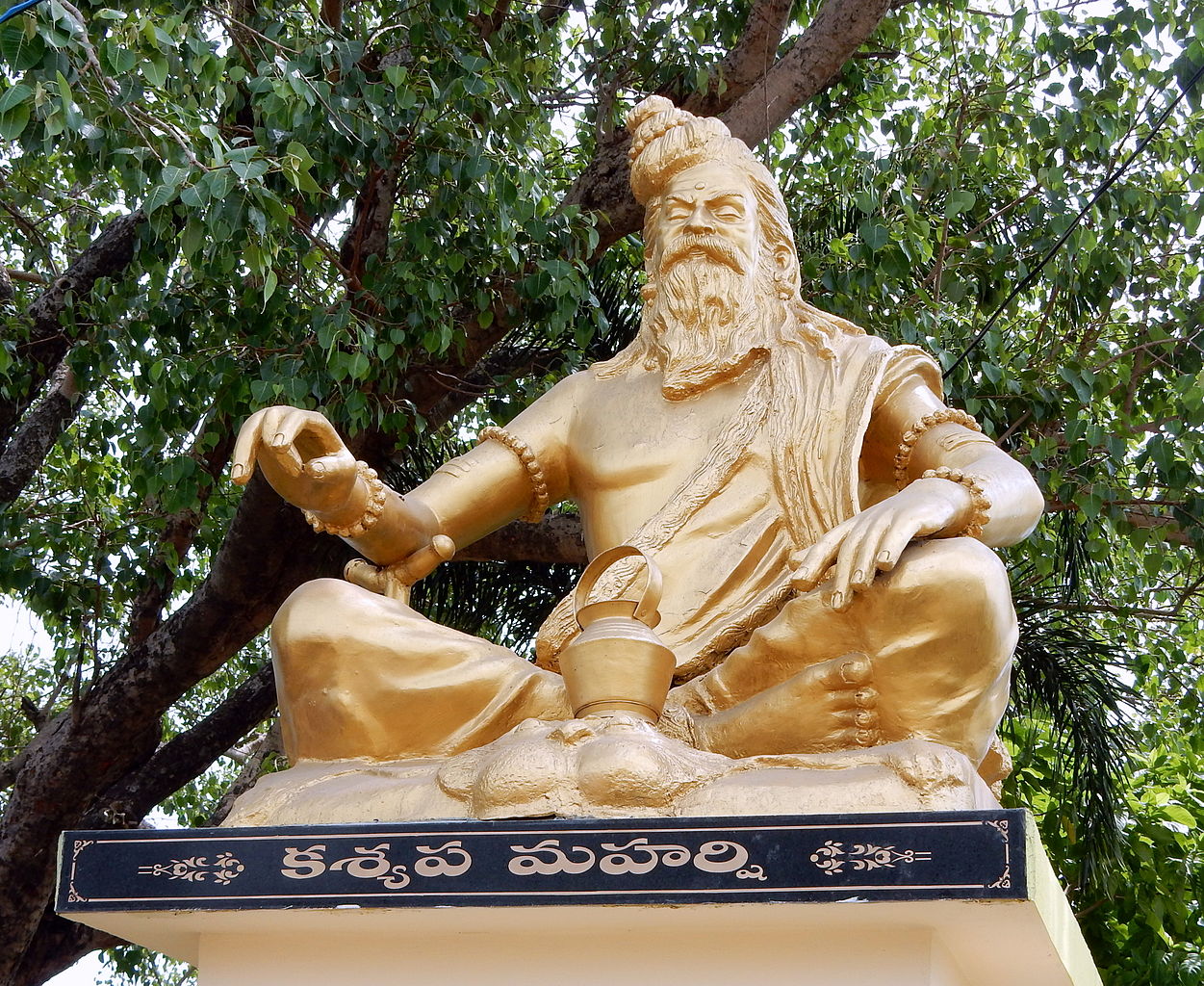
    Kashyapa,one of the Eternal Seven Seers, a Saptha Rishi,may in a sense be considered as the Grandsire of Humanity.

    The term Kashyapa means ‘tortoise’

    Undisturbed am I, undisturbed is my soul,
    undisturbed mine eye, undisturbed mine ear,
    undisturbed is mine in-breathing, undisturbed mine out-breathing,
    undisturbed my diffusive breath, undisturbed the whole of me.

    Thereafter rose Desire in the beginning, Desire the primal seed and germ of Spirit,
    O Kama dwelling with the lofty Kama, give growth of riches to the sacrificer, (…)
    Prolific, thousand eyed, and undecaying, a horse with seven reins Time bears us onward,
    Sages inspired with holy knowledge mount him, his chariot wheels are all the worlds of creatures.

    Kala [Time] created yonder heaven, and Kala made these realms of earth,
    By Kala, stirred to motion, both what is and what shall be, expand, (…)
    Kala created living things and first of all Prajapati,
    From Kala self-made Kasyapa, from Kala Holy Fire was born.

    — Atharvaveda, Book XIX, Hymns L51-5′

    One may recall the Koorma Avatar of Vishnu and the legend of Turtle/Tortoise is present in the formation of Earth in ancient legends.

    Seems there is a message here.

    Am looking into references in world religious texts and legends.

    Kasyapa is the most ancient Rishi listed in the most ancient Upanishad,Brihadaayanka Upanishad.

    Kasyapa is listed as a Saptha Rishi in the Rig Veda.

    Saptha Rishis are eternal and they remain,Along with Narayana in is Yogic Slumber,while the world is being withdrawn.(Pralaya).

    In Hinduism,there is no destruction of the Universe.

    The term Dissolution is used to convey the meaning of the Sanskrit word,Pralaya.

    Withdrawal may be nearer to the meaning of Pralaya.

    These Saptha Rishis preserve the Vedas and lay down the rules for Mankind in Ech Manvantara.

    Kashyapa is one among these.

    His progenies included Devas,the Heavenly Beings and the Asuras,the Beings of the Netherworld,Patala.

    Of his children, 12 Adityas,Lord Vishnu is One.

    Adityaanam Aham Vishnu’ -Bhagavad Gita.Vibhuthi Yoga.

    Rudra is also recorded as a son of Kashyapa and his wife Aditi.

    The Eleven Rudras.

    1. Nirriti
    2. Shambhu
    3. Aparajita
    4. Mrigavyadha
    5. Kapardi
    6. Dahana
    7. Khara
    8. Ahirabradhya
    9. Kapali
    10. Pingala
    11. Senani

    And Kasyapa  had the Eight Vasus among his 33 children.

    ‘Kashyapa was wedded to the famed mothers of Lokas viz. Aditi, Diti, Danu, Kaashtha, Arishta, Anayuvu, Khasa, Surabhi, Vinata, Taamra, Muni, Krodhavasa, and Kadru. His sons were the Dwadashadityaas viz. Dhata, Aryama, Mitra, Varuna , Amsha, Bhaga, Indra, Vivaswanta, Pusha, Parjanya, Twashta, and Vishnu.

    From Surabhi, Kashyapa was blessed with Ekadasha Rudraas viz.Angaraka, Sarpa, Niruti, Sadasaspati, Ajaikapaada, Ahirbhudnya, Jwara, Buvana , Ishwara, Mrityu and Kapali. From Surabhi, there were two daughters, viz. Rohini and Gandharvi; Rohini begot four daughters named Surupa, Hamsakali, Bhadra and Kamadu: Kamadu gave birth to Cows, Hamsakali begot Mahishaas; and Gandharvi begot Ashvas or horses; Surabhi also begot a Vrishabha/ Bull which was secured as ‘ Shiva Vahana’.

    From Aditi, Kashyapa Muni begot Indra and Devatas. Diti gave birth to Hiranya kashipu  as Kashyapa concluded the ‘Ati Raatra’ of the just finished Ashvamewdha Yagna; the new born was the younger brother of Hiranyaaksha. Their younger sister was Simhika the wife of Viprachit and their son was Rahu.

    His wives were the daughters of Daksha.

    His marriage and his offsprings may be interpreted by Cosmology and as an allegory of Astronomy as well.

    Available evidence points out to Kashmir as Kashyapa’s birth place and Kashmir is named after him.

    ‘Rishi. According to the ancient legends, he reclaimed that land from a vast lake, his school was based there, and the land was named after him.The name Kashmir, states Christopher Snedden, may be a shortened form of “Kashyapa Mir” or the “lake of the sage Kashyapa”, or alternatively derived from “Kashyapa Meru” or the sacred mountains of Kashyapa’

    Kasyapa in Russia.

    Caspian Sea.

    The word Caspian is derived from the name of the Caspi (Persian کاسی), an ancient people that lived to the west of the sea in Transcaucasia. Strabo wrote that “to the country of the Albanians belongs also the territory called Caspiane, which was named after the Caspian tribe(Kaswan, Kashyap Jat clans), as was also the sea; but the tribe has now disappeared”. Moreover, the Caspian Gate, which is the name of a region in Tehran province of Iran, is another possible piece of evidence that they migrated to the south of the sea.

    The root of the word Caspian can also be traced to Sanskrit.’

    Works of Kasyapa.

    • Kashyapa Samhita, also called Vriddajivakiya Tantra or Jivakiya Tantra, is a classical reference book on Ayurvedic pediatrics, gynecology and obstetrics. It was revised by Vatsya.
    • Kashyapa Jnanakandah, or Kashyapa’s book of wisdom, is a 9th century text of the Vaishnavism tradition. ( I do not agree with this date. Kasyapa can be dated much earlier).
    • Kasyapa dharmasutra, likely an ancient text, but now believed to be lost. The text’s existence is inferred from quotes and citations by medieval Indian scholars.
    • Kasyapa sangita, likely another ancient text, but now believed to be lost.
    • Kasyapasilpa, also called Amsumad agama, Kasypiya or Silpasastra of Kasyapa, is a Sanskrit treatise on architecture, iconography and the decorative arts, probably completed in the 11th century

    https://ramanisblog.in/2015/02/21/caspian-sea-kashyapa-sagar-of-hinduism/

    References and Citations.

    http://www.kamakoti.org/kamakoti/brahmandapurana/bookview.php?chapnum=12

    https://en.m.wikipedia.org/wiki/Kashyapa

    //ws-na.amazon-adsystem.com/widgets/q?ServiceVersion=20070822&OneJS=1&Operation=GetAdHtml&MarketPlace=US&source=ss&ref=as_ss_li_til&ad_type=product_link&tracking_id=ramasblog-20&marketplace=amazon&region=US&placement=8170305330&asins=8170305330&linkId=094ea6a59f84ff4dfd6819b5be30cae5&show_border=true&link_opens_in_new_window=true

    //ws-na.amazon-adsystem.com/widgets/q?ServiceVersion=20070822&OneJS=1&Operation=GetAdHtml&MarketPlace=US&source=ss&ref=as_ss_li_til&ad_type=product_link&tracking_id=ramasblog-20&marketplace=amazon&region=US&placement=B00P293PO2&asins=B00P293PO2&linkId=ea18983e9c484150128e37beb1a26b4a&show_border=true&link_opens_in_new_window=true

  • Indra In Incas Peru Viracocha Ramayana, Upanishad

    Viracocha of South America tradition, is the great creator deity in the pre-Inca and Inca mythology in the Andes region of South America. Full name and some spelling alternatives are Wiracocha.

    Viracocha god of Incas.Image,jpg
    Viracocha, of Incas.
    Image credit.wiki.

    Tiqsi Huiracocha may have several meanings. In the Quechua language tiqsi means foundation or base, wira means fat, and qucha means lake, sea, or reservoir.Viracocha’s many epithets include great, all knowing, powerful, etc. Wiraqucha could mean “Fat (or foam) of the sea”.

    The name is also interpreted as a celebration of body fat (Sea of fat), which has a long pre-Hispanic tradition in the Andes region as it is natural for the peasant rural poor to view fleshiness and excess body fat as the very sign of life, good health, strength, and beauty.

    Another interpretation of the word is ‘The word ‘Vira’ (वीर) means ‘brave, heroic, powerful, strong’. ‘Kocha’ (कोच) means a ‘man of Mixed Ancestry.

    He reminds of Indra,the Chief of Devas.

    Like Indra Viracocha wields Thunderbolt and the chief Deity among the Incas, pre-Inca Pantheon.

    According to Puranas Indra and Virochana both studied under Prajapathi.

    While Indra advocated the worship of the Atman, The Self as the goal of Life, Virochana worshiped Sarira, the Human Body.

    Hence he was not considered as a Deva in Sanatna Dharma, though his story is narrated in the Puranas and the Ramayana.

    In the Valmiki Ramayan of India, Virochana (Sanskrit: विरोचन), was the first great Asura king with supernatural powers. (Asuras were power seeking deities). The Upanishads say that Virochana and Lord Indra together were taught at the feet of Prajapati. However, contrary to what he was taught, Virochana preached the Asuras to worship the ‘sharira’ (body) instead of the ‘atman’ (absolute consciousness)…

    Scholars say today, the megaliths of South America, such as the Temple of ‘Kalasasaya’ (which houses an idol of Viracocha) in Bolivia, could not have been made without alien help.

    Investigations in Assyrian mythology prove the existence of a tradition in Assyrian history of such a king called Berosus – a distortion of Virochana and Viracocha – as it has often been reiterated ‘b’ and ‘v’ are commutable. According to Swami Vivekananda “the western nations are the children of the great hero Virochana.” (Source: Talks with Vivekananda: Publisher- Advaita Ashram, Mayavati, Himalayas, January 1939.)’

    I have posted about the origin of the Incas as being the Tamils of India.

    The Incas celebrated the Makara Sankaranti in the South Indian Style.

    ‘Most of you in India are familiar with the Charak Puja ceremonial observed in Bengal and several States in South India. This Hindu Ceremonial also observed in Mexicohistorian call it the mexicon and peru. The Spanish Valador ritual. A relief of Bayon central temple of Angkor Thom inCambodia represents a rite similar to the Mexico Valador. The use of parasol (Chhatra) is an age-old sign of royalty and rank in India, Burma, China and Japan. The Maya Astec and the Incas also used it as a sign of royalty. Frescoes of Chak Multum in Yucatan show two types of parasols both of which correspond to types still in use in South-East Asia.’

    Incas celebrated it as “Inti Raymi”

    Makara Sankaranthi in Peru

    For more on this Google Incas ramanan50.

    Reference and citation.

    http://vediccafe.blogspot.in/2012/07/in-valmiki-ramayan-of-india-virochana.html

  • Plasma Tubes In The Sky Science Validates Hinduism

    Fourteen levels of Existence are described in the Hindu Texts,especially in the Puranas.

    I am providing excerpt towards the close of the Post.

    Tube Like Structures in the Sky.jpg, Tube Like Structures in the Sky. Credit: CAASTRO / Mats Björklund (Magipics)

    The Devas, Divine Beings and the Asuras, the wicked ones used to travel along these.

    The Asuras are placed in the Heavens along with the Devas while the Rakshasas were reported to be living in the nether world.

    For the difference between Rakshas and Asuras please read my posts on these.

    These Asuras and Devas frequent the earth.

    Some of them have their abodes in the Earth.

    While they travel, they go through very high temperatures in these areas and they had adequate preparations to counter this.

    The measures taken by them is not clear in the physical level and it looks as though they were involved in some sort of mental conditioning.

    Let me check more and share

    One such was built by Maya, the Divine architect in the Vindhya Mountains, which was a Wormhole.

    Hanuman, while searching for Sita encountered this and a detailed description is found in the Kishkinda Kanda of The Ramayana.


    There Hanuman and others  became disoriented .

    They found, inside the cave verdant flowers and spring, Swans leaving with drenched bodies.

    ‘On entering the Cave, they the monkeys beheld choicest mansions everywhere made out of gold and silver, some with golden and some with silver domes, while some with golden and some with silver multi-stories, but all are studded with lapis gems with golden windows covered with laceworks of pearls. They have also seen everywhere flowered and fruited trees that are similar in shine to red corals and rubies, and golden honeybees, as well as honeys.

    They beheld everywhere diverse and capacious beds and seats that are amazingly crafted with gemstones and gold, and stacks of utensils made of gold, silver and bell metal. They saw the stockpiles of heavenly aloe vera substances and sandalwood sticks and depurated eatables, tubers and fruits. They have also seen top-grade soft drinks, luscious honeys, heaps of finest quality clothing, exotic blankets and sheaves of deerskins. Vanara-s have also observed mounds of undefiled gold stockpiled here and there glowing with the glow of ritual fire’

    Hanuman also noted that the Time was lapsing.

    Remembering that the deadline given by Sugreeva was nearing, He requested the Lady Maya, Swayam Prabha, to deliver all the Vanaras from the Pit.

    ‘She obliged.

    Ramayana states,

    ‘Monkeys enter Riksha cavity, an unsightly and gloomy one, during their search in southern direction. While groping in that dark they loose time set by Sugreeva. Finally, they see luminosity and extraordinarily built mansions, woodlands, trees and lakes. Thereupon they catch sight of an elderly sainted lady and they all approach her asking after the legend of that cavity.


    saha taaraa a.ngadaabhyaam tu sa.ngamya hanumaan kapiH |
    vicinoti ca vindhyasya guhaaH ca gahanaani ca || 4-50-1

    1. kapiH hanumaan= monkey, Hanuma; taaraa angadaabhyaam saha= Lt. Tara, Angada and others, along with; sangamya= associated with; vindhyasya guhaaH ca gahanaani ca= Vindhya’s, caves, also, thick forests, also; vicinoti ca= searched, also.’

    For more on Wormhole in Ramayana Read here.

    And the Puranas describe these places as Tubular Structure.

    The Fourteen worlds.


    Amongst the 14 worlds thus mentioned, the 7th one viz. Bhu-loka is  Earth..

    ‘Bhu’ means ‘Earth’ and ‘loka’ means the surface of planet Earth, where we live.

    2.Bhuvar Loka.

    Vishnu Purana: Chapter 7:- The region that extends from the earth to the sun, in which the Siddhas and other celestial beings move, is the atmospheric sphere (Bhuvar Loka), which also I have described.


    Bhuvar-loka is identified with Earth’s atmosphere and sometimes with the space which is in the immediate neighborhood of Earth.


    In other words Bhuvarloka is the near-Earth space including Earth’s atmosphere.


    This is the region were all the aircrafts fly and where all the artificial-satellites and space-stations that orbit around the Earth are situated.


    This region can be equated to the Geospace, the space dominated by Earth’s magnetic field.


    3.Suvar Loka.


    Vishnu Purana: Chapter 7:- The interval between the sun and Dhruva, extending fourteen hundred thousand leagues, is called by those who are acquainted with the system of the universe the heavenly sphere (Suvar Loka)

    Suvar-loka (alternatively Swar-loka) is beyond Bhuvarloka.

    Some description makes it a planet inhabited by the Devaswith their king Indra.

    Some references make it equivalent to the Swarga

    Some Puranic references to equate Suvarloka to the Solar System.

    As per these the Suvar loka is consisted of nine sub divisions or sectors called….

    Link provided at the end of this Post.

    Hindu Purans, Ramayana and Mahabharata speak of  traveling in the sky by Beings through tube likee structure.

    Now Astronomers have found that there ae tube like structures above us in the Iona sphere and in between the Galaxies/Stars.

    Report.

    TORONTO, ON [1 June 2015] – By observing galaxies billions of light-years away, a team of astronomers has detected tube-like structures mere hundreds of kilometres above the Earth’s surface.

    “For over 60 years, scientists believed these structures existed but by imaging them for the first time, we’ve provided visual evidence that they are really there,” said Cleo Loi of the ARC Centre of Excellence for All-sky Astrophysics (CAASTRO) at the University of Sydney and lead author of a paper published in Geophysical Research Letters last week.

    The astronomers—including Prof. Bryan Gaensler, former director of CAASTRO and the current director of the Dunlap Institute at the University of Toronto—made their observations with the Murchison Widefield Array. The MWA is a radio telescope in Western Australia designed to observe the early Universe and distant galaxies, as well as stars and nebulae within our own Milky Way Galaxy.

    As light from a galaxy passes through layers in the Earth’s magnetosphere, the light’s path—and hence the galaxy’s apparent position—is altered by variations in density in the layers. The effect is like looking up from the bottom of a swimming pool at the distortions caused by waves on the surface.

    Mapping the variations in the positions of multiple radio sources over the course of a night revealed the shape and dimensions of the tube structures. As well, by exploiting the MWA’s rapid “snapshot” capabilities, Loi and her colleagues created a movie—effectively capturing the real-time motions of the tubes.

    According to Gaensler, “We were trying to understand if the motions of the ionosphere were random or had a pattern, both to see if the MWA could be used to study the ionosphere, and also to be able to correct for its effect and study the sources behind it.”

    In addition, the astronomers made their observations using the east and west halves of the MWA’s array of antennas as separate instruments. “This is like turning the telescope into a pair of eyes, and by doing that we were able to probe the 3D nature of these structures and watch them move around,” said Loi.

     http://www.dunlap.utoronto.ca/distant-radio-galaxies-reveal-hidden-structures-heads/


    https://ramanisblog.in/2014/05/24/hinduism-seven-higher-lokas-existence-explained/

  • Monkeys In Shiva Trishul Nazca Lines Peru

    I had written articles on the Nazca Lines, where the three lines in Peru resembling Lord Shiva’s Trishul is present even today and the reference in the Ramayana to the Nazca Lines, , the Hindu Epic,where the Vanara (Monkey) King directs his Monkey army to search for Sita who was abducted by Ravana.

    And I have also written on the three rotating cities destroyed by Shiva.

    Now it has come to light that the Nazca Lines, consist of Monkey figures drawn inside the Lines and archaeologists are unable to explain it!

    Giant Monkey Figure in Nazca Lines, Peru.Image.jpg
    Giant Monkey Figure in Nazca Lines, Peru.

    Monkeys in Nazca Lines.Image.jpg
    Monkeys in Nazca Lines.

    In the Peruvian Desert, about 200 miles south of Lima, there lies a plain between the Inca and Nazca (sometimes also spelled Nasca) Valleys. Across this plain, in an area measuring 37 miles long and 1-mile wide, is an assortment of perfectly-straight lines, many running parallel, others intersecting, forming a grand geometric form. In and around the lines there are also trapezoidal zones, strange symbols, and pictures of birds and beasts all etched on a giant scale that can only be appreciated from the sky.

    The figures come in two types: biomorphs and geoglyphs. The biomorphs are some 70 animal and plant figures that include a spider, hummingbird, monkey and a 1,000-foot-long pelican. The biomorphs are grouped together in one area on the plain. Some archaeologists believe they were constructed around 200 BC, about 500 years before the geoglyphs.

    There are about 900 geoglyphs on the plain. Geoglyphs are geometric forms that include straight lines, triangles, spirals, circles and trapezoids. They are enormous in size. The longest straight line goes nine miles across the plain.


    Discovery and Meaning

    Though discovered by Peruvian archaeologist Toribio Mejia Xesspe who spotted them while hiking through the surrounding foothills in 1927, the forms are so difficult to see from the ground that they were not widely known until the 1930’s when aircraft spotted them while surveying for water. The plain, crisscrossed, by these giant lines with many forming rectangles, has a striking resemblance to a modern airport. The Swiss writer, Erich von Daniken, even suggested they had been built for the convenience of ancient visitors from space to land their ships. As tempting as it might be to subscribe to this theory, the desert floor at Nazca is soft earth and loose stone, not tarmac, and would not support the landing wheels of either an aircraft or a flying saucer.

    So why are the lines there? The American explorer Paul Kosok, who made his first visit to Nazca in the 1940s, suggested that the lines were astronomically significant and that the plain acted as a giant observatory. He called them “the largest astronomy book in the world.” Gerald Hawkins, an American astronomer, tested this theory in 1968 by feeding the position of a sample of lines into a computer and having a program calculate how many lines coincided with an important astronomical event. Hawkins showed the number of lines that were astronomically significant were only about the same number that would be the result of pure chance. This makes it seem unlikely Nazca is an observatory.

    Perhaps the best theory for the lines and symbols belongs to Tony Morrison, the English explorer. By researching the old folk ways of the people of the Andes mountains, Morrison discovered a tradition of wayside shrines linked by straight pathways. The faithful would move from shrine to shrine praying and meditating. Often the shrine was as simple as a small pile of stones. Morrison suggests that the lines at Nazca were similar in purpose and on a vast scale. The symbols may have also served as special enclosures for religious ceremonies.


    How were they built? The lines were apparently made by brushing away the reddish, iron oxide covered pebbles that compose the desert surface and uncovering the white colored sand underneath. In most places wind, rain and erosion would quickly remove all traces of this within a few years. At Nazca, though, the lines have been preserved because it is such a windless, dry and isolated location.

    A writer by the name of Jim Woodman believes that the lines and figures could not have been made without somebody in the air to direct the operations. “You simply can’t see anything from ground level,” states Woodman. “You can’t appreciate any of it from anywhere except from above. You can’t tell me the Nazca builders would have gone to the monumental efforts they did without ever being able to see it.”

    Woodman has proposed that ancient hot-air balloons were used to get an aerial view of the construction. To prove his hypothesis, Woodman constructed a balloon using materials that would have been available to the Nazca people. He was able to conduct a successful flight, though it only lasted two minutes.

    Considering the mass of Finds found in the Americas relating to Hinduism and the Ramayana, I am of the view that the area was peopled by ancient Indians and the lines might have been marked by them.

    Or,since the Patalas , the Nether world, referred to by Hindu Texts as having been inhabited by the Rakshasa,they could have used this as a launching pad to travel to other worlds.

    Citations and Reference.

    http://www.unmuseum.org/nazca.htm


  • Less Than One Crore Shiva Rock Temple Unakoti

    The Images od Lord Shiva carved on Rocks in Unakoti, Tripura are intersting and Unakoti is a Shaiva Pilgrimage spot.


    Ganesa in Unakoti.jpg
    Ganesa in Unakoti.


    Unakoti.jpg
    Unakoti Shiva.”Unakoti (Scorpian ad)”. Licensed under CC BY-SA 3.0 via Wikipedia – http://en.wikipedia.org/wiki/File:Unakoti_(Scorpian_ad).JPG#mediaviewer/File:Unakoti_(Scorpian_ad).JPG

    The word ‘Unakoti’ stands for the meaning “one lesser than a crore”.

    It is believed that, there are that many numbers of carvings present here. Lord Shiva stayed at this location for just one night, when he was making a journey to Kashi. He was making the journey along with other gods and goddesses; a total of one crore in numbers.


    when the night got over, no one else other than Shiva woke up. As a consequence, he got angry and put a curse on the others to become stone figures. Thus, there are one crore minus one number of stone sculptures present here.

    The mythological story related to this place is that, when the night got over, no one else other than Shiva woke up. As a consequence, he got angry and put a curse on the others to become stone figures. Thus, there are one crore minus one number of stone sculptures present here.

    Another story revolves around one Kalu Kamar, the famous sculptor. He was assigned the task to build a crore of the deities in his dream. But keeping the last idol unfinished Kalu created his own image. Thus ‘Koti’ could not be completed. So, the place got its name as Unakoti.

        The history of old Kailashahar is also associated with Unakoti. A 15th generation descendant of King Jujhar Fa, a Shiva disciple who started the Tripurabda (Tripuri Calendar), prayed for Lord Shiva in a village called Chhambulnagar on the banks of the river Mau. It is speculated that Chhambulnagar, which is mentioned in Rajmala, was situated near Unakoti Hill. The Prince prayed for Mahadeva in Unakoti. For this some people believe that the previous name of Kailashahar was Chhambulnagar. Some believers thought that Har (Shiva) resides in Kailash. Therefore the place was known as Kailash Har which was later on transformed to Kailashahar. A Tripura king named Adi-Dharmapha ruled here in 7th century. He performed a great yagna with much pomp and gaiety. The name Kailashahar found currency since that time.

        Unakoti has been included in the tourism map of Tripura and the North-East as a remarkable tourists’ resort. Common pilgrims frequent the place. Tourists from far and wide also converge in Unakoti with much enthusiasm. One can have a trip to Unakoti via Kailashahar or Dharmanagar. The journey takes 20 minutes from Kailashahar and 45 minutes from Dharmanagar

    How to reach.

    By air: The nearest air terminal is located  Agartala.

    By road: One can opt for buses, jeeps, taxis or private cars in order to reach this place.

    Around 178km from state capital Agartala, .