He got his daughters married to the Seven Sages and in one instance had Lord Shiva as his son in law.
Hindus have identified the hand of Prajapati in a Stellar Constellation.
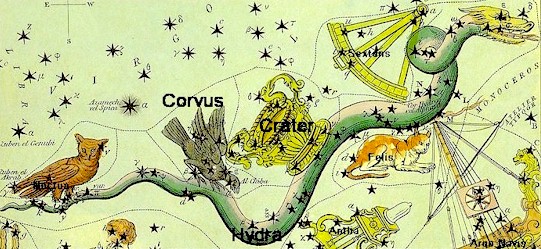
“As these stars were utilized by the Arabs in forming their exaggerated Asad (lion), so also were they by the Hindus in the immense Praja–pati, of which they marked the hand, — this title being duplicated for Orion, and much better known for that constellation. The head of the figure was marked by Citra, our Spica, and the thighs by the two Vicakhas, alpha and beta Libra; while the Anuradhas, delta, and pi Scorpio, formed Praja-pati’s standing-place. Incongruously enough, they considered Nishtya, or Svati, — our star Arcturus, — as the heart; but as this was far out of the proper place for that organ, Professor Whitney substituted iota, kappa, and lambda Virginis of the manzil and sieu.”
Of the few major Deities mentioned in the Vedas ,Subrahmanya is One.
He is called Skanda in the Veda.
The ancient language Tamil venerate Him as the God of Tamil and He is the personification of Tamil.
The eighteen consonants and vowels are represented by Murugan, Murugu in Tamil means exquisitely beautiful, by His six faces and twelve forms.
He imparted Brahma Gnana to Brahma and even preached His Father, Lord Shiva.( The temple depicting this incident is Tiruthani, Tamil Nadu, where Lord Shiva kneels before Subrahmanya!
In Sanskrit, when you add the prefix ‘su’, it means the ‘highest, best’
Of the Trimurtis Shiva is a Brahmin.
Subrahmanya is the Best or the Higher Brahmin for He taught Shiva!
Subramanyas’ footprints..
Lord Subramanya’s Footprints,Jnana malai,Tamil Nadu,India. On the west side of Jnanamalai hillock there is a small Siva temple. Behind it one finds what appear to be deep footsteps in the rock. They appear as footprints on molten lava. Incidentally this is a volcanic mountain from all appearances. There is a local belief that these footsteps are those of Lord Muruga Himself.There is also a belief that Murugan visited this place after marrying Valli Amman in Vallimalai on way to Tiruttani. Tiruttani and Vallimalai form form a triangle with Jñāna Malai and both can be seen from this hill. Around the hill there is a lake and in the rainy season Jnanamalai looks like an island.Murugan Footprint Palani.Murugan Footprint Kinathukadavu.Perched on the 600-ft. imposing hillock, adored as Kanakagiri, Sri Pon Velayudhaswami temple of Kinathukadavu (located midway between Pollachi and Coimbatore) has the glory and pride of place as one of the few shrines in Kongu Nadu, celebrated by Saint Arunagiri Nathar in his divine hymns. The hill shrine can be reached by climbing an easy flight of 200 neatly carved steps. The origin of the temple dates back to the thirteenth century. The temple was renovated by the rulers of Mysore
Altair rotates rapidly, with a velocity at the equator of approximately 286 km/s.[nb 3][4] A study with the Palomar Testbed Interferometer revealed that Altair is not spherical, but is flattened at the poles due to its high rate of rotation.[12] Otherinterferometric studies with multiple telescopes, operating in the infrared, have imaged and confirmed this phenomenon.(wiki)
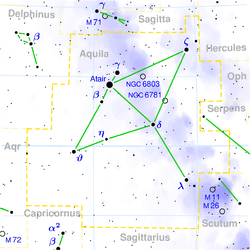
Altair, the foot print of Vishnu.
In classical mythology Aquila, and by extension Altair as well, was an eagle favored by Zeus. He played a part in numerous myths, including the abduction of Ganymede in which a young boy (Ganymede) is carried off to Mount Olympus on Zeus’ command to become the cupbearer to the gods. In another myth Aquila is the eagle that torments Prometheus, and is shot with a poisoned arrow by Hercules.
In India, Altair with its two flanking stars, Beta and Gamma (Tarazed and Alshain), are sometimes thought to be the celestial footprints of the god Vishnu.
Altair is separated from the similar-looking (but brighter) star Vega in the constellation Lyra by the great starlit band of the Milky Way. In Asia, this hazy band across our sky is known as the Celestial River. One story common in China, Japan and Korea a young herdsman (Altair) who falls in love with a celestial princess (Vega), who weaves the fabric of heaven. The princess became so enamored of the herdsman that she neglects her weaving duties. This acts enrages the princess’s father, the Celestial Emperor, who decrees that the herdsman must stay away from his daughter, on the opposite side of the River. The Emperor finally listened to the princess’s pleas, however, and allowed the herdsman to cross the Celestial River once per year, on the seventh day of the seventh month.
Altair is only 16.8 light-years away from Earth, making it one of our nearer stellar neighbors. At least two features of the star Altair make it distinctive.
First, Altair rotates rapidly. This star requires only about 10 hours to spin once on its axis, in contrast to 24 hours for our Earth to spin or roughly a month for our sun. In other words, this mighty star spins on its axis more rapidly than Earth! This rapid rotation tends to flatten the star a bit, much as a pizza crust flattens as it spins. Estimates are roughly that Altair’s flattening is about 14 percent. The sun also is an oblate spheroid, although its flattening is difficult to measure due to the low rotation rate.
That Hinduism , Sanatana Dharma was spread throughout the world, I have been posting articles on this, is evident to those who follow world history, monuments and Archaeology.
I have published articles that Hinduism was in Germany,Greece,China, Central America, Africa, Italy,Russia,Middle east, Iran,Iraq, Burma,Fiji.
A princess is reported to have married a Korean King,noble.
She is venerated as Queen.
Heo Hwang-ok is a legendary queen that mentioned in Samguk Yusa, a 13th-century Korean chronicle. She was the wife of KingSuro of Geumgwan Gaya. The legend states that she arrived on a boat from a distant kingdom, and married the king in the year 48 CE. She was the first queen of Geumgwan Gaya, and is considered an ancestor by several Korean lineages.
The legend of Heo is found in Garakgukgi (or Gaehwangryeok, the Record of Garak Kingdom) within Samguk Yusa. According to the legend, Heo was a princess of the Ayuta (or Ajutuo) kingdom, otherwise known as Ch’un-ch’uk.[2] The extant records do not identify Ayuta except as a distant country. Some writers identify it with Ayodhya in India.[3] Others, such as Grafton K. Mintz, identify it with Ayutthaya in Thailand.”
A Professor Emeritus of Hanyang University and national archeologist from Korea, Prof Byung Mo Kim shares a ‘genetic connection’ with Ayodhya.
“I share my genes with the royal family of Ayodhya. Travellers from both these countries not just traded goods, but also genes. And I hail from the Kara dynasty, whose first woman was the princess of Ayodhya, who married the first Kara king. Her brothers went on to become the Kings of Ayodhya and this is how I am genetically connected to the holy city,” said Prof Kim.
The archaeologist, whose work on the princess of Ayodhya marrying the prince of Korea’s Kara dynasty in 4th century AD has received widespread recognition, is on his fifth visit to the Holy city in search of more evidence for his study.
On his three-day visit to the state, he not only visited Ayodhya but also made a slide presentation on historical evidences of cultural links between Ayodhya and Korea, on being invited by the state government’s Ayodhya Shodh Sansthan. “The queen of Korea’s biggest dynasty Hoh was the daughter of Ayodhya and in that manner, Ayodhya is like our mother city. Princess Ho travelled by sea route and married King Kim Suro of Kara dynasty. He was the first king and the entire Kara clan, which comprises over about two-third the population of Korea are its descendents,” said Prof Kim.
The twin fish, which is the state symbol of Uttar Pradesh and is found on almost all the ancient buildings of Ayodhya, is the biggest clue to the link and the route undertaken by Princess Hoh, says the professor. “I have pictorial evidences. The twin fish symbol is originally from the Meditarrenean states and it travelled to this part of the world and settled around Lucknow. But the same twin fish symbol can also be seen in ancient buildings in Nepal, Pakistan, China and Japan and the gate of royal tomb of King Suro in Kimhae city in Korea,” said Prof Kim.
AYODHYA : A high-power delegation from South Korea visited Ayodhya to revive two millennia-old ties with the temple town. The South Koreans discovered that a Princess of Ayodhya was married to Korean King Suro in the first century CE. Suro was the King of Kimhay kingdom or the present Korea. The Princess was married to the Korean King at the age of 16. The Koreans believe that the Princess was the mother of the descendants who unified various Korean kingdoms in the 7th century CE. Since the first century CE her descendants prospered and became the largest clan in Korea, known as the Karak, whose members had been highly distinguished people. The present President of South Korea Kim Dae-Jung believes that he is also a descendant of the Great Princess of Ayodhya. She is regarded as the most blessed queen of Korea in the last 2,000 years, and Koreans believe that this could be due to the religious significance of the great temple city of Ayodhya where Lord Rama was born. The Counsel General of Korea said “I hope historians will be able to learn more about this great ancient Hindu city.” He urged the ex-Raja of Ayodhya BPN Misra to strengthen the cultural ties between Ayodhya and South Korea.
Lord Shiva never takes Avatars, He is called Ayonija, who never stays in he womb.
However there are a number of instances when He appeared and vanished.
I had assumed, such being the case there could be no footprints of Lord Shiva as such.
How wrong could I be?
There are a number of places where it is believed that Lord Shiva had left His foot prints, mostly on Rocks.
One is in Sri Lanka, which, as usual named as Adam’s feet by the Westerners!
Another one is in Thiruvannamalai,Tamil Nadu.
Some locations where Lord Shiva’s footprints are found are here in Photos.
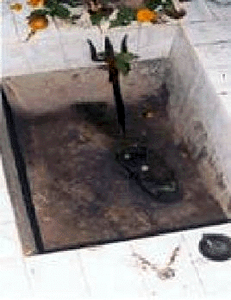
Lord Shiva’s Footprints.Adam’s Peak, Lanka. The giant footprint (5 feet 7 inches by 2 feet 6 inches)Shiva’s Footprints,Thiruvannamalai,Tamil Nadu,India.Rudrapada, Shiva’s feet. Rudrapada Temple The Rudrapada Temple is situated on the bank of the River Brahmaputra, to the east of Tezpur, Assam. Lord Shiva (Rudra) is said to have left the print of his left food (thus the name, ‘Rudra-pada) in a stone in the temple. It is said that Mahadeva revealed himself to King Bana here. Rudrapada Temple was later built on the spot by Siva Singha, in 1730 A.D. The main temple was destroyed due to erosion of the Brahmaputra.Footprints of Lord Shiva. Just in the nose room of the Shiva temple there situated the Naag Mandir. In the month of Shravana monks draws attention of the devotees by keeping snake with themselves. Here lies the footprint of Lord Shiva which is the main place of attraction for the pilgrims and visitors.Pahari Mandir,Ranchi.







You must be logged in to post a comment.