
Lord Ram, as ordained by his father Dasaratha, at the behest of Janaka, Father of Seetha, takes the Shiva Dhanus playfully in his hands, which as a child
Seehta too lifted playfully when she was a child, strings it and it breaks.
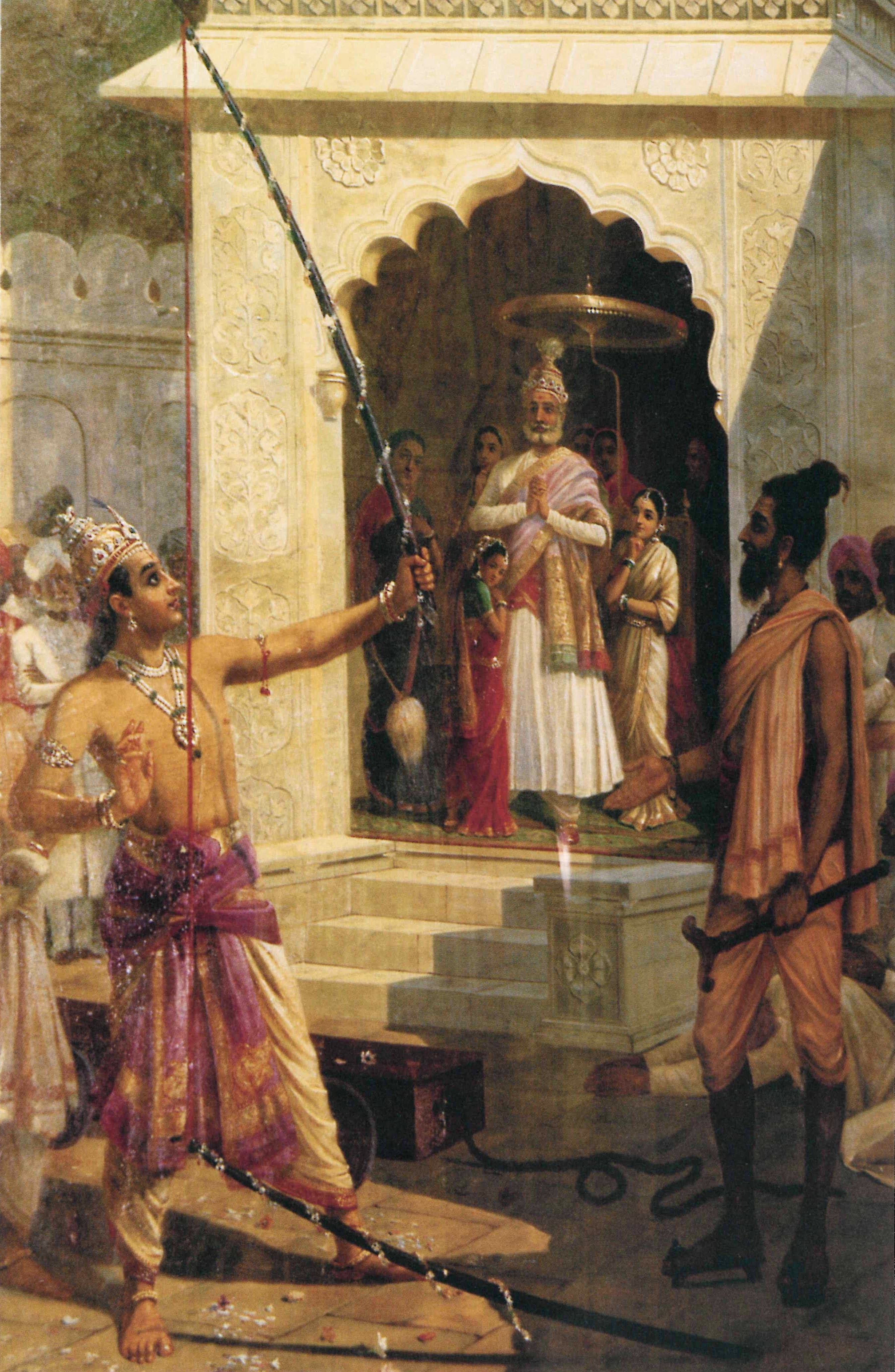
What is the size, measurement of this Shiva Dhanus?
“A bow has a definite height and it is a measure of length, from the ages even up to the age Kautilya, who gave many accounts for weights and measures, in his ‘Artha Shaastra’ a Penguin re-publication.
Four aratni-s cubits are one dhanu, a bow-length, where one aratni is 18 inches, thus a bow-length is 6 feet and above, taking the standard size of archer as a six-footer and a little above.
The bow’s height is the height of the archer plus one measure of his head’s height, as the upper end has to tower the archer’s head.
That being so, this bow belongs to Shiva and its height must be placed more than the human measure of 6 feet, and then it must be some 8 to 10 feet.
And ‘Rama is no crane-legged boy, as his physique is sad to be of ‘medium’ size, and then how a boy of, say of 4, 41/2 feet, could catch the upper end of 8-10 feet bow to bend it…’ is the objection.
An archer has to stand the bow on ground, clutch its lower end under big toe, and with one hand, he has to bend it, while with the other he catches the bowstring to string the other end.
He is not supposed to handle it like a holdall or a briefcase. For this objection it is said in a way that the poet is using the adjectivemahaatmaa to Rama, ‘ an unfathomable one with an equally unfathomable soul… inasmuch as his duty is concerned…’ The minute he touched the bow, it became a spongy stick and it listened to him and bent as he wished.
Other way round, Rama is an ambidextrous archer and furthered is his skill by his possession of some divine missiles as given by Vishvamitra.
Hence, his dexterity is now multiplied and he can handle any divine or human bow ‘effortlessly.”
The action of Sri Ramachandra was so swift that Kamban in Tamil Kambaramayanam describes it best,
‘எடுத்தது கண்டார் ;இற்றது கேட்டார் .”
“people saw the Lifting of the Bow, then heard the sound of it breaking’
What was the sound like?
Valmiki describes it thus in Bala Kanda Sarga 67.
“Further, that dextrous one has stringed that bow with bowstring and started to stretch it up to his ear to examine its tautness, but that glorious one who is foremost among men, Rama, broke that bow medially…
Then there bechanced an explosive explosion when the bow is broken, like the explosiveness of down plunging thunder, and the earth is tremulously tremulous, as it happens when a mountain is exploding.”
”
Bewildered by that raucous caused by the breakage of bow, all the people swooned, except for that eminent-saint Vishvamitra, king Janaka, and those two Raghava-s, namely Rama and Lakshmana. While the people are being reaccustomed after their undergoing the shock, at that moment that sententious king Janaka, whose discomfiture has completely departed by now has said this to the eminent-saint Vishvamitra with a reverent palm-fold.
“Oh, godly sage, the gallantry of Dasharatha’s Rama is evidently seen… and the whys of this boy and wherefores of his stringing that massive bow are unimaginable to me! More so, humans lifting it! How so? This is an unhoped-for incident for me, besides, breaking it! This a is highly wondrous experience for me… My daughter Seetha on getting Dasharatha’s Rama as her husband, she will bring celebrity to the lineage of Janaka-s..”
There is an interesting explanation about the sound the Shiva Dhanus created while breaking.
”
We can write more words for the above sound as, ‘Dhaam, Dhiim, Phut, and DiSkuu…’ etc., as long as thesaurus permit. But all that will be nonsensical.
An ear-splitting sound has come but it is “OM” the auspicious sonus prima grata, produced once upon a time by Shiva’s drum, in order to emanate words through maheshvara suutraaNi, which were unintelligible even for the sages like Sanaka, Sananda, Sanat Kumaara et al., and which were deciphered by Nandi, the Holy Bull vehicle of Shiva, to those sages.
Here it is Shiva’s bow and name of Shiva and all letters that attaches to Him are sha.m, sha.nkara, sha.mbhava, are peace-making letters, as codified in ˜um nama× þambhave ca mayo bhave ca nama× þaðkar˜ya ca mayaskar˜ya ca nama× þiv˜ya ca þivatar˜ya ca | – rudram – soma s¨kta – yajur ( Sri Rudram)
Hence the real sound of Om is audible and it is ear-splitting for ordinary audience, since ordinary people cannot possibly face realities, and it is a regularly audible sound for the other four who have not swooned.
By the way, it will be impossible for us to listen the chanting of Veda-s, even in these days, in any Vedic school for at least half an hour, as our ears are untuned to their ghana paaTha or jaTa or other sorts of chanting.
We feel stranded in some audio studio with fully loaded sound FX.
And the pacemaker Rama lifted the bow of the peacemaker Shiva, where the bow itself is “Om”.
The legendary Indian bow is composed of three parts, unlike Robin Hood’s single-piece bow.
The lower bowing part, upper bowing part combined by a grip handle, and the bowstring.
The three pieces are comparable to the three letters syllabified “Om” – a u ma, where a is upper bowing piece of bow,u, the lower end, and ma, the bowstring.
The painters usually paint this bow-breaking scene, where Rama will be still handling the upper end in his hand, while the lower part will be falling, and the bowstring will be still dangling onto the upper end.
The upper part of bow is a and this a is Vishnu akaara artho viSNuH, and the dangling bowstring is ma Goddess Lakshmi, loka maataa maa ramaa mangala devataa, dangling on the Supreme Person through thick and thin, and the detached-un-detached lower end is u, Lakshmana, or any other adherer.
A lengthy account of this trilogy is provided in Aranya Kanda, Ch. 11, first verse.
And the pacemaker Rama is marrying the world with peace, by stringing the bowstring of peacemaker’s bow, and it is not a mere marriage of some prince charming, with a charmy princess.
Thus, this sound is the initial impact, impetus, brunt, or whatever, for universal peace, and that way this marriage attains a legendary significance in peace process, though by force”
Citation.
Related articles


