
While there are two views on Skanda being the same as Murugan, what is indisputable is the fact that the worship of Skanda/Muruga was very much in
vogue during the Sanatana Dharma, Vedic Times.

Ancient slokas like the Vishnu Sahasranama refers to Lord Skanda.
‘Skandas Skandataro Guhano Vaayuvaahana:’
The mantra of Lord Gannesha refers to Ganesha as he elder brother of Muruga.
‘Skanda Poorvaja:
The worship of Skanda was considered as important and Adi Shankaracharya, while classifying the Vedic Gods and Worship into the Systems, Shanmathas,calls the worship of Muruga as Kaumaram.
The etymology is very interesting.
Kaumara means of Youth, from Kumara.
Here Kumara indicates the son, the son of the One who is eternal and Unborn, that is Shiva,
The word indicates that Kumara is young and never ages.
Beauty is associated with Youth.
Therefore the name Murugan in Tamil .
Murugan means ‘exquisite Beauty’.
It is possible that while denoting the Skanda The Tamils took into consideration of the word Kumara and had it traslated as Beauty, ‘Murugan’
Another fact is that, after Viswamitras sons were banished by Viswamitra to Dravida,which the earlier Santana Dharma considered, wrongly as
undeveloped,they found the Tamil Culture to be more developed if not on par with Sanatana Dharma in terms of Culture.
The Tamils had, designated Gods for each land mass, Muruga being assigned the land mass of Hilly Terrain(Kurinji).
This finds a reference in the early Tamil work Tholkappiyam and Agathiyam, about 5000 years old.
The word to designate Muruga was ‘Seyon;, The Son, a clear allusion to being the son of Shiva.
The word Muruga was a later attribute to this Seyon.
Hence the worship of Skanda, Muruga is as old as the Sanatana Dharma and Tamil Literature.
Tamils language is represented as the personification of Muruga.
The Moola mantra of Muruga , Sarvabhava’ is Shadakshra, six letters , half of Visnhu’s Dwadasa nama, Om Namo Bhagavathe Vasudevaya’ and one letter
more than the Panchakshara od Shiva, Namasivaya.
Hence the Mantra is a combination of protection and Knowledge.
At the Cosmic level, the Mantra and Yantra represent the Cyclic theory of time, enunciated in Hinduism.
This is proved by the Indus Scripts and Signs.
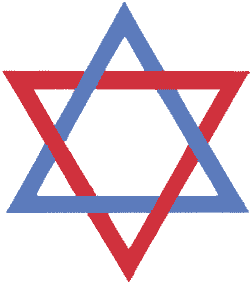
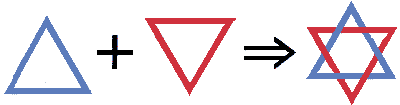
The six pointed hexagram stands for the six faced God Murukan and it expresses the structure of the ritual space in geometrical terms and regulates the yearly chronometry inherent in temple festivals.
The hexagram with the mantram “om saravanabava” inscribed in it serves as a yantram of the deity Murukan and when the mantram is recited, the yantram as a finite hologram of the infinite embodies the primordial sacrifice of prajapati who re-enacts the cosmic order to bring harmony into the world.
The God Murukan of six faces with twelve eyes, twelve arms regulates the sacred architecture with spiritual art and mythic imagery. The cock, which decorates the ceremonial flag of the deity Murukan also refers to the sun. The cock signals the sunrise with its “Kozhi Koovuthal” which refers to an auspicious beginning in the daily religious life of the Tamils of southern India.

This contains the ‘Va’, Vashatkaara of Viishnu, ‘Viswam Visnur vashat Kaaaro’ Vishnu Sahasranama.
‘Sa’ the Universal Brahman Attribute, Hamsa Soham.
‘Ba’ of Bhairava.
The symbolization of the six-pointed hexagram is a zodiacal representation with the astronomical intent (K.V.Ramakrishna Rao, 2002). The concept of the hexagon is linked to a circle and the circle is a polygon with infinite sides. Geometrically the six faces of Murukan parallels the hexagon and the geometry is related to arithmetic and numbers. All these concepts are related to the theory of squaring a circle and circling the square and may compose many mathematical functions and operations. The number six expresses the fullness of the cosmos. The six directions; North, South, East, West, up, and down are considered to be surrounded by the God’s six faces. 4.1
All the festivals that are celebrated for the God Murukan fall on full moon or new moon coinciding with the respective stars. This way the common people are made aware to keep in mind the importance of nakshatras, weekdays, fortnight, month, six months, year etc. in a systematic way by observing the festivities for Murukan from ancient times. The astronomical interpretation of this deity has a powerful association with Indian Tantras, Yantras, Mantras and the five elements (Ether, Wind, Fire, Water, Earth) and God Murukan permeates the sixth, the whole thus the six faces of the deity are represented. 4.2
The mantram “om saravanabava” is geometrically expressed in the hexagonal structure and is very important in the sacred temple rituals prepared for Murukan. The hexagram symbolizes the six pilgrimage centers of Murukan and the purpose of the pilgrimages to these temples work at several levels (Fred W. Clothey, 1983). 4.3
- The Egoscape (The inward pilgrimage of an individual)
- The Socioscape (The communal association & transformation of an individual)
- The Ecoscape (The hills, the terrains, the rivers, the routes and the geographical association of the pilgrimage)
- The Metascape (The metaphysical realization of an individual)


Citation :
http://www.murugan.org/research/valluvan2.htm
Related articles


