The fact that The Devi worship was given importance may be known by the highest place offered to the Devi in the form of the Gayatri Mantra.
Devi is worshiped in the Surya Mandala, and is compared to the Sun and the Sun worship is the primary duty of every Hindu.
In the Sandhyavandan, the Devi is worshiped as the embodiment of the Veda.
The Srividya is the best path for realizing the Devi or Para Brahman.
In a manner of speaking Sandhyavanadan is also Srividya as it worships the Devi.
On the eve of the Mahabharata War, Lord Krishna advised Arjuna to perform the Devi worship and Arjuna did so.
The Devi worship is mentioned in the following Puranas.
Brahmaanda ,Devi Bhagavatham,Markandeya Puaranam.
In addition Devi worship is described in detail in Agama Rahasyam,Samhita,Yaamalam,Aarnavam, Tantram.
The Soundaryalahari of Adi Shankaracharya is a Devi Tantra Shastra as well.
Fifty two Aksharas of the Devi are embedded among the Soundaryalahari 57 slokas composed by Shankaracharya.( the first 43 are reported to have been written by Lord Ganesh.
Apart from these there are innumerable texts on Devi Upasana.
Lord Shiva, after having divulged the secrets of the Shakti through many texts including Mantra and Tantra,has given the world the Sri Tantra.
This is also called the Sri Pura Upasana, Sri Vidya,
(Chatusshashtya Tantrayaihi.. Soundayralahari)
Dattatreya, considered to be an Avatar of Lord Vishnu, in his Datta Samhita, Thripura Upasana( 18, 000 Slokas).
Parashurama, again another Avatar of Lord Vishnu, abridged this and wrote the Parasurama Kalpa Sutram, in 6000 Slokas.
Parasurama’s disciple Sumedhas wrote another sutra, showing the Sutra as a conversation between Lord Rama and Datatareya.
This is now called The Parashurama Kalpasutra.
This is the ultimate authority on the Devi Upasana.
Bhaskararaya’s Disciple Umananda Nathar had wriiten Kithyothsava,an explanation of Parasuramkalpasutra.( Rameswara Sastry, who came after UmanandhaNathar had written “Sowbhaagyasudhodhayam.”
There is no hymn superior than Gayatri Mantra, ‘na gaayatriyaah paramam japam’ .
Now in the Gayatri Mantra we have the mention of Gayatri,Savitri and Sarasvati.
“In invoking Gayatri and praying to be present, we say,
Gayathrrem Aavaahayami,
Savitreem Aavahayaami,
Sarasvatheem Aavahayaami’
Why?
Gayatri Matha
There are three levels of Speech.
First when we think.
If one analyses , when one thinks, he/she would find an echo in the mind, some times quite loud, this is especially so in the case of those who perform Japa, and Devi Upasana.
This applies to our day-to-day thoughts as well.
The implication is that the Universal Sabda, Sound, is being brought forth into individual level and the
One who makes it possible is Gayatri.
This is level One.
The next is as soon as the thoughts are formed,it sits as it were, in the spot just beneath the tongue.
The words are not formed at the physical level and they lie dormant.
We have heard and we also know at times on seeing or while coming into contact with something which we think is new, we say,
‘I Know,it is at the tip of my tongue, it will come’
This is the place of Savitri” the unformed words, with the potential to become words.
This the level where the Speech Impaired people’s impediment lies.
This Mantra has other significance in terms of Mantra and Tantra Shastra and I hope to write on it.
Related information.
Each of three is called sthula (material) form. Three separate forms are grouped as Vyasti. There is also a combined form and that is called Samasti.
(Vishvamitra is the Seer for Gayatri hymn. He is the same Sage to impart ‘bala atibala’ hymns to Lord Rama and Lakshmana.This ‘bala atibala’ mantra is also called as Savitri Mantra and this is available in Savitri Upanishad, Verse 4.This hymn is yet another aspect of Gayatri,)
There is no hymn superior than Gayatri Mantra, ‘na gaayatriyaah paramam japam’
Morning time Gayatri dwells in Surya mandalam. She is having red colour. She is young and having rajoguna. Her vahana is swan and having Brahma amsam. She represents Rig Veda. She is having (in Three hands) kamandalu, lotus and japamala. The fourth hand shows abhaya mudra. She is called Gayatri. (She has four heads).
Midday she dwells in Surya mandalam having white colour and tamoguna. She is having (in three hands) Trident. Cot-leg, rudraksha mala and the fourth hand is in abhaya mudra. She is a middle aged and her vahana is bull. Also she is having three eyes (on all the Five heads).She represents Yajur Veda and takes the Rudra rupini (Rudra amsam). She is called as Savitri in noon.
Evening she is called Saraswati and dwells in Surya Mandalam. She has black colour and old aged. Her vahana is Garuda. She is having (in three hands) chakra, conch and Tulsi mala and the fourth hand is in abhaya mudra. Sha has gnana swarupam and is having satvaguna. She represents Sama Veda. She takes Vishnu amsam. (She has single head only)
The following Dhyana sloka is recited in all the three times by many.
‘Muktavidruma hema nila dhavala chhayirmukhayir streekshanayir
yuktamindu nibaddha ratna makutam tatvartha varnatmikam
Gayatrrem varadabhayam kuskasassubhramka palam gadam
sankham chakra dharavinda ugalam hastyirvahanteem bhaje’
Meditate on the Goddess Gaaytri with five heads, sitting in a pond on a red lotus flower. She wears a red sari and is beautiful. Her heads are pearl, coral, gold, blue, and white in color. Gaayatrii has three eyes and wears the cresant moon upon Her head. She has ten arms. She makes the mudra dispelling fear (abhaya mudra), and the mudra granting gifts (varada mudra), She holds a mace, a chakra, a conch, an ankusam, pasam, kapalam and two lotuses .
Devi Gayatri’s five faces are white like pearl; one is red like coral, second is yellow like gold, third is blue like neelam, fourth white like milk, and the fifth is of ‘trinetra’ or three eyed. We meditate Her gem studded headgear with half- moon like jewel on Her Head,
5) Reference, Book, Personal Collection:
Sri Santhya Vandanam, Srivatsa Somadeva Sarma, Vaideega Dharma Vardani Publication, Chennai, Year 1952, Pages 9 to 13, Total Pages 116+20.
6) Edited:
There are different gayatri metre based mantras for different gods.
The Gayatri Mantra appears in Rigveda 3.62.10 (Yajurveda Mantra 22.9, 30.2 & 36.3, Samaveda Mantra 1462). To distinguish this from others, this is ALSO called as Savitri Mantra as this contain the word Savitr.”
I am posting the latest available list of The Members of The Illuminati, the Organist that has a say in the
running of the World.
Illuminati Organization Chart
“Below is the 300 names which make up the Illuminati Committee of 300. The Committee of 300 is the real world government. I am not sure where this list is from. It is very likely by Dr. John Coleman! How accurate is this list? I have no idea. Some names are IMO correct: Soros, Brzezinski, George HW Bush, Kissinger.
I am used to hearing people of my earlier generation and many from my generation as well, speak highly of the British Rule in India, about British Honesty and Fair play,
Bringing in the Industrial Revolution to India and introducing English in India.Each of these statements need rebuttals for the impressions are not correct and the motives behind these acts are criminal in Nature.
They have invaded all countries that are found in the Map today, excepting 22!
# As is expected of Anglophiles and British pechant for hiding crimes, some Links I have quoted may not work now.See the Sites, you shall understand what I am saying.
Before I start rebutting these points one by one, let me furnish some information about the Genocide of Indians by the British.
We are aware of one Jallianwala Bagh .
We do not know about more serious Genocide by the British in India,
Now Britain claims it is a Champion of Freedom and a friend of the downtrodden and we respect them!
The news was obviously blacked out by the Anglo Media.
Excerpts.
”
Educated Indians are aware of the ghastly 2-century imposition of British colonialism on India. However, because history is generally written by non-scientists, most Indians are utterly unaware of the horrendous human cost (1.8 billion violent and non-violent avoidable deaths in the period 1757-1947).
Under British rule, Indian cultivators were forced to produce for export, and heavily taxed while denied necessary infrastructure, like roads, to move their products to market. As one observer noted, “In this predicament, the cargo of cotton lies sometimes for weeks on the ground, and the merchant is ruined.” Shown: Indian and European merchants trade at the Bombay cotton market, ca. 1870.
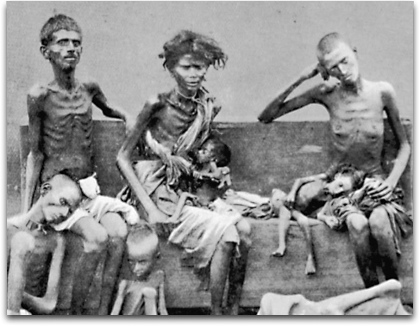
Th British deliberately caused famines in India, in order to force the indigenous population into relief works, such as road-building. The tenant-laborer, writes Carey, “is mercilessly turned from his land and his mud hut, and left to die on the highway.” Here, Indians on their way to the relief works, published in the LondonNews, 1874…
Queen Victoria, Empress of India, ruled over a people broken by poverty, inhumane treatment, famines, and despair. As one British author wrote: “And this occured in British India—in the reign of Victoria the First. Nor was the event extraordinary and unforeseen. Far from it: 1835-36 witnessed a famine in the northern provinces; 1833 beheld one to the eastward; 1822-23 saw one in the Deccan. They have continued to increase in frequency and extent under our
sway for more than half a century.”
During the terrible famine of 1838, according to one reporter, millions of pounds of rice and other edible grains were exported from Calcutta, to feed the kidnapped Indian Coolies, who had been sent to the Mauritius, to work in the fields.
These are just the figures of the British-man-made famines, it does not include the Epidemics induced by Famines, Anglo-Indian Wars, Indians killed fighting for the British, Freedom Fighters martyred by the British.
If all these are included the figures reaches over 1.8 Billion mark (ignored by Anglo Media)
This Link,when I last checked ,was Marked ‘Private’
1. Dutt, Romesh Chunder (1908). The economic history of India under early British rule, Pg. 52
2. Grove, Richard H. (2007), “The Great El Nino of 1789–93 and its Global Consequences: Reconstructing an Extreme Climate Event in World Environmental History”, The Medieval History Journal 10 (1&2): Pg. 75–98
3. Ibid
4. Reference 1: Digby, William. Prosperous British India, Pg.127.
Reference 2 : Dutt, RC. Famines and Land Assessments in India, Pg.3
5. Ibid
6. Ibid
7. Digby, William. Prosperous British India, Pg.127
8. Reference 1: Digby, William. Prosperous British India, Pg.127.
Reference 2 : Dutt, RC. Famines and Land Assessments in India, Pg.5
9. Ibid
10. Ibid
11. Ibid
12. Ibid
13. Fieldhouse, David (1996), “For Richer, for Poorer?”, in Marshall, P. J., The Cambridge Illustrated History of the British Empire, Cambridge: Cambridge University Press. Pp. 400, pp. 132
14. Reference 1: Digby, William. Prosperous British India, Pg.127.
Reference 2 : Dutt, RC. Famines and Land Assessments in India, Pg.9
15. Ibid
16. Ibid
17. A Maharatna, The Demography of Famine, quoted by Mike Davis, Late Victorian Holocausts, El Nino Famines and Making of the Third World, pg 7,table P1.
18. Digby, William. Prosperous British India, Pg.128
19. Ibid
20. Ibid
21. Ibid
22. The Lancet 16 may 1901, quoted in Mike Davis. Late Victorian Holocausts, El Nino Famines and Making of the Third World, pg 7, table P1
23. Maharatna quoted by Mike Davis, Late Victorian Holocausts, El Nino Famines and Making of the Third World, pg 174
24. Bengal Tiger and British Lion: An Account of the Bengal Famine of 1943, Richard Stevenson, Pg.139
Famines in Bengal: 1770-1943, K C Ghosh, pg.111
Famine Inquiry Commission Report, 1943. Pg.110
Doubts have been raised about the Figure 1.8 Billion
”
1.As I have mentioned in the Post the period and between 1757 and 1947.
2.The table shows only Famine deaths.
3.More research papers.
“The “avoidable deaths” (from violence, deprivation and deprivation-exacerbated disease) in British India totalled 1.5 billion (or 1.8 billion if you include the so-called Native States).
Major British-imposed genocidal events in India included the Great Bengal Famine (10 million dead, 1769-1770), successive famines that killed scores of millions of Indians up to the World War 2 Bengal Famine (6-7 million dead in Bengal and surrounding provinces; see the recent BBC broadcast involving me, Economics Nobel Laureate Professor Amartya Sen and others: http://www.open2.net/thingsweforgot/bengalfamine_programme.html ), the estimated 10 million Indians murdered by the British in reprisals for the so-called Indian Mutiny (in which 2,000 British were killed) and the underlying British-imposed condition of “living on the edge” that was responsible for most of the “avoidable deaths” (see my book “Jane Austen and the Black Hole of British History. Colonial rapacity, holocaust denial and the crisis in biological sustainability”, G.M. Polya, Melbourne, 1998, 2008: http://janeaustenand.blogspot.com/ ). https://sites.google.com/site/muslimholocaustmuslimgenocide/indian-holocaust




You must be logged in to post a comment.