


- Objectives of US are
- Oil
- Market access
- Christianity
- Checkmating China
- Defending US from Terrorist attacks in US.
Any process that furthers these objectives, including support of tin pot dictators,invading countries will do fine.
Horror to US is the thought of countries becoming independent in its objectives like France or China.
These countries are the two that chart their own course.
Whether we agree with China or not, it is really the one independent of US in the world.
‘The Arab world is on fire,” al-Jazeera reported last week, while throughout the region, western allies “are quickly losing their influence”. The shock wave was set in motion by the dramatic uprising in Tunisia that drove out a western-backed dictator, with reverberations especially in Egypt, where demonstrators overwhelmed a dictator’s brutal police.
Observers compared it to the toppling of Russian domains in 1989, but there are important differences. Crucially, no Mikhail Gorbachev exists among the great powers that support the Arab dictators. Rather, Washington and its allies keep to the well-established principle that democracy is acceptable only insofar as it conforms to strategic and economic objectives: fine in enemy territory (up to a point), but not in our backyard, please, unless properly tamed.
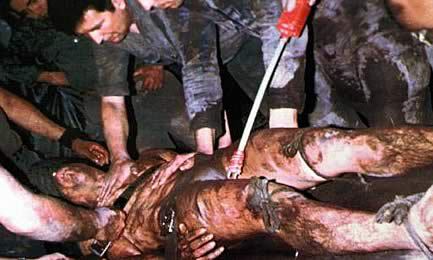
One 1989 comparison has some validity: Romania, where Washington maintained its support for Nicolae Ceausescu, the most vicious of the east European dictators, until the allegiance became untenable. Then Washington hailed his overthrow while the past was erased. That is a standard pattern: Ferdinand Marcos, Jean-Claude Duvalier, Chun Doo-hwan, Suharto and many other useful gangsters. It may be under way in the case of Hosni Mubarak, along with routine efforts to try to ensure a successor regime will not veer far from the approved path. The current hope appears to be Mubarak loyalist General Omar Suleiman, just named Egypt’s vice-president. Suleiman, the longtime head of the intelligence services, is despised by the rebelling public almost as much as the dictator himself.
A common refrain among pundits is that fear of radical Islam requires (reluctant) opposition to democracy on pragmatic grounds. While not without some merit, the formulation is misleading. The general threat has always been independence. The US and its allies have regularly supported radical Islamists, sometimes to prevent the threat of secular nationalism.
A familiar example is Saudi Arabia, the ideological centre of radical Islam (and of Islamic terror). Another in a long list is Zia ul-Haq, the most brutal of Pakistan’s dictators and President Reagan‘s favorite, who carried out a programme of radical Islamisation (with Saudi funding).
“The traditional argument put forward in and out of the Arab world is that there is nothing wrong, everything is under control,” says Marwan Muasher, a former Jordanian official and now director of Middle East research for the Carnegie Endowment. “With this line of thinking, entrenched forces argue that opponents and outsiders calling for reform are exaggerating the conditions on the ground.”
Therefore the public can be dismissed. The doctrine traces far back and generalises worldwide, to US home territory as well. In the event of unrest, tactical shifts may be necessary, but always with an eye to reasserting control.
The vibrant democracy movement in Tunisia was directed against “a police state, with little freedom of expression or association, and serious human rights problems”, ruled by a dictator whose family was hated for their venality. So said US ambassador Robert Godec in a July 2009 cable released by WikiLeaks.
Therefore to some observers the WikiLeaks “documents should create a comforting feeling among the American public that officials aren’t asleep at the switch” – indeed, that the cables are so supportive of US policies that it is almost as if Obama is leaking them himself (or so Jacob Heilbrunn writes in The National Interest.)
“America should give Assange a medal,” says a headline in the Financial Times, where Gideon Rachman writes: “America’s foreign policy comes across as principled, intelligent and pragmatic … the public position taken by the US on any given issue is usually the private position as well.”
In this view, WikiLeaks undermines “conspiracy theorists” who question the noble motives Washington proclaims.
Godec’s cable supports these judgments – at least if we look no further. If we do,, as foreign policy analyst Stephen Zunes reports in Foreign Policy in Focus, we find that, with Godec’s information in hand, Washington provided $12m in military aid to Tunisia. As it happens, Tunisia was one of only five foreign beneficiaries: Israel (routinely); the two Middle East dictatorships Egypt and Jordan; and Colombia, which has long had the worst human-rights record and the most US military aid in the hemisphere.
Heilbrunn’s exhibit A is Arab support for US policies targeting Iran, revealed by leaked cables. Rachman too seizes on this example, as did the media generally, hailing these encouraging revelations. The reactions illustrate how profound is the contempt for democracy in the educated culture.
Unmentioned is what the population thinks – easily discovered.According to polls released by the Brookings Institution in August, some Arabs agree with Washington and western commentators that Iran is a threat: 10%. In contrast, they regard the US and Israel as the major threats (77%; 88%).

[…] US more worried abot Independence than Dictatorships. (ramanan50.wordpress.com) […]