Tag: Yajurveda

  • Seven Rivers Russian Veda Book Of Veles Hinduism in Russia

    Russia is close to Indian thoughts.

    I have written on the fact that the Rig Veda was composed in Russia, under the guidance of Lord Shiva, by  Vasishta.

    Lake Baikal is the Vaikanasa Theertha.

    Russia was called Sthree Varsha, ruled by women.

    Krishna’s son Pradhyumna’s city was in Por Baijn, Siberia.

    Narada’s Mountain Narodnaya is Narada’s Mountain in the Urals.

    Arkaim was Rig Vedic Mandala City.

    Please read m Posts  on each of these, filed under Hinduism.

    There is more!

    There is The Book of Veles considered to be the Russian Vedas.

    There is a view that this document is a forgery.

    But the other evidences are overwhelming.

    There is a refernce of Seven Rivers.

    Zhetysu (Kazakh: Жетісу, pronounced [ʒi̯ɘtɘsʊw] meaning “seven rivers”; also transcribed Zhetisu, Jetisuw, Jetysu, Jeti-su, Jity-su,Жетысу, Джетысу, etc.) is a historical name of a part of Central Asia, corresponding to the South-Eastern part of modern Kazakhstan. It owes its name, meaning “seven rivers” (literally “seven waters”) in Kazakh, to the rivers which flow from the south-east into Lake Balkhash.’

    Baikal as I mentioned is the Vaikhanasa Theertha.

    The Seven Sacred Rivers f the Hindus are,

    Ganges,

    Yamuna,

    G0davari,

    Sarsvati,

    Narmada,

    Sindhu,

    Kaveri.

    Gange ca Yamuneschaiva Godavari Sarasvati,

    Narmadhe Sindhu Kaveri Jalesmin Sannidhim Kuru.

    (Kalas Mandhiram)

    And indeed the ancient faith of the Slavs and the Rus from ancient times, long before the Baptism of Russia, was called Orthodoxy. Russian called themselves Orthodox, for the glory of rules to follow the Path of rules. She also was named Righteous faith, for the Slavs but know the truth, know the primordial Vedas, the ancient Vedas, the sacred legends about the origins of the Vedic faith, the former first faith almost all nations of the world.

    The books from the collection of “Russian Veda” and, above all, in the “Book of Veles,” says twenty thousand years, during which time was born, died and revived Russia. The books tell of ancient ancestral home, the land where generations born Russian, the progenitors of various kinds…

    Book Of Veles, Russia.jpg Book Of Veles, Russia

    Today, one looks healthy forces of society uniting Russian idea of the experience of generations of Russian national tradition is thought to be the only possible way for his country. Mental health of a nation can find, just leaning against the net source of national spirit, a prisoner in the great Russian language, songs and epics, in the tradition of old, stored in. Is it possible to grow up to the sky, with no roots?
    What exactly are the Slavic tradition now?
    Vedism or pravedizm — is the oldest monotheistic faith, that is, the belief in the existence of God, spiritual knowledge, handed down to us in the sacred texts, in the form of folk Orthodox tradition in the form of oral tradition.
    If we turn to the original meaning of the word FAITH, contained in the ancient runic texts, we get the following interpretation:
    FAITH — modern sounding ancient image of a two runes:
    1. Runa “Veda” — means the Veda of reference, ie the ability to come to know the Divine Wisdom of God, and having become slaves of the Most High, to tell it to others.
    2. Fleece “RA” — means the Sun, Light or Light of Truth of God.
    So then faith — is Shining the Light of Wisdom and Truth of God.
    Today, on the revitalization of the old faith and the work of many, many of our fellow citizens.
    Now the rules get in the path of many. In Russia today, there are already hundreds of Vedic communities, reviving the ancient faith, ancient knowledge, rituals and martial arts.
    So who is now among those who direct their efforts to revive the ancient Vedic culture and Vedic Knowledge? Even today, these people, united in various community quite a lot. And every day in Russia, they are becoming more and more.

    You can just give some notation these directions:
    Orthodoxy — the glorification of “rules” — the spiritual world of God and His children Grandparent — light Slavic Gods and Goddesses.
    Rodnoverie — belonging to the Faith and the genus in all its forms: from the Almighty, in the images of Rod-Grandparent and Virgin, to the earthly father and mother. This contains the notion that this belief — native, not foreign.
    Vaishnava — Vaishnava worship, praise and spiritual flock to God in the image of Vishnu (elevated) and Krishna (Kryshen).
    RUSVEDIZM — anastasiytsev movement, followers of Anastasia was, a book Megre ancient Vedic roots of Slavic civilization.
    Agni Yoga — followers of Roerich, by following the Vedic knowledge disclosed Roerich in his writings.
    Vedic culture — a phrase from the concepts of “Veda”, “Cult”, ie, worship, praise and “Ra”. That is, it is worship, worship Shining Light of Wisdom and Truth of God.
    Thus, the different communities call this faith in different ways, but all agree on common definitions — “Vedic culture” and “Veda”, because they are found in all of these names.

    ..

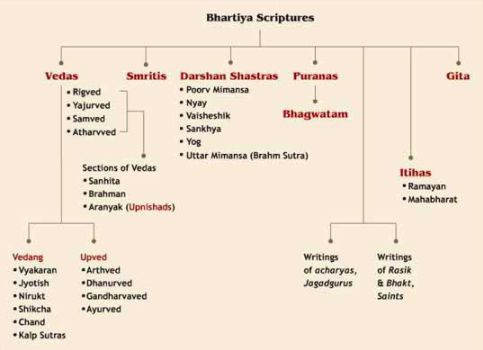
    The most famous books of Vedic religion of India — the Vedas. Four of them. Rig Veda — “Veda hymns,” Sama-Veda — “Veda chants” Yajur Veda — “Veda of sacrificial formulas” and Atharva Veda — “Veda spells.” Later, the Vedas were composed commentaries — hundreds of philosophical treatises: Brahmins Samhita, Upanishads and Aaranyaka.
    Additional Vedic literature of India — is the Mahabharata, the Ramayana and the Puranas. Heroic poem Mahabharata Indians revered as the fifth Veda, it is the greatest poem in the world, including one hundred thousand quatrains. In fact, the Mahabharata is a separate literature (the famous Bhagavad-Gita — the culminating part of the Mahabharata).
    Ramayana — is a poem about an ancient hero and king of India Rama, the incarnation of God. The Puranas are a collection of stories of the incarnations of God, the life of the demigods.

    Zoroastrian literature of Ancient Iran represented primarily Avesta, which has four parts: Yasnu (“worship”), Vispered (“all of the major head”), Videvdat (“the law against the demons”) and Yashty (“Hymn”). It was mentioned only sacred book of the contemporary denominations, not less extensive literature provide archaeological and ethnographic research in various countries of the East. Well as more recent works, based on the Unreached to us priestly books (eg, “Shah-Name” poet Ferdowsi).
    And it would be wrong to assume that all of these texts are not related to the Russian Vedic tradition. On the contrary. Many of these texts tells of the lands lying to the north of India and Iran. This important and very ancient land description single Vedic civilization that existed in ancient times, and is revered and honored ancestral Aryans, the source of the Faith and Vedic Hindus and Zoroastrians.
    Consideration should be given community of many texts, myths and stories of Russian and other Vedic traditions. Texts can be placed next Russian folk songs, spiritual poetry and similar texts of Indian and Iranian Vedic literature.
    Compare these things will inevitably lead to the conclusion that the knowledge preserved in Russia and songs which have as their basis the same roots of Vedic culture.
    The great spiritual heritage of Russia Vedic rightly be placed next to the living tradition of Vedic Eastern countries.
    Ancient songs and tales in the oral tradition of Russia is well preserved. They are poetic, are available. Often Russian tradition sets forth the ancient song, very much loved by the people and not distorted by time. You can call the revered Old Believers “Book of Doves,” “Book of Animals”, “secret book”, the “Golden Book” and many other popular books.
    A complete set of Slavic folk songs, tales, fairy tales and legends, spiritual poems — thousands of volumes. They contain the same reflection original Vedas.
    In addition to thousands of volumes of Slavic folklore Russian Vedic literature is also presented Ancient Texts. First of all — the “Book of Veles”, then — “Boyan Anthem” and “The Tale of Igor’s Campaign”. Already now, monuments enough to talk about the great Russian Vedic literature and literary culture.

    http://survincity.com/2010/12/who-are-russian-went-from-russian-land/

    http://survincity.com/2011/05/vedas-and-vedic-russia

    https://en.wikipedia.org/wiki/Zhetysu

  • Hidden Book Of Koran Vedas. Dara Shikoh Shah Jehan’s Son Sirr-e-Akbar

    To what extent our History can be hidden, is amazing.

    Sirr-i-Akbar by Dara,Image.jpg Sirr-i-Akbar by Dara, Introduction PersianTranslation by Chand Tara.

    Though it is a fact that Islamic rulers of India raped women, killed people, destroyed Temples and forcibly converted Hindus to Islam, it is shocking  to know that they could execute their own siblings for translating The Vedas directly from Sanskrit into Persian.

    It is not about the common fanatic I am speaking about.

    It is about Shah Jehan’s son Muhammad Dara Shikoh, who was also a great Sufi.

    He went to the extent of saying that Islam had its roots in Hinduism, more specifically in The Vedas and the Upanishads, and they were revealed to the Rishis by God much before the advent of Prophet Muhammad.

    ( I am stating facts as I see them; I am not trying to legitimize Islam as many try.

    I just point out the similarities between Hinduism and Islam.

    That 786 is OM, Mecan is Shiva Temple,Ancestors of Arabians c0uld have been Tamils, Prophet Muhammad’s Uncle wrote a Hymn, Stuthi On Lord Shiva)

    Prince Muhammad Dara Shikoh (1627-1658 AD) the favorite Sufi son of Moghul emperor, Shah Jehan. Known the world over for his unorthodox and liberal views. He was a mystic and a free thinker.

    Dara Shikoh, wrote in his Persian translation of the Upanishads.

    “After gradual research; I have come to the conclusion that long before all heavenly books, God had revealed to the Hindus, through the Rishis of yore, of whom Brahma was the Chief, His four books of knowledge, the Rig Veda, the Yajur Veda, the Sama Veda and the Atharva Veda.”

    He had learned Sanskrit and studied the Hindu scriptures in the original.

    He translated the Upanishads, Bhagavad Gita and Yoga-Vasishta into Persian directly from Sanskrit and called it Sirr-e-Akbar (The Great Mystery). Titled “The Upanishads: God’s Most Perfect Revelation” and then into Latin by Anquetil Duperron (1801 and 1802) under the title Oupnekhat, contained about fifty. The Quran itself, he said, made veiled references to the Upanishads as the “first heavenly book and the fountainhead of the ocean of monotheism.”

    In his Majma-al-Bahrain, he sought to reconcile the Sufi theory with the Vedanta.

    He was able to affirm that Sufism and Advaita Vedantism (Hinduism) are essentially the same, with a surface difference of terminology.

    And in introduction to this work he says that one finds in Upanishads the concept of tawhid (the doctrine of Unity of God, the most fundamental doctrine of Islam) after the Qur’an and perhaps the Qur’an refers to Upanishad when it refers to Kitab al-Maknun (The Hidden Book). His work Majma-al-Bahrain (Mingling of the Two Oceans i.e. Hinduism and Islam) is very seminal work in the history of composite culture of India.

    Two years after the completion of the Sirr-i-Akbar, Dara was executed on the orders of his brother.

    “Dara subsequently developed a friendship with the seventh Sikh Guru, Guru Har Rai. Dara devoted much effort towards finding a common mystical language between Islam and Hinduism. Towards this goal he completed the translation of 50 Upanishads from its original Sanskrit intoPersian in 1657 so it could be read by Muslim scholars. His translation is often called Sirr-e-Akbar (The Greatest Mystery), where he states boldly, in the Introduction, his speculative hypothesis that the work referred to in the Qur’an as the “Kitab al-maknun” or the hidden book, is none other than the Upanishads.[


    Sirr-e-Akbar English Translation Download.

    Citation.

    http://www.veda.harekrsna.cz/connections/Islam.php

    http://en.wikipedia.org/wiki/Dara_Shikoh

  • Upanayana, Navjote For Zoroastrians Zend Avesta Veda Connection

    Iran was  apart of Hindu Empire during the Vedic Period.

    This continued to be so till Vikramaditya’s period.

    The Faravahar, believed to be a depiction of a fravashi. image.png
    The Faravahar, believed to be a depiction of a fravashi

    The customs and cultural behaviour of the Zoroastrians  indicate the Vedic roots of Zoroastrianism.

    A treaty signed by the Hittites and Mitannis dating to the fourteenth century BC calls upon Indara/Indra, Mitras(il)/Mitra, Nasatianna/Nasatya and Uruvanass(il)/Varuna, all known to Rig-Veda and Avesta.

    Hittites and Mitannis were from North Syria.

    I had posted articles about the Vedic /Tamil origin of these people.

    Though there are similarities  the roles of the Devas seem to have been reversed.

    (haoma (soma), daha(dasa), hepta (sapta), hindu (sindhu), and Ahura (Asura) in Avesta)

    Indra and the devas  are demonic in Avesta,and Ahura/asura is considered the highest deity.

    “At the time of composition of the Vedas, Varuna was losing his importance to Indra. In Avesta, Ahura Mazda  is the main divinity and some people think that he is thesame as Varuna. Varuna sat with his spies who flew all around the world and bought back reports on the conduct of mortals. He abhorred sin and loathed evil deeds prompted by anger, drink and gambling.”

    Probably a sect left on this issue and had a role in this difference.

    Rig Veda is dated around 5000 BC while Avesta is dated around 1000 BC.

    The Chief God worshiped in the Vedas is Agni,Fire.

    Zoroastrians are Fire worshipers.

    Another important connection is Upanayana ceremony which is the primary duty of a Hindu.

    Zoroastrians have a similar Ceremony  ‘Navjote’

    ‘The Navjote[pronunciation?] (Persian: سدره‌پوشی, Sedreh pushi‎) ceremony is the ritual through which an individual is inducted into theZoroastrian religion and begins to wear the Sedreh and Kushti. The term navjote is used primarily by the Zoroastrians of India (theParsis), while sedreh pushi is used primarily by the Zoroastrians of Iran. Zoroastrians from Pakistan consisting of both Parsis andIranis use both terms…

    Although there is no upper limit to the age of the individual for which the ceremony takes place, in common practice it occurs before a girl or boy reaches maturity. Under no circumstances is it permitted to be done for a child less than seven years of age since the child at that age range cannot comprehend the significance of the event.

    In Vendidad 18.54, individuals above the age of 15 (once considered the age at which one attained adulthood) who are not yet been invested are said to be likely to fall into evil ways. In the 9th-12th century texts of Zoroastrian tradition, the same group are said to bekushad davarashni, literally “running about improperly clothed”. So for instance Menog-i Khrad 2.35 and the Book of Arda Viraf(25.6.10). The latter considers such a thing to be a service to demons (the daevas). Other texts of tradition that define adulthood as the boundary include the Sad-dar 10.1 and Shayast na-Shayast 10.13. ,.

    The ceremony is traditionally the first time a Zoroastrian wears the sedreh undershirt and kushti belt, which they then continue to wear for the rest of their life. The sacred clothing signifies parental responsibility as well as responsibility for the one who is undergoing this ceremony. When the child wears the sacred clothes, it means the parents are now obligated to morally and religiously educate the child. If the child commits a wrongful act, it is their responsibility, as they may also take some pride in themselves when their child commits a righteous act. The sacred thread and shirt also teach the child responsibility, as they are to be untied before certain practices, such as prayer, bathing, and before meals, and re-tied shortly after the task is completed.

    The shirt has a construction extremely specific to this culture.

    Upanayana of Hinduism.

    Upanayana is an important Samskara, duty of a Hindu.

    The three Varnas, Brahmana, Kshatriya and Vaisya must have this performed.

    Read my posts on Samskaras.

    The wearing of the sacred thread opens the inner eye.

    One becomes a Dwija, born for the second time.

    The Upaveeda must remain clean.

    It has to be changed periodically.

    It is also changed for special occasions like Marriages,Homas,Poojas,Apara Kriyas.(https://ramanisblog.in/2014/10/17/yagnopaveeda-dharana-mantra-poonal/)

    Zoroastrianism.

    Zoroastrianism was founded by the Prophet Zoroaster (or Zarathustra) in ancient Iran. The precise date of the founding of Zoroastrianism is uncertain. An approximate date of 1500–1200 BCE has been established through archaeological evidence and linguistic comparisons with the Hindu text Rig Veda. However there is no way of knowing exactly when Zoroaster lived, as he lived in what, to his people, were prehistoric times. Depending on different approaches, it is thought that he lived some time between 1700 BCE to 500 BCE .Zoroaster was born in either Northeast Iran or Southwest Afghanistan. He was born into a Bronze Age culture with a polytheistic religion, which included animal sacrifice and the ritual use of intoxicants. This religion was quite similar to the early forms of Hinduism in India. The name Zoroaster is a Greek rendering of the nameZarathustra. He is known as Zartosht and Zardosht in Persian and Zaratosht in Gujarati. Zoroaster’s birth and early life are little documented. What is known is recorded in theGathas—the core of the Avesta, which contains hymns thought to be composed by Zoroaster himself. Born into the Spitama clan, he worked as a priest. He had a wife, three sons, and three daughters. Zoroaster rejected the religion of the Bronze Age Iranians, with their many gods and oppressive class structure, in which the Karvis and Karapans(princes and priests) controlled the ordinary people. He also opposed animal sacrifices and the use of the hallucinogenic Haoma plant (possibly a species of ephedra) in rituals, but held the rooster as a “symbol of light”and associated the cock with “good against evil” because of his heraldic actions..

    * Cock is associted with Sunbrahmanya.

    According to Zoroastrian belief, when Zoroaster was 30 years old, he went into the Daiti river to draw water for a Haoma ceremony; when he emerged, he received a vision ofVohu Manah. After this, Vohu Manah took him to the other six Amesha Spentas, where he received the completion of his vision.[51] This vision radically transformed his view of the world, and he tried to teach this view to others. Zoroaster believed in one creator God, teaching that only one God was worthy of worship. Furthermore, some of the deities of the old religion, the Daevas (Devas in Sanskrit), appeared to delight in war and strife. Zoroaster said that these were evil spirits and were workers of Angra Mainyu, God’s adversary.

    Zoroaster’s ideas did not take off quickly, and, at first, he only had one convert: his cousin Maidhyoimanha.The local religious authorities opposed his ideas. They felt their own faiths, power, and particularly their rituals, were threatened because Zoroaster taught against over-ritualising religious ceremonies. Many ordinary people did not like Zoroaster’s downgrading of the Daevas to evil spirits. After 12 years, Zoroaster left his home to find somewhere more open to new ideas. He found such a place in the country of King Vishtaspa (in Bactria). The King and his queen, Hutosa, heard Zoroaster debating with the religious leaders of his land, and decided to accept Zoroaster’s ideas and make them the official religion of their kingdom. Zoroaster died in his late 70s. Very little is known of the time between Zoroaster and the Achaemenian period, except that, during this period, Zoroastrianism spread to Western Iran. By the time of the founding of the Achaemenid Empire, Zoroastrianism was already a well-established religion.

    Humata, Hukhta, Huvarshta (Good Thoughts, Good Words, Good Deeds) are the basic tenets of the religion.

    Faravahar (or Ferohar), one of the primary symbols of Zoroastrianism, believed to be the depiction of aFravashi (guardian spirit)

    In Zoroastrianism, Ahura Mazda is the beginning and the end, the creator of everything that can and cannot be seen, the Eternal, the Pure and the only Truth. In the Gathas, the most sacred texts of Zoroastrianism thought to have been composed by Zoroaster himself, the prophet acknowledged devotion to no other divinity besides Ahura Mazda.

    Daena (din in modern Persian) is the eternal Law, whose order was revealed to humanity through the Mathra-Spenta (“Holy Words”).Daena has been used to mean religion, faith, law, and even as a translation for the Hindu and Buddhist term Dharma. The latter is often interpreted as “duty” but can also mean social order, right conduct, or virtue. The metaphor of the “path” of Daena is represented in Zoroastrianism by the muslin undershirt Sudra, the “Good/Holy Path”, and the 72-thread Kushti girdle, the “Pathfinder”.

    Daena should not be confused with the fundamental principle asha (Vedic rta), the equitable law of the universe, which governed the life of the ancient Indo-Iranians. For these, asha was the course of everything observable—the motion of the planets and astral bodies; the progression of the seasons; and the pattern of daily nomadic herdsman life, governed by regular metronomic events such as sunrise and sunset. All physical creation (geti) was thus determined to run according to a master plan—inherent to Ahura Mazda—and violations of the order (druj) were violations against creation, and thus violations against Ahura Mazda. This concept of asha versus the druj should not be confused with the good-versus-evil battle evident in western religions, for although both forms of opposition express moral conflict, the asha versus druj concept is more systemic and less personal, representing, for instance, chaos (that opposes order); or “uncreation”, evident as natural decay (that opposes creation); or more simply “the lie” (that opposes truth and righteousness). Moreover, in his role as the one uncreated creator of all, Ahura Mazda is not the creator of druj, which is “nothing”, anti-creation, and thus (likewise) uncreated. Thus, in Zoroaster’s revelation, Ahura Mazda was perceived to be the creator of only the good (Yasna 31.4), the “supreme benevolent providence” (Yasna 43.11), that will ultimately triumph (Yasna 48.1).

    A Parsi Wedding, 1905

    In this schema of asha versus druj, mortal beings (both humans and animals) play a critical role, for they too are created. Here, in their lives, they are active participants in the conflict, and it is their duty to defend order, which would decay without counteraction. Throughout the Gathas, Zoroaster emphasizes deeds and actions, and accordingly asceticism is frowned upon in Zoroastrianism. In later Zoroastrianism, this was explained as fleeing from the experiences of life, which was the very purpose that the urvan (most commonly translated as the “soul”) was sent into the mortal world to collect. The avoidance of any aspect of life, which includes the avoidance of the pleasures of life, is a shirking of the responsibility and duty to oneself, one’s urvan, and one’s family and social obligations.

    Central to Zoroastrianism is the emphasis on moral choice, to choose the responsibility and duty for which one is in the mortal world, or to give up this duty and so facilitate the work of druj. Similarly, predestination is rejected in Zoroastrian teaching. Humans bear responsibility for all situations they are in, and in the way they act toward one another. Reward, punishment, happiness, and grief all depend on how individuals live their lives.

    Reference.

    References: Early India by Romila Thapar, The Wonder That Was India by A. L. Basham. See Also: Avestan and Vedic

    http://en.wikipedia.org/wiki/Navjote

    Zoroastrianism Wiki.

  • Pancha Brahma Upanishad Shiva with Five Faces

    The Pancha Brahama Upanishad belongs to the Krishna Yajur Veda.


    Pancha Brahma Upanishad deals with the Five Aspects of Lord Shiva.


    The Five Faces of Shiva.


    1. Sadyojāta
    2. Vāmadeva
    3. Aghora
    4. Tatpurusha
    5. Īshāna


    Sadyojāta is associated with the western direction and represents Icchā Shaktī–will power.     Sadyojāta is associated with Manomaya Kosha—the sheath covering the soul that consists of mind.     Additionally, this face is associated with the fire element representing the fire of the mind and the fire of the body.     This face is Shiva’s function as the creative force and is associated with Manipura chakra.

    Vāmadeva is associated with the northern direction.     This face of Shiva is associated with the shakti of strength and beauty as well as the goddess Maya.       Vāmadeva is associated with the Vijῆānamaya Kosha.     This face is the Citta rūpa, the form of the universal consciousness limited to the individual mind. Several traditions believe that mantra to Vāmadeva has considerable healing benefit. This is the preserving energy of Shiva, and is connected with the air element as well as the Ānahata Chakra.

    Aghora is associated with the southern direction and jῆāna Shaktī–the power of knowledge; as well as the Buddhi rūpa meaning the form of the intellect. This face is associated with the Pranamaya Kosha, and represents the rejuvenating and dissolving qualities of Shiva as well as being connected with the water element and Svadishthana chakra.

    Tatpurusha is the eastern face.     This face represents the parātman or supreme soul behind the physical being. This form is Ānānda Shaktī, the power of bliss.     Connected with the Annamaya kosha, tatpurusha in its higher manifestation is bliss; in the lower manifestation it is the concealing power of Shiva.     This face is associated with the earth element, muladhara chakra and is considered beneficial for increasing focus.

    Īshāna is the upper or skyward face. It is the Citta Shaktī or power of the individual consciousness to realize the universal consciousness.     This form is associated with Akasha or ether, and the Vishuddha chakra. This is the total energy of Shiva encompassing all attributes of Shiva.     This is the face of Shiva that is the revealing power and is associated with the Anandamaya kosha. F


    Om. Next Paippalada addressed (Mahadeva) ‘What is That which came to exist at first’?

    2. (He replied). Sadyojata. ‘What is that O Lord’, ? ‘Aghora’. What is that, O Lord? ‘Vamadeva’. What are those, O Lord? ‘Tatpurusha.’ What are these, O Lord? ‘Isana, the instructor of all the Vidyas.’

    3. He is the Isana (ruler) of the past and the future and of all the gods.

    4. All the Secrets, whatever they have with colors, divisions and energies, the Lord Mahesa gave out to him (Paippalada).

    5. Adoration to Mahadeva, Maharudra.

    6. O Sakala, hear from me, whatever are the secrets of secrets in the world (a teacher says to his pupil).

    7. Sadyojata, which bestows all the desired objects, represents Earth, Pusha (the sun), Lakshmi, Brahma, Trivritsvara (sound), Rig Veda, Garhapatya fire, the mantras which have seven notes, yellow color, and Kriyasakti.

    8. Aghora, which destroys all the multitude of sins, which pacifies evils, and which bestows all prosperities, represents water, the moon, Gauri, Yajurveda, cloud color, Sandrasvara, Dakshinagni, the mantras with fifty syllables, protection and Ichchasakti.

    9. Vamadeva, which gives the great wisdom, represents Agni, Vidyakala, Samaveda, Svara with eight notes, Dhirasvara (majestic sound), Ahavantya fire, knowledge and dissolution energies, and white color mixed with darkness. He, whose brightness is equal to that of crores of suns, possesses full consciousness and is the leader of the three states (of consciousness). He distributes the fruits of all actions to men, who are in the three states of consciousness, and also bestows on them all the prosperities. He, whose mantra is Eight syllabled one, resides in the center of eight-petalled lotus (of the heart).

    10. Tatpurusha is he, who possessed the air, the five fires, who is the leader of the mantra energies, and who has the fifty letters and their notes, and Atharvaveda. He is the head of crores of the Ganas (Elements) and whose body is the whole universe. His color is Red-which gives the desired objects. He is the panacea for all kinds of diseases, the cause of the creation, preservation and destruction &c., and the possessor of all the Saktis. He is above the three states of consciousness, the fourth (Turiya), and existence, consciousness and bliss himself, He is worshipped by Brahma, Vishnu and others, and the Supreme Father of all.

    11. Isana should be known as the Supreme Ruler and the witness of the intelligence. He is the Ether unmanifested, and to be worshipped by the ‘Omkarasvara’. He is all the Devas, calm, and above the calmness, and beyond the ‘Svara’ (notes). He is the presiding deity of the letters ‘A’ and other Svaras, and whose body is the Ether itself. He is the cause of the five functions (creation &c.) in the great form of the five Brahmans (Sadyojata &c.). He remains (at the time of dissolution) involving the five Brahmans in himself, and also remains after absorbing all the manifestations of his own maya in himself. He shines by his own glory transcending the five Brahmans. He shines in himself in the past, present and future depending on none else.

    12. All the Devas, do not realize him, bewildered by the maya of Sambhu, the Mahadeva, the Guru of the universe and the Cause of all the causes.

    13. His form will not stand before any. He is the highest of the highest, the support of the universe, the person, by whom the universe is manifested and in whom it is involved. He is the Supreme Brahman, calm, he is the Supreme abode and I am that Brahman itself.

    14. One should understand the five Supreme Brahmans, Sadyojata and others; whatever we see and hear all are the five Brahmans. These five are, as it were, the division of one Brahman. Thus understanding the one as five he reaches Isana (the fifth). The learned should absorb all, which are in the form of the five Brahmans, in his self and realize that ‘I am they’, and he reaches Brahman, becoming immortal. He who knows thus, becomes freed from the bondage; there is no doubt in this.

    15. Sambhu is in the form of the five-syllabled mantra (Panchakshara). He is the Supreme Brahman. Knowing the Panchakshara as consisting from the letter ‘Na’ to ‘Ya’, one should repeat the mantra.

    16. One should realize the universe as Panchakshara in the nature of the five Brahmans.

    17. He, who studies this vidya of the five Brahmans with devotion, attaining the state of the five Brahmans, shines himself in five forms.

    18. Thus Mahadeva, addressing Galava, the great Soul, blessing him and disappeared there.

    19. By hearing which alone, the unheard things become heard, the unthought, O Sakala, and the unknown is known. Just as by knowing one lump of earth alone, O Gautama, all the Earth is known as the effect (pot &c.) is not separate from the cause (Mother Earth); just as by knowing one jewel alone, all other metals one known; and just as by knowing one nail parer only, all other iron made things are known, as they are not in nature different from their cause, so is the effect (the universe) not separate from its cause (Isvara). The effect becomes always eternal in the form of its cause. The saying as different is indeed false. The cause is only one, and he is not separate (from the effects) nor with both forms (separateness and non-separateness). The idea of separateness is false, as it is impossible to find out the cause of difference. Therefore the cause is only one, the eternal and second less. This second less cause is, surely the Pure Consciousness itself.

    20. In this city of Brahman (Body) there is, O Sage, a small lotus like house. In the center of it, there is a subtle ether. He is Siva, Sat, Chit, and Ananda. He should be sought after by those desirous of Salvation. As He is residing in the heart as the witness of all, without differences, Siva is called ‘Hridaya’ (resider in the heart), the liberator from the Samsara.

    Thus ends the upanishatTranslation by R.A Sastri.Citation.http://www.shaivam.org/english/sen-sd-panchabrahma-upanishad.htm