Tag: Yagnyas

  • Homa Cleans Environment Rids Microbes 3870°C Athirathra Study

    Homa Cleans Environment Rids Microbes 3870°C Athirathra Study

    There are Homas and Yagnyas sanctioned by Vedas, the scriptural authority in Hinduism.

    Though performance of both are mandatory,they are different.

    Yagnyas need not involve Fire,for example Brahma Yagnyas,whereas Homas involve Fire ,Agni.

    Homas are performed with specific purpose in mind,like personal or welfare of the society or for Rains..

    But Yagnyas are mandatory.

    They are to be performed because they ought to be.

    It is A Duty.

    Example,Tharpana,Sraddha,Brahma Yagnyas.

    The Homa involves Agni,Fire,the Primary God of Sanatana Dharma.

    Agni,as Vaisvanara transmits the Oblations to the God addressed in The Homa.(though personal God’s are mentioned in Hinduism,the core of the Vedas describe Reality as Beyond Name and Form.For details click here.

    Scientific studies have been done on the efficacy of the Materials used in Homas,like Darbha and the Homas.

    Darbha,A scientific study

    Many Homas are prescribed in Vedas.

    Homas List.

    One such is Athirathra Homa.

    https://vimeo.com/139488147

    Athirathra Homa
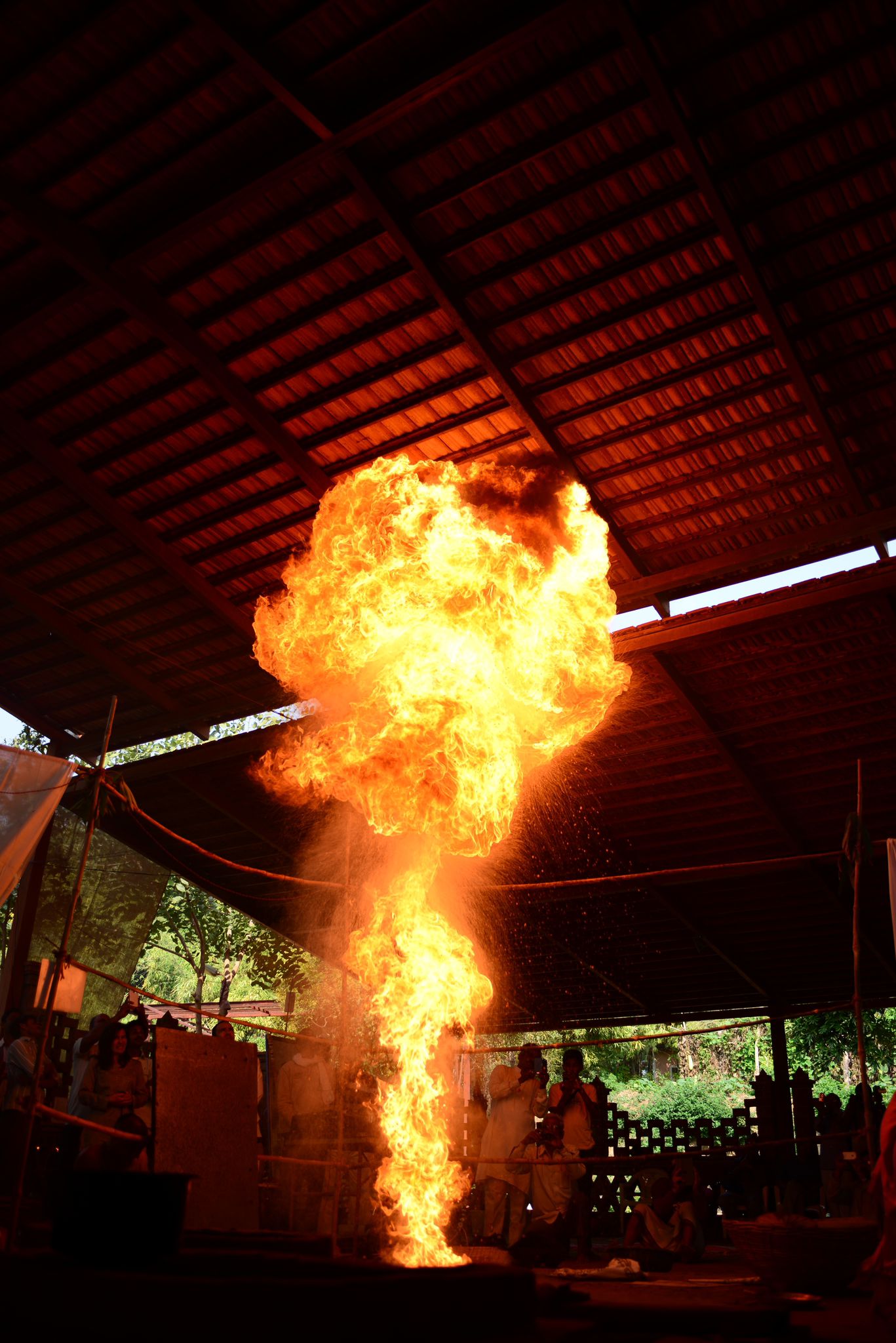
    In the Sanatana Hindu Dharma, Pravargyawas a ceremony introductory to the Agnishtoma (Soma sacrifice), at which fresh milk is poured into a heated vessel called mahavira or gharma and offered to the Ashvins. The ceremony is described in details in the technical texts on proper ritual, the Brahmanas, Aranyakas and Shrautasutras.The temperature in the sun’s chromosphere is 4,320℃. As part of Pravargya (a special ball of fire), a sudden flash of temperature to the tune of 3870℃ is created in order to cleanse the environment.[citation needed] Pravargya almost matches the Sun’s temperature to cleanse the atmosphere.

    Source.

    https://en.m.wikipedia.org/wiki/Pravargyahttps://en.m.wikipedia.org/wiki/Pravargya

    A Scientific study has the following information.

    A 4,000 year old fire ritual conducted in the remote village in Kerala in April this year has a positive impact on the atmosphere, soil and other environment effects, according to scientists who are now ready with their findings.

    The “Athirathram” ritual held on April 4— 15 at Panjal village in Thrissur district was the focus of a detailed study by a team of scientists led by Prof V P N Nampoori, former director of the International School of Photonics, Cochin University of Science and Technology.

    The scientists had focused on the fire ritual’s scientific dimensions and impact on the atmosphere, soil and its micro—organisms and other potential environmental effects.

    The yagna seems to have accelerated the process of seed germination and also the microbial presence in air, water and soil in and around the region of the fire ritual is vastly diminished, according to a statement released by the Varthathe Trust, who organised the ritual.

    The team had planted three types of seeds — cowpea, green gram and Bengal gram — on all four sides of the ritual venue at varying distances. They found that the growth was better in case of pots kept closer to the fire altar.

    This effect, the study says, was more pronounced in the case of Bengal gram with growth about 2,000 times faster than in other places.

    According to Nampoori, sound is a vibration and continuous positive vibrations through chanting, accelerates the process of germination.

    “The findings would not only help dispel superstitious notions associated with Vedic rituals but also help in continuation of such tradition for the betterment of nature and the environment,” says Nampoori.

    He added that further research on the phenomenon were on which could prove that some bio—amplifier generated in the atmosphere because of the ritual, had a selective effect on Bengal gram.

    The study focused on counting bacterial colonies at three locations — within the yagnashala, 500 metres and 1.5 kilometres from the yagnasala. Microbial analysis made before, during and four days after the yagna revealed that the air in the vicinity of the yagnashala was pure and had very low count of microbe colonies.

    The research team also found that microbial activities in the soil and water around the yagnashala were remarkably less compared to normal ground.

    The “Athirathram” ritual which literally means “building up of the fireplace and performed overnight” and usually held to propagate universal peace and harmony, was first documented 35 years ago by US—based Indologist Frits Staal.

    Staal, currently Emeritus Professor of Philosophy and South and Southeast Asian Studies at the University of California, Berkeley had in 1975 organised and recorded the ritual in detail with the help of grants and donations from the Universities of Havard, Berkely and Finland”s Helsinki University.

    The research team conducted tests near the fire altars of the 1918 and 1956 Athirathram, still preserved in the backyards of Namboothiri homes, reveal that the bricks continue to be free of microbial presence.

    “It’s an indication that the effect of the ritual is long—lasting. Studies are on to find out if other positive changes on the atmosphere are transitional or permanent,” say researchers.

    An analysis conducted on the dimensions of temperature from the flames of the pravargya by Prof A K Saxena, head of photonics division, Indian Institute of Astrophysics, Bangalore, found that the fire ball that formed during the ritual had a particular wavelength with an unusually high intensity similar to what is observed in typical laser beams at about 3,870 degree centigrade.

    It may be possible to have stimulated emission at this wavelength (700 nm) and gain from plasma recombination. It needs to be studied further, he says.

    The members of the team of scientists’ team at the Panjal Athirathram 2011 included experts from various disciplines and included Dr Rajalakshmy Subrahmanian (Cusat), Dr Parvathi Menon (M G College, Thiruvanathapuram), Dr Maya R Nair (Pattambi Government College), Prof Saxena ( Indian Institute of Astrophysics, Bangalore) and Prof. Rao (Andhra University).

    The scientific team members were supported by Zarina (Research Scholar, CUSAT), Ramkumar (Biotechnologist), Asulabha (Biotechnologist) and a number of postgraduate, graduate and school students.

    Source

    https://www.thehindu.com/sci-tech/ancient-fire-ritual-has-positive-impact-on-environment-scientists/article2103881.ece

  • Yagnyas Yaagas Of Hinduism List

    There is difference between Yagnya and Yaaga.


    While Yagnya is performed as a  Duty , without expecting any results, Yaaga is performed with a specific purpose.

    Homa being performed.jpg
    Homa being performed.


    The Forty Samskaras of Hinduism contain Yagnyas.

    BRAHMAYAGNA

    DEVA YAGNA

    PITUR YAGNA

    MANUSHYA YAGNA

    BHOOTA YAGNA (VAISWADEVA YAGNA).


    Paka Yagnyas.Seven

    ASTAKA
    STHAALI PAKA
    PAARVANA
    SRAAVANI
    .AAGRHAYANI
    CAITRI
    ASVAYUJI

    Havir Yagyas, Seven.


    AGNI AADHANA-
    AGNI HOTHRA
    DARSA POURNA MASA
    AAGRAYANA
    CHATUR MASYA
    NIROODA PASU BANDA
    SAUTRAMANI

    Soma Yagnyas. Seven.

    AGNISHTOMA
    ATYAGNI SHTOMA
    UKTYA
    SODASI
    VAJPAPEYEE
    ATIRATHRA
    APTORYAMA

    List of Homas.


    There seems to have been over 400 Yaagas during the Sanatana Dharma period.

    Some of them are listed here.

    Readers may contribute.

    Rajasuya and Aswamedha are meant for Kings.

    Puthrakameshti is a very powerful homa to beget children.

    Dasaratha peformed this to beget Rama, Lakshmana, Bharata and Satrugna.

    Sri Rudram Chandi, Gita Homa are some of the most sacred Homas

    • NAVAGRAHA YAJNA : yajna performed for all 9 planets
    • SHIVA MAHA YAJNA : For spiritual progress, integrity and good mental qualities
    • SHIVA SAHASRA YAJNA : For strong spiritual feeling and material progress
    • SHIVA PANCHAKSHARA YAJNA : For good public relation and progress
    • SHIVASTAKA YAJNA : For happiness and overcoming sufferings
    • BANALINGAM YAJNA : For pure knowledge, good health and for avoiding enmities
    • ADITYA HRIDAY YAJNA : for avoiding all difficulties, be kind to everyone, and get rid of serious skin diseases
    • SURYA SAHASRANAM YAJNA : according to cast and gotra – Brahmin will get knowledge – Kshatria will get success and no enmity – Vaishya will get prosperity and good business – Shudra will get spirituality
    • NRISHINGHA YAJNA : For overcoming danger and accidents
    • JAGANNATHA YAJNA : For spiritual progress
    • VISHNU MAHA YAJNA : for progressing in the four path ; Dharma ( spirituality), Artha (economic progress), Kama (enjoyment and fulfillment), Moksha ( enlightenment)
    • VISHNU SAHASRA NAMA YAJNA : For wealth, prosperity and happiness
    • PURUSHA YAJNA : for spiritual knowledge, purity and integrity
    • MADHU SUDANA YAJNA : for avoiding fear and getting more friends
    • NARAYANA YAJNA : to increase the potentiality of giving love to everyone
    • DINOBANDHU YAJNA : to get support from nature to avoid all obstacles
    • SANKATA NASHANA YAJNA : For avoiding serious obstacles
    • PRAPANNA GITA YAJNA : Get rid of bad karma and for getting respect from everyone
    • NARA SINGHA YAJNA : for fulfillment of desires
    • SRI RAMA YAJNA : for getting more progress in all areas of life
    • GANESH YAJNA : for success
    • MAHA GANAPATI YAJNA : for great success in business
    • SANKATA NASHANA GANESH YAJNA : for avoiding serious harm and loss
    • GANESH SAHASRA NAMA YAJNA : for success over enmity and overcoming serious fear
    • MAHA KALI YAJNA : for family happiness and prosperity and wealth
    • MAHA TARA YAJNA : for knowledge, education, good karma and fame
    • MAHA VIDYA YAJNA : for success in education
    • MAHA LAKSHMI YAJNA : for wealth
    • SRI VIDYA YAJNA : for the welfare of the family
    • TRIPURA SUNDARI YAJNA : for beauty and fame
    • BHUVANESWARI YAJNA : for permanent prosperity and progress
    • SRI VAIRABI YAJNA : for good speaking qualities and avoiding obstacles in speech
    • BAGALAMUKTI YAJNA : for success in court case, avoiding enmity and for good reputation
    • MATANGI MAHA YAJNA : for great success and prosperity
    • RUDRA CHANDI YAJNA : for avoiding danger in life
    • CHANDI MAHA YAJNA : family happiness and good relation between husband and wife
    • SATA CHANDI MAHA YAJNA : overcoming all difficulties in life
    • SARASWATI MAHA YAJNA : for deep understanding of vedic knowledge
    • RUDRA YAJNA : spiritual progress and getting more knowledge
    • MAHA RUDRA YAJNA : for good health and avoiding serious illness
    • ANNAPURNA YAJNA : for knowledge and strong sacrificing qualities
    • GANGA MAHA YAJNA : for purity and avoiding bad karma
    • RINMOCHAKA MANGLA YAJNA : for getting help from nature to repay debt
    • AGANI YAJNA : for general progress, good health and general prosperity
    • VASTUDEVA YAJNA : foundation for good home and house
    • SASTHI MAHA YAJNA : good for children’s health
    • NAIKA MAHA YAJNA : for getting good lover and good relation with lover
    • APARAJITA YAJNA : for success in a project or special matter
    • BATUK VAIRABA YAJNA : avoiding obstacles from government and increase success
    • Unknown name : For removal of serious psycho-physiological illness
    • TILOKANCHAN YAJNA – SHORAS YAJNA – BRISATSARGA YAJNA – DANSAGAR YAJNA: to remove impurities from the time of death and to promote the evolution of the soul( to be performed after that someone has passed away. 

    Citation.

    http://www.yajna.com/list.htm