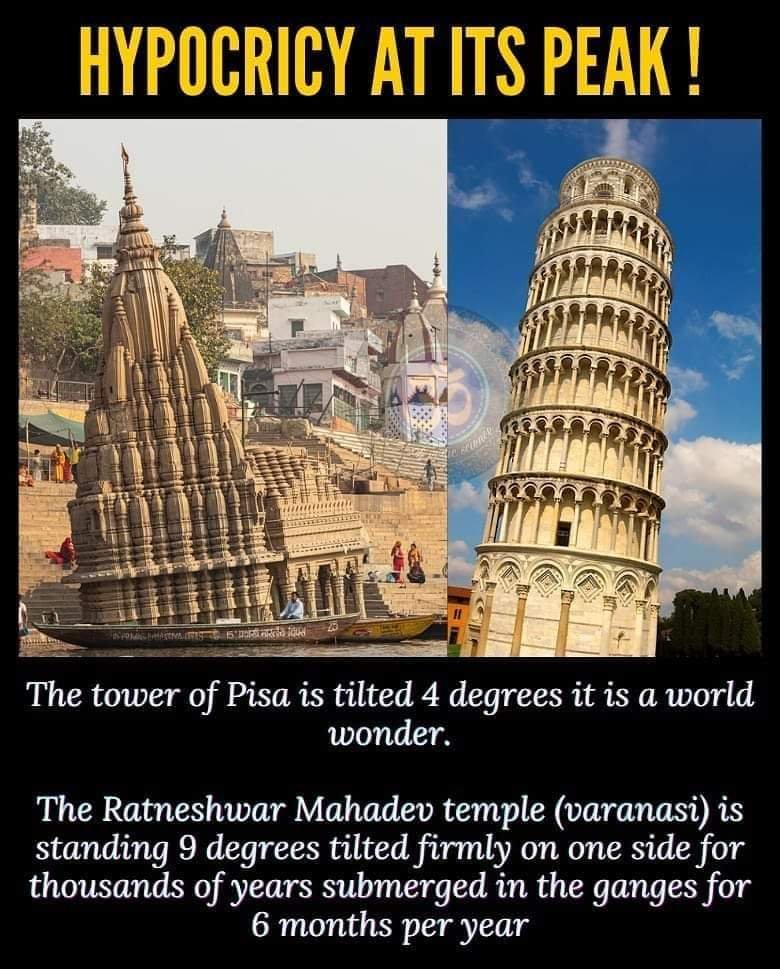
The list goes on. Add the Raneswara temple in Varanasi.
Ratneshwar Mahadev temple Varanasi.
Also known as Matri-rin Mahadev or Kashi Karvat, Ratneshwar Mahadev Temple has to be one of the most photographed temples in the holy city of Banaras. An image of this temple is almost guaranteed to appear in any promotional materials about the ancient city, it is probably the most recognisable monument along the ghats for foreign visitors. The location of this temple is also a curious one. Rather than being built at a higher level and protected from the high flood waters of the Ganga during the monsoon season, it appears that the builders made a conscious decision to construct the temple in a location where for many months of the year it would be partially underwater.Today it would be all too easy to assume that the location of this temple and its leaning aspect is an anomaly, but there is plenty of evidence to suggest otherwise. Many paintings of the ghats from the early to mid 19th century depict leaning temples close to the Ganga, so it would appear that Ratneshwar Mahadev is now a lone survivor of this phenomenon. …..
We also have documentary evidence of these leaning temples. The artist William Daniell writing in The Oriental Annual in 1834 observed :
“One of the most extraordinary objects to be witnessed at Benares and which is generally one of great curiosity to the stranger, is a pagoda standing in the river, there is nothing to connect it with the shore. The whole foundation is submerged, and two of the towers have declined so much out of the perpendicular as to form an acute angle with liquid plain beneath them….It has been surmised, and with probability, that this temple was originally erected upon the bank of the river, which then offered a firm and unsuspected foundation;..During the Winter and Spring months the water levels of the great Ganga are low enough to permit access without getting your feet wet. It’s worth a quick exploration, there’s some nice carvings that have remained in remarkably good condition considering the length of time this temple is submerged each year. Source.
The claim is true. The Ratneshwar Mahadev Temple is situated at Manikarnika Ghat, Varanasi. The temple has developed a nine-degree slant. It is also referred to as Kashi Karvat (Kashi is the ancient name for Varanasi and karvat means leaning in Hindi). A Times Now report said that one of the beliefs held regarding the temple is that the ‘ghat’ had collapsed and leaned backwards after not being able to withstand its weight. The temple supposedly stood straight before the 1860s. An Indian Travel Photography Blog, Kevin Standage, stated that the temple is famous for having a tilt of about nine degrees. Below are screenshots from the blog which shows the temple from varied angles:
Ratneshwar Mahadev Mandir (Hindi: रत्नेश्वर महादेव मंदिर) (also known as Matri-rin Mahadev, or Leaning temple of Varanasi) is one of the most photographed temples in the holy city of Varanasi in Uttar Pradesh, India. The temple, while apparently well-preserved, leans significantly towards the back side (north-west), and its garbhagriha is generally below the water much of the year, except for a few months during the summer. The Ratneshwar Mahadev Temple is situated at Manikarnika Ghat, Varanasi. The temple has developed a nine-degree slant. It is also referred to as Kashi Karvat (Kashi is the ancient name for Varanasi and karvat means leaning in Hindi).[
I have written on Indian temples which baffle science.
There are temples where the Shiva Linga changes colors five times daily,Ganesha remains black during the fifteen days of the waning moon, Krishna and white during waxing moon, Shukla Paksha,where in the same temple water in the temple tank remains black and white according to Shula Paksha and Krishna Pakshsa,Temple where Vishnu idol looks like make when seen in front and female when looked from behind, Narasimha idol which gobbles up fifty percent of Jaggery water irrespective of the Vessel from which it is drawn and throws it up,the atomic composition of Palani Subrahmanya is not known…
The list is endless!
Siva Temple, Thiruneelakkudi
There is yet another temple where the Shiva Linga absorbs entire Oil when abhisheka is performed.
‘This sivasthalam temple is located 13 Kms from Kumbakonam. The temple is located on the road side at Tiruneelakudi on the Kumbakonam – Karaikkal road. From Mayiladuthurai, travel upto Aduthurai on the way to Kumbakonam, and then take a branch road from there to reach Thiruneelakkudi (3 Kms. from Aduthurai).
Another unique feature is that the Bilva leaves here have five petals instead of three!
‘(திருநீலக்குடி நீலகண்டேஸ்வரர் கோயில்) is a Hindu temple located at Thanjavur district of Tamil Nadu, India. The historical name of Tiruneelakkudi is Thennalakudi . The presiding deity is Shiva. He is called as Neelakandeswarar. His consort is Oppilamulaiyal.
Leave a Reply