Tag: St.Thomas Church

  • Thomas Did Not Visit India Thomas Mount is Bhringi Malai

    Thomas Did Not Visit India Thomas Mount is Bhringi Malai

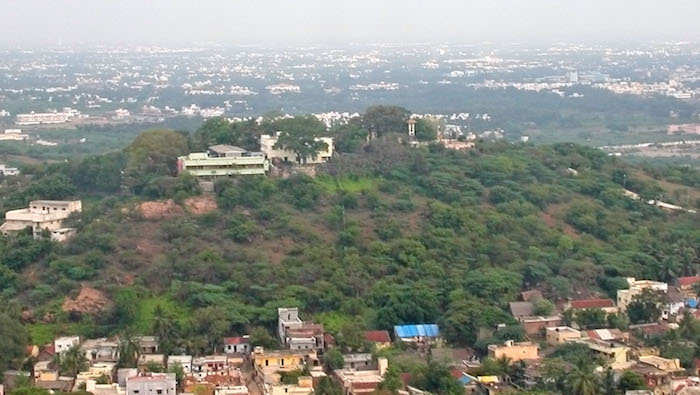
    St.Thomas Mount in Chennai is assumed to be the place where Thomas was killed and a Church exists there.

    But The Hindu tradition has it that it is a Shiva Temple and  Bhringi Maharishi lived and did penance there

    St.Thomas Mount, Chennai image
    Nandeeswarar temple is one of those temples in this original locality belonging to the Hindus. Some even claim that Lord Shiva appeared in the form of Nandi (holy bull) to Bringi in this site.
     
    The east facing ancient temple is a small one without a tower and flag post. A small Nandi and bali peeth face the main shrine. The Shiva Linga idol (Nandeeswarar) is big however the idol of Avudai Nayaki, the Goddess, which is located in a separate south facing shrine is not very attractive. The temple has just one prakara. In the parakara the sub shrines of Sundara Vinayaka, Subramanya with his two consorts and Navagraha are found. Inside the maha mandapa the idol of Ganesha, Surya and Bhairava are located. Near the entrance of the main shrine the idols of Ganesha and Subramanya are found. The wall surrounding the main shrine has the small Goshta images of Nardana Ganapati, Dakshinamurty, Vishnu, Durga and Brahma. The idol of Chandikeshwara is found to be big and of ancient period.
     
    Christians have it that since Tamils used to call Foreigners as ‘Parangi, the name Parangi Malai came into use.
     
    The fact is that Thomas did not come to India ,much less was murdered by Hindu Brahmins.
     

    The church is built on the foundations of a Hindu temple, though Ponnu Elizabeth Mathew neglected to mention this fact. The church contains on its altar reredos a famous “bleeding” stone cross said to have been carved by St. Thomas. That St. Thomas has never been described anywhere as a stone cutter seems to have escaped the writer’s notice, as does the old Palhavi inscription on the carving’s border which identifies it to be of Persian origin. It has been dated to the 8th Century by experts, as have other “St. Thomas” crosses found in Kerala churches. Crosses were not used by Christians to identify their religion until long after the Council of Nicea in the 4th Century, probably not until the 7th Century.

    Another item of interest the article brought to the reader’s attention is the icon of the Virgin Mary, allegedly painted by St. Luke and brought to India by St. Thomas. There are seven of these icons by “St. Luke” distributed around the world, the most famous one being in Santa Maria Maggiore Basilica at Rome. All of them are medieval productions, and the idea that they could be associated with either St. Luke or St. Thomas is absurd. Both 1st Century apostles were practicing Jews and fierce iconoclasts. The cult of the Virgin Mary, like the cult of the cross, is a late development in the evolution of Christian religion. The protagonists of the St. Thomas tale always forget to put all the accoutrements and accretions of the apostle’s Portuguese legend into a 1st century context…

    “The allegation that St. Thomas converted a Mylapore king to Christianity and was then murdered is deeply offensive to Hindus as it implicates Hindus in the assassination of an important Christian saint. The true martyrs of the whole affair were the Hindus who lost their ancient Kapaleeswara temple on the beach when the Portuguese destroyed Mylapore. The Vatican has stated in a letter to me that the question of whether or not St. Thomas came to India is one for historians to decide.”[2]

    This letter was published in The New Indian Express on 16 July 2004, after a reminder had been sent to the managing editor. He and his chief, blind and stubborn as they are about the implications of spreading the St. Thomas tale, did not want to know anything more about it.

    Source:

    http://apostlethomasindia.wordpress.com/2011/12/21/did-a-hindu-king-kill-st-thomas-ishwar-sharan/

    Related articles
    Enhanced by Zemanta
  • Santhome Church Is Kapaleewsarar Temple St.Thomas Fraud.

    Madras , aka, Chennai has a lot of tourist attractions.

    One such is the Santhome Church in Mylapore.

    Kapaleeswarar Temple,Chennai.
    The Present Kapaleeswarar Temple,Mylapore
    Thomas Church, Santhome, Chennai
    Santhome Church, chennai

    This is not only a Church but a religious spot for the Christians.

    The Church is dedicated to St,Thomas who is reported to have landed in Chennai around 300 AD and spread Syrian Christianity .

    This Saint Thomas was infamous Acts of Thomas by Bardesanes, and this  is the source of the legend of St. Thomas in India.

    Dr. Elst studied under Jesuits at Katholieke Universiteit in Belgium, Europe’s oldest Catholic university at Leuven, has done extensive research on this

    subject and says that At.Thomas is a Fraud perpetrated on the Indians by corrupt Catholic priests to spread Catholicism in India.

    The original Kapaleeswarar temple in Mylapore was ransacked , demolished by The Portuguese . a Church was built  and was named as   San Thome

    Cathedral Basilica on the Mylapore beach in Chennai.

    The original structure was a Shiva Temple, that of Kapaaleswara.

    Dr.Elst writes thus,

    According to Christian leaders in India, the apostle Thomas came to India in 52 AD, founded the Syrian Christian Church, and was killed by the fanatical Brahmins in 72 AD. Near the site of his martyrdom, the St. Thomas Church was built. In fact this apostle never came to India. The Christian community in South India was founded by a merchant called Knai Thoma or Thomas of Cana in 345 AD—a name which readily explains the Thomas legend. He led four hundred refugees who fled persecution in Persia and were given asylum by the Hindu authorities.

    In Catholic universities in Europe, the myth of the apostle Thomas going to India is no longer taught as history, but in India it is still considered useful. Even many vocal “secularists” who attack the Hindus for “relying on myth” in the Ayodhya affair, off-hand profess their belief in the Thomas myth. The important point is that Thomas can be upheld as a martyr and the Brahmins decried as fanatics.

    In reality, the missionaries were very disgruntled that the damned Hindus refused to give them martyrs (whose blood is welcomed as “the seed of the faith”), so they had to invent one. Moreover, the church which they claim commemorates St. Thomas’s martyrdom at the hands of Hindu fanaticism, is in fact a monument of Hindu martyrdom at the hands of Christian fanaticism. It is a forcible replacement of two important Hindu temples—Jain and Shaiva—whose existence was insupportable to the Christian missionaries.

    No one knows how many Hindu priests and worshipers were killed when the Christian soldiers came to remove the curse of Paganism from the Mylapore beach. Hinduism does not practice martyr-mongering, but if at all we have to speak of martyrs in this context, the title goes to these Jina- and Shiva-worshipers and not to the apostle Thomas.—Dr. Koenraad Elst

    *The Myth of Saint Thomas and the Mylapore Shiva Temple, third revised edition, 2010 is available from publisher Voice of India, New Delhi. It has an extensive bibliography and is a valuable tool for researchers and historians.”


    *FAIR USE NOTICE
    Articles and images on this web site which contain copyright material that has not been specifically authorized for use by the copyright owner, have been made available here to advance learning and to inform the Hindu community at large of issues that may concern it. We believe this constitutes “fair use” of copyright material as understood in Indian and US copyright law.

    Reference:

    http://ishwarsharan.wordpress.com/

    Enhanced by Zemanta