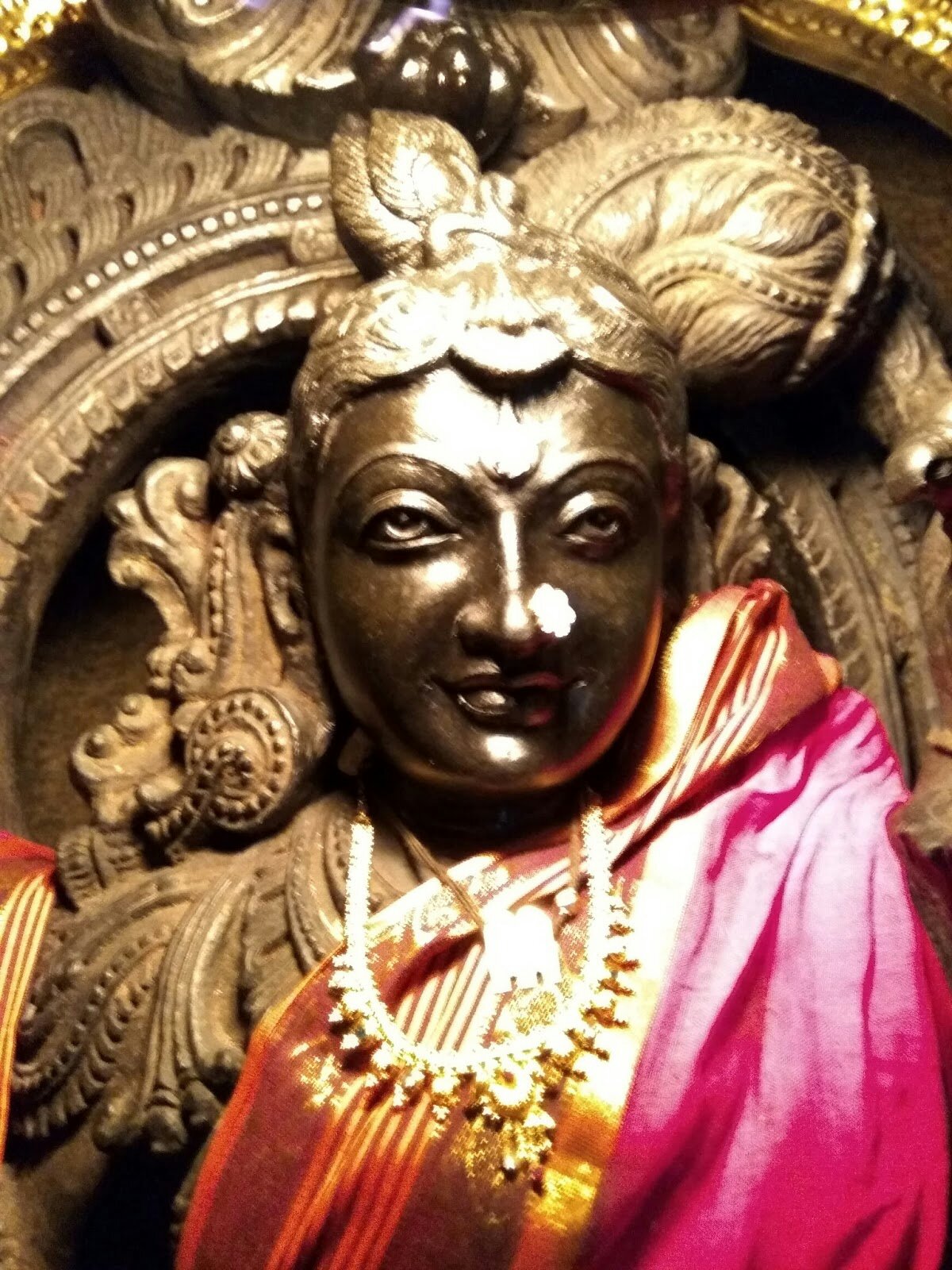
Tag: Srivilliputhur

  • Eyes Glow Real Lakshnikantha Andal Hedthale Temple 16 Faced Hall

    Eyes Glow Real Lakshnikantha Andal Hedthale Temple 16 Faced Hall

    Though a Shaivite by tradition,our home accords Andal place of pride in our pooja room.

    My mother used to say we are Andal’s children.

    Reason , I was born in Srivilliputhur,one of the Divya Kshetras of Vaishnavism.

    My familiarity with Vaishnavite practices is slightly better than Shaivite practices.

    Such is the greatness of Andal,one of the twelve Azhwars,and the only woman,she evokes proximity to Godhood easily.

    Though there are Sannadhis, separate sanctum for Andal in most of the Divya Kshetras,very little is known about Andal sanctum at Lakshmikanthaswamy temple at Hedthale,near Nanjangudu,near Mysuru, Karnataka,India.

    The special features of this temple include,

    1.The eyes of Lord Lakshmikantha,Vishnu with Lakshmi,look real whenights are out and Aarthi is performed.

    2.Same with Andal Sannidhi.

    3.Sixteen faced hall where the Observer can not be seen by the observed.

    4.A Special dais where if one is seated before Lord Narasimha,one can feel the positive vibrations.

    Lakshmikantha, the principal deity for whom the temple is named, is four-armed with the padma or lotus and gadha held at the back, the shankha and chakra held in the front in the samasharna mudra or mode, that is, in the right and left hands, contrary to norms (most forms of Vishnu have the shankha-chakra symbols on the left and right hands respectively).

    Lakshminarasimha, the deity placed on the left of Lakshmikantha, is perfectly symmetrical with goddess Lakshmi being chiselled in perfect proportion and seated at a level that is proportionate in relation to the Lord.

    In front of the shrine is drawn a circular motif upon which one is supposed to sit in meditation posture and look steadfast at the eyes of Narasimha. This is believed to result in positive vibrations felt by the worshipper.

    Tribhangi

    The idol of Venugopala, flute in hand, in tribhangi, the dance posture, is most enticing, even as cows and gopis stand entranced by the melody of his music. Andal, whose idol is of recent origin, sculpted over a decade ago, is the piece de resistance in the temple.

    The idol has been sculpted not just aesthetically, but also scientifically perhaps.

    The eyes that look ordinary in normal light appear real when the priest performs ‘aarathi’ in total darkness with all lights switched off.

    As the light from the aarathi is held at level with Aandaal’s forehead, her gaze appears to be directed at you, looking straight into your eyes!

    The temple architecture typically consists of three chambers – the garbha griha or sanctum sanctorum, the sukhanasi and the navaranga. Seven ft. high lathe turned pillars hold aloft the hall, the ceiling of which has an exquisitely carved banana bunch.

    Much of the ceiling has sculpted geometric patterns. Unlike Hoysala temples, the exterior walls are bereft of sculptures.

    Brilliantly designed

    The Hadinaru Mukha Chavadi in front of the Garuda Sthambha is brilliantly designed and entails an interesting tale. It was built by Bhimanna Danda Nayaka, a palegar who had 16 daughters, all of them married and settled in life.

    As an annual event, the palegar would have all his daughters and sons-in-law visit him and there would be merriment. He conceived and built the chavadi with purpose and tradition in mind.

    On the one hand because of the sheer numbers of daughters he had, he found it increasingly difficult to match the sons-in-law with the respective daughters.

    Rooted in tradition

    Also, according to traditions of the times, women were not allowed to see their sons-in-law directly or face-to-face. Danda Nayaka thus had the 16-faced hall with 16 seats, one for each daughter/son-in-law pair.

    Further, the 16 faces were built in such a way that while the palegar himself could see all his daughters and all the respective sons-in-law, his wife would only be able to see her daughters but not the sons-in-law from the pedestal in which the duo would sit!

    Source.

    https://www.thehindu.com/todays-paper/tp-features/tp-propertyplus/the-16faced-hall/article6134865.ecehttps://www.thehindu.com/todays-paper/tp-features/tp-propertyplus/the-16faced-hall/article6134865.ece

    ‘How to reach.

    12 km from Nanjangudu .

    Airport.Mysuru/Bangalore.

    Railway station.Mysuru,Nanjangudu.

    Bus station. Nanjangudu.

  • Date of Andal Srivilliputhur 3004 BC?

    Date of Andal Srivilliputhur 3004 BC?

    I am checking the dates and history of India during middle ages to sort out misinformation that had crept into early Indian History.

    In this article ,I am looking at the date of Andal,the only Saint Poetss in Tamil,an Azhwar among the twelve.

    Why have I chosen Andal,not others?

    Honest reason is I was born in Srivilliputhur and studied there.

    Srivilliputhur Andal temple.image.
    Srivilliputhur Andal temple.The Tower is The Emblem of aTamil Nadu.

    This small town is the birth place of Andal and Srivilliputhur Andal Temple is famous as the second Divyakshetra after Srirangam for Sri Vaishnavas.( Vaikuntam is taken as the first Divyadesa,but as it is celestial it is not taken into account as a Divyadesa in Earth)

    Though an Iyer, I am conversant with Vaishnava Sampradaaya as much as Iyers’ mostly because I spent my formative years at lap of Andal and I am moved by Thiruppavai as much as Abhirami Andhadi.

    As to the date of Andal,the scholars (?)assign 7 or 8th Century AD.

    The evidence they rely on are,

    Internal evidence in Andal’s Thiruppavai mainly and her foster father Vishnuchittha’s Works.

    The astronomical event described in Thiruppavai.

    The internal evidence rests on the style of Andal’s Works belong to a much later period than the Sangam period.

    She refers to Sangam period as Sangath Tamizhmaalai Muppadhum Thappame,’Garland of poems modeled after Sangam Tamil Style,

    ‘சங்கத் தமிழ்மாலை முப்பதும் தப்பாமே’ Thiruppaavai 30.

    The same style is found in her foster father’s Works.

    Secondly,reference is taken to another Thiruppaavai,

    புள்ளின்வாய் கீண்டானை, பொல்லா அரக்கனைக்

    கிள்ளிக் களைந்தானைக் கீர்த்திமை பாடிப்போய்,
    பிள்ளைகள் எல்லாரும் பாவைக் களம்புக்கார்;
    வெள்ளி எழுந்து, வியாழம் உறங்கிற்று;
    புள்ளும் சிலம்பினகாண்; போதரிக் கண்ணினாய்!
    குள்ளக் குளிரக் குடைந்து நீராடாதே,
    பள்ளிக் கிடத்தியோ? பாவாய்! நீ நன்னாளால்
    கள்ளம் தவிர்ந்து கலந்தேலோ ரெம்பாவாய். ‘

    வெள்ளி எழுந்து, வியாழம் உறங்கிற்று;

    This refers to the celetial phenomenon of Venus rising in the East and Jupiter setting in the West,in the early hours of the day.(Brahma Muhurtha between 3.45 and 4.30 am)

    Based on this thecday on which the poem was composed is fixed either  on 25th November 885 AD or 24th December 886 AD.

    So the datevof Andal is assigned as 8th Century AD.

    Before looking at the other evidence which dates Andal at 3025 BC,let us look at some issues in the above dates.

    1.The style no doubt is an important factor to determine the dates.

    True,the Andal’s literary style is not Sangam Style.

    But is that alone sufficient to date around 8th Century AD?

    Those who assign 8th Century take reference to Vallabha Pandya who was a contemporary of Vishnu Chitta and Andal and his date is determined around 8th Century AD.

    Vishnuchitta is assigned 8oo to 885 AD.

    ஞானசம்பந்தர் (640-656 A.D.) (மாமல்ல I, பாண்டியன் அரிகேசரி நெடுமாறன்  சம காலத்தவர்)அப்பர் (580-660 A.D.) (மஹேந்திரன், மாமல்ல மற்றும் பாண்டியன் அரிகேசரியின் சமகாலத்தவர்)பெரியாழ்வார் (800-885 A.D.) (பாண்டியன் ஸ்ரீ மாற ஸ்ரீ வல்லப சமகாலத்தவர்), நம்மாழ்வார் (745 to 780 A.D.) போன்றோர் வாழ்ந்த காலம் பற்றிய தெளிவு கிடைக்கின்றது.

    எனவே பெரியாழ்வார் ஸ்ரீ மாறன் ஸ்ரீ வல்லபன் (கி.பி. 815 – 862) என்ற பாண்டியன் காலத்தில் வாழ்ந்தவர் என்று ஐயத்திற்கு இடமின்றி ஏற்றுக்கொள்ளலாம்.  பெரியாழ்வாரே பாண்டியன் கோ நெடுமாறன் தன் சமகாலத்வர் என்று மூன்று இடங்களில் குறிப்பிட்டுள்ளார்: 

    1. பருப்பதத்து கயல் பொறித்த பாண்டியர் குலபதி. (பெரியாழ்வார் திருமொழி 5-4-7) 
    2. கொன்னவில் சுடர் வெல் கோன் நெடுமாறன் (பெரியாழ்வார் திருமொழி 4-2-7 ) 
    3. குறுகாத மன்னரை கூடு கலக்கி (பெரியாழ்வார் திருமொழி 4-2-8)

    குருபம்பரை நூலிலும் பாண்டியன் ஸ்ரீ வல்லபன் பெரியாழ்வாரின் சமகாலத்தவர் என்று குறிப்பிடப்பட்டுள்ளது.’

    Source.  http://akharam.blogspot.in/2015/01/blog-post.html

    However as there are more kings by the same name,which one should we take?

    Again the planetary alignment stated above  is not limited to the two dates mentioned above.

    They had happened earlier,even during Sangam Period and will take place in future as celetial events take place with regularity,as in Agastya Star,Star Canopus for example.

    The difficulty in taking celestial event as proof is not foolproof.

    Please read my article on Difficulty in dating Hinduism.

    Now let us look at another date assigned  to Andal based on another Text.

    Sri Andal is considered the incarnation of Bhoomi Devi (Mother Earth). She was like Sri Seetha born of Mother Earth. Divya Suri Charita records that she appeared as a child in the 97 th year after the onset of Kali Yuga termed the Nala year, in the Tamil month of Adi in the Purva Phalguni asterism. Follow the link for a brief outline of Sri Andal (Godha) and her works’

    Source.

    http://azhwar.org/?p=28

    I am not sure from where you are getting the idea of Andal being born in 8th century. It is laughable and this is what happens when an outsider puts out the information as he likes and publishes a book. Indeed 3025 BC is a wrong date. I re-edited it to post the correct birth date i.e 97/98th year of Kali Yuga (3102 BC) that puts the date around 3004 BC. Out of 12 alwars, the last alwar was Thirumangai Alwar who was born in 2706 B.C. Nalayira Divya Prabandhams were lost during the big 3500 year gap between Thirumangai Azhwar and Nathamuni. Andal birth date is clearly mentioned, why are you guys who have no idea of the sanatana dharma are tampering with the traditional accounts is beyond me. Should you guys push everything after the christ or something? I don’t understand. Indeed it was a mistake on my part to say 3025 BC but the correct date is around 3004 BC. Research the alwars history, the last alwar was Thirumangai. I don’t care if you bar me from editing the page, its just that wiki loses authority by pushing the dates. I am done…—-Kalyan — Preceding unsigned comment added by SriKrushna7(talk • contribs)

    @SriKrushna7: Do you have a reliable source for this, per WP:V and WP:RS? Blogs, random websites and self-published sources are neither scholarly nor acceptable in wikipedia. If you read the pages in the sources cited, you will see support for 8th/9th century. @Redtigerxyz has suggested that we acknowledge the traditional hagiographies, an idea I like, per wiki’s NPOV policy. Ms Sarah Welch (talk) 17:51, 18 December 2015 (UTC)

    ────────────────────────────────────────────────────────────────────────────────────────────────────@183.82.214.129: In response to your comment on my talk page, please note that the article already has the traditional ~3000 BCE date as a special note. Ms Sarah Welch (talk) 23:56, 24 February 2016 (UTC)

    That small note at the bottom is an insult to the Sri Vaishnava sampradaya followers and is considered blasphemy. Your consistent vandalizing of the page with the false dates and preferring of one source over the other just because it does not sound practical for you is absurd. If I could have reported you, I would have already done that to admins and your threats of blocking me and all is absolute nonsense and why would I be blocked for asking a valid question. The date of birth of Andal comes from traditional Tamil scriptures and not by an author of the book who out of his mind sets a date! Read the book ‘Divya Suri Charita’ which actually mentions Andal date of birth (97th Kali/3005 BC to be exact) or and is the primary source of information. Lastly, I don’t know why you are editing a page which you have NO idea about, absurd to say the least. — Preceding unsigned comment added by 183.82.214.129 (talk) 11:52, 27 February 2016 (UTC)’

    Source.  https://en.m.wikipedia.org/wiki/Talk:Andal#3025_BC_versus_8th.2F9th_century_dating_in_reliable_source

    The bottom line is,

    1.Texts are taken to vadidate dates.

    But when there are more texts mentioning different dates,which one to rely on?

    For westerners and Wiki,dates that place Indian History later to Christ or Western Sources.

    That’s the reason why I do not edit wiki,despite their communication as I am convinced that minecwill be removed.

    I quote Wiki,despite many readers asking me not to rely on it,because I choose a wiki article based on its resources.

    I shall write in detail on this in my Page shortly

    2.The Sangam date assigned around 3000 BC calls for revision in the light of new archeological finds at Attirampakkam,Poompuhar which set Sangam dates back by 30,000 years.

    So the date of Andal at 8th Century AD could be open to question as it might be 3025 BC as the proof here is also dependant on text as in the case of 8th Century AD.

    Let me check further.

    Scholars may send information.

  • Who Has The Courage Of Andal To Address Vishnu Thus

    I have written on the intimate level in which God is held in Hinduism.

    We have many legends historical facts to back this up.

    Sanskrit literature abounds in narrating these instances and , if one is of the right disposition, shall bring tears .

    Andal, Srivilliputtur.jpg
    Andal, Srivilliputtur

    When Tamil takes position on this?

    The result is exquisite.

    There are many who have treated God as a Lover, Meera an example.

    Andal, an Azhwar by her own right steals the show in this lover role Nayaka Nayaki Bhava.

    Her yearning for Vishnu, Krishna is something ephemeral and would melt one’s heart without being erotic.

    Tamil calls the satisfaction  in culmination, consummation of Love as pleasure of the Lowest Order while Realizing Reality or communon with God as ecstasy or Bliss.

    The former is called as Chirinbam(சிற்றின்பம்)

    The latter as Perinbam ( பேரின்பம் )

    Andal of Srivilliputhur has composed many exquisite poems and her father Vishnuchitta, Periyaazhvar in One who Blessed even Vishnu!

    Of most importance is Andal’s Thiruppavai(which incidentally is being celebrated as a function in  South east Asia), thirty poems oozing Bhakthi and Love for Vishnu, Krishna.

    There are such utterances my Andal that bespeaks of her ardent Love.

    She has the Love and audacity (?) to call Krishna/ Vishnu as one who was immersed with his wife Nappinnai and instead of asking him to disengage himself, Andal exhorts Nappinnai, Krishna’s wife?

    This Poem is recited twice when reciting Thiruppavai (Vagak kadla Kadaintha is also recited twice?

    The meaning of the words/sentence in Italics convey more than what has been translated.

    I am sure my readers can understand.

    Tell me, which religion, or Devotee has the courage and conviction to address as Such?

    By the way this is yet another Proof that Lord Krishna married the Pandyan Princess Nappinnai.

    Please read my post on this.

    Rangamannar in the lap of Andal.jpg Rangamannar in the lap of Andal.

    20.முப்பத்து மூவர் அமரர்க்கு முன்சென்று

    கப்பம் தவிர்க்கும் கலியே! துயிலெழாய்;

    செப்பம் உடையாய்! திறலுடையாய்! செற்றார்க்கு

    வெப்பம் கொடுக்கும் விமலா! துயிலெழாய்;

    செப்பன்ன மென்முலை செவ்வாய் சிறுமருங்குல்

    நப்பின்னை நங்காய்! திருவே! துயிலெழாய்;

    உக்கமும் தட்டொளியும் தந்துஉன் மணாளனை

    இப்போதே எம்மை நீராட்டேலோ ரெம்பாவாய்.

    Translation   By Dr. V.K.S.N. Raghavan

    Oh Valiant Lord , who removes the tremblings of the thirty three (crores of) gods , by going to battles (on their behalf) and by being in front of them (in such battles)! Kindly awaken from sleep .Oh Lord , who cares about our protection , and is fully equipped with enormous strength and valour ! Oh Lord , blemishless and pure, and the One who defeats with vigour Your enemies ! Kindly awaken. (now turning to His consort, Nappinnai ) Oh the great Lady Nappinnai , possessing a charming physique –with a jar-shaped soft bosom , enchanting rosy lips and slim waist! Oh the embodiment of Goddess Lakshmi! Be pleased to rise up. May You give us a fan , a mirror and Your Lord as well , and at this time itself , may You help us to take our (ceremonial) bath .

    muppaththu  mUvar  amararkku                 mun cenRu *
    Thirty      three  immortals (gods) (He who) goes to
    
    kappam         thavirkkum            kaliyE                  thuyilezhaay *
    fears (theirs) removes    (You That) heroic one (please) wake up .
    
    ceppam  utaiyaay thiRal      utaiyaay * ceRRaarkku
    Perfect one      omni-potent one        enemies (He who)
    
    veppam   kotukkum                vimalaa           thuyilezhaay *
    burn(s)  gives (up) , (You That) Lord (please) wake up .
    
    ceppenna               men  mulaic  cev vaayc ciRu    maruNGkul *
    Like a perfect vessel  soft breasts red lips  slender waist
    
    nappinnai                            naNGkaay thiruvE            thuyilezhaay *
    (You) nappinnai (The Lord's consort) lady     beautiful (please) wake up .
    
    ukkamum    thattoLiyum than^thu                           un   maNaaLanai *
    Fan (and)  mirror      give (to us) (please also wake up) your husband (The Lord)
    
    ippOthE        emmai       nIraattu
    right now (so) us (we can) bathe .
    
    El                                Or empaavaay
    Come (Let us do) (the penance of) paavai nOmbu
    Citation.
    http://www.ibiblio.org/sripedia/ebooks/tpv/vstp20.html
    
    
  • Where Are These Muslims?

    My father worked in Bodinayakkanur, Tamil Nadu,as a Teacher before he settled down in Srivilliputhur.


    He served as a Teacher for 35 years.


    He had a student, Habib, who was a Devout Muslim at Bodinayakkanur.


    After quite a few years he received a message from Habib that he had become a DEO, District Educational Officer and he would be visiting the school where my father was working,Srivilliputhur.


    DEOs visit schools to inspect them and as such,schools, especially aided schools are very vigilant and accord all respects to the DEO when he is on Inspection tour.


    He had informed my mother, not my father, through a messenger , that it had been long since he ate my mother’s food, he would like Ragi Dosa every night and he would be sending a boy to pick it up daily during his stay at the Traveler’s Bungalow.


    After completing the inspection, he sat with the Headmaster of the school , informed him that he was satisfied with his inspection and he would be leaving.


    The Headmaster who knew the relationship of the DEO with my father asked hm whether he had visited my Fathers Class.


    He is reported to have replied that he could not visit his teachers class and he(Habib) was  an example of what a Teacher could do a poor student.


    Till his untimely demise, he used to come to our Home at least once a year and pay  his respect to my father!


    I was in Bangalore with three of my friend and we were staying together for about six years.


    I had/have a friend Syed Siddique.


    He might even forget the dates of Ramzan and Bakrid, but very sure about Amavasya!


    He was very much attached to my parents.


    He used to go to my mother in kitchen and demand food/special dishes and she would oblige him.


    My father had a stroke and was admitted to a Hospital.


    Siddique came till the Hospital and refused to come inside the room saying he could not bear the sight of my father lying sick.


    My father expired the next day.


    Siddique was nowhere to be found.


    While we were preparing the body for funeral.


    He came, inebriated, crying , demanding that he be allowed to carry my father’s body to the cremation ground.


    The priests objected to this, him being a Muslim.


    My eldest brother said that Siddique was more attached to our father than us and my father reciprocated that.


    Siddique carried the body.


    He vowed that he would not eat non vegetarian food and sop drinking till the thirteenth day ceremony and he stuck to it,


    When I lost my first wife he was one of the few who was by  side leaving his family commitments and consoled me.


    Even after 40 years, I can not forget his affection .


    I am still searching for him for we went our ways because of our profession.


    He is a native of Chozhachakkaranallur,near Myiladuthurai, en route to Vaitheeswara Koil.


    I have tried to locate him, in vain.


    If some one, his children, grand children happen to read this remind ‘Swamigal’, that’s how I used to call him because of his knowledge of Hinduism, or Vellai Iyer is searching for him.


    Now where are all these Muslims Gone?


    Are we missing them or they are not showing up?

  • Nine Sleeping Poses Of Lord Vishnu

    Lord Vishnu is portrayed as Sleeping on a Bedroll of a Huge Snake in Paarkkadal,Ksheera Sagara(Ocean of Milk).

    This is allegory.

    Lord Vishnu does not sleep.

    His sleep is called Yoga Nidra (Sleeping posture in Yoga) or Ari Thuyil(Tamil-sleeping while being aware of everything)

    The Snake Adisehsa is the coiled Cosmic energy in the Solar Plexus(Mooladhaara).

    The Ksheera Saagara is a representation of the Milky way Galaxy.

    Please read my Post Vishnu’s’ Conch and Discus in galaxies, filed under Hinduism/Astrophysics.

    This Yoga Nidra of Lord Vishnu is of Nine types.

    1.Vadabadra Sayanam, Srivilliputtur.Moolavar Image not available.

    Vadabhadrasai
    Vadabathrasayye Srivilliputtur

    2.Veera Sayanam at Thiruindalur near Mayuram or Myiladuthurai.

    Image is not available.

    3.Bhujanga Sayanam.SrirangamThiruvellore,Thirukkottiyur-in twenty Places

    Sleeping Visnhnu, Sri Rangam
    Bhujanga Sayanam,Sri Ranga,

    4.Uthara Sayanam, Sarangapani Temple,Kumbakonam

    Sarnagapani Temple,Kumbakonam
    Sarangapani Temple,Uthara Sayanam

    5.Dharpa Sayanam.This is where Lord Rama is said to have meditated lying down to cross over to Sri Lanka .

    He sleeps on Grass(Dharpa)

    Thiruppullani Sleeping Vishnu
    Dharpa Sayanam Thiruppullani

    6.Yoga Sayanam.Chidambaram Thiruchithra Koodam

    Sleeping Vishnu Chidambaram
    Yoga Nidra of Vishnu Thiruchitrkoodam Chidambaram

    7.Manikka Sayanam. Thiruneermalai, near Chennai. Moolavar Image not available.

    Thiruneermalai Vishnu
    Neervannaperumal Thiruneermalai

    8.Bhujanga Sayanam. SriRangam.

    Ranganathar, Sri Rangam
    Bhujanga Sayana Sri Rangam

    9…Ananatha Sayanam. Thiruvananthapuram,Kerala.

    Padmanabha Swamy Thiruvananthapuram
    Anantha Sayanam ,Thiruvananthapuram

    I shall be posting on the significance of each posture

    Enhanced by Zemanta