Tag: Sri Chakra

  • Hinduism Is Mathematics Fibonacci Golden Ratio In Meru

    Philosophical enquiry needs an  analytic  Mathematical Mind.

    One would notice that most of the Great Philosophers of the world have also been great Mathematicians.

    Rene Descartes, Leibniz,Spinoza,Siddhas of India,Pingala, Arya Bhatta, Varaha Mihira….

    It is easy for a Mathematician to understand Nature which is mathematically constructed.

    Every atom to an elephant is made mathematically.

    There is Uniformity and Rhythm in Nature.

    This applies to actions and reactions.

    The term Rta is dealt separately in Hinduism.

    This means order.

    Please read my post on this.

    Another point in Hinduism is what is in Macrocosm is in Microcosm and vice versa.

    What is found in the Universe is found in Man.

    For example,

    The ratio 1:1.618 is a golden ratio which is found all over the cosmos. Stick out your forefinger. The ratio from the first two bones is 1:1.618. Now the ratio between the 2nd middle bone and the third bone terminating at the knuckle is also 1:1.618.  The ration from your navel to top of your head and bottom of your feet is also 1:1.618

    This is called the Fibonacci Ratio.

    Fibonacci Ratio in Leaves

    Arrangements of the leaves

    Fibonacci Ration in Leaves.Image.jpg
    Fibonacci Ration in Leaves.

    Also, many plants show the Fibonacci numbers in the arrangements of the leaves around their stems. If we look down on a plant, the leaves are often arranged so that leaves above do not hide leaves below. This means that each gets a good share of the sunlight and catches the most rain to channel down to the roots as it runs down the leaf to the stem.
    The computer generated ray-traced picture here is created by my brother, Brian.

    Leaves per turn

    The Fibonacci numbers occur when counting both the number of times we go around the stem, going from leaf to leaf, as well as counting the leaves we meet until we encounter a leaf directly above the starting one.

    If we count in the other direction, we get a different number of turns for the same number of leaves.

    The number of turns in each direction and the number of leaves met are three consecutive Fibonacci numbers!

    Fibonacci Number in Mount Meru


    Mount Meru is an actual and sacred mountain in Tanzania/Arctic, it is also the name given to the Fibonacci series in the Maatraameru (Mountain of Cadence) written by Pingala in the Chhandah-shastra (Art of Prosody) around 450 BC. In this writing, it was organized as a pyramid, today known as Pascal’s triangle, like this:

    Mount Meru In Numbers.photot.jpg
    Mount Meru In Numbers

    Kubera was revered as the chief of the Guhyakas and was the ‘king of kings’, the ‘god’ and ‘guardian of the North’. The word Guhyakas comes from the word ‘godha’ (root gudh or guh), meaning chameleon – a dragon-serpent. It seems that in Hindu mythology, ‘god’ is a ‘naga’ or ‘dragon serpent’ who lives at the top of Mount Meru and hides a golden treasure.

    Thus we find that God is associated in ancient Hindu mythology with the infinite and irrational golden ratio at the center of a Fibonacci spiral symbolized as a mountain, pyramid or perhaps an infinite spiraling vortex (like the Hindu Schwass-tika). Further reading on the subject describes Mt. Meru as home to all of the gods, closely resembling the Biblical concept of a heaven paved with gold.

    As one last note, in Vedic astrology, Kubera’s golden treasure is guarded by Shukra, which is the Hindu name for the planet Venus. Shukra is then celebrated in a specific month in the Hindu calendar called JyeshTha, corresponding to May-June.

    One would find he same in Carnatic Music and Bharata Natya.

    More to follow.

    Citation.

    Journal of the American Oriental Society, Volume 33 by E. W. Hopkins, 1918.

    2. The Golden Mean and the Physics of Aesthetics, Subhash Kak, Archive of Physics: physics/0411195, 2004

    http://www.hinduism.co.za/anahata.htm#Fibonacci Fingers?

  • Lalitha Devi Chariot Sri Chakra Raja Ratha Description

    Sri Lalitha Sahasranama states,


    “Chidagnikunda sambhoota”
    “Deva kaarya samudyataa” and
    “Chakra Raja Rathaa Roodha Sarvaayudha Parishkritaa”
    Lalita Tripura Sundari.jpg
    Lalita Tripura Sundari.
    The Devathas were being harassed by Bhandasura and the Devas entreated Brahma, Vishnu and Shiva.
    Lord Shiva in his Form as Maha Sambhu performed a Maha Yaga and Lalitha Devi appeared in the Homa Kunda, Chdagni Kunda-Philosophically  speaking from the Chit.
    Article follows on the Special Homa by Shiva.
    Lalita Devi appeared in Her Chariot, Sri Chakra Raja Ratha.
    This is the description by Brahmanda Purana and Lalithaopkyana.
    The Sri Chakra Raja Ratha had the following dimensions:
    A. Width
    4 Yojanas (1 Yojana is approximately 9 miles)
    B. Height
    10 Yojanas
    C. Parvas (landings)
    9 in number
    D. Chakras (wheels) – the four Vedas
    E.
    Horses – the four-fold aims (Purusharthas)
    F.
    Flag
    absolute bliss
    G.
    The seat at the topmost landing is the Bindu Peetha.
    H.
    Form :
    of the form of Meru Prastara.
    I.
    The material that was used to make this was ‘Tejas
    Meta Physical Explanation follows.
    This took place on the sixth day of Navaratri.
  • Navavarana Pooja Procedure Mantras Part 1

    I am providing the Navavarana Pooja details with Mantras below.


    This is as disclosed by Khadgamala Vidhi.


    Begin the Pooja with Ganesha Partishta, Kalasa Pooja and follow the  procedures here with Sankalpa.


    Use the Diagram of Sri Chakra I have provided in my earlier post Navavarana Pooja,Lallita Devi Tripura Sundari Principle.


    Use Akshata, Kumkum or Flowers, preferably red flowers.


    Avoid Thulukka Samanthi.

    Face The East, preferable, or North.


    The Devatas are to be worshiped in the specific places in the Chakra.


    Image provided in the Post.


    ** I am posting this with what little I know of the subject.Corrections,Improvements are welcome.


    May people be benefited by these Maha Mantras,


    Location of Devis in Sri Chakra.


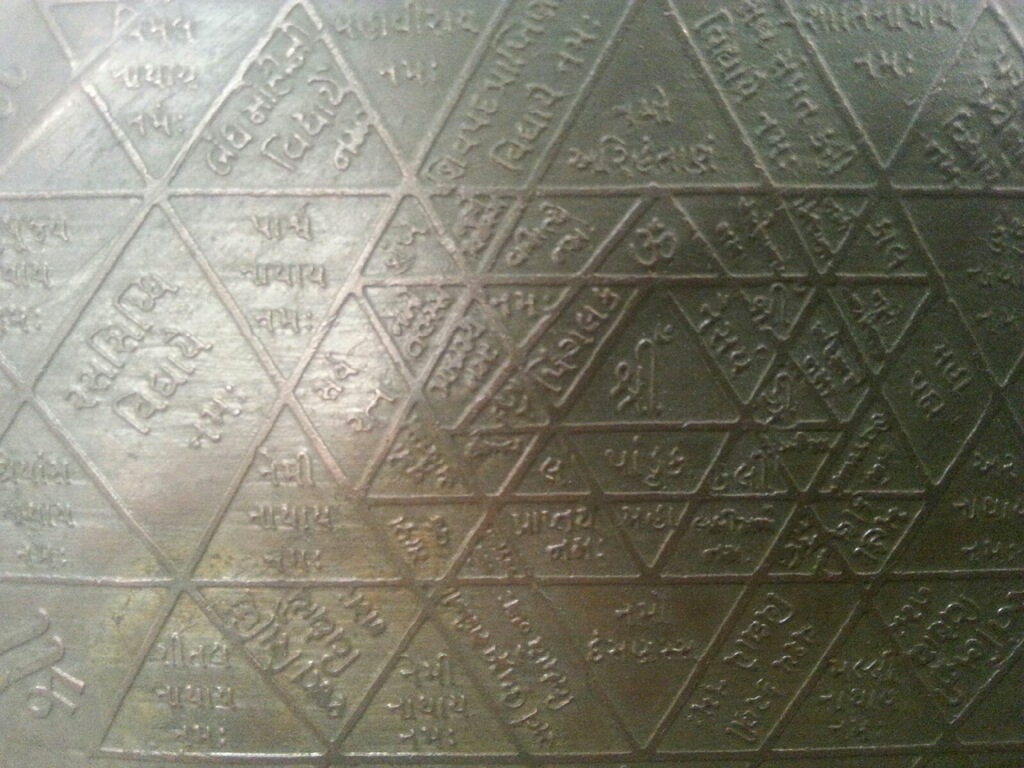
    Five downward pointing triangles representing Devi intersect with four upward pointing triangles representing Siva, forming 43 triangles including the central triangle.

    From the five Shakti triangles comes creation and from the four Shiva triangles comes the dissolution. The union of five Shaktis and four Fires causes the chakra of creation to evolve.

    At the centre of the bindu of the Shri Yantra is Kamakala, which has three bindus. One is red, one is white and one is mixed. The red bindu is Kurukulla the Female form, the white bindu is Varahi the Male form, and the mixed bindu is the union of Shiva & Shakti – the individual as the potential Shri Cakra. Varahi, the father-form, gives four dhatus to the child and Kurukulla, the mother-form, gives five dhatus to the child. Theses represent the nine dhatus of the human body.

    Varahi’s four fires are the 12 (4 x 3) sun Kalas, the 12 Zodiac constellations. Kurukulla’s five triangles are the 15 (5 x 3) Kalas of the moon, 15 lunar Tithis.

    These nine triangles also represent the nine stages of growth of the human child in the womb.Surrounding the 43 triangles formed by the intersection of the nine triangles is the 16 petals circle. Surrounding the 16 petal circle is an 8 petal circle. After that the 3 lines and at the outermost part of the Sriyantra there are 3 lines called the Bhupura.


    The Form of the Goddess is Kanchi Kamakshi.


    *The Poojas to be performed for the other Devatas, Ganesha, Surya, Shiva,  Vishnu and Devi are provided ina separate post.


    (Citation . http://www.astrojyoti.com/scpooja3.htm


    Perform Angannyasa and karanyasa as in Lalitha Sahasranama or simply recite the following Mantra.


    “Avahanam najanami, najanami visarjanam,
    poojamchaiva najanamani kshamaswa Maheswari.
    Yatkrutam yatkarishyami tathsarvam twamarpanam,
    poojam poorna phalam kuru”.


    The tip of the top triangle must be pointing at you, at the bottom right hand side corner of the Shreechakra resides Lord Ganesha.

    The bottom left hand side corner resides Lord Surya.

    The top left side corner resides Lord Vishnu and the top right corner of the Shreechakra resides Lord Shiva.

    They must be worshipped before starting the Pooja of the Nava-Avaranas.

    After that the eight primordial directions are guarded by the eight Lokapalas. Indra guards the East, Agni guards the South East, Yama guards the South, Nirriti guards the South West, Varuna guards the West, Vayu guards the North East, Soma guards the North and Ishana guards the North East.

    The Sri Chakra Pooja

    Karanyasa

    Aim Angushtabhyam namah
    Hreem Tarjaneebhyam namah
    Shreem Madhyamabhyam namah
    Aim Anamikabhyam namah
    Kleem Kanishtikabhyam namah
    Souh Karatalakara prushtabhyam namah

    Anganyasam

    Aim Hrudayaya namah
    Hreem Siraseswaha
    Shreem Shikhayaivashat
    Aim Kavachayahum
    Kleem Netratrayayaoushat
    Souh Astrayaphat

    Three Salutations to Devi

    Om aim hreem shreem aim kleem souh Kriyashakti pithayai Shripadukam poojayami namah
    Om aim hreem shreem aim kleem souh Gyanashakti kundalinyai Shripadukam poojayami namah
    Om aim hreem shreem aim kleem souh Ichhashakti shri mahatripurasundaryai Shripadukam poojayami namah

    Nityayajanam (pooja of nitya devies)

    Om aim hreem shreem aim kleem souh – these bijas must be added before each of the names from now onwards. After the name add the beejas Shripadukam poojayami namah
    Kameswari nityamba – Shripadukampoojayaminamah

    Bhagamalini nityamba

    Nityaklinna nityamba

    Bherunda nytyamba

    Vahnivasini nityamba

    Mahavajreswari nityamba

    Shivaduti nityamba

    Twarita nityamba

    Kulasundari nityamba

    Nitya nityamba

    Neelapataka nityamba

    Sarvamangala nityamba

    Jwalamalini nityamba

    Chitra nityamba

    Mahanitya nityamba

    Parameswara parameswari devi

    Mitreshamayi devi

    Shastisamayi devi

    Uddisamayi devi

    Charyanathamayi devi

    Lopamudramayi devi

    Agastyamayi devi

    Kalatapanamayi devi

    Dharmacharyamayi devi

    Muktakeliswaramayi devi

    Deepakalanathamayi devi

    Vishnudevamayi devi

    Prabhakaradevamayi devi

    Tejodevamayi devi

    Kalyanadevamayi devi

    Vasudevamayi devi

    Ratnadevamayi devi

    Shriramanandamayi devi

    Prathama Avarana pooja

    (The 3 outer lines)

    The position of the Devis on the 3 lines is indicated by numbers

    The First line

    O1-Anima Sidhyamba

    O2-Laghima Sidhyamba

    O3-Mahima Sidhyamba

    O4-Ishvita Sidhyamba

    O5-Vasitva Sidhyamba

    O6-Prakamya Sidhyamba

    O7-Bhukti Sidhyamba

    O8-Ichha Sidhyamba

    O9-Prapti Sidhyamba

    10-Sarvakama Sidhyamba

    The second line

    M1-Shree Brahmi Matruka

    M2-Shree Maheswari Matruka

    M3-Shree Koumari Matruka

    M4-Shree Vishnavi Matruka

    M5-Shree Varahi Matruka

    M6-Shree Mahendri Matruka

    M7-Shree Chamunda Matruka

    M8-Shree Mahalakshmi Matruka

    The third line

    1-Sarvasankshobhini Devi

    2-Sarvavidravini Devi

    3-Sarvakarshini Devi

    4-Sarvavashankari Devi

    5-Sarvonmadini Devi

    6-Sarvamahankusha Devi

    7-Sarvakhechari Devi

    8-Sarvabeeja Devi

    9-Sarvayoni Devi

    10-Sarvatrikhanda Devi

    Trilokyamohanachakraswamini Devi

    Prakatayogini Devi


    Dwiteeyaavarana pooja

    1. Kamakarshini shakti

    2. Budhyakarshini shakti

    3. Ahankarakarshini shakti

    4. Shabdakarshini shakti

    5. Sparshakarshini shakti

    6. Rupakarshini shakti

    7. Rasakarshini shakti

    8. Gandhakarshini shakti

    9. Chittakarshini shakti

    10. Dhyryakarshini shakti

    11. Smrutyakarshini shakti

    12. Namakarshini shakti

    13. Beejakarshini shakti

    14. Atmakarshini shakti

    15. Amrutakarshini shakti

    16. Sharirakarshini shakti

    Sarvasha paripuraka chakraswamini

    Guptayogini

    Truteeyaavarana Pooja

    1. Ananga Kusuma shakti

    2. Ananga Mekhala shakti

    3. Ananga Madana shakti

    4. Ananga Madanatura shakti

    5. Ananga Rekha shakti

    6. Ananga Vegini shakti

    7. Anangankusha shakti

    8. Ananga Malini shakti

    Sarvasamkshobhini chakraswamini

    Guptatarayogini

    Chaturthaavarana Pooja

    1.Sarvasmkshobhini devi

    2.Sarvavidravini devi

    3.Sarvakarshini devi

    4.Sarvaahladini devi

    5.Sarvasammohini devi

    6.Sarvasthambhini devi

    7.Sarvajrumbhini devi

    8.Sarvavashankari devi

    9.Sarvaranjani devi

    10.Sarvonmadini devi

    11.Sarvarthasadhika devi

    12.Sarvasampattipurani devi

    13.Sarvamantramayi devi

    14.Sarvadwandwakshayankari devi

    Sarsoubhagyadayaka chakraswamini

    Sampradayayogini

    The Panchama Avarana

    1.Sarva Siddhiprada devi

    2.Sarvasampatprada devi

    3.Sarvapriyankari devi

    4.Sarvamangalakarini devi

    5.Sarvakamaprada devi

    6.Sarvadukhavimochini devi

    7.Sarvamrityuprasamani devi

    8.Sarvavighnanivarini devi

    9.Sarvangasundari devi

    10.Sarvasoubhagyadayini devi

    Sarvartha Sadhaka Chakraswamini

    Kulotteerna Yogini

    The Shastha Avarana

    1.Sarvagya devi

    2.Sarvashakti devi

    3.Sarvaswaryapradayini devi

    4.Sarvagyanamayi devi

    5.Sarvavyadhinivarini devi

    6.Sarvadharaswarupa devi

    7.Sarvapapahara devi

    8.Sarvanandamayi devi

    9.Sarvarakshaswarupini devi

    10.Sarvepsitaphalaprada devi

    Sarvarakshakara chakraswamini

    Nigarbhayogini

    Saptmavarana Pooja

    1.Vasini Vagdevi

    2.Kameswari Vagdevi

    3.Modini Vagdevi

    4.Kamala Vagdevi

    5.Aruna Vagdevi

    6.Jayini Vagdevi

    7.Sarveswari Vagdevi

    8.Koushini Vagdevi

    Sarvarogahara chakraswamini

    Rahasya yogini

    Banini

    Chapini

    Pashini

    Ankushini

    Ashtamavarana Pooja

    Mahakameswari devi

    Mahavajreswari devi

    Mahabhagamalini devi

    Sarvasidhiprada chakraswamini

    Atirahasyayogini

    Navamavarana Pooja

    Shri Shri Mahabhattarika

    Sarvanandamaya Chakraswamini

    Paraapararahasyayogini

    Concluding Pooja

    Tripura devi namah …………Dhyayami
    Tripureshi devi namah ……….Avahayami
    Tripurasundari devi namah …….. Asanam samarpayami
    Tripurasidha devi namah …….. Snanam samarpayami
    Tripuramba devi namah ……… Vastram samarpayami
    Mahatripurasundari devi namah …. Abharanam samarpayami
    Mahamaheswari devi namah …. Gandham dharayami
    Mahamaharagyi devi namah …. Pushpani pujayami
    Shrimatsimhasanaiswaryai namah .. Padou poojayami
    Lalitayai namah .. Gulphou poojayami
    Maharagyi namah .. Janghou poojayami
    Paramkushayai namah .. Januni poojayami
    Chapinyai namah .. Urum poojayami
    Tripurayai namah .. Katim poojayami
    Maha Tripura Sundaryai namah .. Nabhim poojayami
    Sundaryai namah .. Vasitrayam poojayami
    Chakranathaya namah .. Udaram poojayami
    Samragyai namah .. Hrudayam poojayami
    Chakrinyai namah .. Kantham poojayami
    Chakreswaryai namah .. Oshtam poojayami
    Mahadevyai namah .. Kapolam poojayami
    Kameswaryai namah .. Dantapanktim poojayami
    Parameswaryai namah .. Chubukam poojayami
    Kamarajapriyayai namah .. Nasikadwayam poojayami
    Kamakotikayai namah .. Bhroomadhyam poojayami
    Chakravartinyai namah .. Netradwayam poojayami
    Mahavidyayai namah .. Shrotradwayam poojayami
    Shivanganavallabhayai namah .. Phalam poojayami
    Sarvapatalayai namah .. Mukham poojayami
    Kulanathayai namah .. Parswam poojayami
    Amnayanathayai namah .. Shiram poojayami
    Sarvamnayanivasinyai namah .. Padukam poojayami
    Mahashrungaranayikayai namah .. Sarvangani poojayami
    Mamahashakti devi namah .. Dhoopam aghrapayami
    Mahamahagupta devi namah .. Deepam Darshayami
    Mahagyapta devi namah .. Nivedyam samarpayami
    Mahamahananda devi namah .. Tambulam samarpayami
    Mahamahaskanda devi namah .. Neerajanam samarpayami
    Mahamahashaya devi namah .. Mantrapushpam samarpayami
    Mahamaha shreechakra nagara samragyidevi namah .. Pradikshana
    namaskaram samarpayami

    If you cannot do this detailed worship, simply worship the Sri Yantra 108 times with the Panchadasakshari Mantra, which is one of the greatest mantras of Devi and next only to the Shodasi Mantra:

    Ka E i La Hreem – Ha Sa Ka Ha La Hreem – Sa Ka La Hreem


    Om aim hreem shreem aim kleem souh
    (This must be added before every name)
    Shripadukampoojayaminamah
    (This must be added after every name)

    Kam Sarvasidhiprada devi
    Kham Sarvasampatprada devi
    Gam Sarvapriyankari devi
    Gham Sarvamangalakarini devi
    Gyam Sarvakamaprada devi
    Cam Sarvadukhavimochini devi
    Cham Sarvamrityuprasamani devi
    Jam Sarvavighnanivarini devi
    Jham Sarvangasundari devi
    Egyam Sarvasoubhagyadayini devi
    Sarvarthasadhakachakraswamini devi
    Kulotteernayogini devi
    Shashtavarana Pooja

    Mam Sarvagya devi
    Yam Sarvashakti devi
    Ram Sarvaswaryapradayini devi
    Lam Sarvagyanamayi devi
    Vam Sarvavyadhinivarini devi
    Ssam Sarvadharaswarupa devi
    Sham Sarvapapahara devi
    Sam Sarvanandamayi devi
    Ham Sarvarakshaswarupini devi
    Sarvarakshakara chakraswamini
    Nigarbhayogini
    Saptmavarana Pooja

    Am Vasini Vagdevi
    Kam Kameswari Vagdevi
    Cham Modini Vagdevi
    Tm Kamala Vagdevi
    Tam Aruna Vagdevi
    Pam Jayini Vagdevi
    Yam Sarveswari Vagdevi
    Ssam Koushini Vagdevi
    Sarvarogahara chakraswamini
    Rahasya yogini
    Banini
    Chapini
    Pashini
    Ankushini
    Ashtamavarana Pooja

    Kailahreem Mahakameswari devi
    Hasakahalahreem Mahavajreswari devi
    Sakalahreem Mahabhagamalini devi
    Sarvasidhiprada chakraswamini
    Atirahasyayogini
    Navamavarana Pooja

    Kam em eem namah shrishri Mahabhattarika
    Sarvanandamaya Chakraswamini
    Paraapararahasyayogini
    Tripura devi namah …………. Dhyayami
    Tripureshi devi namah ………… Avahayami
    Tripurasundari devi namah …….. Asanam samarpayami
    Tripurasidha devi namah …….. Snanam samarpayami
    Tripuramba devi namah ……… Vastram samarpayami
    Mahatripurasundari devi namah …. Abharanam samarpayami
    Mahamaheswari devi namah …. Gandham dharayami
    Mahamaharagyi devi namah …. Pushpani pujayami
    Shrimatsimhasanaiswaryai namah .. Padou poojayami
    Lalitayai namah .. Gulphou poojayami
    Maharagyi namah .. Janghou poojayami
    Paramkushayai namah .. Januni poojayami
    Chapinyai namah .. Urum poojayami
    Tripurayai namah .. Katim poojayami
    Maha Tripura Sundaryai namah .. Nabhim poojayami
    Sundaryai namah .. Vasitrayam poojayami
    Chakranathaya namah .. Udaram poojayami
    Samragyai namah .. Hrudayam poojayami
    Chakrinyai namah .. Kantham poojayami
    Chakreswaryai namah .. Oshtam poojayami
    Mahadevyai namah .. Kapolam poojayami
    Kameswaryai namah .. Dantapanktim poojayami
    Parameswaryai namah .. Chubukam poojayami
    Kamarajapriyayai namah .. Nasikadwayam poojayami
    Kamakotikayai namah .. Bhroomadhyam poojayami
    Chakravartinyai namah .. Netradwayam poojayami
    Mahavidyayai namah .. Shrotradwayam poojayami
    Shivanganavallabhayai namah .. Phalam poojayami
    Sarvapatalayai namah .. Mukham poojayami
    Kulanathayai namah .. Parswam poojayami
    Amnayanathayai namah .. Shiram poojayami
    Sarvamnayanivasinyai namah .. Padukam poojayami
    Mahashrungaranayikayai namah .. Sarvangani poojayami

    (If you can recite either Lalita Sahasranama or Lalita Trishati or Lalita Ashtottara Shatanamavali here)

    Om Aim Hreem Shreem Aim Kleem Souh

    Mamahashakti devi namah .. Dhoopam aghrapayami
    Mahamahagupta devi namah .. Deepam Darshayami
    Mahagyapta devi namah .. Nivedyam samarpayami
    Mahamahananda devi namah .. Tambulam samarpayami
    Mahamahaskanda devi namah .. Neerajanam samarpayami
    Mahamahashaya devi namah .. Mantrapushpam samarpayami
    Mahamahashreechakranagarasamragyidevi namah .. Pradikshana
    namaskaram samarpayami

    Sadhuva Sadhuvakarma yadyadacharitamaya
    Tatsarvam krupaya devi gruhanaaraadhanam mama
    Devanatha guruswamin desikaswatmanayaka
    Trahi Trahi krupa sindho poojam poornataram kuru..
  • Navavarana Pooja Lalitha Tripura Sundari Principle

    The Navarana Pooja for Devi is considered  as Supreme in the worship of Lalitha Devi, Tripura Sundari.


    This forms a part of Tantra Shastra of Hinduism.


    Avarana means concealment,masking, obstruction.


    The attempt to realize self is  is paved the path of Obstructions.


    This lies with the individuals mind and ego.


    Lalitha Tripurasundari image.image
    Lalitha Tripurasundari


    Losing one’s ego and the impediments of the mind clears the way for realization, first the Saguna Brahma,Reality of Name and Form.


    Once the level is reached, one is automatically guided to the Ultimate Reality, the Nirguna Brahman.


    The Avaranas of are of two kinds.


    1.Klesa Avarana.

    Klesa means confusion, unable to decide.

    Sinful desires, Lust,hankering after Wealth, lead to misery.

    These obstruct the individual in spiritual path.

    The removal of these obstacles,Klesaprahan is essential.( Gaudapadakarika)

    Kama, Krodha, Lobha, Madha, Mathsarya, Dvesha, Moha, Maana are some of the Klesas.


    The other in Jneya Avarana.

    Here the object of worship is seen as different from the subject, from the one who is worshiping.

    The merging of the worshiper and the worshiped is Realization.


    There are procedures laid down in the Tantra Shastras for the removal of the Avaranas.


    A form of Pooja performed to Goddess Lalitha Devi, Tripura Sundari is called the Navarana Pooja.


    This Pooja is performed for the Sri Chakra.


    It is essential to understand the construction of Ari Yantra before starting the Pooja.


    Five downward pointing triangles representing Devi intersect with four upward pointing triangles representing Siva, forming 43 triangles including the central triangle.


    From the five Shakti triangles comes creation and from the four Shiva triangles comes the dissolution.


    The union of five Shaktis and four Fires causes the chakra of creation to evolve.


    At the centre of the bindu of the Shri Yantra is Kamakala.


    It has three bindus. One is red, one is white and one is mixed.


    The red bindu is Kurukulla the Female form, the white bindu is Varahi the Male form, and the mixed bindu is the union of Shiva & Shakti – the individual as the potential Shri Cakra. Varahi, the father-form, gives four dhatus to the child and Kurukulla, the mother-form, gives five dhatus to the child. Theses represent the nine dhatus of the human body.


    Varahi’s four fires are the 12 (4 x 3) sun Kalasa, the 12 Zodiac constellations. Kurukulla’s five triangles are the 15 (5 x 3) Kalas of the moon, 15 lunar Tithis.


    These nine triangles also represent the nine stages of growth of the human child in the womb.


    Surrounding the 43 triangles formed by the intersection of the nine triangles is the 16 petals circle.


    Surrounding the 16 petal circle is an 8 petal circle.


    After that the 3 lines and at the outermost part of the Sriyantra there are 3 lines called the Bhupura.


    The 43 triangles constitute the six inner sections called Avaranas, the two circles of petals are two more avaranas and the Bhupura of 3 lines is the last Avarana.


    These 9 Avaranas of the Sri Yantra have various presiding Devis.

    They are the Devi’s Parivar (retinue) of total 108. In the Srichakra pooja they are systematically worshipped one by one with their names and mantras.


    The presiding Deity of Srichakra, Devi, is Known as Lalita Tripura Sundari.


    The form of Devi Kamakshi of Kancheepuram is the closest resemblance of the Devi as described in the scriptures.


    Lalita means The One Who Plays.


    All creation, manifestation and dissolution is considered to be a play of Devi.


    Tri-Pura means the three worlds and Sundari means beauty.


    She is the transcendent beauty of the three worlds.


    She is the ruler of the the three gunas of Satva, Rajas and Tamas; and sun, moon and fire – the zodiac and the planets, and therefore Time itself;

    She is also “tripura” as Will (Iccha), Knowledge (Jnana) and Action (Kriya).


    She is also “tripura” as intellect, feelings & physical sensation; and She is triple as the three states of the soul – awakening, dreaming and -sleeping states.


    Her five triangles also represent the Pancha Tatwas and the Pancha Bhootas. ( ”Panchami pancha bhuteshi pancha sankhyopacharini “. Lalitha Sahasranama)


    Lalita holds five flowery arrows, noose, goad and bow. The noose represents attachment, the goad represents repulsion, the sugarcane bow represents the mind and the flowery arrows are the five sense objects.


    Names of Devis in Navarana Pooja.


    First Line:

    Anima Sidhamba, Laghima Sidhamba, Mahima Sidhamba, Isitva Sidhamba, Vasitva Sidhamba, Prakamya Sidhamba, Bhuti Sidhamba, Iccha Sidhamba, Prapti Sidhamba and Sarva Kama Sidhamba.
    Second Line: Sri Brahmi Matruka, Maheswari Matruka, Kaumari Matruka, Vaishnavi Matruka, Varahi Matruka, Mahendri Matruka, Chamunda Matruka, and Mahalakshmi Matruka.


    Third Line:


    Sarva Sankshobhini Devi, Sarva Vidravini Devi, Sarvakarshini Devi, Sarva vashankari Devi, Sarvonmadini Devi, Sarva Mahankusa Devi, Sarva Khechari Devi, Sarva Beeja Devi, Sarva Yoni Devi, Sarva Trikhanda Devi, Trilokya Mohana Chakraswamini Devi and Prakata Yogini Devi.
    ‘Dvitheeya Avarana’(Second Enclosure): Kamakarshini Shakti, Buddhyakarshini Shakti, Ahankarakarshini Shakti, Sabdakarshini Shakti, Sparshakarshini Shakti, Rupakarshini Shakti, Rasakarshini Shakti, Gandhakarshini Shakti, Chittakarshini Shakti, Dhairyakarshini Shakti, Smrutyakarshini Shakti, Namakarshini Shakti, Beejakarshini Shakti, Atmakarshini Shakti, Amrutakarshini Shakti, Sharirakarshini Shakti, Sarva Aasha Paripurka Chakraswamini and Gupta Yogini.
    ‘Truteeya Avarana’ ( Third Enclosure): Anga Kusuma Shakti, Ananga Mekhala Shakti, Ananga Madana Shakti, Ananga Madanatura Shakti, Ananga Rekha Shakti, Ananga Vegini Shakti, Ananga Ankusha Shakti, Ananga Malini Shakti, Sarva Sankshobhana Chakraswamini, and Gupta thara Yogini.
    ‘Chaturdha Avarana’


    Fourth Enclosur:

    Sarvakshobini Devi, Sarva Vidravini Devi, Sarvakarshini Devi, Sarvahladini Devi, Sarva Sammohini Devi, Sarva-Sthambhini Devi, Sarvajhrumbhini Devi, Sarvavashankari Devi, Sarva Ranjani Devi, Sarvonmadini Devi, Sarvatha Sadhika Devi, Sarva Sampatti Purani Devi, Sarva Mantramayi Devi, Sarva Dvandva Kshayankari Devi, Sarva Soubhagya Dayaka Chakraswamini Devi and Sampradaya Yogini Devi.
    ‘Panchama Avarana’


    Fifth Enclosure:

    Sarva Siddhiprada Devi, Sarva Sampathprada Devi, Sarva Priyankari Devi, Sarva Mangala Karini Devi, Sarva Kamaprada Devi, Sarva Dhuhkha Vimochani Devi, Sarva Mrithyu Prasamani Devi, Sarva Vighna Nivarini Devi, Sarvanga Sundari Devi, Sarva Sowbhagya Dayani Devi, Sarva Ardha Sadhaka Chakraswamini and Kulotheerna Yogini.
    ‘Shashtha Avarana’

    Sixth Enclosure: Sarvagya Devi, Sarva Shakti Devi, Sarva Aishvarya Pradayani Devi, Sarva Jnanamayi Devi, Sarva Vyadhi Vinasini Devi, Sarvadhara Swarupa Devi, Sarva Papahari Devi, Sarva Anandamayi Devi, Sarva Raksha Swarupini Devi, Sara Epsitha Phalaprada Devi, Sarva Rakshakara Chakra Swamini and Nigarbha Yogini.
    ‘Saptama Avarana’  Seventh Enclosur: Vasini Vagdevi, Kameswari Vagdevi, Modhini Vagdevi, Vimala Vagdevi, Aruna Vagdevi, Jayani Vagdevi, Sarva Eswari Vagdevi, Kaulini Vagdevi, Sarva Rogahara Chakraswaini, Rahasya yogini, Banini, Chapini, Paasini and Ankusini.
    ‘Ashta’ Avarana’ (Eighth Enclosure): Maha Kameswari Devi, Maha Vajreswari Devi, Maha Bhagamalini Devi, Sarva Siddhiprada Chakraswamini and  Ati Rahasya Yogini.
    ‘Nava Avarana’  Ninth Enclosure: Sri Sri Bhattarika, Sarvanandamaya Chakraswamini and Parapara Rahasya Yogini.


    Citation.

    http://www.astrojyoti.com/scpooja.htm


    http://books.google.co.in/books?id=Lz08gSuuLQkC&pg=PA210&lpg=PA210&dq=avarana+sanskrit+meaning&source=bl&ots=BLEYAJuCUB&sig=i0Twxd_–jo5mD1WMKJRzG9z8c0&hl=en&sa=X&ei=00wWVLa_C9KzuASel4GwAw&ved=0CFUQ6AEwCA#v=onepage&q=avarana%20sanskrit%20meaning&f=false


    Devi Bhagavatham


  • Lalitha Devi’s Abode Chinatmani Gruham Details

    Devi Lalita resides in Her Abode Chinatmani,


    “Smaram yonim Lakshmeem thrithayamidamaadau thava manoh
    Nidhaayaike nithye niravadhimahaabhogarasikah
    Bhajanthi thvaam Chintamani gunanibaddhaakshavalayah
    Shivaagnau juhvanthah surabhighruthadhaaraahuthi shathaih.”


    Literal meaning:-Some connoiseurs of the highest enjoyment,adding before the beginning of Thy mantra(verse)the Bija-syllables of Kaamaraaja(kleem),Bhuvaneswari(hreem),and Sree(shreem)and adorned with a necklace of Chintamani,worship Thee with oblations consisting of countless streams of Kamadhenu‘s ghee in the purified fire of Shiva(i.e.Shakthi established as the thrikona in the anaahatha-chakra).

    Sonundaryalahari of Adi Shankaracharya.


    Sumeru madhya shrungasthaa Sreemannagaranaayika
    Chintamanigruhaantha:sthaa Panchabrahmaasanasthithaa!”-Lalita Sahasranama.


    In Sri.Bhaaskararaya’s commentary on Lalitha Sahasranamam , the term “Chintamani” is described as thus:-


    Chintamani is that jewel which yields all the objects desired;of this the city is built.


    Lalitha Devi in Her Abode, Chintamani
    Maha Tripura Sundari, in Chintamani Gruham


    This house is described in detail in the Brahmaanda Purana,”In that house of Chintamani all is Chintamani.”This house having an extent of a thousand yojanas is above the world system.


    The Rudrayaamala says,”In that Chintamani house of a thousand yojanas in extent.


    “The house which is on Meru is smaller in size.


    The Lalithaasthavaratna (v.105) says,”May that house,built of Chintamani stone which is on the northern side of Sringaaravana (on Meru),whither all the devas go to worship,remove all my mental trouble(chinta).”


    In the commentary on Gowdapaada-sutra(no.7)the Chintamani house is explained as the place of origin of all those mantras which bestow all desired

    objects(chinthitha),and its construction is elaborately described.


    Chintamani is specially mentioned in the 3rd,8th and the 33rd slokas of Soundarya Lahari.


    :”Avidyaanaamanthasthimiramihiradweepanagari
    jadhaanaam chaithanyasthabakamakarandasruthijhari
    Daridraanaam Chintaamanigunanikaa janmajaladhau
    Nimagnaanaam dhamshtraa muraripuvaraahasyabhavathi.”


    The dust of Thy lotus feet is the Island City,wherefrom takes place the luminous sun-rise of spiritual illumination driving away the over-casting darkness of ignorance in the hearts of the devotees.


    It forms the cluster of flower buds from which gushes forth the nectar of intelligence,enlivening the dull-witted.


    It is a veritable necklace of wish-yielding gems for the poverty-stricken.And for those immersed in the ocean of worldly affairs,it becomes their uplifter like the tusk of Vishnu,which raised the earth from submergence in pralayaa waters when He incarnated as the Cosmic Boar.


    The Nagara.


    Nagara had 25 streets circling it, made of iron, steel, copper, and lead. An alloy made of five metals, silver, gold, the white Pushpa raga stone, the red Padmaraga stone, onyx, diamond, Vaidoorya, Indra neela (topaz), pearl, Marakatha, coral, nine gems and a mixture of gems and precious stones.


    In the eighth street was a forest of Kadambas.


    This is presided by Syamala. In the fifteenth street lived the Ashta Digh palakas. In the sixteenth lived Varahi alias Dandini who was her commander-in-chief.


    Here Syamala also has a house.


    In the seventeenth street lived the different Yoginis. In the eighteenth street lived Maha Vishnu.


    In the nineteenth street lived Esana, in the twentieth Thara Devi, twenty-firstVaruni, the twenty-second Kurukulla who presides over the fort of pride,


    twenty-third Marthanda Bhairava, twenty-fourth the moon and twenty-fifth Manmatha, presiding over the forest of love.


    Bhaskararaya’s Explanation.


    Sri Nagara is beyond all the Universes,in the middle of Amrutha Saagara,in Ratna Dweepa.


    It is surrounded by many Forts and lush gardens .


    These are.


    1. Diifrent Trees,


    2. Mahothyaanam Kalpa Vatikai.


    3.Santhaana Vatikai.


    4.Hari Santhana Vatikai.


    5Manthaara Vatikai.


    6.Parijaatha Vatikai.


    7.Kadambavana Vatikai.


    Forts as described in the above, of metals and Gems.


    In addition to this it is surrounded by Manas(mind),Buddhi(Discriminating power, Intellect),Ahankaaram(‘I’ ness),the Tejas of Sun and Moon.


    In this resides Mha Padhmadavi.


    In the Center ,lies the Chintamani Gruham.


    In the middle of this Chinatamani Gruham lies the Sri Chakra, surrounded by the Nava Aavarnaas.


    In its center, Mahathripurasundari is seated in the Mahasmihaasana(on the Pancha Brahmaasana),of the Bindu Peeta of Sarvaanadhamaya.


    Lalita Sahsranaama Astalakshmi Stotras Text Translation


    Enhanced by Zemanta