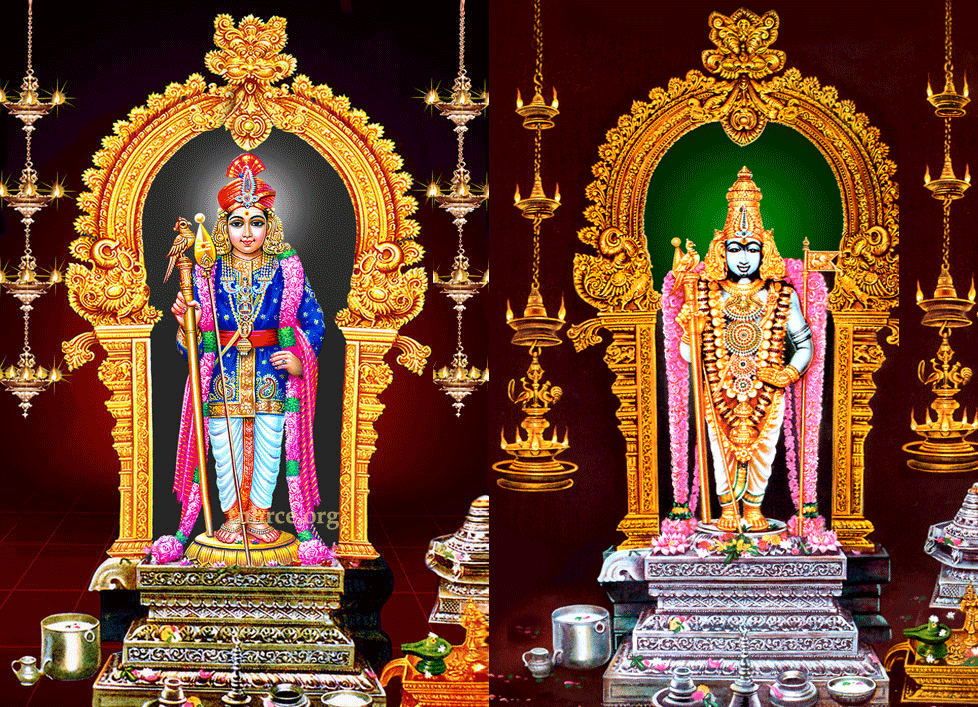
Tag: Siddha

  • Who Is Mystic Avadhuta, Types

    Unlike other Faiths, Hinduism does not bring all those who realized Godhead or self-realization under one name, Mystic.


    There are Siddhas, Rishis of Different kinds,Munis,Guru,Yogins, Savikalpa and Nirvakalpa,Saints, Sages.


    Though there is this common factor of having realized God/Self, there is a minute difference among them.


    Please read m posts on Rishis, different kinds.


    Siddhas are realized souls, do not die and live eternally.


    Yogis reach the State of samadhi.


    This is of two kinds.


    Savikalpa where the realized soul is seemingly active here.


    In Nirvakalpa everything is renounced.


    We have yet another classification.


    Avadhuta.


    An Avadhuta.jpg.
    An Avadhuta.


    Avadhoota (अवधूत avadhūta) is a Sanskrit term from some Indian religions referring to a type of mystic or saint who is beyond egoic-consciousness, duality and common worldly concerns and acts without consideration for standard social etiquette.


    Also spelled as Avdhoot, such personalities “roam free like a child upon the face of the Earth”.


    An Avadhoota does not identify with their mind or body or ‘names and forms’ (Sanskrit: namarupa).

    Such a person is held to be pure ‘consciousness’ (Sanskrit: caitanya) in human form.

    Avadhoota play a significant role in the history, origins and rejuvenations of a number of Dharmic Traditions such

    as YogaVedantaBuddhadharma and Bhakti ‘lineage’ (Sanskrit:parampara) even as they are released from standard observances.

    Avadhuts are the voice of the avadhuti the channel that resolves the dichotomy of the ‘left hand path’(Sanskrit: Vamamarga; “Vamachara”) and ‘right

    hand path (Sanskrit: Dakshinamarga) traditions and left and right channels (otherwise known as the outer channels) of the energetic body, though an

    Avadhut may or may not continue such dichotomous rites of the āstika or nāstika Darśana for they are free from sectarian ritual observance and

    affiliation.


    Feuerstein (1991: p. 105) frames how the term ‘Avadhoota’ came to be associated with the mad or eccentric holiness or ‘crazy wisdom‘ of some antinomian paramahamsa who were often ‘skyclad’ or ‘naked’ (Sanskrit: digambara):

    “The appellation “Avadhoota,” more than any other, came to be associated with the apparently crazy modes of behaviour of some paramahamsas, who dramatize the reversal of social norms, a behaviour characteristic of their spontaneous lifestyle. Their frequent nakedness is perhaps the most symbolic expression of this reversal.”

    Sacrifice.

    Chandra et al.. (1902: p. 20) equates the ‘chodpa‘ (Tibetanགཅོད་པWyliechod pa) as a type of Avadhoota:

    “ཀུ་སུ་ལུ་པ ku-su-lu-pa is a word of Tantrik mysticism, its proper Tibetan equivalent being གཅོད་པ, the art of exorcism. The mystic Tantrik rites of the Avadhauts, called Avadhūtipa in Tibet, exist in India.”

    The rites of chod differ between lineages but essentially there is an offering of their body as food, a blessing to demons and other entities to whom this kind of offering may be of benefit. This leitmotif and sadhana is common to another denizen of the charnel groundDattatreya the Avadhoota, to whom has been attributed the esteemed nondual medieval song, the Avadhoota Gita. Dattatreya was a founding adi guru of the Aghor tradition according to Barrett (2008: p. 33):

    “…Lord Dattatreya, an antinomian form of Shiva closely associated with the cremation ground, who appeared to Baba Kina Ram atop Girnar Mountain in Gujarat. Considered to be the adi guru (ancient spiritual teacher) and founding deity of Aghor, Lord Dattatreya offered his own flesh to the young ascetic as prasād (a kind of blessing), conferring upon him the power of clairvoyance and establishing a guru-disciple relationship between them.”

    Mahānirvāṇatantraṃ

    Woodroffe, in his translation of the Mahānirvāṇatantraṃ from the original Sanskrit into English under his nom-de-plume of Arthur Avalon, may be the opening discourse of the archetype of “Avadhoota” to the English reading public, as none of the Avadhoota upanishads were translated amongst the collections of minor upanishads such as the Thirty Minor Upanishads (Aiyar: 1914).The pen-name is play on the magical realm of Avalon and the young later-to-be, King Arthur, within the story-cycle of tales known generally as King Arthur and the Knights of the Round Table; specifically according to Taylor (2001: p. 148), Woodroffe chose the name from the noted incomplete magnum opus, the painting ‘Arthur’s Sleep in Avalon‘ by Burne-Jones.[9] Moreover, Taylor (2001: p. 148) conveys the salience of this magical literary identity and contextualizes by making reference towestern esotericismHoly grailquestoccult secretsinitiations and the Theosophists:

    “This is quite important to know, for here we have a writer on an Indian esoteric system taking a name imbued with western esotericism. The name at any rate seems to hint at initiations and the possession of occult secrets. The Arthurian legends are bound up with the story of the Holy Grail and its quest. This was a symbol of esoteric wisdom, especially to Theosophists who appropriated the legend. Anyone who named himself after King Arthur or the mystic isle of Avalon would be thought to be identifying himself with occultism, in Theosophists’ eyes.


    How to identify an Avadhuta,


    The book of Brahmanirvantantra describes how to identify the avadhuts of the following types:

    1. BramhAvadhoota : An avadhut from birth, who appears in any class of society. Completely indifferent to the world or worldly matters.
    2. ShaivAvadhoota : Avadhuts who have taken to the renounced order of life (sannyas), often with unkempt long hair (jata), or who dress in the manner of Shaivites and spend almost all of their time in trance (samādhi), or meditation.
    3. VirAvadhoota : This person looks like a sadhu who has put red colored sandal paste on his body and wears saffron clothes. His hair are very well grown and are normally furling in the wind. They wear in their neck a Rudraksha mala or a string with bones. They hold a wooden stick (danda) in their hand and additionally they always have an axe (parashu) or a damaru (small drum) with them.
    4. KulAvadhoota : These people are supposed to have taken initiation from the Kaula sampradaya. It is very difficult to recognize these people as they do not wear any signs outside which can identify them from others. The speciality of these people is that they remain and live like usual people do. They can show themselves in the form of Kings or a family man.


    The avadhoota represents the pinnacle of spiritual evolution; none is superior to him. Avadhoota means “one who is immortal” (akshara), and who has totally discarded worldly ties. He is verily Brahman himself. He realizes himself to be pure intelligence. He is unmindful of the six infirmities of human birth, namely: sorrow, delusion, old age, death, hunger and thirst. He has shaken off all bondage of the experimental world, and moves about freely like a child, a madman or one possessed by spirits.

    He may be with or without clothes. He does not wear any distinct emblem of any order. He has no desire to sleep, beg or bathe. He views his body as a corpse and subsists on food which comes to him from all classes. He does not interpret the shastras or the Vedas. For him nothing is righteous or unrighteous, holy or unholy.

    He is free of karma. The karmas of this life and past lives are all burnt away, and due to the absence of kartritva (doership) and bhoktritva (desire for enjoyment), no future karmas are created. Only the prarabdha (unalterable) karmas which have already begun to operate will affect his body, helping to sustain it, but his mind will remain unaffected. He will live in this world until the prarabdha karmas are worked out, after which his body will fall off. Then he is said to attain videhamukti (state beyond body consciousness).

    Such a liberated soul never returns to the embodied state. He is not born again; he is immortal. He has achieved the final aim of taking birth in this world.”

    Bhad-avadhuta Upanisad, thus: “The Avadhuta is so called because he is immortal ; he is the greatest ; he has discarded worldly ties ; and he is indicated in the meaning of the sentence “Thou art That,”


    http://www.ramakrishnananda.com/en/prabhuji/avadhuta/


    http://en.wikipedia.org/wiki/Avadhuta#Types_of_Avadhootas

  • Square Hills 2 Shiv Lingas 8 Temples Cow Footprint Chaturagiri

    Chaturagiri is in Tamil Nadu,India and is a mysterious Hill, where a Shiva Temple nestles among verdant forest.


    Even in this modern age, it is a difficult terrain to travel.


    This slideshow requires JavaScript.


    There have been credible reports of paranormal activity in this Hill,


    Of one being able to feel the Siddhas presence, following Pilgrims,floating in the air,mysterious sounds reminding one of chanting mantras,


    Sathuragiri is home to many Siddhas.


    Many Siddhas, both formless and with form, perform their penance in Sathuragiri


    It takes about two days to trek the Hill, can be done in day but it is tedious.


    Cave of Gorakka, a Siddha is here.


    There are also the footmarks of a Cow in Hill, presumed to be made by the Divine Cow, Kamadhenu.


    Legend:

    The divine place Sathuragiri is surrounded by four hills, hence its name Sathuragiri or Chathuragiri.


    It is said that the name Sathuragiri is derived from the Sanskrit word Chathur meaning FOUR.


    Surrounding Hills form the Shape of a square, Chaturam in Tamil means Square.


    Other names for Chaturagiri.


    Mahalingagiri, Menugiri/Merugiri, Kailasagiri, Indiragiri, Sarvalogagiri, Suriyagiri, Brahmagiri, Siddhagiri, Yamagiri/Yemagiri, Sivagiri, Sakthigiri,


    Udayagiri, Sanjivigiri/Sathuragiri.(Siva Puran)Sathuragiri

    Legend:

    Footmark (hoof-marks) of the divine/celestial/Indira Loga cow “Kamadhenu”.
    Once upon a time, a devotee was on his way to Sathuragiri. In those days only a few people used to go to the hills, as it was thick forest with lots of wild animals. Since being new to the hills he soon got lost in the thickly populated mountains. Seeing this the Lord asks Kamadhenu, the divine cow to help his devotee and bring him back to the correct path. Kamadhenu immediately appeared before the devotee and lead him to the correct path. After bringing the devotee to the correct path, Kamadhenu, being a divine cow, had to travel back to its heavenly abode. In the process, of starting to fly, Kamadhenu gave pressure to her legs and the pressure was so immense that her hoofs left an indelible mark, that can be seen even today.

    Gorakunda (Goraknathar Cave)
    Goraknathar is one of the foremost important Indian Siddha. He is part of the 18 siddha tradition of South India. He is also one amongst the Nava Nath Siddha tradition of North India. He is also closely associated with Vajrayana (Tantric) Buddhism. He attained Siddha by mastering sound. The main siddha of Sathuragiri is Goraknathar. Goraknathar created thousands of new siddha medicines like Kayakalpa etc to attain immortality. Every 10th in the Tamil Calendar he appears in light form to his devotees at this place. On every no moon day Sri Kalimuthu Ashram offers a lingam made of Thinai Maavu and the same is worshipped.


    How to reach.


    By Air. Madurai.


    Nearest Railway Station. Srivilliputtur,,Madurai,Virudhunagar,Theni


    Bus station.Srivilliputtur,Madurai,Virudhunagar,Theni.


    At the foothills (Vathirairuppu)
    1. Vinayagar/Ganesha
    2. RajaKali Amma
    3. Paechi Amma
    4. Karuppasamy

    Of these, Paechi Amma and Karuppasamy were installed by Siddhars for guarding the southern side of the Hill.

    On the way to Sathuragiri (after foothills till Sundara Mahalingam):
    1. Two sanctums of Sivalingams inside two separate caves at Kora Kunda (Gorakkar Cave)
    2. Two Lingams in a single sanctum called “Irattai Lingam” or Sankaran Narayan Lingams (Legend given below)
    3. Vana Durgai Amma
    4. Pilavadi Karuppasamy

    Pilavadi Karuppasamy & Kali, are the guardian angels/gods of the Sathuragiri Hills. Vana Durgai Amma is the guardian of Sundaramahalingam temple.

    They safe guard the area from evil forces. The pradistai of these three guardian angels/gods were done by the Siddhas of Sathuragiri hill.

    Sathuragiri plays host to three temples. They are Sundara Mahalingam temple, Santhana Mahalingam temple and Anandavalli Amma temple.

    Sundara Mahalingam Temple:
    1. Sundara Murthy Swamigal Sanctum at the entrance of the temple .
    2. Lord Sundara Mahalingam Temple (100 metres from Sundara Murthy Swamigal Sanctum)..
    Santhana Mahalingam Temple:
    1. At Santhana Mahalingam Temple, separate sanctums for 18 Siddhars, Lord Ganesha,


    Lord Muruga, Navagrahas, Santhana Mahadevi (Sakthi), and Santhana Mahalingam (Sivam) are available. Satta Muni Cave can also be found nearby. (Legend given below)

    .
    Anandavalli Amma temple:
    1. Anandavalli Amma’s temple mandapam can be found behind Sundara Mahalingam temple. Anandavalli Amma is formless.

    Only during Navarathiri she takes a form (Legend given below).
    Puja Timings:
    At Sundara Mahalingam temple the daily pooja starts by 6 ‘o’ clock in the morning.


    At Santhana MahalingamTemple the daily pooja starts by 3 ‘o’ clock in the morning.


    The two jama poojas are performed before sunrise. At both the temples Ardha Jama Poojas are finished before 18.00 hrs and closed. On full moon and new moon days, the puja schedule changes according to the visit of pilgrims.


    • Post Monsoon season is advisable for visiting Chaturagiri,
    • Sri Kalimuthu Swamigal Madam or Kanji Madam (Mob no: 93610 11741) provides place for people to stay. Check the Mobile number.
    • Barest facilities available.
    • Round the clock Anna dhaanam is served at the Kanji Madam Ashram near Sundara Mahalingam temple.
    • Travel light, carry breakfast/lunch, water bottle, snacks, torch-light, batteries, charger and a few clothing, bedding, toiletries etc.
    • Head load carriers are available for carrying luggage
    • Doli available..
    • There are no wash rooms on the way, as it is a forest area. 
    • Do not travel alone. travel with a guide.
    • Ammavasya and Pournami days would be crowded.
    • The darshan timings for Sundara Mahalingam starts at 6 am and ends at 6 pm.
    • Sandhana Mahalingam starts at 3 am


    Citation.

    Sathuragiri.


    Images.

    http://hill-temples.blogspot.in/2009/03/sathuragiri-mahalingam-temple.html


    Enhanced by Zemanta
  • The Siddhas A Short Note

    Siddhas were human beings, who by consistent and regular practice of Yoga had elevated themselves spiritually.

    Siddhas Basic Details.
    Siddhas Basic Details.

    The Yoga Sutra mentions the procedure to be followed to practice Yoga,” to communicate’-Yoga Patanjali means in Communion with the Reality.

    For more on this, please read my series on Yoga Sutra of Patanjali, under Hinduism, Indian Philosophy..

    There are two levels reached by the practitioner of Yoga.

    Savikalpa Samadhi ,when the practitioner becomes a master of controlling the modifications of the Mind, is elevated, yet remains amidst the world of senses.

    Example, Ramana Maharishi.

    These people Realized The Reality and yet stay amidst the world, with all its joys and sorrows, unaffected by them.

    Nirvakapla Samadhiis a State when the Realized one remains rooted in the Reality and do not return to the world of Senses at all.

    Sri Ramakrishna Parahamsa.

    Yet there are some souls who are on an intermediate plane.

    This is because the remnants  of the sense impressions do not get dissolved..

    In such cases they are born as Yogis, most of the times, do not die in the normal sense a.

    They linger in their Sookshma Sarrera of Subtle Body.

    They, as befits a Master of Yoga, can attain the Eight special powers, Ashtama Siddhis.

    • Anima (shrinking) – Power of becoming the size of an atom and entering the smallest beings.
    • Mahima (illimitability) – Power of becoming mighty and co-extensive with the universe. The power of increasing one’s size without limit.
    • Lagima (lightness) – Capacity to be quite light though big in size.
    • Garima (weight) – Capacity to weigh heavy, though seemingly small size.
    • Prapthi (fulfillment of desires) – Capacity to enter all the worlds from Brahma Loga to the neither world. It is the power of attaining everything desired.
    • Prakasysm (irresistable will) – Power of disembodying and entering into other bodies (metempsychosis) and going to heaven and enjoying what everyone aspires for, simply from where he stays.
    • Isithavam (supremacy) – Have the creative power of God and control over the Sun, the moon and the elements and
    • Vasithavam (dominion over the elements) – Power of control over all the living being. The power of changing the course of nature and assuming any form.

    Please read my post on Why Yogis are reborn.

    They transcend Time, Space, assume any form, cure illnesses.

    They are more than The Mystics and in many a case are social reformers too.

    These are called The Siddhars .

    Siddhi means fruition.

    The Siddhas have attained Fruition.

    There are Eighteen Siddhars, as the legend goes.


    Sri Pathanjali

    Sri Agasthiar

    Sri Kamalamuni

    Sri Thirumoolar
    Sri Kuthambai
    Sri Korakkar
    Sri Thanvandri
    Sri Sundaranandar

    Sri Konganar
    Sri Sattamuni
    Sri Kakabujandar
    Sri Ramadevar
    Sri Sivavaakyiar
    Sri Idaikkadar
    Sri Machamuni

    Sri Karuvoorar
    Sri Bogar
    Sri Pambatti

    But the Siddhars are shy of revealing themselves.

    There might be innumerable Siddhars around, of whom we know not.

    Lord Shiva is described as the First Siddha as Yogeeswara.

    Sage Agasthya is reported to be first Human Being to be elevated to the Status of a Siddha.

    Agastya is classified as the Founder of  the Tamil language along with Lord Shiva and Lord Subramanya.

    He is also a Doctor of a class his own.

    Many of his treatises on Medicine are followed by the Indian Medicine, Siddha Medicine.

    A good site below On Alchemy. Siddhas were/are Alchemists.

    http://www.levity.com/alchemy/tamil_si.html

  • Neem Papaya Juice Cures Dengue Fever.How To Prepare

    Dengue Fever has assumed alarming proportions in India recently.

    The Dengue fever broke out some years earlier also and it was contained with difficulty.

    The new strain seems to be resistant to Antibiotics.

    Home remedy of Neem leaves  regular ,Neem obtained from the hilly regions and Papaya juice control the Dengue Fever.

    This has been proved by King Institute of Preventive Medicine,Chennai.

    Neem Tree
    Neem

    ‘Government of Tamil Nadu Health & Family Welfare Department Commissionerate of Indian Medicine and Homoeopathy.

    How To prepare The Concoction

    Treat and prevent Dengue fever through Siddha Medicine Natural healing through traditional medicine

    (1)             PAPAYA LEAF JUICE

    Fresh Papaya leaves (excluding veins) should be mixed with a little cold water and ground and filtered. Consume 10 ml four times a day. Fever will subside on consumption for five days. Even after recovery from fever this may be continued for another two days.

    Papaya leaf juice is a traditional home made natural medicine.

    (2)             MALAIVEMBU LEAF (HILL NEEM) JUICE.

    Fresh Malaivembu leaves should be mixed with a little cold water and ground and filtered. Consume 10 ml two to three times a day. Fever will subside on consumption for five days. Even after recovery from fever this may be continued for another two days.

    Malaivembu leaf juice is a traditional home made natural medicine.

    (3)             NILAVEMBU KUDINEER

    Boil 10 grams of Nilavembu Kudineer Powder in 100 ml of water until it gets reduced to half and consume 50 ml two times per day in the morning and evening. Prepare the Nilavembu Kudineer freshly for each dose. Fever will subside on consumption for five days. Even after recovery from fever this may be continued for another two days.

    Nilavembu Kudineer powder is available in all Siddha wings in | Government Hospitals and Primary Health Centres free of | cost.

    For further information contact:

    INDIAN MEDICINE WINGS OF THE GOVERNMENT HOSPITALS

    http://www.projectsjugaad.com/2012/12/treat-and-prevent-dengue-fever-through-siddha-medicine/

    Neem Medicinal Uses.

    • Neem oil is used for preparing cosmetics such as soap, neem shampoo, balms and creams as well as toothpaste.
    • The stem of neem is used as a toothbrush and is called datun.
    • Besides its use in traditional Indian medicine, the neem tree is of great importance for its anti-desertification properties and possibly as a good carbon dioxide sink.[citation needed]
    • Practitioners of traditional Indian medicine recommend that patients with chicken pox sleep on neem leaves.[citation needed]
    • Neem gum is used as a bulking agent and for the preparation of special purpose food.
    • Traditionally, slender neem branches have been chewed to clean one’s teeth. Neem twigs are still collected and sold in markets for this use, and in rural India one often sees youngsters in the streets chewing on neem twigs.
    • Neem blossoms are used in Andhra PradeshTamil Nadu and Karnataka to prepare Ugadi pachhadi. “Bevina hoovina gojju” (a type of curry prepared with neem blossoms) is common in Karnataka throughout the year. Dried blossoms are used when fresh blossoms are not available. In Tamil Nadu, a rasam (veppam poo rasam) made with neem blossoms is a culinary specialty.
    • A mixture of neem flowers and bella (jaggery or unrefined brown sugar) is prepared and offered to friends and relatives, symbolic of sweet and bitter events in the upcoming new year.
    • Cosmetics : Neem is perceived in India as a beauty aid. Powdered leaves are a major component of at least one widely used facial cream. Purified neem oil is also used in nail polish & other cosmetics.
    • http://en.wikipedia.org/wiki/Azadirachta_indica#Traditional_medicinal_use

    Related:

    After more than 37,000 dengue cases, including 227 which resulted in death, across India, a grandma’s antidote for the virus seems to be getting scientific endorsement. A herbal concoction — juice of papaya leaf, common neem and hill neem — being given to dengue patients in government hospitals in Tamil Nadu has been found to have anti-viral properties. Tests conducted at the King Institute of Preventive Medicine found that the Siddha preparation brought down symptoms and speeded up the recovery of patients.

    Scientists dropped the four strains of the dengue virus on the cell lines (drawn from the gut cells of dengue causing albopictus mosquito) and added the herbal preparation. Normally, the virus would have entered the cells. “After two days, we found the cell-lines were unaffected. The virus was neutralized by the herbal formulation. Further tests showed it blocked the virus from entering the cell. In cells where the virus had already entered, it prevented multiplication,” said King Institute director Dr P Gunasekaran.

    http://articles.timesofindia.indiatimes.com/2012-12-20/chennai/35933070_1_dengue-virus-dengue-cases-dengue-patients

    Enhanced by Zemanta