Tag: Shanmatha

  • Haridra Ganapati For Black Magic   Impotency Wealth

    Haridra Ganapati For Black Magic Impotency Wealth

    Post Vedic period,myriad of deities were worshiped, overlooking the fact the core of the Vedic teaching that defines Reality as One without attributes,Nirguna Brahman.

    However, realizing  that the human Mind can not operate and concentrate on mere abstractions, the Vedas have also hinted at worship of Individual Gods..

    And there are two broad classifications of all the Vedic teaching .

    One is Karma Kanda,path of Action as explained in the Brahmanas..

    The other one is Gnana Kanda, which emphasizes Knowledge as a path of salvation, Path of Knowledge, as detailed in the Upanishads.

    People started leaning more towards the karma kanda and this was carried to the extreme by the Mimamsa system of Indian Philosophy.

    The Mimamsa believed  only in Karma, or action.

    In the process they lost sight of the Ultimate Reality through Gyana ,knowledge.

    Performance of rituals reigned supreme with dedication to many Gods.

    This led to distortion of Vedic thought and the number of deities became countless.

    People ere confused whom to worship because of the presence of numerous deities.

    This confused state paved the way for the advent of Buddhism and Jainism and Hinduism was losing ground.

    Adi Shankaracharya sorted out this confusion and established Six systems of worship,Shanmataha.

    For details on this please read my Post Six systems of worship Shankaracharya.

    They are,

    Ganapathya, worship of Ganesha, Ganapati,

    Saura, of Surya, the Sun,

    Saktha, of Devi,

    Saiva, of Shiva,

    Vaishnava, of Vishnu and

    Kaumaram , of Subrahmanya.

    Tantik sects of these six deities are also there.

    Ganapathya is devoted to Lord Ganesha, Protector and Remover of obstacles.

    There are various forms of Ganapati.

    Please read my posts on these.

    One such form is Haridra(Turmeric) Ganapathi.


    Turmeric is a symbol of prosperity and auspiciousness.

    Ganesha is worshiped by making an image of him by hand and perform Pooja to him in any function before going ahead.

    There is an interesting anecdote in the Vinayaka Puran,

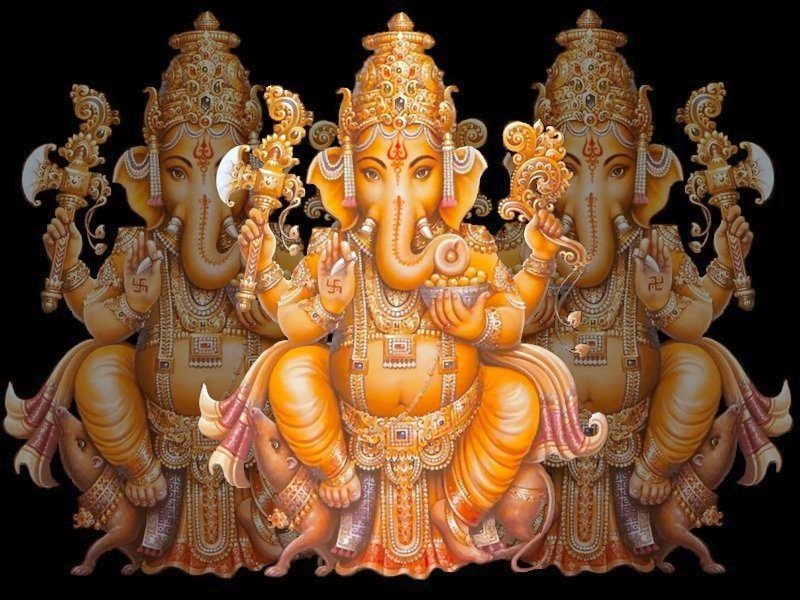
    Haridra Ganapati
    Haridra Ganapati, folio from the Sritattvanidhi (

    Goddess Parvati created Him with the turmeric she applied to her body while bathing and ordained that worship of Ganapathi in the form of turmeric is most aust auspicious.

    Worship of Ganapathi was done by making an image of Him with foams of the Sea by Lord Shiva, during his battle with Tripurantaka.

    Haridra Ganapathi worship is essentially a tantrik practice, though one can perform this pooja in a normal manner.

    Haridra Ganapati (Sanskrit: हरिद्रा-गणपति, Haridrā-gaṇapati, literally “turmeric Ganesha”) is an aspect of the Hindu God Ganesha(Ganapati).

    Haridra Ganapati is also known as Ratri Ganapati.

     Haridra Ganapati is depicted as yellow like turmeric and wears yellow garments.

    He is one of the most popular thirty-two forms of Ganesha

    (Please check my post on this).

    He is described as having three eyes. He sits on a golden throne. He is yellow-complexioned like turmeric and also wears yellow clothes. He has four arms and carries a pasha (noose), an ankusha (elephant goad), a modaka (sweet) and the danta (his own broken tusk) in his four hands. He draws his devotees closer by the noose, while goads them in the right direction by the ankusha.(Refer Niyotsava and the Mantra-maharnava)

    Haridra Ganapati has six arms and sits on a jewelled throne, in addition to his yellow colour and yellow vestments. His three right hands hold the ankusha and display the krodha-mudra (the gesture of anger) and abhayamudra (the gesture of protection). His left hands carry the pasha, a parashu (battle-axe) and displays the varadamudra (gesture of Granting Boons) -refer The Dakshinamnaya.

    Haridra Ganapati is described as turmeric-colored and flanked by two unnamed wives

    (Ajitagama)

    Haridra Ganapati is worshipped for wealth and well-being.

    He is also described to protect his devotees.

    Haridra Ganapati is the patron of the Haridra Ganapatya sect.

    The Haridra Ganapati followers consider him as leader of all deities including Brahma, Vishnu, Shiva.

    Worshipping Haridra Ganapati is believed to grant moksha(emancipation).

    These sectarians used to brand by iron the head of Ganesha and his tusk on their palms.

    Haridra Ganapati is a Tantric form of Ganesha. Special mantras and yantras are used in his worship.

    Rituals involving his worship generally are performed to fulfill material objectives, especially gaining boons related to sexuality.

    He is also associated with six rituals of abhichara (uses of spells for malevolent purposes) by which the adept can cause the target to suffer delusions, be overcome with irresistible attraction or envy, or to be enslaved, paralysed or killed.

    Reference and citation.

    1. T. A. Gopinatha Rao (1993). Elements of Hindu iconography. Motilal Banarsidass Publisher. p. 59. ISBN 978-81-208-0878-2.
    2. https://en.wikipedia.org/wiki/Haridra_Ganapati

    Image credit Haridra Ganapati. By Unknown – Folio from Sritattvanidhi, Public Domain, https://commons.wikimedia.org/w/index.php?curid=27496883

  • Is it a Sin or Dosham For Sri Vaishnava Visit Siva Sthalam?

    Differentiating between Siva and Vishnu is in fact a sin.


    Sankaranarayana
    Siva and Vishnu in One Murthy.Image Source:http://sankarankoviltemple.in/arulmigusankaranaarayanaswamy_english.htm


    Prambanan: Vishnu, Shiva, Brahma temple
    Prambanan: Vishnu, Shiva, Brahma temple (Photo credit: Felix Krohn)


    Siva means ‘that which is auspicious(mangalam)’, while Vishnu means “supporter(from the root Jishnu-Vishnum Jishnum,Vishnu Sahasranaama-means support)


    Tri -murthis,Brahma, Vishnu are the three Principles representing three aspects of Reality namely,Creation,Protection and Dissolution and Reality is manifested as an aspect in each and that is not complete.


    In Nirguna(Attributeless) Upasana where Reality is conceived as principles that are attributable we use the terms Avayaya,avakta,aprameya etc(Vishnu Sahasranama); while worshiping as Sauna(with attributes that are the best according to us)(this is a lower level in Self Realization– we use some epithets which we normally use when w praise namely Maheswara,Rama,Krishna,Vishnu etc.


    So, for a Devotee both standpoints -that is worshiping only one ,without worshiping the other, are correct.


    But in the correct Philosophical sense it is incorrect.


    This concept of Siva Vs Vishnu along with other Gods , have been a hall- mark of middle ages in India when Buddhism was on the up-rise for Buddha preached Nihilism or Sunya while people , with a vengeance as it were, to counter him, worshiped many Gods that too one God to the exclusion of others .

    Adi Sankaracharya wanted this Polytheism to be streamlined and established

    SixSystemsShanmatha,Kaumaaram,Souram,Ganapathyam,Saivam,Saaktham, and Vishnavam and declared that one can follow any one of these.


    Unique to Indian Philosophy is the fact is that Self-Realization is intensely personal and no institution is recommended-in fact Vedas do not mention common worship or temple worship at any place-and Self Realization is conditioned by individual Gunas or Dispositions;there fore one can worship Reality in any form he wants so long as his goal is Realization.

    As an aside you may find find common Naamavalis in Vishnu Sahasranaama and Siva Sahasranaama and between Lalitha Sahasranaama and Laksmi Sahasranaama.
    For staunch Vishistadvains-“Akaasat paththam thoyam yatha gacchati Saagam;Sarva Deva Namakaaraha,Kesavam pratigacchadhi”


    Enhanced by Zemanta