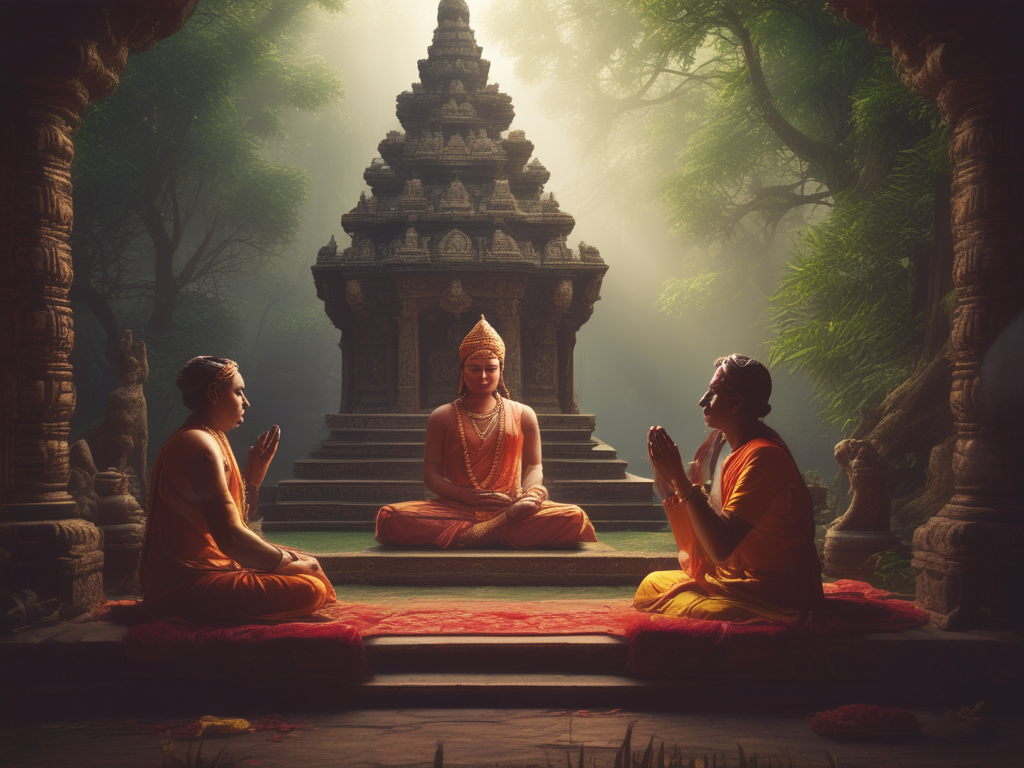
Tag: Saguna Brahman

  • Understanding Saguna and Nirguna Brahman in Hinduism

    Understanding Saguna and Nirguna Brahman in Hinduism

    Introduction To Nirguna Saguna Sahasranama Aradhana.

    Saguna means “with attributes.” Nirguna means “without attributes.” “Saguna Brahman” describes a God with (tangible) attributes. The term “Nirguna Brahman” describes a God with no (tangible) attributes.

    One with Attributes, qualities,Saguna.The other Nirguna, without Attributes,Nirguna.The western thought explores the Universe through what is outside,the perceived.It is necessary to have something in us to perceive .For all we know, there may be things out there and if one does not se it or perceive it, one may never know it, aware of it.Awareness, which is the rudiment of Knowledge,, needs two things.That which is to one known and that which knows or is aware.‘We have the Mind as an instrument.We know things through the Mind.If the Mind is absent or dysfunctional, we will not know things out there or may not know them as they are.Hinduism makes further distinction.Mind is what interprets sensations and the Data received.The sensations or Data is received is through the Brain, which is just like a CPU, just receives.The job of sorting them out, collating adding value judgements is reserved for the Mind.The classification and addition of value judgments is by the Chitta that directs the mind.The Chitta is based on Human Dispositions.The dispositions of individuals vary.So what is out there varies .So logically what we perceive is not what IS but what we perceive as what IS.So Reality expresses itself in the way we want to perceive it.This is the reason why many Gods and Goddesses are found in Hinduism.Without accommodating the Mind to perceive by providing it with a Target, we can not know what is outside.Therefore knowing the limitations of the Mind, Hinduism prescribes different systems of worship.The target of worship may be an Idol, Symbol.Once the Mind gets focussed on this, it evolves to comprehend the Ultimate Reality without Attribute, Brahman.These procedures are like gradually moving from LKG to Ph.d.Once you obtain Ph.d , LKG seems to be irrational and look unnecessary.But without it, you could not have reached Ph.d level.Yet there are individuals who are equipped with dispositions to do Ph.d, that is to understand Reality without Attributes, Nirguna Brhaman.One Like Ramana MaharishiAdi Shankaracharya has provided a Stotra addressed to Nirguna Brahman which explains these.One may notice that all the Sahasranamas, Vishnu and Lalitha Sahasranamas have Saguna and Nirguna Brahma upasanas embedded in them.Lalitha Sahsranama has organised this better by allotting separate portions,like Saguna Aradhana, Nirguna Aradhana and the identification of Shiva and Shakthi in the same Text.

    Aghora Pasupatha Homa Evil Eye Protection Mukthi

    Removal of Evil eye, Protection from forces that hinder Spiritual development. Protection from Black magic,Animals. Increases self confidence and self assurance. Clarity of thought.. Above all,Mukthi and Gnana are facilitated.

    Rig Veda Inflenced Civilizations Outside India

    Date of Rig veda in Ramanisblog According to Ramanisblog, the date of the Rig Veda is subject to considerable debate, with modern scholarly estimates generally ranging between 2000 BCE to 1000 BCE[1]. However, Ramanisblog highlights that Hindu tradition considers the Vedas to be timeless and without a specific beginning[1]. Perspectives on Rig Veda Dating Ramanisblog…

    Navavarana Pooja 1 Guru Stuthi

    Following in the Ai Generated transcript of the Navavarana Pooja Mantras . Recorded and sent to my Shishyas. This is being made public so that this secret knowledge is not lost to posterity. Those who want to be initiated may contact me through mail at ramanan50@gmail.com. Also they can contact through the comment column. If…

    Brahman

    Brahman, a key concept in Hinduism, is the ultimate, unchanging reality beyond the physical world. It is described as omnipresent, infinite, and eternal. The concept of Brahman encompasses both Saguna (with attributes) and Nirguna (without attributes) manifestations. Saguna Brahman represents a God with tangible attributes, while Nirguna Brahman represents a God without tangible attributes. Understanding and realizing Brahman is central to various forms of Hindu worship and philosophical inquiry.

    In Hindu philosophy, the human mind plays a crucial role in perceiving and interpreting the external world. According to Hindu thought, the mind interprets sensations and data received from the external world, with the brain acting as a receiver. However, it is the mind that processes and adds value judgments to this information through the faculty known as Chitta, which is influenced by individual dispositions.

    Recognizing the limitations of the human mind, Hinduism prescribes various approaches to worship and spiritual practice. Different systems of worship are intended to gradually lead the mind from focusing on tangible forms, such as idols or symbols, to comprehending the ultimate reality without attributes, the Nirguna Brahman. This gradual progression is likened to the educational journey from kindergarten to obtaining a Ph.D. Individuals with predispositions for understanding the reality without attributes, like Ramana Maharishi and Adi Shankaracharya, are rare yet exemplify this profound understanding.

    It is notable that Hindu scriptures, such as the Vishnu and Lalitha Sahasranamas, incorporate both Saguna and Nirguna aspects of Brahman worship. Lalitha Sahasranama, in particular, comprehensively organizes these aspects by allocating separate sections for Saguna and Nirguna worship, acknowledging the interplay of Shiva and Shakti within the same text.

    In summary, the concept of Brahman in Hinduism encompasses both Saguna and Nirguna manifestations, reflecting the profound understanding of ultimate reality and the methods to realize it.

    Related Articles

  • Brahman Upasna in Sri Rudram

    Vedic texts speak of Reality, the underlying and immanent Principle as with out Name and Form.
    This aspect of Reality is called Nirguna Brahman, Devoid of Attributes.
    However as Reality is something to be realised, the Vedic people understood the difficulty of realising an Attribute- less Reality.

    image

    A Reality that can not be realised is a mere academic exercise.
    As Hinduism addresses the issue of Life and Death in a practical way, it does not stop with mere abstractions, though it may appear so.
    If Reality has to be known it can be through two sources.
    One is by Knowing  ( mind) and another is by
    Experiencing.
    Knowing belongs to mind while experiencing is of the realm of the Heart (heart)
    Realising Brahman through Experience is through the Bhakti Yoga, Path of Devotion.
    This calls for total surrender to God.
    But human mind being what it is , is never satisfied with following something without knowing it to be true.
    This, knowing well that knowledge is relative and not entirely dependable.
    So human mind seeks confirmation by the Mind.
    Mind, to understand some concepts needs some thing to concentrate upon for mind can not concentrate and operate in a vacuum.
    So two aspects of Reality  are explained in the Vedas.
    One, the Nirguna Brahman without Attributes and another Saguna Brahman with Attributes.
    This Saguna Aaradhana or worship ls worship of Gods be personifying them with Human Attributes in Perfection.
    Therefore Nirguna and Saguna Brahman worship are recimmended to suit individual dispoilsitions.
    One would find, in Hindu prayers, complete exposition of attributes to one God in Saguna Form of Worship.
    In some prayers the Nirguna Brahman is worshiped that is ‘without Attributes’
    But there are some Mahamantras which contain both Saguna and Nirguna worship.
    For example, the Lalitha Sahasranama has both Saguna and Nirguna worship.
    In the Vedic texts one finds this format in Sri Rudram addressed to Rudra, an aspect of Siva.
    Contrary to what many think the SriRudram also addresses the Nirguna Brahman.
    This is the reason why it is called as a Mahamantra.
    In Sri Rudram the Universal Reality is invoked.
    In later parts the Saguna asoect is worshiped.
    As Sri Rudram contains both forms of worship, it is chanted while performing Abhisheka, bathing the Deity,irrespective of the Deity.
    It may be Ganesa  , Subrahmanya  or  Devi.
    Strictly speaking Vishnu Abhishaka is to be done with Sri Rudra aling with Purusha suktha, Narayana, Vishnu, Sri and Durga Suktha.
    Some Vishnu temples avoid SriRudram.
    All Abhisheka must be performed with the Five Sukthas and Sri Rudram.
    Here below is an excerpt from Sri Rudran that addresses the Universal Reality.
    ‘ Original text (TS iv.5.5) 5th Anuvaka

    namo bhavāya cha rudrāya cha
    namaḥ śarvāya cha paśupataye cha
    namo nīlagrīvāya cha śitikaṇṭhāya cha
    namaḥ kapardine cha vyuptakeshāya cha
    namaḥ sahasrākṣāya cha śatadhanvane cha
    namo girīśāya cha śipiviṣṭāya cha

    English Translation:

    Prostration to the one who is the most dear (pleasant), to the one who is the most dreaded terroriser (frightening).
    Prostration to the one who kills living beings with arrows, to the Lord (benefactor) of all living beings.
    Prostration to the blue-necked one (disfigured (discoloured) naturally), to the one with whitened throat (throat smeared with Bhasma (ash); disfigured (discoloured) artificially).
    Prostration to the wearer of matted tangled locks of hair, to him of shaven beard.
    Prostration to him of a thousand eyes (view from one point to everywhere), to him who has the capability of hundred bowmen (view from everywhere to one point – concentration of the view from all directions.

    * I began this article with the intention of writing on the benefits of Rudram and why Rudram is a Maha Mantra, on the request of a Reader but ended up with this article.
    Shall write on Benefits of Rudram shortly.

  • Shankaracharya Misinterpret Vedas Misled, Shiva In Padma Purana?

    Shankaracharya Misinterpret Vedas Misled, Shiva In Padma Purana?

    Not for nothing Dr. Radhakrishnan, former President of India and a Philosopher said that ,

    ‘Indian Philosophy is not a view of Life, but a Way of Life’.

    It is one thing to read,study the Vedas and other Hindu Texts but it is another proposition to understand its soul and ethos.

    Mere Intellectual or Bhakthi approach would not help one to understand the spirit of Hinduism.

    Hinduism should be lived and practiced for years  to understand it in its multifarious aspects.

    Mere abstraction would remain just that, an intellectual Narcissism..

    Mere Bhakthi, or total surrender to God , though highly recommended, is likely to lead one into disappointment as this path is, though seems easy to say, is the toughest to practice.

    One must understand that Hinduism is a personal Religion in the sense that one can practice it the way it suits him, so long it is in conformity with the Vedas.

    As individuals are numerous, so are their mental attitudes.

    Hence Hinduism provides four paths to follow so that people of different mindsets can follow Spirituality.

    They are,

    Karma Yoga, Path of Action,

    Gnana Yoga, Path of Knowledge,

    Raja Yoga, Path of Mental and Physical Discipline and

    Bhakthi Yoga, the Path of total surrender.

    The fact that one is emphasized in the Vedas and other Hindu texts, when they speak of a particular path, does not mean that the other Paths are inferior.

    They are spoken this way so as to instill in the mind the conviction to follow the path that appeals to them and such sayings reinforces the attitude.

    The same logic applies to Nirguna Brahman,Reality without Attributes and Saguna Brahman,Reality with Attributes.

    (for details  please read my article God with names and forms Yes and No)

    This one can understand from the Vedas, Puranas, Ithihasas and the Slokas /Mantras.

    One would, in the same breath, the Vedas talk about Nirguna Brahman and Saguna Brahman.

    One would find the Reality being described as a principle, Nirguna, in the Mahavakyas thus,

    1. prajñānam brahma – “Prajña is Brahman” or “Brahman is Prajña”(Aitareya Upanishad 3.3 of the Rig Veda)
    2. ayam ātmā brahma – “This Self (Atman) is Brahman” (Mandukya Upanishad 1.2 of the Atharva Veda)
    3. tat tvam asi – “Thou art That” (Chandogya Upanishad 6.8.7 of the Sama Veda)
    4. aham brahmāsmi – “I am Brahman”, or “I am Divine” (Brhadaranyaka Upanishad 1.4.10 of the Yajur Veda)

    Then you find in the Narayana Suktha.

    Narayanam mahagyem Viswaathmaanam Parayanam,

    Vishnu Suktha,

    Vishnornukam veeryani pravosam..

    or the Sri Rudram,

    nama sivaya cha, Sivadharaaya Cha,

    where the Individual deities are  praised.

    or look a the Lalitha Sahasranama, where a portion is allotted for worshiping the Devi as Nirguna, the chapter being Nirguna Upasna and another Saguna Upasna where personal deity is worshiped.

    So both options are provided.

    Reading one and discarding the other is not compatible with the Vedas.

    Quoting Vedas in isolation lands one into situations and interpretations that run counter to Vedas themselves, as it has happened in the case of the Mimamsa.

    The Karma Kanda, the portion of the Vedas that deal with duties and performance of Yagas and Yagnyas, was carried to such an extreme that only the Karmas in the form of Yagnyas were followed and the Gnana and Bhakthi were totally omitted..

    And the performance of only Yagnas and sacrifices caused a revulsion among people and this one of the reasons for the raise of Buddhism.

    And many Gods were worshiped in the Yagnyas.

    It took all the Life of Shankaracharya to set matters right and establish the authority of the Vedas, by systematizing  worship into Shanmaha, Six systems of worship.

    And he reestablished the concept of Nirguna Upasna and also provided room for Saguna Upasna.

    Iswara concept found in Patanjali’s yoga Sutra was reinforced by him.

    Such being the case I was shocked to find an observation by Stephen Knapp who has done yeoman service to Hinduism by propagating Sanatana Dharma concept that Shankaracharya misinterpreted the Vedas!

    and

    he quotes Padma Purana and Siva Purana.

    We must point out that some spiritual authorities say that Shankaracharya was an incarnation of Lord Shiva who had been ordered by the Supreme Lord to cheat the atheists. The Shiva Purana quotes the Supreme Lord as ordering Shiva: “In Kali-yuga mislead the people in general by propounding imaginary meanings from the Vedas [Vedic literature] to bewilder them”:

    dvaparadau yuge bhutva

    kalaya manushadishu

    svagamaih kalpitais tvam ca

    janan mad-vimukhan kuru 1

    The Padma Purana also says that Lord Shiva would descend as a brahmana sannyasi and teach Mayavada philosophy in the verse:

    mayavada ashat shastram prachchanna

    boudhyam uchyate moya ebe godidam

    devi kalou brahmana murtina

    To do this, Shankara gave up the direct method of Vedic knowledge and presented an indirect meaning which actually covered the real goal of Vedanta. This is confirmed in the Padma Purana where Lord Shiva addresses his wife, Parvati:

    shrinu devi pravaksyami

    tamasani yathakramam

    yesham shravana-matrena

    patityam jnaninam api

    apartham shruti-vakyanam

    darshayal loka-garhitam

    karma-svarupa-tyajyatvam

    atra ca pratipadyate

    sarva-karma-paribhramsan

    naiskarmyam tatra cocyate

    paratma-jivayor aikyam

    mayatra pratipadyate

    “My dear wife, hear my explanations of how I have spread ignorance through Mayavada philosophy. Simply by hearing it even an advanced scholar will fall down. In this philosophy which is certainly very inauspicious for people in general, I have misrepresented the real meaning of the Vedas and recommended that one give up all activities in order to achieve freedom from karma. In this Mayavada philosophy I have described the jivatma and Paramatma to be one and the same.” 2

    The Padma Purana, in the quote that follows, describes how Lord Shiva tells his wife, Parvati, that he would appear in Kali-yuga to teach the impersonalistic philosophy, which is impious and merely a covered form of Buddhism. Yet, as explained next, there was a purpose for it.

    mayavadam asac-chastram

    pracchannam bauddham ucyate

    mayaiva kalpitam devi

    kalau brahmana rupini

    brahmanas caparam rupam

    nirgunam vaksyate maya

    sarvasvam jagato’py asya

    mohanartham kalau yuge

    vedante tu maha-shastre

    mayavadam avaidikam

    mayaiva vaksyate devi

    jagatam nasha-karanat

    “The Mayavada philosophy is impious. It is covered Buddhism. My dear Parvati, in the form of a brahmana in Kali-yuga I teach this imagined Mayavada philosophy. In order to cheat the atheists I mislead them by describing the Supreme Lord to be without any personal form or qualities.”

    Herein, Lord Shiva himself points out that to believe God has no form is not accurate and is equal to atheism. Even though this Mayavada philosophy was not good for pious people to hear because it would sway them toward an impersonalistic viewpoint, we should note that Shankara’s philosophy was just right for the time and circumstance. The Buddhists, who had spread throughout India and neglected the Vedas, believed in neither a soul nor a God and that, ultimately, the essence of everything is the nothingness or void wherein lies nirvana, freedom from all suffering. So considering how the Buddhists had followed a philosophy of what would generally be considered atheism for hundreds of years and would never have accepted a viewpoint which advocated a supreme personal God, Shankara’s was the only philosophy they would have considered. It was like a compromise between atheism and theism, but Shankara used portions of Vedic knowledge as the basis of his arguments. In this way, as Shankara traveled throughout India his arguments prevailed. Thus, Buddhism bowed and Vedic culture was brought back to prominence. Therefore, his purpose was accomplished, so much so that his Sariraka-bhasya is considered the definitive rendition of Vedanta even to the present day.’

    Totally wrong interpretation.

    If Bhaja Govindam is quoted to buttress the view that Shankaracharya was really only after

    Bhakthi to Vishnu, what about his nirvana Shatgam ,Manisha Panchakam, Soundarya Lahari,Kanakadhara Sthavam,Subrahmanya Bhujanga,Ganesha Pancharatnam?

    Shankaracharya should be studie in full an no in bits.

    And if proof is needed that there are interpolations in the Puranas, Padma Purana and Shiva Purana, this is it.

    This accusation against Shankaracharya is not new.

    He was also called a Pseudo-Buddhist for His Advaita!

    If Shankaracharya was misquoting the Vedas, then how come the Mahavakyas I have quoted above speak of Nirguna Brahmana and not Saguna Brahman, Reality without Attributes?

    ‘AUM
    That supreme Brahman is infinite, and this conditioned Brahman is infinite.
    The infinite proceeds from infinite.
    Then through knowledge, realizing the infinitude of the infinite, it remains as infinite alone-

    Mundaka Upanishad.

    Great indeed are the devas who have sprung out of Brahman.-Atarva Veda.

    ‘satyam jnanam anantam brahman
    “Brahman is of the nature of truth, knowledge and infinity” -Taittriya Upanishad.

    Reference and citation.

    http://www.stephen-knapp.com/complete_review_of_vedic_literature.htm

    Images credit.

    https://ribhuv.wordpress.com/tag/shankaracharya/

  • Definiton of Bhagvan God Hinduism

    It is Bhagavan, the Supreme Personality or God who possesses these attributes.

    There are two names for him in ancient Tamil to describe Dhe deity.

    “Kadavul” beyond the mind.

    “Iraivan dwells in my heart.

    Post by these attributes.

    Hinduism uses the term Bhagavan to denote God.

    Bhag means Fortune, unlimited Wealth.

    In Hinduism material wealth is not considered as Wealth or Fortune.

    Attributes or Qualities that are Eternal are considered so.

    The Authority of Hinduism is the Vedas and they declare Reality as devoid of Attributes, Nirguna.

    It is a Principle.

    It is indescribable, Avaktavya.

    This is the reason the Upanishads, while describing the Reality, uses the ,Neti Nyaya’

    That is the process of describing a thing by excluding others from it.

    Brahman, The Reality is described as Neither Tall.nor Short, neither Male, nor Female……

    By excluding the Attributes through which we can know anything, the message implied is that the Reality is Unknowable.

    But can be experienced.

    This method of description is called the ‘Neti Nyaya’

    Yet,Hinduism advocates Image worship in the form of Gods, Symbols.

    This is because the Human Mind, being limited, can not grasp or concentrate on Nothing.

    The worship of Idols of God is the first step.

    This worship of Personal God, Iswara(Iswara means personal God in Indian Philosophy,is called Saguna Aradhana.

    As one evolves by worshiping the Personal Gods, he will realize that the Reality is in and beyond the Personal Gods.

    Please read my posts under Hinduism on this issue.

    Especially the one ‘Does God have and Form’.

    So the term Bhagavan is used to denote the Saguna Brahman, God

    Bhag implies six attributes:

    Absolute Fame,

    Absolute Dharma,

    Absolute Wealth,

    Absolute Knowledge,

    Absolute Beauty and,

    Absolute Detachment.

    One possessing these attributes is Bhagavan, the Supreme Person or God..

    The ancient language Tamil has two names for God.

    “Kadavul’, beyond the Mind.

    ‘Iraivan, one who dwells in the heart.

    I shall be posting on each of these Attributes.

    http://ramanisblog.in/2009/09/28/does-god-have-name-and-form/

  • Why Siva Muruga Have No Dynasties

    I have received an interesting question as a comment for my post How To Construct Shiva Linga”

    Shiva and His sons
    Ganapti, Shiva and Muruga.

    “Iam asking why  there is no  Dynasty for Siva, Muruga for the legacy continued from treta yuga till date ? I have been doing some research in both shaivism and Vaishnavism ? but records and history and dynasty hermitage has been well preserved in vaishnavism, but in shaivism why there is no records about the dynasty lineage is not present ? abrupt disruption or is it hidden, I have been doing some research about pratyangira devi in sholinganallur ? i could nt find the character in even shiv purana or shakti purana ? and the stala purana which is being told is completely false ? why this kind of false and misinterpretation shaivism ??”

    It is from Mr.Rajesh Kumar.

    The question, to some, may sound heretic and silly.

    I feel that the question is rational and an explanation is called for.

    It needs an effort to sift  the allegories, allusions from Philosophy in Hinduism.

    The  question has two parts.

    1.Why Shiva and Muruga do not have Dynasties?

    2.Why does not it continue in the Kaliyug?

    1.In Hindusim most of the Gods mentioned are symbolic representations of the principles of Nature.

    Vishnu the Kinetic Energy,Shiva The Potential Energy,Manmatha as the embodiment of sexual desire,Goddess Parvati as the dormant energy of the Macrocosm and the Microcosm.

    However, the same principles represented as Gods have also descended to the earth as Avatars.

    When an Avatar as a Human Being takes place, the Gods are also bound by the laws applicable to Man.

    They undergo the whole process that Man goes through.

    So we have Lord Ram and Krishna getting married , having children, winning and losing wars and  dying.

    If they had not been born( I am not sure my grammar is correct here), they would not have had to undergo the tails and tribulations of Man.

    By definition Gods in Hinduism have some basic qualities that qualify their existence.

    1.Their feet will not touch the ground.

    2.Their eyelids do not blink.

    3. Garland adorned by them will not wither away.

    4.They do not have sexual intercourse through Genital Organs.

    If one notices, Brahma was born out of the navel,Nabhi, of Vishnu,Subrahmanya, Muruga was born of the third Eye of Lord Shiva and Ganapati from  essence of Parvati’s whole body.

    So in the strictest Human sense Sybramanya, Ganapati are not the progeny of Lord Shiva, unlike Lava, Kusa,sons of Lord Ram  or Pathyumna or Samba of Lord Krishna.

    So as Gods representing principles they do not have children in our usage of the term.

    Once born as an Avatar they o beget children like we do.

    One interesting point to note is that Lord Shiva is not reported to have been born of a Womb even as an Avatar.

    He appears, does His Job and vanishes.

    He is called ‘Ayonijan’,one who does not stay in the Womb.

    Therefore He does not have children in His Avatars.

    Again in the Case of Muruga , allegorically, He is  explained is the Embodiment of Suddha Brahman, Nirguna and Saguna Brahman(without and with attributes, respectively)

    Siva in Sanskrit means ,Prosperity’ and the Dormant energy when spoken with Shakti or Parvati, the Prime mover

    2.Why there is no continuity of Dynasties in Kaliyuga?

    The  Purana do not indicate any Dynasty for the Kalki Avatar.

    It is safe to assume that there is none for Him to continue as a legacy.

    Please read my post Is There God, Yes and NO Hinduism


    Enhanced by Zemanta