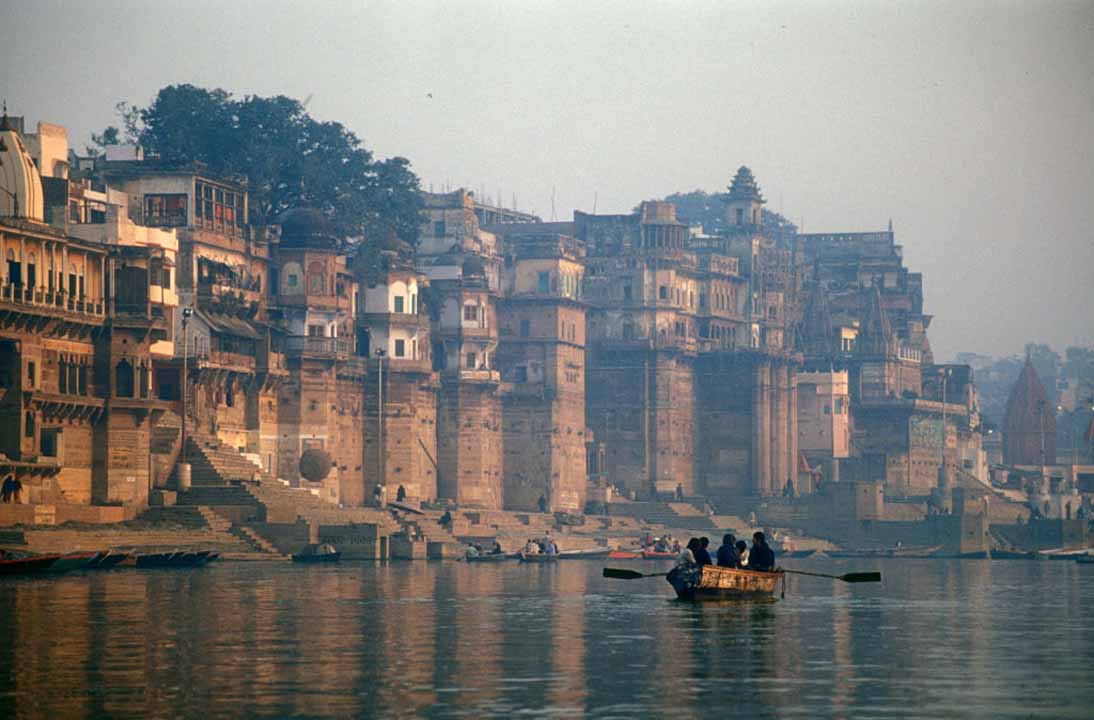
Tag: Rivers Of India

  • River Ganga 25 Million Years Old

    River Ganga 25 Million Years Old

    Ganga,aka Ganges,is one of the largest Rivers of India and is considered as holiest of the Holies in Hinduism.

    As many as eleven major  Hindu pilgrimage centers are on the banks of the River Ganga.

    There are seven holy rivers mentioned in ancient Hindu texts.

    Ganga,

    Yamuna,

    Godavari,

    Sarasvathi,

    Narmada,

    Sindhu, and

    Kaveri.

    Ancient Vedic culture flourished here along with the other Vedic cultures on the banks of the other six rivers mentioned above.

    In examining the antiquity of Sanatana Dharma,Gaga region has not attracted as much attention as Sarasvathi.

    Similar is the case with the other rivers.

    How old is river Ganga?

    Hindus normally take it to be from the time Bhagiratha ,by intense Prayers to Lord Shiva, brought it back to earth.

    One has to note that he ‘brought it back’

    That means it must have existed before and vanished.

    There seems to be a message here.

    According to all Puranas, Satyavrata Manu was the first human being on earth.

    Bhagavatha Purana records that he was a King from Dravida(south)Desa( country).

    He being forewarned of a Tsunami,moved to a high plateau in Madagascar and then moved to Ayodhya,where his son Ikshvaku founded the Ikshvaku Dynasty.

    No mention of Ganga at the corresponding time frame of Manu,when he was in the south.

    So there is scope for research in this.

    Then we have the Southern kingdom he is reported to have ruled before the Tsunami.

    It indicates that he had a country to rule and there must have been other regions,apart from Dravida Desa.

    There were four civilizations then.

    Uighur,

    Atlantis,

    Manu and

    Lemuria.

    And there is reference that Lake Baikal ,Russia being the Vaikanasa Theertha of Indra .

    More on this in future articles.

    Now there are three versions as to the origins of Ganga.

    One by Indra,

    By Vamana,an Avatar of Vishnu and by

    Bhagiratha,ancestor of Rama,descendant of Manu,.

    The Vedic version, Indra, the Lord of Svarga (Heaven) slays the celestial serpent, Vritra, releasing the celestial liquid, the soma, or the nectar of the gods which then plunges to the earth and waters it with sustenance.

    In the Vaishnava version of the myth, Indra has been replaced by his former helper Vishnu. The heavenly waters are now a river called Vishnupadi (padi: Skt. “from the foot of”).As he completes his celebrated three strides—of earth, sky, and heaven—Vishnu as Vamana stubs his toe on the vault of heaven, punches open a hole, and releases the Vishnupadi, which until now had been circling around the cosmic egg within. Flowing out of the vault, she plummets down to Indra’s heaven, where she is received by Dhruva, the once steadfast worshipper of Vishnu, now fixed in the sky as the polestar. Next, she streams across the sky forming the Milky Way and arrives on the moon She then flows down earthwards to Brahma’s realm, a divine lotus atop Mount Meru, whose petals form the earthly continents.There, the divine waters break up, with one stream, the Alaknanda, flowing down one petal into Bharatvarsha (India) as the Ganges.

    It is Shiva, however, among the major deities of the Hindu pantheon, who appears in the most widely known version of the avatarana story.

    ……..the story begins with a sage, Kapila, whose intense meditation has been disturbed by the sixty thousand sons of King Sagara. Livid at being disturbed, Kapila sears them with his angry gaze, reduces them to ashes, and dispatches them to the netherworld. Only the waters of the Ganga, then in heaven, can bring the dead sons their salvation. A descendant of these sons, King Bhagiratha, anxious to restore his ancestors, undertakes rigorous penance and is eventually granted the prize of Ganga’s descent from heaven. However, since her turbulent force would also shatter the earth, Bhagiratha persuades Shiva in his abode on Mount Kailash to receive Ganga in the coils of his tangled hair and break her fall. Ganga descends, is tamed in Shiva’s locks, and arrives in the Himalayas. She is then led by the waiting Bhagiratha down into the plains at Haridwar, across the plains first to the confluence with the Yamuna at Prayag and then to Varanasi, and eventually to Ganga Sagar, where she meets the ocean, sinks to the netherworld, and saves the sons of Sagara.’

    1.The version of Vedas are to be taken as it is the earliest record and in Hindu traditions Veda is final and  Puranas and Ithihasas Ramayana,Mahabharatha are only secondary.

    In case of conflict with Vedas,the words of Veda is final.

    2.As mentioned in the above paragraphs,there must have been other regions,before the Tsunami,when Manu ruled the South.

    3.Bhagiratha brought Ganga from Deva Loka of Indra.

    Deva loka is identified as the present Russia and Indra’s capital Amaravathi was in Russia.

    Lake Baikal was Vaikanasa Theertha of Indra.

    4.The term Ganga has only one more significant meaning.

    Name of the source of the gaṅgā- (said to have sprung from viṣṇu-‘s foot or from an aperture made in the mundane egg by the toe-nail of viṣṇu-)’

    Reference. http://sanskritdictionary.com/?iencoding=iast&q=Ganga&lang=sans&action=Search

    Now that brings in the Vishnu connection and Vamana Avatar.

    This Avatar is in Satya Yuga, The Eon earlier to the Treta Yuga,when Bhagiratha brought Ganga back

    And this Avatar was in the south.


    Therefore Ganga dates earlier to Bhagiratha .

    Now to Geology on Ganga’s Date.

    ‘The Indian subcontinent lies atop the Indian tectonic plate, a minor plate within the Indo-Australian Plate.Its defining geological processes commenced seventy-five million years ago, when, as a part of the southern supercontinent Gondwana, it began a northeastwards drift—lasting fifty million years—across the then unformed Indian Ocean.The subcontinent’s subsequent collision with the Eurasian Plate and subduction under it, gave rise to the Himalayas, the planet’s highest mountain ranges. In the former seabed immediately south of the emerging Himalayas, plate movement created a vast trough, which, having gradually been filled with sediment borne by the Indus and its tributaries and the Ganges and its tributaries,now forms the Indo-Gangetic Plain’

    As the  Geological process  began 75 million years ago and it took 50 million years for the Drift,it is logical that Ganga was formed around 25 million years ago.

    Reference and Citation. In Block Quote.

    https://en.m.wikipedia.org/wiki/Ganges

  • Tripura Ashes Gods’ Abode Ganges Visits Amarkantak

    Lord Shiva burnt the Tripura He had  a portion of the Ashes to fall in Kailash, and some in Amarkantak,Madhya Pradesh,.


    This is also the place the Narmada River originates.


    The presiding Deity of River Ganges visits this place, as the Legends would have it.


    origin of River narmada
    This photo of Bhrigu Kamandal is courtesy of TripAdvisor


    Amarkantak, on the western edge of ancient Kingdom of Kalinga, is a place of worship for all the three worlds. Gods and Gandharvas (celestial beings), Asuras (demons), Saints and sages have achieved great spiritual powers here. It is believed that who ever dies at Amarkantak is assured a place in heaven. If a woman makes offerings of fruits and flowers, she will gain the respect of her husband, and no doubt she will achieve a place in heaven.


    When Lord Shiva destroyed Tripura (the three cities) by fire, the ashes of one fell upon mount Kailash, the ashes of another fell upon Amarkantak, and the ashes of the third were saved by Lord Shiva and kept in heaven. The ashes that fell upon Amarkantak turned into crores of Shivalingas. Only one is visible at Jwaleshwar in Amarkantak.


    Legend has it that Lord Shiva blessed Narmada with unique purifying powers.


    Whereas to purify himself, a devotee requires to take one dip in the Holy Ganga, seven days’ prayers on the banks of Yamuna and three days prayers on the banks of Saraswati, the mere sight of Narmada is enough.


    A charming folk tale describes the superiority of Narmada over Ganga.


    Once every year, after she herself is polluted beyond tolerance, Ganga visits Narmada dressed like a dark woman and takes a cleansing purifying dip in its waters!


    There are other rivers too, popular, romantic and life sustaining, each glamourized in the folk lore and history but none can match the mystique of Narmada.


    Amarkantak is a Sanskrit word the literal meaning of which is immortal (amar) obstruction (kantak). The place was abode of gods but was disturbed by the hindrances of Rudraganas and hence called Amarkantak. The poet Kalidas has mentioned it as Amrakoot, which later became Amarkantak. Myth is that the dense forests of this region were full of mango (amra) trees”.


    Amarkantak and rivers originating from it do not find mention in Vedic literature, but they have been mentioned in Puranas, Ramayana, Mahabharata, Vashishtha samhita and “Shatapatha Brahmana”. After Mahabharata the history of about 3000 years is in dark. Professor Arjun Chaube Kashyap concludes that the Puranic name of Amarkantak was Riksh parvat. About 6000 years back the Suryavanshi samrat Mandhata founded a town in the valley Riksh parvat and named it Mandhata. The queen of samrat Purukutsa, who was son of Mandhata, gave the title of Narmada to the river. Due to occupation of this area by Mandhata the descendants of Yayati moved from this area to west of Madhya Pradesh and settled on the banks of Narmada River.


    According to tradition, this Vindhyachal area was included in the Kingdom of Ayodhya, Kapila Muni, Bhrigu Rishi and Markandeya Rishi had ashrams here. It is said that Pandavas stayed here and gained spiritual benefits during their exile.


    After about 3000 years of Mahabharata the Adi Shankarachrya was born in 788 AD and consecrated on the banks of Narmada River. He founded Pataleshwar Mahadev in Amarkantak at the origin of Narmada from the bamboo clumps. This place is known as Surajkund today. There are no bamboo clumps now.


    How to Reach:


    Nearest airports are Jabalpur (228 km.) and Raipur (230 km).


    The nearest rail head is Pendra Road (42 km) on the Katni – Bilaspur section of the South-Eastern Railway.


    Amarkantak is connected by regular bus service with Shahdol, Umaria, Jabalpur, Rewa, Bilaspur, Anuppur and Pendra Road.

    Citations.


    Amarkantak


    Wiki Amarkantak


    Enhanced by Zemanta