Tag: River Sarasvati

  • Who Are Gauda Saraswat Brahmins

    I had written on the History of Brahmins in India and followed it up with an article From where did the Brahmins come from.

    I had written a couple of articles about the Brahmins of Tamil Nadu ,Karnataka.

    Now let us see who the Gouda  Sarswat Bramins are .(GSB)


    http://ecx.images-amazon.com/images/I/51OHd1rjq0L._SX351_BO1,204,203,200_.jpg

    Kalhana, King cum Historian about the distribution of Families in India thus.

    कर्णाटकाश्च तैलंगा द्राविडा महाराष्ट्रकाः,
    गुर्जराश्चेति पञ्चैव द्राविडा विन्ध्यदक्षिणे ||
    सारस्वताः कान्यकुब्जा गौडा उत्कलमैथिलाः,
    पन्चगौडा इति ख्याता विन्ध्स्योत्तरवासि ||

    Karnataka (Kannada), Telugu (Andhra), Dravida (Tamil and Kerala), Maharashtra and Gujarat are Five Southern (Panch Dravida). Saraswata, Kanyakubja, Gauda, Utkala (Orissa), Maithili are Five Northern (Pancha Gauda ).

    -Kalhana in Raja Tharangini

    saraswat_brahman

    During the period of Sanatana Dharma, when the landmass of India was different,when Lemuria and Atlantis were in place as a part of Rodina , the Super Continent, Hindus were apread throughout the world.

    Brahmins being a part of the group, were also spread through out the world.

    Brahmins were found in as far away places from the present India to Ireland,Egypt, Turkey,Caucasus Region, Arctic, Polynesia and Australia to mention a few placed.

    Taking into account the present political map of the present India, concentration of Brahmins were in the following regions.

    Dravida Desa, comprising of the present States of Tamil Nadu, Kerala, Karnataka,and Andhra.

    Among this there were two areas were Brahmins were more concentrated.

    That is in The Godavari Valley and the Cauvery Delta.

    While the former are now found more in Andhra and Karnataka, the later are settled in Tamil Nadu and Kerala.

    In the North we have the Brahmins in the Basins of Sind, Saraswati,Ganges.

    Panch Gaur (the five classes of Northern India):


    (1) Saraswat, (2) Kanyakubja, (3) Maithil Brahmins, (4) Gauda brahmins (including Sanadhyas), and (5)Utkala Brahmins .


    In addition, for the purpose of giving an account of Northern Brahmins each of the provinces must be considered separately, such as, Kashmir, Nepal, Uttarakhand, Himachal, Kurukshetra, Rajputana, Uttar Pradesh,Ayodhya (Oudh), Gandhar, Punjab, North Western Provinces and Pakistan, Sindh, Central India, Trihoot, Bihar, Orissa, Bengal, Assam, etc. The originate from south of the (now-extinct) Saraswati River.

    In Bihar, majority of Brahmins are Kanyakubja Brahmins, Bhumihar Brahmins and Maithil Brahmins with a significant population of Sakaldiwiya or Shakdwipi Brahmins.

    Of this there were Families that migrated from the Saraswathi River region towards the south,probably due to a Tsunami that engulfed the Region towards the closing years of Dwapara Yuga, that is some time after the Mahabharata War.

    This finds a reference in the Bhagavatha Purana and Tamil Classics.

    One group led by Sage Agastya came to Dravida Desa and they were 72 Families who were called Velirs and formed a part of Tamil Kingdom.

    These Kingdoms were mostly under the tutelage  of the Cholas of Tamil Nadu though at times they became independent  and at some other times with the Rashtrakutas.

    . Im They belonged to Smartatradition and primarily worshipped Panchayatana (the five deities): Shiva, Vishnu, Devi, Surya and Ganesha.  These Brahmins were one of the Pancha Gouda Brahmin groups who lived north of the Vindhyas. 

    Saraswat Brahmins mastered the Vedas, and administered the priestly rites in the temples. The Vedas were passed down to the generations by the virtue of word of mouth, as written records didn’t exist at that time.  The Saraswat Brahmins had to maintain a very tight hold on their culture to maintain and protect their legacy. 
    The first migration of Saraswats to Goa took place around 700 BC. They migrated from the Saraswati, mostly through sea routes in search of greener pastures.  They took up farming and trading business in Goa and worked in partnership with indigenous people. At the same time, they retained their Vedic way of life, performing their rituals and retaining their cultural traditions.  They also brought theirKuladevtas and established temples for their deities. These temples facilitated socio-cultural activities of the community.’
    ‘According to the mythological chronicle Sahyadrikhanda of the Skanda Purana, ninety-six Brahmin families belonging to ten gotrasmigrated to Goa from north-western India.The Purana adds that the sage Parashurama brought Saraswats to Goa. Even if Parashurama is considered as a historical figure, the regionalisation of Brahmins had not taken place during his era and he had brought only Brahmins and not specifically Saraswats Brahmin. According to Bhau Daji and Dharmananda Damodar Kosambi, there is no connection between Parashurama and the migration of the Brahmins. The Sahyadrikhaṇḍa is a later inclusion in the original SanskritSkanda Puraṇa, not a part of the original Sanskrit text. The Parashurama legend serves as a symbol of the Sanskritisation that Goan culture experienced with the advent of Brahminical religion to the region. This was achieved to a certain extent through the agency of the Saraswat Brahmins who had migrated to Goa who sought to establish their hegemony.

    Sahyadrikhanda mentions the original home of Saraswats as Tirhut. The section in which the Tirhut is mentioned has been tentatively dated to 1400 CE. A writer on the basis of the genealogy and chronology of Puranic sages has mentioned that Aryans reached Goa around 2500 BCE. This is based on a preconceived notion that Aryans and Saraswats were identical. Elsewhere in the same work the author has argued that Parashurama had brought only Brahmins and not Saraswats. Therefore, equating Aryans and Saraswats seems to be far-fetched.[3] It is more reasonable to suppose that the Saraswats of Goa migrated from northwestern Uttar Pradesh, Punjab, Sindh, Kutch and Saurashtra. There is no agreement among scholars about the original home of Saraswats. The name by which these Brahmins have been designated clearly indicates that the river Saraswati had played an important role in the life in their life. Even after the disappearance of the river, the Brahmins who had once inhabited the banks of river Saraswati retained the name of the region. There are evidences in history about the migration of the population from one region to another regions account of foreign invasions and sudden climatic changes. Recent researches in archaeology have shown that the Saraswati river dried up before 1000 BCE. For the study of the migration of the Saraswats to Konkan and Deccan, the linguistics provides corroborative evidence. The main line of Indo-Aryan linguistic expansion began from north to south much before 500 BCE. The Saraswats settled themselves in Rajasthan, Sindh and Gujarat. In ancient Gujarat there was a separate division called Saraswat Mandal. There are many Konkani words which are found only in Gujrati. From this it is evident that Saraswats had settled in Gujarat migrated to Goa. This also indicates that the Saraswats from the Kutch regions might have migrated to Goa on account of Arab invasion in the 8th century CE.[3]

    Reference to Saraswat names are found in Shilaharas well as Kadambacopper plate inscriptions. Certain Muslim incursions in North India provoked the Brahmin exodus. The inscriptions found in Goa bear testimony to arrival of Brahmin families in the Konkan region.Sahyadrikhanda and Mangesh Mahatmya allude to migrations of Saraswats, constituting sixty-six families, who settled in eight villages of Goa. There were regional variations among the Saraswats, such as those among Bardeskars, Pednelkars, Kudalkarsand Sashtikars. The Konkana mahatmya, from the 17th century CE, deals with the internal rivalry of the Saraswats and strained relations between these groups. Saraswats were not recognised by the local Brahmins as well as others. They were not entitled to the six duties of the Brahmins called Shatkarmas and they were called Trikarmi, entitled to three duties like the other Dvijas. Hence besides their sacerdotal duties, they took up administrative vocations under the ruling dynasties. Therefore, they gradually established themselves in the landowning class and also as traders. After settling down in Konkan and Goa in about 800 CE Saraswats may have taken about a century to acquire patronage from the Shilaharas and the Kadambas of Goa. Many Saraswats left Goa after the invasion of Malik Kafur to the neighbouring regions and during the period of religious persecution of the Portuguese also Saraswats migrated to Uttar Kannada, Dakshina Kannada and North Konkan. The Saraswat Brahmins particularly served as village Kulkarnis, financiers, tax farmers, merchants in the intra-Asian trade, and diplomats. Many sources of government income in Goa, Konkan and elsewhere, including taxes on commodities and customs duties, remained in their hands.


    First Migration :
    A king from Saraswat country, called Videgha Mathava with his preceptor, Gautama Rahugana set out eastwards to find out new pastures. In those days fire was to be carried physically from place to place and the king carried a tiny spark on his tongue. On the way the preceptor started conversing with the king but the king remained tight-lipped without giving any reply for fear that the spark might fall or get extinguished. The preceptor understood the anxiety of the king and invoked Agni, the fire-god. On hearing the praises, out came the flames of fire from the mouth of the king and started rolling on the ground like the waves of the sea. “Agnideva, what is thy command?” the priest asked, “Follow me,” was the commandment of the fire-god. Accordingly, they followed. The flames sped away eastwards through the Gangetic belt and on reaching the western bank of the River Sadaneera vanished. This is how the civilisation moved to the eastern region, later to be known as Aryavarta, and some of the families of Saraswat Brahmins moved to the east and settled down in Trihotrapura a township in Gowda Desha and later called them selves as Gowda Saraswats. According to another version, our forefathers never went to Trihotrapura but were called Gowda Saraswats as Saraswats were one among five groups of Brahmins who were collectively called Panchagowdas as stated above at the beginning. Whatever be the version, civilisation moved from western part of India to the Eastern India and definitely some families, when the river went dry must have gone to Trihotrapura. This anecdote is mentioned in Shatapatha Brahmana.

    Second Migration :
    As stated in the Sahyadri Khanda of Skanda Purana Lord Parashurama after reclaiming land from the western sea invited various groups of Brahmins from different parts of Bharat Khanda. In response ten families of Gowda Saraswats came down from Trihotrapura with their deities of daily worship and settled down in Gomantak now known as Goa. In gratitude even today the Gowda Saraswats dedicate all their havans and yajnas be it Gayatri or Mrityunjaya to Lord Parashurama stating “Yajnantargat Bhagwan Shri Parashuramamurti priyatam.”

    In the course of time the ten families multiplied and with the passage of time they took to trade and commerce as permitted by the scriptures, besides officiating as priests. Depending upon their occupations this gave them various surnames as they have to-day like Kini – a treasurer handling money with the jingling sound, Mallya – a construction contractor who built mansions or mahals, Nayak-a leader in any army. In Goa they were in full bloom and they built up hundreds of shrines and temples besides establishing Shri Kaivalya Math in the eighth century.

    Brother Communities :
    Their brother Saraswats migrated to various other parts of the country. Those who migrated to Kashmir called themselves as Kashmiri Pandits, Sind-Sind Saraswats, Kutch-Kutchi Saraswats, Rajapur-Rajapur Saraswats, Punjab-Punjab Saraswats, Rajasthan-Rajasthan Saraswats and Chitrapur-Chitrapur Saraswats.

    This in a nutshell is the mythological and historical background of the Gowda Saraswat Brahmins popularly known as GSBs. 

    Saraswat Muni : Saraswat was the son of Maharshi Dadhichi and the River Goddess Saraswati brought him up. When he was a student mastering the scriptures on account of successive droughts, the river went dry and people leaving their home and hearth on the banks of the River Saraswati left for other places in search of food and water. The young Saraswat also wanted to leave the place but the mother persuaded him to stay back and pursue his studies, and assured that she would provide him food and water. According to another version, he had the prowess to conquer hunger, thirst and sleep. Like this 12 long years passed and the normalcy returned only thereafter. In the meantime the Brahmins had forgotten the Vedas in their anxiety to survive. 

    When they were eager to learn again, only one person, that was Saraswat, was available as a teacher. They became his shishyas irrespective of their age and learnt from him the Vedas that were forgotten. They were altogether 60,000 brahmins and single handedly Saraswat taught them in his gurukula. Perhaps nowhere in the history of mankind there is a record available that one single teacher had taught such a huge assembly of students. This story is told in Mahabharat and it is believed that long ago our forefathers must have been his disciples and we acquired the name Saraswats as his disciples. Vishnupurana while giving a list of Vyasas (which in fact is a title given to a sage who had rendered selfless service for the preservation and propagation of Vedas) mentions Saraswat’s name also.

    Jagaduru Gowdapadacharya : Lived in 8th Century and for the first time expounded Adwaita philosophy. His very name and fame attracted Shri Adiguru Shankaracharya and at the behest of Shri Gowdapada, his shishya Shri Govindapada gave deeksha to Shri Shanakara and also to Shri Vivarananda Saraswati to commence a new Guruparampara for GSBs. More is narrated about him under “Our Religious Seats, Shri Kavle Math.”


    Citations and references.

    https://en.wikipedia.org/wiki/Goud_Saraswat_Brahmin


    http://www.gsbkonkani.net/OurHistory.htm


  • Vedic Sarasvati River Flows Again In Haryana

    Vedic Sarasvati River Flows Again In Haryana

    The Hindu Texts mention Sarasvati river exhaustively.

    Sarasvathi River Found, Yamuna Nagar,Haryana.

    The River Sarasvati is included in the Prokshana,Sandhyavandan and Snana Mantra..

    Gange cha Yamenes chaiva Godavari Sarasvathi,

    Narmade Sindhu Kaveri Jalesmin Sannidhim Kuru.

    There was a Vedic civilization flourishing on the banks of the Sarasvati river and it was named as Sarasvati Civilization.

    Initially all the references found in the Vedas,Puranas and Ithihasas were dismissed as Myths.

    As science advances and the web becomes the source of information , which has been not available earlier, the Myths are found to be facts.

    Starting from the dates of the Vedas, Ramayana , Mahabharata and Puranas, many of the events have been proved to be facts.

    Recent to be proved is the River Sarasvati.

    About five thousands year ago ,the Sarasvathy River flowed from Himalaya in a south-westerly direction along Bata valley and crossed through present day Haryana, where geologists found pebbles generally transported by flowing water of rivers and refined sand generally found in a river path.

    Now the Sarswathi river has been found by Geologists in Yamuna Nagar, Haryana.

    The water of the river is very shallow – only six feet deep. Locals say that there is a continuous stream running underground as they have found water at 200 feet 1 km from Mugalwali.

    Source.

    http://strangesounds.org/2015/05/like-a-miracle-the-mythical-saraswati-river-revives-after-4000-years-in-india.html

  • River Sarasvati Flowed Proof Literary,Geo Physical Satellite

    When Hindus visit Allahabad while on Pilgrimage to Varanasi, also known as Benares,one is ordained to take bath at the Triveni Sangam in Allahabad (Prayag), where the Rivers Ganges,Yamuna and Saraswati are in Confluence.

    One goes deep into the Ganges and takes bath, where the Sarasvati River is supposed have underneath-invisible now.

    The Vedic Civilization prospered on the banks of the River Saraswati.

    The ancient Rig Veda speaks of River Sarasvati thus.

    The sixth Mandala of the Rig Veda has 75 hymns, mainly to Agni and Indra. Most hymns in this book are attributed to the bārhaspatya family of Angirasas, especially to Bharadvaja. It is one of the “family books” (mandalas 2-7), the oldest core of the Rigveda.

    Deities addressed besides Indra and Agni include the VishvadevasPusan, the AsvinsUshas (Dawn), the MarutsDyaus and Prthivi (Heaven and Earth), SavitarBrhaspati and SomaRudra.

    The rivers mentioned in the sixth Mandala are the SarasvatiYavyavati and Hariupiya. RV 6.61 is entirely dedicated to Sarasvati. In RV 6.45.31 the term Ganga occurs which may refer to the Ganges River.(wiki)”

    According to the Yajur Veda, the River Sind becomes Sarasvati.

    “In a supplementary chapter of the Vajasaneyi-Samhita of the Yajurveda (34.11), Sarasvati is mentioned in a context apparently meaning the Sindhu: “Five rivers flowing on their way speed onward to Sarasvati, but then become Sarasvati a fivefold river in the land.”[19] According to the medieval commentator Uvata, the five tributaries of the Sarasvati were the Punjab rivers DrishadvatiSatudri (Sutlej), Chandrabhaga (Chenab), Vipasa (Beas) and the Iravati (Ravi).”(wiki)

    Course of River Saravati.

    Course of River Sarasvati.
    Course of River Sarasvati

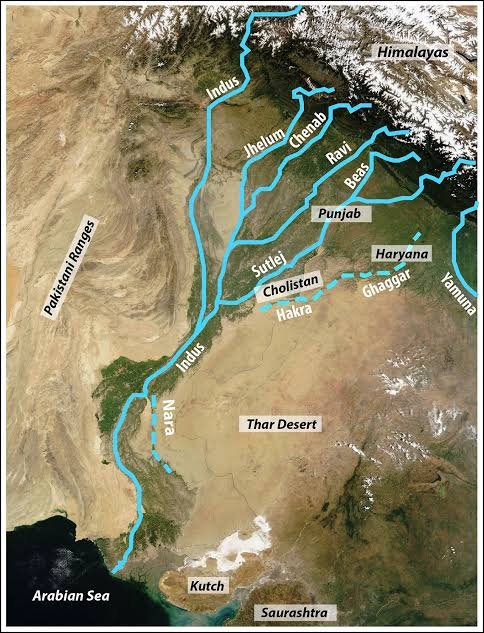
    There is an overwhelming evidence from remote earth sensing pictures taken by LANDSAT (USA), IRS-IC (India), SPOT (France), ERS-½ (Europe) that prior to 3000 BC a mighty river, described as Sarasvati in the Vedas, flowed from the Himalayas through the present Ghaggar Hakra bed in Punjab, Haryana, Rajasthan and Bahawalpur (in Pakistan) and then through the Nara bed in Sind (Pakistan); making delta in the Runn of Kuchchh before flowing into the Arabian Sea. More than 7000 years back it was the mightiest river, having Yamuna & Sutlej as its tributaries and was flowing along the Aravalli Hills. Due to northward movement of the plate of Indian subcontinent, tectonic upheaval of the Aravallis, basement structural high of Delhi-Hardwar ridge, Sarasvati river kept on migrating towards west and northwest. Its two tributaries, Yamuna and Sutlej, migrated in opposite directions – Yamuna moved eastward to join the Ganges later-on and Sutlej moved westward and was flowing as an independent river upto the sea for hundreds of years and thereafter joined Beas, a tributary of Sind River. Studies of LANDSAT imagery have revealed that there were seven main stages of this migration of river Sarasvati. Bakliwal and Grover have described these seven stages in their book “Signature and Migration of Sarasvati River in the Desert”. In the first stage it was flowing along the foothills of Aravalli, in the 3rd stage through Bikaner and Ramdevera meeting Luni near Tilwara. In the 5th stage Sarasvati passed through Jaisalmer Runns and Gad Road to reach the Rann of Kachchh and in the seventh stage it flowed through the present dry bed of Ghaggar, through Hakra and then flowed through Nara to meet Rann of Kachchh. The differences and discrepancies in study reports of archaeologists/geologists are because they have been studying the dry channels of Sarasvati river in different stages of its north-westerly migration.
    Yashpal et al studied the LANDSAT imagery of palaeochannels (Refer – “Remote sensing of the Lost Sarasvati River (1980)” and deciphered these as under :-
    [Present river system and the major palaeochannels as deciphered from LANDSAT imagery (after YashPal et at-1980)]– pg 123 of Memoir 42 of GSI, Bangalore.
    The study led to the description of present drainage system and palaeochannels of Sarasvati and its tributaries and it supported the following conclusions :-
    (i) The Sutlej once flowed into the present Ghaggar (Sarasvati) river bed and was probably joined by the Yamuna.
    (ii) The Sutlej has a sharp westward right-angled bend near Ropar suggestive of its diversion due to change in the river course.
    (iii) There is a sudden widening of narrow Ghaggar valley at Shatrana (25 Km south of Patiala) indicative of a major river joining Ghaggar bed here.
    (iv) Another channel which corresponds to the Drishadvati (present Chautang) joins Sarasvati (Ghaggar) near Suratgarh.
    (v) That the Yamuna probably flowed into the ancient Sarasvati before joining Ganga through Chambal.
    (vi) Physiographically, there is depression westward (elevation less than 230 m msl) and a corresponding uplift eastward (elevation more than 250 m msl) of the old Sutlej bed, which might have forced its westward migration.
    (vii) Near Anupgarh Sarasvati bifurcates and both channels come to an abrupt end at Marot and Beriwala (in Bahawalpur Distt of Pakistan) from where Sarasvati is likely to have extended through the Hakra/Nara bed to the present Runn of Kachchh.
    As per Ghosh, Kar & Husain, LANDSAT imagery has revealed hitherto unknown abandoned courses of the former Sarasvati River in Jaisalmer District of Rajasthan (“The lost courses of Sarasvati river in the great Indian Desert”). Based on study of remotely sensed data of IRS-IC Ramasamy & Verma have concluded that there are plenty of paleo-channels with well sprung-up tentacles throughout the Thar Desert which reveal the traces of mighty Sarasvati river which once ruled the desert (Remote Sensing & River Migrations in Western India). The river kept on shrinking in size due to change of course by the tributaries and finally due to some major tectonic upheavals in the Himalayas, the glacier connection of the river got severed converting Sarasvati into a non-perennial river dependant on monsoon rains. Sarasvati’s march to oblivion commenced around 3000 BC; bereft of water, the Sarasvati remained here and there as disconnected pools/lakes e.g. Didwara and Sambhar etc and ultimately got reduced to dry channel beds e.g. Ghaggar and Hakra. Thus, the satellite imagery corroborates the findings of ecological dynamic model.

    Literary Evidence :

    These different stages in the northwest migration of River Sarasvati do get broadly reflected in the hymns of Vedas and other ancient manuscripts – the early stages agree with the description in Rigveda, Middle stages with the hymns of Yayurveda/Atharvaveda whereas the last stages coincide with the description in Mahabharata.
    In Rig Veda, Sarasvati is described as the mightiest river – “Seven sistered, sprung from three-fold sources” [6:61:12]. Again it is described as “Saptathi Sindhumata” i.e., mother of seven rivers strongly flowing and swelling in volumes (7:36:6). Prayers are offered to ten rivers including Sarasvati, the names are mentioned sequentially– “O Ganga, Yamuna, Sarasvati, Sutlej, Ravi, Chenab, Marudvrudha, Jhelam, Sohana and Vyas and other rivers listen to our eulogy (10:75:5)”.
    In later part of Rig Veda, Sarasvati, Sarayu and Sindhu are worshipped as three mighty rivers [10:64:9].”
    Archaeological Finds :
    Archaeological excavations and research reports further corroborate the geological findings and satellite imagery. More than 1200 ancient settlements on Sarasvati river basin have been dug out giving clinching evidence of existence of a mighty river, which sustained maritime civilization and metal-based economy prior to 3000 BC (S.Kalyanaraman in journal of Geological Society of India No.42, 1`999 PP 25-33). It has been concluded that it was possible to travel on the Sarasvati river from the gulf of Khambat to Mathura via Lothal, Dholavira, Granweriwala, Kalibangan, Banawali, Paonta-Doon, Rakhigarhi and Indraprastha. Based on the evidence gathered through exacavations, the Arachaeologists have concluded that between 7000 BC to 2500 BC an advanced civilization, vedic in nature, was flourishing along Sarasvati and Indus rivers. When Sarasvati started drying up, Vedic Aryans moved towards west beyond Indus, east beyond Ganges & south beyond Godavari. It was the continuation of Sarasvati-Indus Civilization, which was given the name ‘Harappan’ probably because the first town excavated was Harappa. Archaeological Survey of India has dug out more than 2400 settlements at the ancient Indus-Sarasvati river basins but no ancient settlements have been found along the present day course of Yamuna or Sutlej.
    As per V.S.Wakankar, who is known as ‘Bhisham Pitamah’ of Archaeology, extensive excavations carried out by the Archaeological Survey of India have revealed that :
    (i) Harappan and Pre-Harappan Civilizations developed along ancient Sarasvati and therefore these may be more appropriately described as part of Sarasvati-Indus Civilizations.
    (ii) Most of the Rishi Ashrams described in Ramayana and Mahabharata were lined along Sarasvati river.
    (iii) Perforated pottery jars and fire altars (µÖ–֍ãÓ›) are found in most of the 1200 settlements excavated along Sarasvati river indicating that civilization which flourished was vedic.

    (iv) Land was fertile and barley etc were cultivated in the Sarasvati region even 7000 years back and same style of cultivating the fields continues till date in areas like Rajasthan & Haryana. [Atharvaved (6:30:1)]

    (v) It is unhistoric and unscientific to say that Vedic Aryans migrated from any other region to India. They belonged to India & compiled Vedas in settlements along Sarasvati River.
    Archaeological Finds :
    Archaeological excavations and research reports further corroborate the geological findings and satellite imagery. More than 1200 ancient settlements on Sarasvati river basin have been dug out giving clinching evidence of existence of a mighty river, which sustained maritime civilization and metal-based economy prior to 3000 BC (S.Kalyanaraman in journal of Geological Society of India No.42, 1`999 PP 25-33). It has been concluded that it was possible to travel on the Sarasvati river from the gulf of Khambat to Mathura via Lothal, Dholavira, Granweriwala, Kalibangan, Banawali, Paonta-Doon, Rakhigarhi and Indraprastha. Based on the evidence gathered through exacavations, the Arachaeologists have concluded that between 7000 BC to 2500 BC an advanced civilization, vedic in nature, was flourishing along Sarasvati and Indus rivers. When Sarasvati started drying up, Vedic Aryans moved towards west beyond Indus, east beyond Ganges & south beyond Godavari. It was the continuation of Sarasvati-Indus Civilization, which was given the name ‘Harappan’ probably because the first town excavated was Harappa. Archaeological Survey of India has dug out more than 2400 settlements at the ancient Indus-Sarasvati river basins but no ancient settlements have been found along the present day course of Yamuna or Sutlej.
    Source: